This variable combines Tenure type (TEND) and Landlord type (LLDD) to provide more detailed information for rented dwellings.
Scope
Occupied private dwellings
Categories
Code
Category
1
Owned outright
2
Owned with a mortgage
3
Rented: Real estate agent
4
Rented: State or territory housing authority
5
Rented: Community housing provider
6
Rented: Person not in same household
7
Rented: Other landlord type
8
Rented: Landlord type not stated
9
Other tenure type
&
Tenure type not stated
@
Tenure type not applicable
Number of categories: 11
Other tenure type includes dwellings being occupied rent free and dwellings being occupied under a life tenure scheme
Owned with a mortgage includes dwellings being purchased under a shared equity scheme
Not applicable (@) category comprises:
Unoccupied private dwellings
Non-private dwellings
Migratory, off-shore and shipping SA1s
Question(s) from the Census form
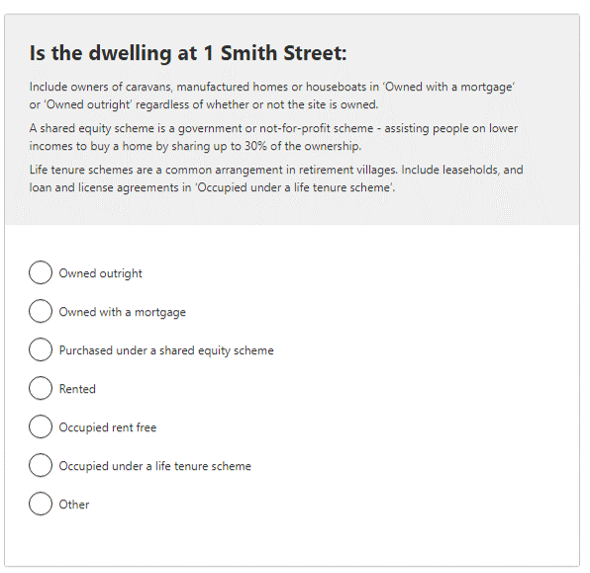
Is this dwelling: (please open this section to view response categories)
Image
Description
Is the dwelling at 1 Smith Street:
Include owners of caravans, manufactured homes or houseboats in ‘Owned with a mortgage’ or ‘Owned outright’ regardless of whether or not the site is owned.
A shared equity scheme is a government or not-for-profit scheme - assisting people on lower incomes to buy a home by sharing up to 30% of the ownership.
Life tenure schemes are a common arrangement in retirement villages. Include leaseholds, and loan and license agreements in ‘Occupied under a life tenure scheme’.
• Dwelling ownership
• Owned outright
• Owned with a mortgage
• Purchased under a shared equity scheme
• Rented
• Occupied rent free
• Occupied under a life tenure scheme
• Other
Example
Image
Description
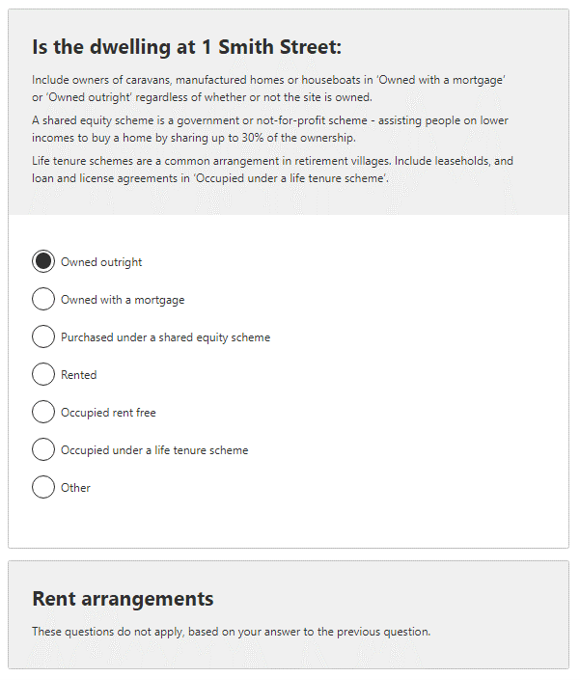
Is the dwelling at 1 Smith Street:
Include owners of caravans, manufactured homes or houseboats in ‘Owned with a mortgage’ or ‘Owned outright’ regardless of whether or not the site is owned.
A shared equity scheme is a government or not-for-profit scheme - assisting people on lower incomes to buy a home by sharing up to 30% of the ownership.
Life tenure schemes are a common arrangement in retirement villages. Include leaseholds, and loan and license agreements in ‘Occupied under a life tenure scheme’.
Dwelling ownership
Owned outright (selected response)
Owned with a mortgage
Purchased under a shared equity scheme
Rented
Occupied rent free
Occupied under a life tenure scheme
Other
Rent arrangements
These questions do not apply, based on your answer to the previous question.
Example
Image
Description
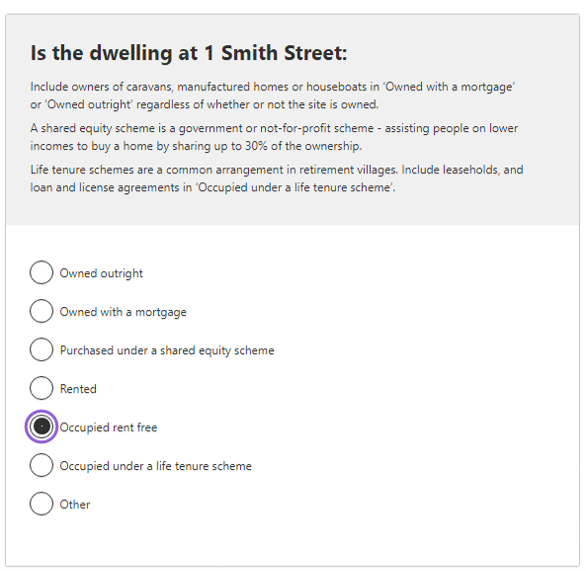
Is the dwelling at 1 Smith Street:
Include owners of caravans, manufactured homes or houseboats in ‘Owned with a mortgage’ or ‘Owned outright’ regardless of whether or not the site is owned.
A shared equity scheme is a government or not-for-profit scheme - assisting people on lower incomes to buy a home by sharing up to 30% of the ownership.
Life tenure schemes are a common arrangement in retirement villages. Include leaseholds, and loan and license agreements in ‘Occupied under a life tenure scheme’.
Dwelling ownership
Owned outright
Owned with a mortgage
Purchased under a shared equity scheme
Rented
Occupied rent free (selected response)
Occupied under a life tenure scheme
Other
Example
Image
Description
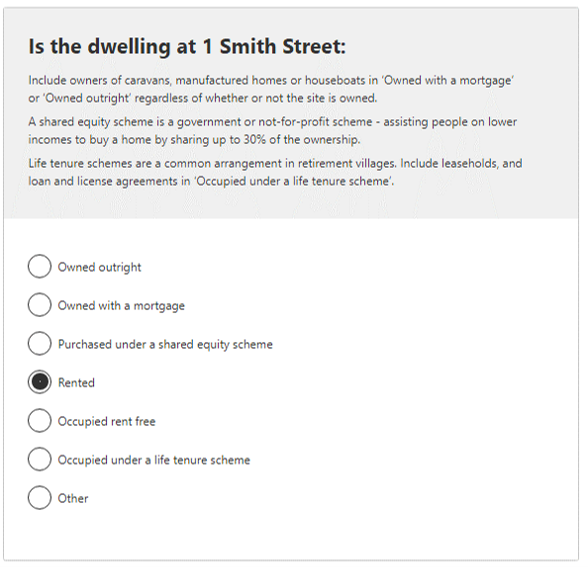
Is the dwelling at 1 Smith Street:
Include owners of caravans, manufactured homes or houseboats in ‘Owned with a mortgage’ or ‘Owned outright’ regardless of whether or not the site is owned.
A shared equity scheme is a government or not-for-profit scheme - assisting people on lower incomes to buy a home by sharing up to 30% of the ownership.
Life tenure schemes are a common arrangement in retirement villages. Include leaseholds, and loan and license agreements in ‘Occupied under a life tenure scheme’.
Dwelling ownership
Owned outright
Owned with a mortgage
Purchased under a shared equity scheme
Rented (selected response)
Occupied rent free
Occupied under a life tenure scheme
Other
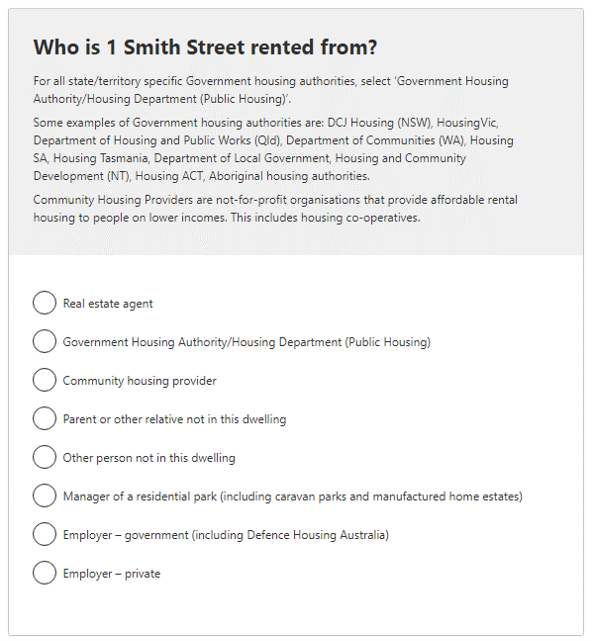
Who is this dwelling being rented from?
Image
Description
Who is 1 Smith Street rented from?
For all state/territory specific Government housing authorities, select ‘Government Housing Authority/Housing Department (Public Housing)’.
Some examples of Government housing authorities are: DCJ Housing (NSW), HousingVic, Department of Housing and Public Works (Qld), Department of Communities (WA), Housing SA, Housing Tasmania, Department of Local Government, Housing and Community Development (NT), Housing ACT, Aboriginal housing authorities.
Community Housing Providers are not-for-profit organisations that provide affordable rental housing to people on lower incomes. This includes housing co-operatives.
• Rental type
• Real estate agent
• Government Housing Authority/Housing Department (Public Housing)
• Community housing provider
• Parent or other relative not in this dwelling
• Other person not in this dwelling
• Manager of a residential park (including caravan parks and manufactured home estates)
• Employer – government (including Defence Housing Australia)
• Employer – private
How this variable is created
This variable is derived from responses to the Tenure type and Landlord type questions on the Census form.
History and changes
The Tenure and landlord type (TENLLD) combined variable was first available for use during the 2011 Census. Prior to this, data was obtained by manually combining the Tenure type (TEND) and Landlord type (LLDD) variables.
For 2021, the category ‘Rented: Housing co-operative, community or church group’ has been reworded to ‘Rented: Community housing provider’, and it has been repositioned to category 5, moving the category ‘Rented: Person not in same household’ to category 6.
‘Other tenure type’ has been rescoped for 2021 to include houses being occupied rent free, which in previous censuses have been covered by the rented categories (4-8), to align with the ABS Standard for Tenure Type.
Data use considerations
'Other tenure type' includes dwellings occupied under a life tenure scheme and dwellings occupied rent free. 'Owned with a mortgage' includes dwellings being purchased under a shared equity scheme (termed a rent/buy scheme in 2011).
This variable does not have a non-response rate as it is created during Census processing by using responses from more than one question on the Census form.