Commencing in 2022, the ABS will undertake a major review of the Australian Standard Classification of Religious Groups (ASCRG) and the associated Religious Affiliation standard. The aims of this review are to update the ASCRG to reflect the modern Australian community; and to ensure the standard (the way the question is asked) is inclusive.
Why the ASCRG needs to be updated
While the current version of the ASCRG had some minor updates in 2016, it largely reflects the original 1996 version based on the social environment in Australia at that time. The Australian community has changed considerably over this time and the ASCRG and Standard both need to be reviewed to reflect this. The ABS has also received feedback from individuals and organisations identifying areas that need review. Data from the 2021 Census will further inform the review.
Next steps
The first round of public consultation is scheduled to commence in August 2022. At this time, the ABS will invite feedback through the ABS Consultation Hub, regarding the high priority areas (scope) of the ASCRG and the associated Standard for review. More information will be available at the ABS Consultation Hub in the coming months, including information how to participate in the review process. There will be another consultation process when the proposed changes are released in June 2023.
If you would like more information, please email the ABS at standards@abs.gov.au.
The categories using the ASCRG are listed in groups below. The full list is available from the Data downloads on this page.
1 Buddhism
1
Buddhism
101
Buddhism
1011
Buddhism
2 Christianity
2
Christianity
200
Christianity, nfd
2000
Christianity, nfd
201
Anglican
2012
Anglican Church of Australia
2013
Anglican Catholic Church
2019
Anglican, nec
203
Baptist
2031
Baptist
205
Brethren
2051
Brethren
207
Catholic
2070
Catholic, nfd
2071
Western Catholic
2072
Maronite Catholic
2073
Melkite Catholic
2074
Ukrainian Catholic
2075
Chaldean Catholic
2076
Syro Malabar Catholic
2079
Catholic, nec
211
Churches of Christ
2110
Churches of Christ, nfd
2111
Churches of Christ (Conference)
2112
Church of Christ (Non-denominational)
2113
International Church of Christ
213
Jehovah's Witnesses
2131
Jehovah's Witnesses
215
Latter-day Saints
2150
Latter-day Saints, nfd
2151
The Church of Jesus Christ of Latter-day Saints
2152
Community of Christ
217
Lutheran
2171
Lutheran
221
Oriental Orthodox
2210
Oriental Orthodox, nfd
2212
Armenian Apostolic
2214
Coptic Orthodox Church
2215
Syrian Orthodox Church
2216
Ethiopian Orthodox Church
2219
Oriental Orthodox, nec
222
Assyrian Apostolic
2220
Assyrian Apostolic, nfd
2221
Assyrian Church of the East
2222
Ancient Church of the East
2229
Assyrian Apostolic, nec
223
Eastern Orthodox
2230
Eastern Orthodox, nfd
2231
Albanian Orthodox
2232
Antiochian Orthodox
2233
Greek Orthodox
2234
Macedonian Orthodox
2235
Romanian Orthodox
2236
Russian Orthodox
2237
Serbian Orthodox
2238
Ukrainian Orthodox
2239
Eastern Orthodox, nec
225
Presbyterian and Reformed
2250
Presbyterian and Reformed, nfd
2251
Presbyterian
2252
Reformed
2253
Free Reformed
227
Salvation Army
2271
Salvation Army
231
Seventh-day Adventist
2311
Seventh-day Adventist
233
Uniting Church
2331
Uniting Church
24
Pentecostal
2400
Pentecostal, nfd
2401
Apostolic Church (Australia)
2402
Australian Christian Churches (Assemblies of God)
2403
Bethesda Ministries International (Bethesda Churches)
2404
C3 Church Global (Christian City Church)
2406
International Network of Churches (Christian Outreach Centres)
2407
CRC International (Christian Revival Crusade)
2411
Foursquare Gospel Church
2412
Full Gospel Church of Australia (Full Gospel Church)
2413
Revival Centres
2414
Rhema Family Church
2415
United Pentecostal
2416
Acts 2 Alliance
2417
Christian Church in Australia
2418
Pentecostal City Life Church
2421
Revival Fellowship
2422
Victory Life Centre
2423
Victory Worship Centre
2424
Worship Centre Network
2499
Pentecostal, nec
28
Other Protestant
2800
Other Protestant, nfd
2801
Aboriginal Evangelical Missions
2802
Born Again Christian
2803
Christian and Missionary Alliance
2804
Church of the Nazarene
2805
Congregational
2806
Ethnic Evangelical Churches
2807
Independent Evangelical Churches
2808
Wesleyan Methodist Church
2811
Christian Community Churches of Australia
2812
Methodist, so described
2813
United Methodist Church
2899
Other Protestant, nec
29
Other Christian
2900
Other Christian, nfd
2901
Apostolic Church of Queensland
2902
Christadelphians
2903
Christian Science
2904
Gnostic Christians
2905
Liberal Catholic Church
2906
New Apostolic Church
2907
New Churches (Swedenborgian)
2908
Ratana (Maori)
2911
Religious Science
2912
Religious Society of Friends (Quakers)
2913
Temple Society
2915
Grace Communion International (Worldwide Church of God)
2999
Other Christian, nec
3 Hinduism
3
Hinduism
301
Hinduism
3011
Hinduism
4 Islam
4
Islam
401
Islam
4011
Islam
5 Judaism
5
Judaism
501
Judaism
5011
Judaism
6 Other Religions
6
Other Religions
601
Australian Aboriginal Traditional Religions
6011
Australian Aboriginal Traditional Religions
603
Baha'i
6031
Baha'i
605
Chinese Religions
6050
Chinese Religions, nfd
6051
Ancestor Veneration
6052
Confucianism
6053
Taoism
6059
Chinese Religions, nec
607
Druse
6071
Druse
611
Japanese Religions
6110
Japanese Religions, nfd
6111
Shinto
6112
Sukyo Mahikari
6113
Tenrikyo
6119
Japanese Religions, nec
613
Nature Religions
6130
Nature Religions, nfd
6131
Animism
6132
Druidism
6133
Paganism
6135
Wiccan (Witchcraft)
6139
Nature Religions, nec
615
Sikhism
6151
Sikhism
617
Spiritualism
6171
Spiritualism
69
Miscellaneous Religions
6901
Mandaean
6902
Yezidi
6991
Caodaism
6992
Church of Scientology
6993
Eckankar
6994
Rastafari
6995
Satanism
6996
Theosophy
6997
Jainism
6998
Zoroastrianism
6999
Religious Groups, nec
7 Secular Beliefs and Other Spiritual Beliefs and No Religious Affiliation
7
Secular Beliefs and Other Spiritual Beliefs and No Religious Affiliation
7000
Secular Beliefs and Other Spiritual Beliefs and No Religious Affiliation, nfd
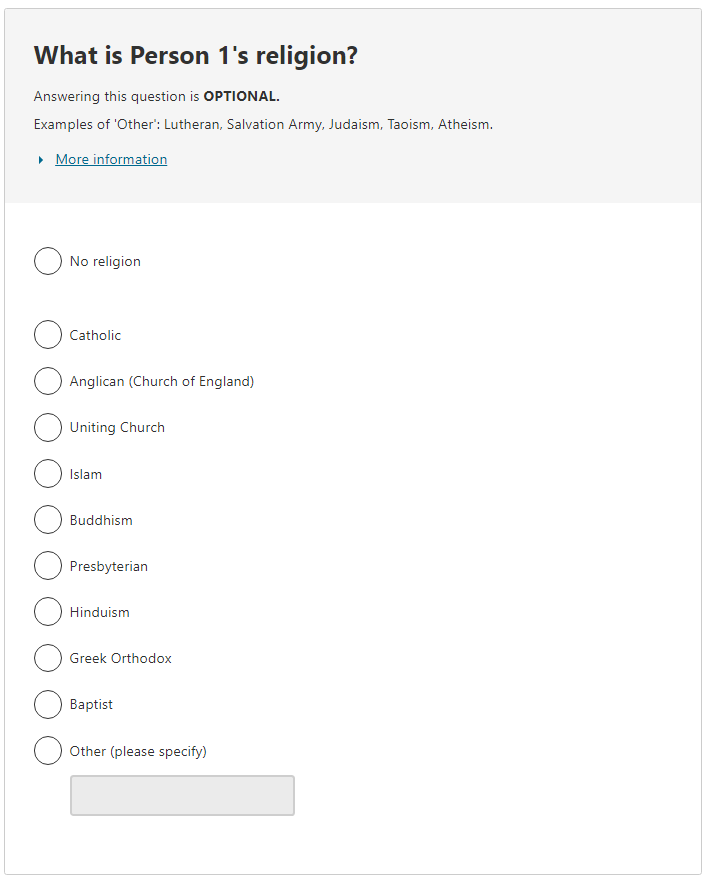
What is Person 1's religion?
Answering this question is OPTIONAL.
Examples of 'Other': Lutheran, Salvation Army, Judaism, Taoism, Atheism.
More information
Person's religion
No religion
Catholic
Anglican (Church of England)
Uniting Church
Islam
Buddhism
Presbyterian
Hinduism
Greek Orthodox
Baptist
Other (please specify)
More information
Image
Description
What is Person 1's religion?
Answering this question is OPTIONAL.
Examples of 'Other': Lutheran, Salvation Army, Judaism, Taoism, Atheism.
More information
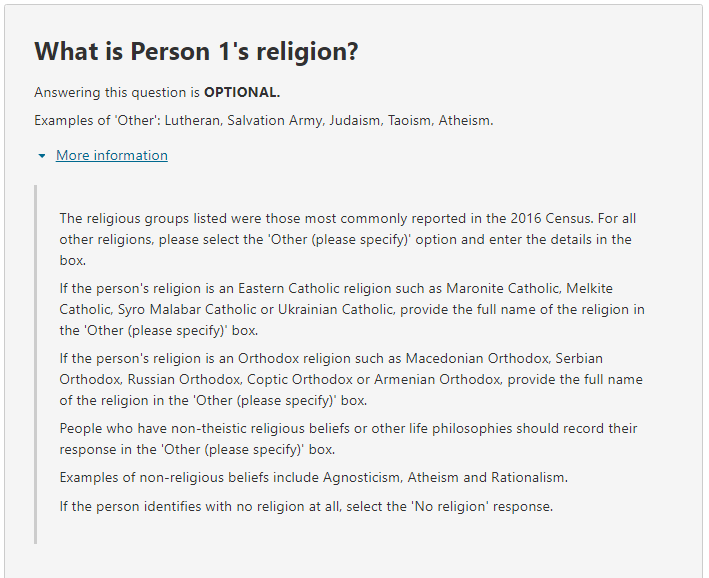
The religious groups listed were those most commonly reported in the 2016 Census. For all other religions, please select the 'Other (please specify)' option and enter the details in the box.
If the person's religion is an Eastern Catholic religion such as Maronite Catholic, Melkite Catholic, Syro Malabar Catholic or Ukrainian Catholic, provide the full name of the religion in the 'Other (please specify)' box.
If the person's religion is an Orthodox religion such as Macedonian Orthodox, Serbian Orthodox, Russian Orthodox, Coptic Orthodox or Armenian Orthodox, provide the full name of the religion in the 'Other (please specify)' box.
People who have non-theistic religious beliefs or other life philosophies should record their response in the 'Other (please specify)' box.
Examples of non-religious beliefs include Agnosticism, Atheism and Rationalism.
If the person identifies with no religion at all, select the 'No religion' response.
How this variable is created
This variable is created from responses to the religious affiliation question, which are coded to the ASCRG.
Respondents could use one of the mark boxes to indicate their religious affiliation or write the name of their religion in the text field. The question includes the 10 most common responses from the 2016 Census as mark boxes, as well as a write in text box.
Responses are coded accordingly:
Most responses are captured automatically from a mark box response.
Written responses are coded using a combination of automatic reading and coding processes.
Remaining responses require manual coding processes when they could not be coded or derived automatically.
When more than one religion or a mark box religion and a text response is recorded, the responses are accepted in the order they appear on the form and the extra response is rejected.
If a religion is not listed in the classification, it is coded to 'Inadequately described'.
History and changes
A question on religion has been included in all Australian censuses since 1911. Answering this question has always been optional, the very nature of which is provided for in legislation.
The ASCRG was first published in 1996 and has been used to code religious affiliation for all Australian censuses since. Throughout this time, the classification has evolved to reflect the diverse religious affiliations identified amongst Australia’s population.
From 1991 to 2011 the 'No religion' response category was the last response option. For 2016, a change was made to the question format, moving this category to the first response option. This change was made following the 2016 Census topic review process, where many submissions recommended changes to the Religious affiliation question. 'No religion' was again the first response option in 2021.
For 2021, the response category order has been updated based on the most common responses in the 2016 Census:
'Presbyterian' moved from 5th to 7th position
'Islam' moved from 7th to 5th position
'Greek Orthodox' moved from 8th to 9th position
'Baptist' moved from 9th to 10th position
'Hinduism' moved from 10th to 8th position.
Changes have also been made to the 'other' examples given in the question instructions.
Data use considerations
The Census question is intended to measure religious affiliation, which may be different from a person's practice of or participation in a religious activity. It allows people to respond with secular or spiritual beliefs and to indicate if they have no religious affiliation at all.
Data on religious affiliation is used for:
planning the location of educational facilities, aged care and other social services provided by religion-based organisations
planning the location of church buildings
the assigning of chaplains to hospitals, prisons, armed services, and universities
the allocation of time on public radio and other media
sociological research.
The non-response rate for Religious affiliation (RELP) was 6.9% in 2021. This is a decrease from 9.1% in 2016.