This variable records the number of people with a profound or severe core activity limitation. People with a profound or severe core activity limitation are those needing assistance in their day to day lives in one or more of the three core activity areas of self-care, mobility and communication because of:
a long-term health condition (lasting six months or more)
a disability (lasting six months or more)
old age
Scope
All persons
Categories
Code
Category
1
Has need for assistance with core activities
2
Does not have need for assistance with core activities
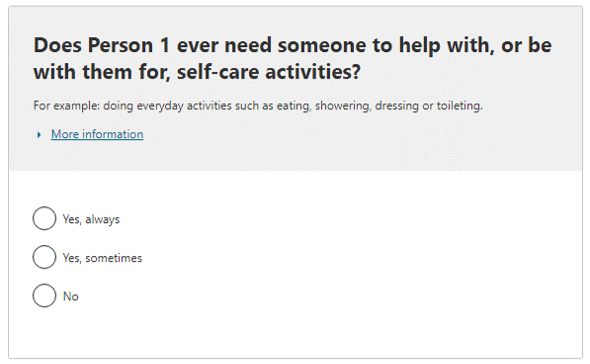
Does the person ever need someone to help with, or be with them for, self-care activities?
Image
Description
Does Person 1 ever need someone to help with, or be with them for, self-care activities?
For example: doing everyday activities such as eating, showering, dressing or toileting.
More information
Person's need for help with self-care
Yes, always
Yes, sometimes
No
More Information
Image
Description
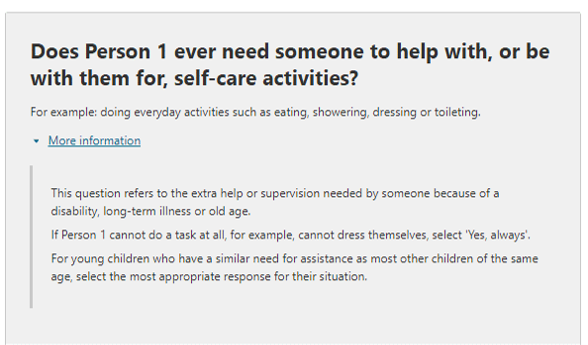
Does Person 1 ever need someone to help with, or be with them for, self-care activities?
For example: doing everyday activities such as eating, showering, dressing or toileting.
More information
This question refers to the extra help or supervision needed by someone because of a disability, long-term illness or old age.
If Person 1 cannot do a task at all, for example, cannot dress themselves, select 'Yes, always'.
For young children who have a similar need for assistance as most other children of the same age, select the most appropriate response for their situation.
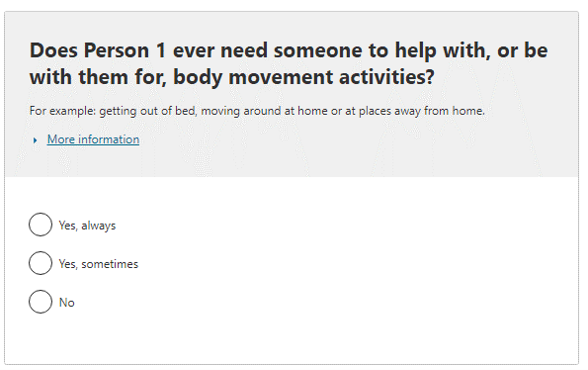
Does the person ever need someone to help with, or be with them for, body movement activities?
Image
Description
Does Person 1 ever need someone to help with, or be with them for, body movement activities?
For example: getting out of bed, moving around at home or at places away from home.
More information
Person's need for help with body movement
Yes, always
Yes, sometimes
No
More information
Image
Description
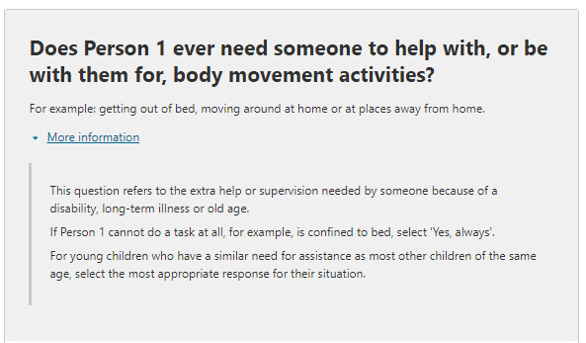
Does Person 1 ever need someone to help with, or be with them for, body movement activities?
For example: getting out of bed, moving around at home or at places away from home.
More information
This question refers to the extra help or supervision needed by someone because of a disability, long-term illness or old age.
If Person 1 cannot do a task at all, for example, is confined to bed, select 'Yes, always'.
For young children who have a similar need for assistance as most other children of the same age, select the most appropriate response for their situation.
Does the person ever need someone to help with, or be with them for, communication activities?
Image
Description
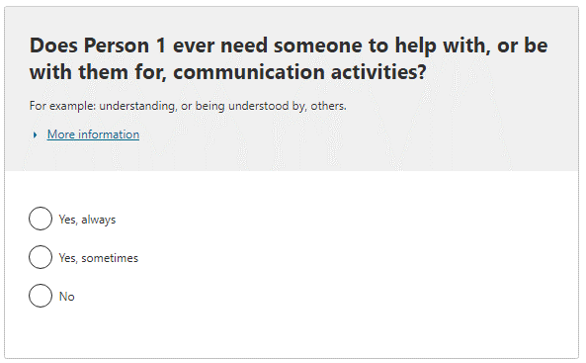
Does Person 1 ever need someone to help with, or be with them for, communication activities?
For example: understanding, or being understood by, others.
More information
Person's need for help with communication
Yes, always
Yes, sometimes
No
More information
Image
Description
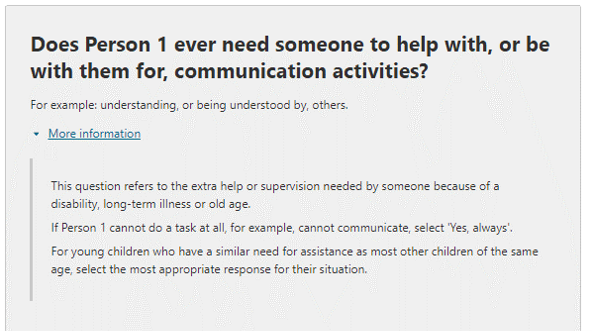
Does Person 1 ever need someone to help with, or be with them for, communication activities?
For example: understanding, or being understood by, others.
More information
This question refers to the extra help or supervision needed by someone because of a disability, long-term illness or old age.
If Person 1 cannot do a task at all, for example, cannot communicate, select 'Yes, always'.
For young children who have a similar need for assistance as most other children of the same age, select the most appropriate response for their situation.
What are the reasons for the need for assistance or supervision shown in Questions 24, 25 and 26?
Image
Description
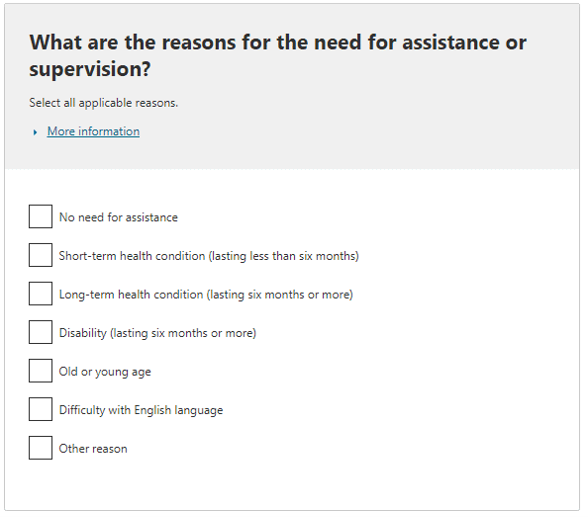
What are the reasons for the need for assistance or supervision?
Select all applicable reasons.
More information
Reason person needs help
No need for assistance
Short-term health condition (lasting less than six months)
Long-term health condition (lasting six months or more)
Disability (lasting six months or more)
Old or young age
Difficulty with English language
Other reason
More information
Image
Description
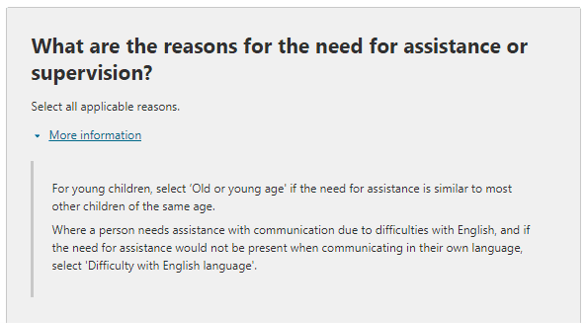
What are the reasons for the need for assistance or supervision?
Select all applicable reasons.
More information
For young children, select ‘Old or young age' if the need for assistance is similar to most other children of the same age.
Where a person needs assistance with communication due to difficulties with English, and if the need for assistance would not be present when communicating in their own language, select 'Difficulty with English language'.
How this variable is created
The Census uses a set of four questions (paper form questions 24-27) to derive ‘core activity need for assistance’. Responses to the questions are captured automatically from mark box responses.
To determine if a person’s need for assistance in one or more of the three core activity areas is due to a long-term health condition, disability or old age, the question on the Census form asks, ‘What are the reasons for the need for assistance or supervision?’.
To be coded to the category ‘Has need for assistance with core activities’, the response needs to be one or more of the following:
Long-term health condition (lasting six months or more)
Disability (lasting six months or more)
To be coded to the category ‘Does not have need for assistance with core activities’, the response needs to be one or more of the following:
No need for assistance
Short-term health condition (lasting less than six months)
Difficulty with English language
Other cause
If a person’s only response is ‘Old or young age’, they are coded as follows:
If under 40 years of age – ‘Does not have need for assistance with core activities’
If 40 years or over – ‘Has need for assistance with core activities’
History and changes
The Census ‘Core activity need for assistance’ concept was developed for the 2006 Census to indicate the disability status of people in Australia according to geographic area, and for small groups within the population.
No changes have been made for 2021.
Data use considerations
This variable helps service providers and governments plan what local facilities, services and support are required, such as in-home support, respite care and support to carers.
Of all ABS collections of disability data, only the Survey of Disability, Ageing and Carers (SDAC) is considered to comprehensively measure disability populations, and to provide rates of prevalence at the national and state levels. The Census concept ‘Core activity need for assistance’ is related to the ‘disability status’ information collected in the SDAC. The purpose of the Census is to identify people with a ‘profound or severe core activity limitation’ using similar criteria to the SDAC.
Users wanting more comprehensive information about the disability status of people in Australia should instead refer to the publication Disability, Ageing and Carers, Australia: Summary of Findings, 2022. Despite the conceptual consistency of the measures in the Census and SDAC, abbreviating the set of questions used to collect data on disability, as required for the Census, reduces the number of people who can be classified as having a disability or to a particular level of disability, depending on the concept being collected. The publication, ABS Sources of Disability Information, 2018-2023 examines the different ABS sources of disability data.
The non-response rate for Core activity need for assistance (ASSNP) was 5.9% in 2021. This is a decrease from 7.1% in 2016.
Related variables and glossary terms
Unpaid assistance to a person with a disability, health condition, or due to old age (UNCAREP)