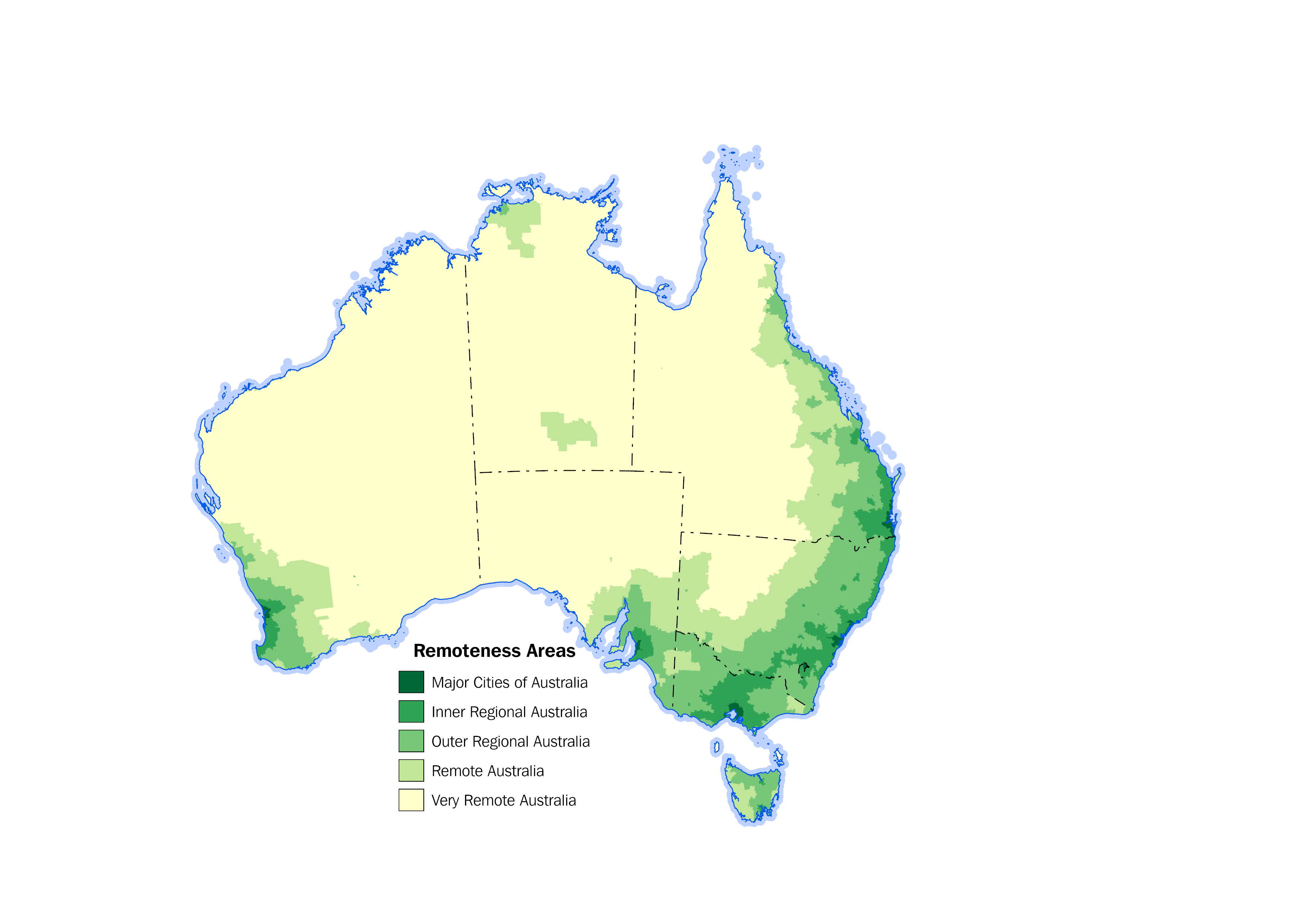
The Australian Statistical Geography Standard (ASGS) Remoteness Structure defines 5 classes of relative geographic remoteness across Australia. These 5 classes are:
- Major Cities of Australia
- Inner Regional Australia
- Outer Regional Australia
- Remote Australia
- Very Remote Australia
Relative geographic remoteness is measured in an objective way using the Accessibility/Remoteness Index of Australia Plus (ARIA+).
ARIA+ is derived by measuring road distance from various populated locations to five categories of service centre, using population as a proxy measure for service availability. ARIA+ uses ASGS Edition 3 Urban Centres and Localities and 2021 Census of Population and Housing data to reflect different levels of service availability based on five defined population ranges. For more information on how ARIA+ is created, please refer to the University of Adelaide website.
The University of Adelaide supplies ARIA+ to the ABS as a one kilometre grid which covers all of geographic Australia. Each grid cell contains an ARIA+ score representing its relative geographic remoteness. This is used by the ABS to calculate the average ARIA+ grid values for each Statistical Area Level 1 (SA1) to apply the correct remoteness class for the resulting value. The Remoteness Area classes and their associated ARIA+ ranges are shown in the table below.
Remoteness Areas aggregate to States or Territories and cover the whole of Australia without gaps or overlaps.
Further criteria are used by the ABS to refine Remoteness Areas in a standardised way. These criteria are applied to remove anomalies that the index may produce and are consistent with the methodology that was applied in previous editions of the Remoteness Structure. For example, a single SA1 that is not an Urban Centre, and which is completely surrounded by SA1s of a different remoteness class, is merged into the surrounding remoteness class.
The Urban Centres and Localities referenced in the above criteria are defined according to Australian Statistical Geography Standard (ASGS) Edition 3 - Significant Urban Areas, Urban Centres and Localities, Section of State released in October 2022.
Within each State or Territory each Remoteness Area represents an aggregation of non-contiguous geographical areas for a particular remoteness class. Not all Remoteness Area classes are represented in each State or Territory as the characteristics of remoteness are determined in the context of Australia as a whole. While Remoteness Areas are released for each individual States and Territories, Census data will also be available at a national level.