Latest release

Methods: Four pillars of labour statistics

Labour Statistics: Concepts, Sources and Methods
Reference period
2023

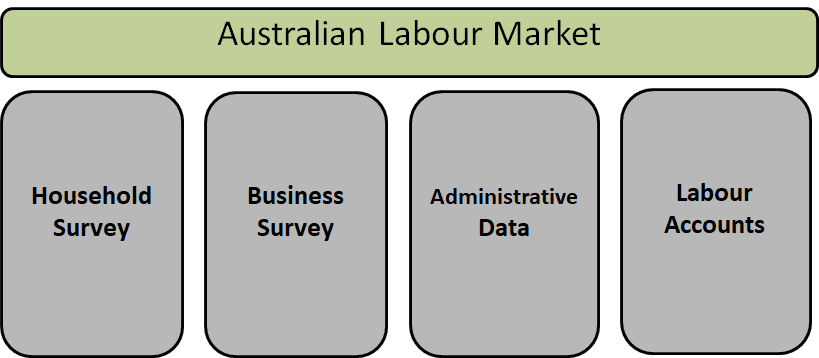
ABS labour statistics are drawn from four key types of data sources, or “pillars” of data, which provide complementary insights into the labour market. These are:

  • household surveys - individual households answer labour market questions about their individual, family or household circumstances (e.g. the monthly Labour Force Survey)
  • business surveys - collect a broad range of information from businesses about jobs and employees (e.g. the Survey of Employee Earnings and Hours, Job Vacancies Survey)
  • administrative data - information maintained by governments (such as taxation data) and other entities made available to the ABS for statistical purposes (e.g. as published in Weekly Payroll Jobs)
  • accounts compilation - bringing together data from separate administrative, business, and household sources to produce an Australian Labour Account
Shows the four pillars that underpin Australian labour market statistics: Household Surveys, Business Surveys. Administrative Data and Labour Accounts

Sample surveys versus censuses

Sample design and sampling techniques

Weighting and estimation

Editing

Time series estimates

Reliability of estimates

Confidentiality

Household surveys

Household surveys and population censuses constitute the primary sources of ABS labour statistics on people and households. In addition to information about current and previous labour force participation, information collected also includes demographic data, such as age, sex, family characteristics and country of birth. Labour statistics collected about people provide insight into the supply of labour to the Australian labour market.

Household surveys falling within the labour statistics program include:

The ABS household survey program also includes other social surveys that contain a labour force status module. Other labour-related data include:

For specific information on each of these surveys, refer to the relevant methodology pages for each statistical release.

Scope and coverage

Collection methodologies

Sample design

MPS and SSS master samples

Benchmarks

Non-response

Labour Force Survey

The Labour Force Survey (LFS) provides Australia's official measure of employment, unemployment and labour force participation. The data captured in this survey are some of Australia’s key economic statistics, providing insight into the Australian economy and Australian people.

About the Labour Force Survey

The Labour Force Survey
FrequencyMonthly
Responding sample sizeApprox. 26,000 households (52,000 people)
ScopeUsual resident civilians 15 years and over
Response rateApprox. 93%
PublicationLabour Force, Australia; Labour Force, Australia - Detailed; Labour Force Status of Families, Australia; Longitudinal Labour Force, Australia;
Data availabilityQuarterly from 1966-1977 and monthly from 1978 onwards; Longitudinal Labour Force, Australia is available monthly from October 1982

Each month, The LFS collects data on the labour force activity of persons around 52,000 people in 26,000 households. The information is collected through a household sample survey conducted by trained interviewers either face-to-face or over the phone, or via online self-completion form. The survey is detailed, including around 70 questions.

The scope of the LFS is limited to the usually resident civilian population of Australia, aged 15 years and over. As such, the survey includes residents who are temporarily overseas (less than 6 weeks), but excludes members of the permanent defence forces. The ABS then weights the people in the survey sample to the most recent population figures, to provide a representative picture of the whole population.

In addition to data on employment and unemployment, the LFS also collects information on underutilisation, hours worked, job searching and retrenchments, as well as socio-demographic characteristics.

The Labour Force Survey Standard Products and Data Item Guide is a useful reference for users seeking different data variables from the Labour Force Survey. The guide is divided into two sections:

  • Section 1: Labour Force Survey standard product data - The first section alphabetically lists and explains the data items in Labour Force Survey standard products and where to find them.
  • Section 2: Detailed information on Labour Force Survey standard products - The second section lists the Labour Force Survey standard products, and specifies the data items contained within each spreadsheet and data cube.

Sample rotation

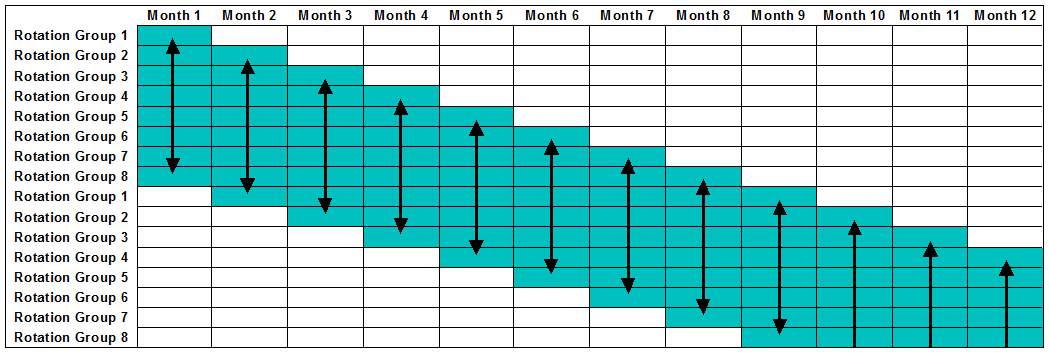
The LFS sample can be thought of as comprising eight sub-samples (or rotation groups), with each subsample remaining in the survey for eight months. A new rotation group is introduced each month to replace an outgoing rotation group, generally from the same geographic area.

Sample rotation enables reliable measures of monthly change in labour force statistics to be compiled, while ensuring the sample reflects changes in the household population.

Figure 1: Sample rotation

Figure 1: Sample rotation
As shown in Figure 1, the LFS sample can be thought of as comprising eight sub-samples (or rotation groups), with each subsample remaining in the survey for eight months. A new rotation group is introduced each month to replace an outgoing rotation group, generally from the same geographic area. Sample rotation enables reliable measures of monthly change in labour force statistics to be compiled, while ensuring the sample reflects changes in the household population.

For more information about the Labour Force Survey, see the Labour Force, Australia methodology page.

Using labour force data

Time-series data

Data collected regularly over time may display seasonal and irregular patterns. This raw data, known as the original series, can be very volatile, making it difficult to identify underlying trends. The ABS therefore publishes two additional data series to aid time-series analysis: seasonally adjusted and trend data in addition to the original (unadjusted) survey estimates.

Trend data helps to determine the underlying path of the series, by smoothing out any irregularities. It is calculated as a 13 month moving average, using data from 6 months prior to and following the reference period.

Seasonally adjusted data has been modified to remove any patterns caused by regularly repeating cycles in the real world, such as the Christmas period, harvesting season, and school holidays. This series aids in short-term forecasting and allows series to be compared between periods; however, can still be volatile.

Reliability

As the LFS is a sample survey, the data are subject to sampling and non-sampling error. The ABS takes data quality seriously and makes every effort to minimise error where possible, achieving a response rate of 93%. While the sample is designed to ensure sampling error is as low as possible at the national and state/territory level, it can be higher for labour force regions or for detailed population breakdowns.

International comparisons of Labour Force Surveys

International comparisons of labour statistics are essential in providing a global context to economic analysis, social research and policy formation and evaluation. When comparing data across countries, consideration must be given to the differences in how labour concepts are measured. Since 1919, the International Labour Organisation (ILO) has maintained and developed a system of international labour standards. The ABS provides data about the Australian labour for to groups such as the Organisation for Economic Co-operation and Development (OECD) and ILO, who collate data from multiple countries on a similar basis to allow such cross-country comparisons to occur.

When comparing data across countries, consideration should also be given to differences in the collection methodologies of each country’s labour force survey.

Comparison of Labour Force Surveys
 AustraliaCanadaNew ZealandUnited KingdomUnited States
SurveyLabour Force SurveyLabour Force SurveyHousehold Labour Force SurveyLabour Force SurveyCurrent Population Survey
OrganisationAustralian Bureau of StatisticsStatistics CanadaStatistics New ZealandOffice for National StatisticsBureau of Labour Statistics
FrequencyMonthlyMonthlyQuarterlyQuarterlyMonthly
ScopeUsually resident, civilians aged 15+Civilian non-institutionalised population aged 15+Usually resident, civilian non-institutional populations aged 15+Permanent residents aged 16-74 yearsUsually resident, civilian non-institutional populations aged 16+
Sample SizeApprox. 26 000 dwellings (52 000 persons)Approx. 56 000 dwellings (100 000 persons)Approx. 15 000 dwellings (30 000 persons)Approx. 40 000 dwellings (100 000 persons)Approx. 60 000 dwellings (112 000 persons)
Population (June, 2016)24.21 mill.36.71 mill.4.70 mill.58.38 mill.325.34 mill.
% population in survey0.21%0.27%0.64%0.17%0.03%
Working age population (2016)0.33%0.42%0.98%0.24%0.05%
Sample rotationRotating panel sample design. Selected households remain in the survey for eight consecutive months. A new rotation group is introduced each month to replace an outgoing group (one-eighth of the sample).Rotating panel sample design. Selected households remain in the survey for six consecutive months. A new rotation group is introduced each month to replace an outgoing group (one-sixth of the sample).Rotating panel sample design. Selected households remain in the survey for eight consecutive quarters. A new rotation group is introduced each quarter, from the same Primary Sampling Unit, to replace an outgoing group (one-eighth of the sample).Rotating panel sample design. Selected households respondents are questioned five times at 13 week intervals (consecutive) and one-fifth of the sample is replaced each quarter.Eight representative rotation groups, each in the sample for eight months total. Each rotation group is included in the sample for two four month periods, separated by an eight month period not in the sample. 75% of the sample is common from month-to-month and 50% one year apart for the same month.
Collection methodologyPersonal interview, telephone interview, and online form. Data is collected for each in-scope household member from 'Any Responsible Adult'.Personal or telephone interview (in English or French). Data collected from a knowledgeable household respondent. Proxy reporting accounts for 65% of collected information.First interview conducted in person with subsequent interviews via telephone, unless personal interview requested by respondent.First interview conducted in person, with subsequent interviews via telephone. 35.0% of the interviews in 2015 were carried out by proxy.Personal interview conducted in first and fifth month (after 8 month dormant period). Other interviews via telephone. Data collected from a responsible adult household respondent.
Response ratesApprox. 93%Approx. 90%Approx. 78%Approx. 49%Approx. 87%
TopicsEmployment, unemployment, underemployment, labour underutilisation, participation, working time, job search, last job and economic inactivity by socio-demographic groups and by region.Employment, unemployment, underemployment, labour underutilisation, working time, weekly earnings and economic inactivity by socio-demographic groups and by Provinces.Employment, unemployment, underemployment, labour underutilisation, working time and economic inactivity by socio-demographic groups and by region.Employment, unemployment, underemployment, labour underutilisation and economic inactivity by socio-demographic groups.Employment, unemployment, underemployment, labour underutilisation, working time and economic inactivity by socio-demographic groups and by States.

For more information on Labour Force Surveys in other countries, see:

For further information, please email labour.statistics@abs.gov.au

Labour force supplementary surveys

A supplementary topic was included with the Labour Force Survey (LFS) for the first time in November 1961, and this concept was gradually extended so that the majority of months in each year included supplementary questions on one or more topics.

Each Labour Force Supplementary Survey (LFSS) comprises a series of additional questions asked at the end of each LFS interview. The survey methodology does not differ greatly among the supplementary surveys, and in many aspects is the same as the LFS methodology (outlined in the section: Labour Force Survey). This section describes the broad survey methodology of the supplementary surveys. They should be used in conjunction with the subsections of this section, which outline elements of the methodology which are unique to each supplementary survey.

From July 2014, the ABS improved and consolidated the content of the LFS and labour supplementary surveys. See Information Paper: Outcomes of the Labour Household Surveys Content Review, 2012 and Forthcoming changes to ABS Labour Force and Supplementary Surveys for more information.

The Characteristics of Employment Survey (COE) combines the key elements from the previous separate Employee Earnings, Benefits and Trade Union Membership Survey (EEBTUM), Forms of Employment Survey (FOES) and Working Time Arrangements Survey, to provide a comprehensive and coherent dataset on characteristics of persons' employment.

The Participation, Job Search and Mobility (PJSM) Survey combines the key elements from the previous separate Persons Not in the Labour Force Survey (PNILF), Underemployed Workers Survey (UEW), Job Search Experience Survey (JSE) and Labour Mobility Survey (LM), to provide a comprehensive and coherent dataset on persons' experiences relating to job search, job change and increasing participation.

Objectives of the labour force supplementary surveys

The LFSSs form an important component of the ABS's household surveys program, which aims: 

  • to provide a range of statistics required to monitor the social and economic wellbeing of Australians, with particular reference to important sub-groups of the population; and
  • to support the development, implementation and evaluation of policies and programs of key Commonwealth and State government agencies.

The information requirements of ABS household surveys are determined on the basis of submissions from users on their needs for and uses of household survey data. They also reflect ABS deliberations on what is required of a national statistics program in the various subject fields, based on user contact and consultation.

In the field of labour statistics, supplementary surveys provide detailed information on a range of labour topics and interest groups such as:

  • labour force - labour force experience,
  • employment - underemployment; multiple job holding; forms of employment,
  • employees - earnings; trade union membership; benefits; and working arrangements,
  • unemployment - job search experience; successful and unsuccessful job search,
  • persons not in the labour force - discouraged job seekers; other persons with marginal attachment to the labour force, and
  • persons retrenched or made redundant from work.

Current supplementary survey statistical releases

Publication FrequencyDescription
Characteristics of Employment, Australia AnnualThe Characteristics of Employment (COE) survey is conducted annually in August as a supplement to the monthly Labour Force Survey (LFS). From 2020, statistics from COE are published in three topic-based releases. Data from the biennial labour hire workers module in COE contributes to the multi-source Labour Hire Workers publication.
 Employee earningsAnnual 
 Working arrangementsAnnual 
 Trade union membershipBiennial 
Participation, Job Search and Mobility, Australia AnnualThe Participation, Job Search and Mobility (PJSM) survey is conducted annually in February as a supplement to the monthly Labour Force Survey (LFS). From 2021, statistics from PJSM are published in three topic-based releases.
 Potential workersAnnual 
 Job mobilityAnnual 
 Underemployed workersAnnual 
Education and Work, Australia AnnualThe Survey of Education and Work (SEW) is conducted annually in May as a supplement to the monthly Labour Force Survey (LFS). 

Historical supplementary survey statistical releases

PublicationCatalogue NumberDescription
Employee Earnings, Benefits and Trade Union Membership, Australia6310.0This product has been replaced by Characteristics of Employment. Archive of statistics from this survey is available from 1975-2013.
Forms of Employment, Australia6359.0This product has been replaced by Characteristics of Employment. Australia. Archive of statistics from this survey is available from 1998-2013.
Locations of Work, Australia6275.0This product has been replaced by Characteristics of Employment. Archive of statistics from this survey is available from 1989-2008.
Working Time Arrangements, Australia6342.0This product has been replaced by Characteristics of Employment. Archive of statistics from this survey is available from 1993-2012.
Job Search Experience, Australia6222.0This product has been replaced by Participation, Job Search and Mobility, Australia. Archive of statistics from this survey is available from 1976-2013.
Labour Force Experience, Australia6206.0This product has been replaced by Participation, Job Search and Mobility, Australia. Archive of statistics from this survey is available from 1968-2011.
Labour Mobility, Australia6209.0This product has been replaced by Participation, Job Search and Mobility, Australia. Archive of statistics from this survey is available from 1972-2013.
Persons Not in the Labour Force, Australia6220.0This product has been replaced by Participation, Job Search and Mobility, Australia. Archive of statistics from this survey is available from 1975-2013.
Persons Not in the Labour Force, Underemployed Workers and Job Search Experience, Australia6226.0.55.001This product has been replaced by Participation, Job Search and Mobility, Australia. Originally, this product replaced the publications in 2014: Persons Not in the Labour Force, Australia; Underemployed Workers, Australia; and Job Search Experience, Australia.
Underemployed Workers, Australia6265.0This product has been replaced by Participation, Job Search and Mobility, Australia. Archive of statistics from this survey is available from 1985-2013.
Characteristics of Recent Migrants, Australia6250.0Survey was last conducted in 2020.
Child Employment, Australia6211.0Survey was last conducted in 2006.
Multiple Jobholding, Australia6216.0Survey was last conducted in 2001. This product has been replaced by Multiple job-holders, which is a multi-source release, combining data from the Labour Force Survey, the Australian Labour Account and Jobs in Australia.
Pregnancy and Employment Transitions, Australia4913.0Survey was last conducted in 2017.

Labour Multipurpose Household Survey topics

The Multipurpose Household Survey (MPHS) was introduced in 2004–05. The MPHS is conducted each financial year throughout Australia as a supplement to the ABS' monthly Labour Force Survey (LFS). The MPHS topic questions are asked each month from July to June in a personal interview. The MPHS is designed to provide statistics annually for a number of small, self-contained topics.

The MPHS collects detailed information on a number of labour market issues, including:

In addition to the labour-related topics mentioned above, the MPHS program also includes other social topics not related to labour statistics, such as:

  • Crime victimisation;
  • Participation in sport and physical activity;
  • Environmental views and behaviours;
  • Patient experiences in Australia; and
  • Household use of information technology.

For all MPHS topics, general demographic information such as age, sex, labour force characteristics, education and income are also available.

This section describes the broad survey methodology of the MPHS. For information on the four labour related MPHS topics that have been conducted to date, see the following sub sections: Barriers and Incentives to Labour Force Participation; Retirement and Retirement Intentions; Work-Related Injuries; and Qualifications and Work.

Objectives of the Multipurpose Household Survey

The MPHS topics are an important part of the ABS household surveys program, which aims to:

  • provide a range of statistics needed to monitor the social and economic wellbeing of Australians, with particular reference to important sub-groups of the population; and
  • support the development, implementation and evaluation of policies and programs of key Commonwealth and State government agencies.

The information requirements of MPHS topics are determined on the basis of submissions from users on their needs for, and uses of, household survey data. They also reflect ABS deliberations on what is required of a national statistics program in the various subject fields, based on user contact and consultation.

The MPHS is a flexible multi-topic survey vehicle, which is used to collect and output data in a timely fashion. The MPHS includes a number of topics that require personal interview (rather than using the any responsible adult (ARA) method), and are therefore unsuited to the monthly supplementary survey program. The MPHS has a shorter development and output time than the special social surveys to achieve flexibility in responding to user demands as they arise, and to allow the ABS to respond to emerging demand and contemporary priorities in a timely way (publications are usually available within six months of the completion of data collection).

The MPHS is conducted as a supplement to the monthly LFS. Each month one eighth of the households in the LFS sample are rotated out of the survey. Generally, around 80% of these rotating-out households are then selected for the MPHS each month. In these households, after the LFS has been fully completed for each person in scope and coverage, a person aged 15 years and over is selected at random (based on a computer algorithm) and asked the additional MPHS topic questions in a personal interview. In cases where the MPHS topic is age sensitive, permission is sought from a parent or guardian before conducting the personal interview with a person aged 15 – 17. If permission is not given, the parent or guardian may be asked on behalf of the 15 – 17 year old, but are not asked questions relating to opinions/perceptions.

Unlike LFS which collects information from all members of the household from any responsible adult, the MPHS uses a randomly selected member of the household to answer questions about themselves.

Data are collected using Computer Assisted Interviewing (CAI), whereby responses are recorded directly onto an electronic questionnaire in a notebook during a telephone, face-to-face personal interview or online self-completion.

Data for MPHS topics are collected each month over a financial year. This reduces the impact of any seasonal effects on the data.

Census of Population and Housing

The Census of Population and Housing is conducted every five years to measure the number of people in Australia on Census night, their key characteristics and the households and dwellings in which they live. By collecting lots of information in a standardised way, from the country as a whole, the Census provides a rich and detailed snapshot of Australia. Australia's seventeenth (and most recent) national Census was conducted on 10 August 2021.

The Census and the Labour Force Survey (LFS) both measure information about the labour market activity of persons aged 15 years and over. While both collections measure the same concepts surrounding the labour force in Australia, there are a number of differences between the two that should be considered when comparing the data, as statistics produced from these collections are not the same.

Labour-related topics on the 2016 Census include: labour force status, status in employment, employment type, occupation, industry of employment, hours worked, place of work and method of travel to work. For unemployed persons, information is collected on whether looking for full-time or part-time work.

Purpose of Census and the Labour Force Survey

Understanding differences between the LFS and Census

Business surveys

This section provides an overview of the survey methodology used in ABS labour-related business surveys. Business surveys are the primary source of data on labour costs, earnings, job vacancies and industrial disputes, all of which provide insight into the demand for labour in the Australian labour market.

Business surveys falling within the labour statistics program collect information from employing businesses on a range of topics. The program includes:

For specific information each of these surveys, refer to the methodology pages for each statistical release.

Scope and coverage

ABS business register

Statistical units

Sample design and selection

Collection methods

Estimation

Editing and non-response adjustment

Administrative data

The ABS regularly uses administrative data to support the collection of data in business and household surveys. The ABS also uses combined data assets, such as those supplied by the Australian Tax Office (ATO), to develop labour statistics to provide unique insights into the Australian labour market from both a jobholder and employer perspective:

More granular demographic and employer characteristics are available in these statistics than in survey based outputs, providing detailed insights into jobs, jobholders, wages and income.

ATO administrative data assets used in the generation of these labour statistics include:

  • Australian Business Register
  • Business taxation information (BIT) for owner managers of un-incorporated enterprises
  • Client Register (CR)
  • PAYG payment summary
  • Personal Income Tax return (PIT)
  • Single Touch Payroll (STP)

Differences from traditional collection methods

Administrative datasets are not typically designed with statistical production in mind. The underlying concepts relate to administrative policy or procedures, rather than statistical constructs. This can result in coverage, definition and quality differences compared to survey based outputs.

Administrative data can cover large populations in more detail and therefore provide different levels of insight than traditional collection methods. However, administrative data can capture very specific populations or sub-populations, compared to surveys which collect information from a representative sample of the population.

While more detailed statistics are available, the estimates may present unique views of the population, particularly where adjustments are not applied to broaden the population represented.

In addition to more variable reporting quality, administrative datasets are significantly larger than those obtained from business and household surveys. The timeliness of outputs is weighed against the quality assurance of individual records. As such, the increased speed of statistical production may require macro level adjustments to address anomalous reporting (such as in WPJ). Where more time and information are available to resolve anomalous records, micro level adjustments may be in use.

Producing statistics from administrative data requires an alternative approach to processing and quality assurance than those used in survey based statistics. However, administrative datasets are an increasingly valuable source of new data, providing a rich variety of alternative insights into the labour market.

More information on the methodologies supporting the current suite of Labour statistics derived from administrative data can be found in the respective statistical releases: Jobs in Australia; Personal Income in Australia; Public Sector Employment and EarningsWeekly Payroll Jobs and Monthly Employee Earnings Indicator.

Linked Employer-Employee Dataset (LEED)

The Linked Employer Employee Dataset (LEED) is a cross-sectional database which is built using Australian Tax Office (ATO) administrative data linked to ABS Business Longitudinal Analytical Data Environment (BLADE).

The LEED enables simultaneous analysis of met supply and demand in the Australian labour market, through:

  • providing supplementary labour statistics and facilitates labour market research at industry and regional levels.
  • enabling analysis of the Australian labour market at macro and micro levels;
  • enabling analysis of how specific events impact employees and employers;
  • helping to understand structural changes in the labour market.

The LEED consists of three cross-sectional files:

  • a person file;
  • a jobs file; and
  • an employer file.

    The LEED associates information about a person with information about their employing business. This is done by establishing the existence of a job. An employed person can have one or more jobs throughout the year with one or more employers, some of which may be held concurrently with others. A job can be created either by an employing business or the personal enterprise of the individual (an owner manager).

    LEED overview

    Scope

    The LEED contains information for all persons who interacted with the Australian taxation system since the 2011-12 financial year. The LEED covers all persons who either:

    • submitted an individual tax return (ITR); or
    • had an Income Statement (previously Pay As you Go (PAYG) payment summary) issued by an employer and then remitted to the ATO.

    Employees who did not submit a tax return and have not provided their Tax File Number to their employer will not appear in the LEED. Owner managers of unincorporated enterprises (OMUEs) who did not submit an ITR are also excluded.

    The LEED includes all sources of income, regardless of whether the income provider is based within Australia's economic territory.

    Migrant data

    From 2022, migrant data were added to the LEED. The migrant data used in LEED are sourced from the Person Level Integrated Dataset (PLIDA), formerly known as the Multi-Agency Data Integration Project (MADIP).

    The migrant data are a suite of administrative datasets (visa grants and settlements database) from the Department of Home Affairs. These data pertain to permanent migrants and temporary entrants to Australia.

    Integration methodology

    LEED links jobs to employers and employed persons are linked to employers via the jobs they hold.

    Initial data cleaning is undertaken to remove duplicate and erroneous records. In particular, job records are repaired to minimise the impact of administrative noise on output statistics, such as annual income statements issued in two separate parts.

    Before the linkage takes place, an input job level file is created largely based on the income statement file. This file is also enhanced with job records derived using ITR information, to cover jobs without income statement information, such as OMUE jobs. Data quality of this file is also enhanced using occupation information from ITR, and the best available age, sex, and geographic information between the Income Statement, ITR and Client Register (CR) data.      

    Jobs are integrated with the employer by one of two methods. The method is dependent on which part of the business population on the ABS Business Register the employer is grouped into.

    • Non-profiled population (businesses with a simple structure): a deterministic approach using the Australian Business Number (ABN).
    • Profiled population (businesses with a complex structure): a more detailed approach to linking is used, detailed below.

    Profiled population linking

    Where an employer is part of the profiled population, the relevant jobs are assigned to type of activity units (TAUs) based on a logistic regression model developed using Census data. The model references independent variables common to both Census and personal income tax data, including sex, age, occupation, and region of usual residence. These are used to predict the industry of employment, which conceptually aligns to a type of activity unit. 

    Where an employee has multiple job relationships with the same reporting ABN in an enterprise group, each job relationship is assigned to the same type of activity unit.

    Based on the model, each job record is assigned a probability of being in each of the type of activity units present in the employing enterprise group. Iterative random assignment is undertaken using these probabilities until employment benchmarks are met. Benchmarks are based on Quarterly Business Indicators Survey (QBIS) data where a unit is in scope. BLADE employment levels are substituted where QBIS data is not available, otherwise no benchmarking is done.

    The above process is applied to link the different input datasets for each financial year. Records have not been integrated across years and therefore, the LEED is a cross-sectional database and is not longitudinal.

    Integrating migrants data

    Personal identifiers were used to first integrate the migrant data with the ATO's Client Register data and then integrated into LEED. This enables more detailed analysis of labour market and fiscal contributions of migrants to the economy, allowing policy makers and researchers to better understand the migrant experience and their economic contribution to Australia. 

    ABS data integration practices comply with the High-Level Principles for Data Integration Involving Commonwealth Data for Statistical and Research Purposes. For further information see - Keeping integrated data safe

    Legislative environment

    The LEED incorporates:

    • person level ITR data, job level income statement data and Client Register data supplied by the ATO to the ABS under the Taxation Administration Act 1953 - which requires that such data is only used for the purpose of administering the Census and Statistics Act 1905; and
    • employer level data that include the ABS's BLADE data and the ABS Business Register data supplied by the Registrar of Australian Business Register (ABR) to the ABS under A New Tax System (Australian Business Number) Act 1999 - which requires that such data is only used for the purpose of carrying out the functions of the ABS. 

    The data limitations or weakness outlined here are in the context of using the data for statistical purposes, and not related to the ability of the data to support the ATO's or ABR's core operational requirements.

    Legislative requirements to ensure privacy and secrecy of these data have been followed. In accordance with the Census and Statistics Act 1905, results have been confidentialised to ensure they are not likely to enable identification of a particular person or organisation. All personal information is handled in accordance with the Australian Privacy Principles contained in the Privacy Act 1988.

    All personal income tax statistics were analysed in de-identified form with no home address or date of birth included in LEED input files. Addresses were coded to the Australian Statistical Geography Standard (ASGS) and date of birth was converted to an age at 30 June of the reference year prior to data provision.

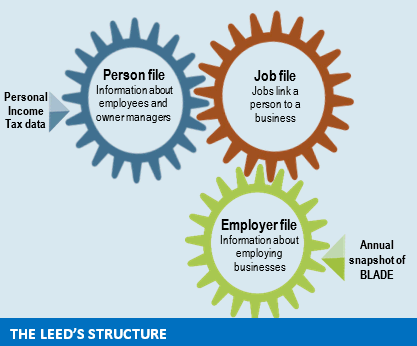
    The LEED is comprised of a person file, a job file and an employer file

    The LEED is comprised of a person file, a job file and an employer file
    Figure 1 gives an overview of the LEED and shows how it is cross-sectional database. It is comprised of a person file, a job file and a business (employer) file. The LEED includes person and employer level information provided to the ABS by the ATO and the Registrar of the Australian Business Register (ABR). LEED uses this data via the Business Longitudinal Analysis Data Environment (BLADE). The persons filed classifies persons as either not employed or employed. The jobs file is a complete list of the job relationships held at any time during the reference year. Whilst the employer file contains all employers in a job relationship with someone on the person file at any point during the reference year.

    Person file

    Each person file contains data for all persons who either submitted an Individual Tax Return (ITR) or who were identifiable on an income statement in the reference year. Each record includes de-identified demographic and geographic data, and aggregate income information.

    Employed persons may be either employees (including Owner Manager of Incorporated Enterprises or OMIEs), Owner Managers of Unincorporated Enterprises (OMUEs), or both. Employees are identified by the presence of aggregate employee income and at least one linked employee job.

    Employees who have not submitted an ITR but who have provided their Tax File Number to their employer are imputed from income statement data.

    OMUEs are identified by the presence of any of the own unincorporated business income types and a linked OMUE job.

    Tax lodgers who are not employees or owner managers (such as persons with only investment incomes) are included on the person file to support statistical analysis that requires a more complete view of the tax lodger population.

    Jobs file

    The jobs file is a complete list of the job relationships held at any time during the reference year. It is constructed primarily from income statement data. Income statements describe the payments made to an individual by an employer within a financial year. Conceptually, income statement data should include most employee/employer job relationships. OMUE jobs are derived from ITR data and are added to the jobs file, some of these link to businesses in the Business Longitudinal Analysis Data Environment (BLADE).

    In some cases a synthetic employee job record has been created based on information in the person file. This has occurred when a person has recorded wage or salary information that cannot be identified in income statement data. Sometimes, an employee job may not be able to be linked to an employing organisation due to reporting errors or missing information.

    A person can hold several jobs during the year, either concurrently (as a multiple job-holder) or consecutively. For a person who is an employee of several employers, each relationship is listed as a separate job. Due to data limitations, only one self-employment job can be recorded for any OMUE even if a person owns and manage more than one enterprise. In the LEED, an OMUE can hold other jobs as an employee.

    The LEED jobs file excludes voluntary jobs and unpaid contributing family worker jobs.

    Employer file

    In the LEED, an employer is any legal entity in the non-profiled population that is linked to a job; and any type of activity unit in the profiled population that is linked to a job.

    The employer file contains business units present in BLADE that could be linked to a job, as well as unincorporated entities. Some unincorporated entities are identified in personal income tax data and are not otherwise included in BLADE or cannot be identified in BLADE. Industry and several other employer variables are not available for these unincorporated entities, except from 2017-18, where industry information in their ITR has been used if available.

    LEED outputs

    Key outputs

    The LEED provides cross-sectional information relating to employees and owner managers of unincorporated enterprises

    Key data/series include:

    • Employed persons and their jobs (employees and owner managers of unincorporated enterprises)
    • Multiple job holders
    • Income at job and person levels
    • Regional spotlights of jobs and employed persons

    Other data includes (but is not limited to):

    For people with income:

    • Income types: Total, Employee, Investment, Own unincorporated business, Superannuation
    • Counts of earners
    • Distributional information: mean, median, quartiles, percentile ratios, gini coefficient, income share
    • Geography - region of residence (at State and Territory, Local Government Area, Statistical Area 4, 3, and 2 levels)
    • Demographic information: age, sex
    • Migrant characteristics: visa, year of arrival, applicant status

    In addition, for persons with jobs:

    • Counts: Employed persons, Jobs, Employees, Owner-Managers of Unincorporated Enterprises, Multiple job holders
    • Status in employment: Employee, Owner-manager of Unincorporated Enterprise
    • Income: Employment, Employee, Own Unincorporated Business, Duration adjusted income per job (annualised)
    • Detailed occupation and skill levels of persons
    • Detailed industry of job
    • Sector (public/private)
    • Number of jobs held (employee jobs and owner manager of unincorporated enterprise jobs)
    • Duration of jobs
    • Concurrent and non-concurrent jobs

    Information relating to employers:

    • Employment size
    • Detailed industry of business activity
    • Type of legal organisation (TOLO)
    • Institutional sector (SISCA)

    Statistical releases

    LEED data is disseminated through the publications listed below. Additional data is available through Customised Data Requests.

    Jobs in Australia
    Frequency: Annual, from 2011-12
    Jobs in Australia (JIA) provides aggregate statistics from the Linked Employer-Employee Dataset. It provides information about filled jobs in Australia, the people who hold them, and their employers. JIA provides data across 2,288 Statistical Areas as well as Local Government Areas.

    Personal Income in Australia
    Frequency: Annual, from 2011-12
    Personal Income in Australia (PIIA) provides a comprehensive range of income indicators across small geographic areas. 

    Tablebuilder: Jobs and Income of Employed Persons
    Frequency: Annual, from 2011-12
    Release of LEED data for employed persons through TableBuilder. This enables users to build their own customised tables from the Linked Employer-Employee Dataset microdata, including for State and Commonwealth Electoral Divisions.

    Single Touch Payroll (STP)

    The Australian Taxation Office (ATO) receives payroll information from employers through Single Touch Payroll (STP) enabled payroll and accounting software each time the employer runs its payroll. The ATO provides selected employer and job level data items from the STP system to the ABS for the production of official statistics. STP replaces the need for businesses to provide a payment summary annual report or 'group certificates.'

    Estimates based on STP data begin from January 2020 at the earliest. Employers with 20 or more employees (large employers) commenced transition to STP reporting on 1 July 2018. Employers with less than 20 employees (small employers) began transitioning to STP on 1 July 2019. Any reporting concessions that were made available for small employers ended on 30 June 2021. From July 2021, almost all large employers and eligible small employers report through STP.

    Other data sources

    The STP data are enhanced through combining other administrative data held by the ABS (also sourced from the Australian taxation system).

    Industry of activity, state/territory of operations, sector and employment size variables of the employing business are sourced from the ABS Business Register (ABSBR).

    Sex, age and residential geography variables are primarily sourced from Client Register data (supplied by ATO to the ABS as part of the transfer of Personal Income Tax data). Sex can only be sourced from Client Register data. When age and residential geography are not available from Client Register data, they are sourced from STP data. The ABS receives annual snapshots of de-identified Client Register data from the ATO, for use in the production of statistics.

    Scope and coverage

    Detailed information on the scope and coverage of Labour statistics derived from Single Touch Payroll data can be found in the methodology pages accompanying respective statistical releases: Weekly Payroll Jobs; Monthly Employee Earnings Indicator and Public Sector Employment and Earnings.

    STP outputs

    The ABS has been using Single Touch Payroll (STP) data from the Australian Tax Office (ATO) to produce unique insights into the labour market since April 2020.

    Monthly Employee Earnings Indicator

    STP data are compiled into calendar month reference periods of total wages and salaries paid by employers. Estimates are compiled using STP data received around 6 weeks after the end of the latest reference month and are scoped and weighted to all active employing businesses/organisations in the Australian economy.

    The release includes level estimates and percentage change for national, state and territory, Australian and New Zealand Standard Industry Classification (ANZSIC) division and subdivision, employment size and public/private sector, as outlined in Standard Economic Sector Classifications of Australia.

    The estimates are presented as an original series only. Seasonally adjusted and trend estimates are not yet available as a number of years of stable data are required before seasonal patterns can be observed and adjusted for.

    To improve the comparability of estimates between calendar months, an adjustment has been applied to account for the differing number of days in each month. The adjustment standardises all months to an average length of days and is known as calendar adjustment. This type of adjustment is usually done as part of seasonal adjustment.

    The data underlying these estimates are revised in each release.

    From February 2026, a new monthly employee jobs measure will be added to provide insights into jobs growth and its influence on the composition of total wages and salaries.

    Public Sector Employment and Earnings

    STP data are compiled annually to measure public sector wages and employee jobs. These are published annually in Public Sector Employment and Earnings (PSEE).

    Each release contains cash wages and salaries for the financial year, and employee jobs in the month of June and is scoped and weighted to all active employing public sector organisations in the Australian economy.

    Estimates are available by:

    • Level of Government (Local, State and Commonwealth)
    • National, state and territory
    • Australian and New Zealand Standard Industry Classification (ANZSIC) division

    The PSEE series commences from the 2021-22 financial year and replaces the annual Survey of Employment and Earnings which covered 2007-08 to 2021-22.

    Weekly Payroll Jobs

    Up until its retirement in July 2025, Payroll Jobs provided indexes of week-to-week changes in jobs, and previously wages paid, from STP data, across all industries.

    Payroll jobs, and previously wages, are as reported to the ATO through STP-enabled payroll or accounting software. Payroll Jobs and wages indexes can be used to understand the short term changes in wages paid between January 2020 and June 2023 and in industry employment between January 2020 and March 2025.

    Each release contains both indexes and percentage changes which are available for national, state and territory and Australian and New Zealand Standard Industry Classification (ANZSIC) division and subdivision by selected jobholder and employer attributes across the series.

    Levels for jobs and wages are not available in this release. The payroll jobs index provides a measure of changes in jobs over time.

    The estimates are presented as an original series only and the underlying data were revised in each release.

    The issue was originally named Weekly Payroll Jobs and Wages and was renamed Weekly Payroll Jobs and then Payroll Jobs across its release history to reflect changes in content and methods.

    Australian Labour Account

    The Australian Labour Account provides a conceptual framework for integrating data from a number of sources including household survey, business survey and administrative data to produce a coherent and internally consistent set of aggregate estimates of key labour market variables, which more effectively enable the description and analysis of the state and dynamics of the Australian labour market. These core variables can help users make sense of seemingly inconsistent labour related data, which are often based on different reference periods, populations, concepts, definitions and methodologies.

    The Australian Labour Account is macro-economic in scope, building on the International Labour Organisation fundamentals and expanding them to ensure consistency with the Australian System of National Accounts. It aims to extend the analytical capacity of national accounts data by providing a labour-specific lens. The Australian Labour Account framework has been designed to conceptually align with the System of National Accounts production boundary (see Institutional Units and the Economically Active Population). This ensures direct compatibility with National Accounts and productivity estimates, as well as providing a mechanism for bringing together conceptually related aggregate data from business, household and administrative sources.

    The Labour Account provides a time series of estimates of the number of employed people, the number of jobs, hours worked and the income earned for each industry in one coherent framework. Historically, published estimates of employed people in each industry have only been available for industry of main job. The expanded scope and additional data sources used in the Labour Account include data for multiple job holders by their industry of second, third and fourth job. The Australian Labour Account is published on a quarterly basis in Labour Account Australia.

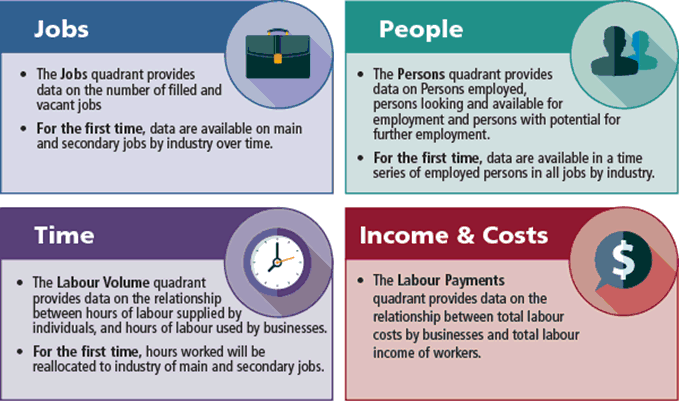
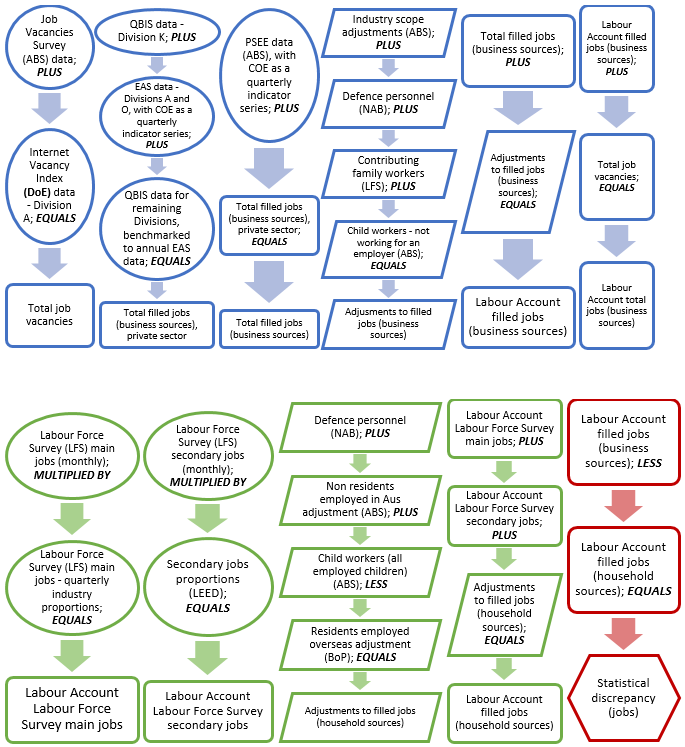
    The Australian Labour Account framework incorporates four quadrants: Jobs, People, Hours and Labour Payments.

    Australian Labour Account quadrants

    Australian Labour Account quadrants
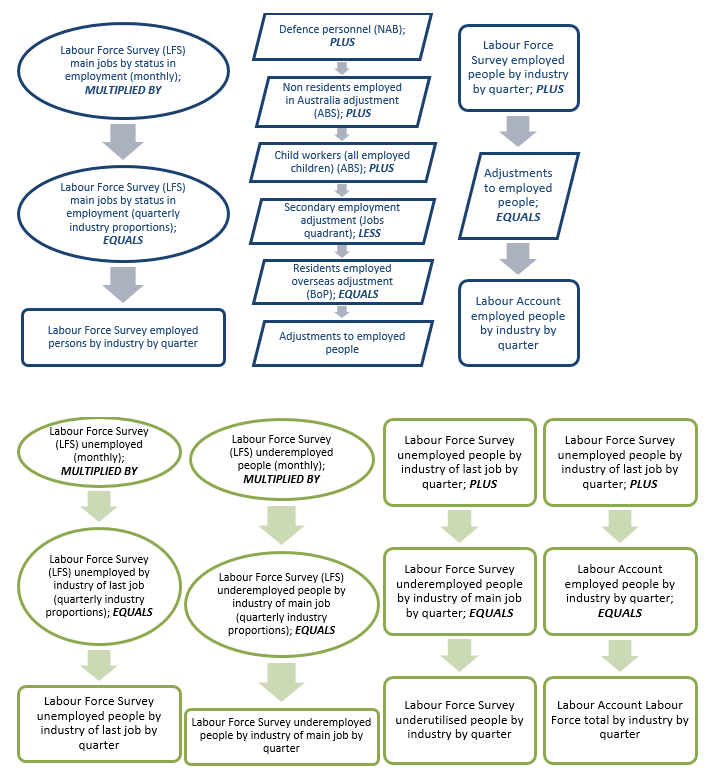
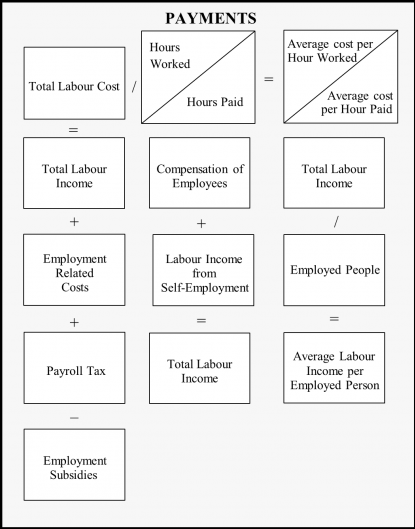
    The four quadrants of Labour Account made up Jobs; Persons; Labour (volume) and Payment. The jobs quadrant provides data on numbers of filled jobs, vacant jobs and total number of jobs in the economy. The persons quadrant provides data on numbers of employed persons, together with data on numbers of unemployed and underemployed persons. The labour volume quadrant provides data on the relationship between hours of labour supplied by individuals, and hours of labour used by businesses. Lastly, the labour payments quadrant provides data on the relationship between total labour costs by businesses and total labour income by workers.

    The Labour Account is also used in multi-source releases including:

    • Labour hire workers - The headline estimate of people employed and jobs worked in Labour Supply Services are sourced from the Australian Labour Account. Insights into the characteristics of people working as labour hire workers is available from Jobs in Australia (JIA) on an annual basis and Characteristics of Employment (COE) every two years. 
    • Multiple job-holders - The headline estimates of the level and rate of multiple job-holding are sourced from the Australian Labour Account. Additional detail on socio-demographic and employment characteristics of multiple job-holders are sourced from the Labour Force Survey and Jobs in Australia.

    International context

    There are currently no international standards regarding the production of a labour account, however a four step process has been documented by the ILO and was followed (to varying degrees) by the National Statistical Organisations in Denmark, the Netherlands and Switzerland in compiling their own labour accounts. The ILO process has been used as a guide in compiling the Australian Labour Account. For further information on the four step process, refer to Labour Accounts: A Step Forward to a Coherent and Timely Description of the Labour Market.

    The ILO describes two approaches to compiling a labour account: a cross-sectional approach involving confrontation and reconciliation of key labour market measures, and a longitudinal approach which incorporates changes to population and labour force via births, deaths, and net migration, and includes measures such as duration of employment. The Australian Labour Account focuses on the cross-sectional approach (since this is the approach that supports data confrontation and reconciliation), and also provides a time-series dimension.

    The ILO lists six central elements in labour statistics:

    • employed people and jobs;
    • unemployed and underemployed people;
    • job vacancies;
    • hours of work and full-time equivalents;
    • income from employment and labour costs; and
    • organisation of the labour market (i.e. statistics on collective labour agreements, industrial disputes and trade-union memberships).

    No country has yet compiled a labour account that measures all of these elements. The Australian Labour Account covers most elements listed in the ILO approach, with the exception of data on full-time equivalents and statistics on labour market organisation. The Australian Labour Account also includes measures of underutilised labour (an estimate of the hours of work sought by the unemployed, plus additional hours preferred by the underemployed).

    The Australian Labour Account, in particular the quarterly information disaggregated by industry division, provides an opportunity to significantly improve the quality of aggregates such as the number of jobs occupied and total number of people employed within each industry, measures of hours worked, and changes in labour productivity.

    Uses of the Labour Account

    The Australian Labour Account is an enhancement to the broader set of Australia’s National Accounts. It aims to provide a set of labour related statistics on employed people, filled jobs, hours and payments that is consistent with the concepts, definitions and scope of the Australian National Accounts.

    Australian Labour Account data are likely to be of most value to people engaged in the use of labour statistics in macro-economic analysis, forecasting and in policy related research. They should also assist economic journalists and public commentators in informing public understanding of labour statistics.

    The Australian Labour Account should be used for industry analysis of labour growth and performance in terms of people, jobs, hours, labour costs and income. For example, Labour Force Survey data for employed people by industry has historically only been available for industry of main job. The expanded scope and additional data sources of the Australian Labour Account includes data for the total number of all secondary jobs (including second, third and fourth job etc.), allocated to industry of main and secondary job. This allows for an industry perspective of the number of people employed in each industry in a time series. These data can be used by researchers and policy makers to better model how the number of people employed could be impacted by shocks to industry or changes to policy.

    The Australian Labour Account is a complement to the existing suite of labour statistics. Users should continue to use the Labour Force, Australia for headline employment, unemployment and people not in the labour force estimates, as this is the data suite that is internationally comparable and aligned with International Labour Organisation (ILO) conventions.

    Macro-economic analysis

    Micro-economic analysis

    International comparisons

    Limitations to be aware of in the use of the Labour Account are described below.

    Conceptual limitations

    Content limitations

    Scope limitations

    Other limitations

    Labour Account framework

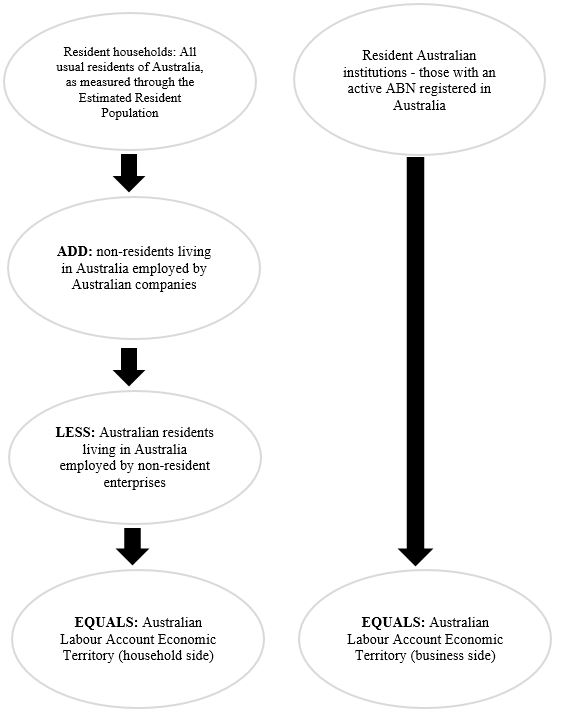
    The Australian Labour Account framework has been designed to conceptually align with the accounting conventions of the United Nations System of National Accounts (2008 SNA), as applied in the Australian System of National Accounts (ASNA). In particular, the Australian Labour Account aligns with production and residency boundaries of the ASNA. This ensures direct compatibility with national accounts and productivity estimates, as well as providing a mechanism for bringing together conceptually related aggregate data from business, household and administrative sources. The scope of the Australian Labour Account is consistent with that of the national economy, as defined in the Australian System of National Accounts (ASNA), which follows the international standard set out in the United Nations System of National Accounts.

    The Labour Account consists of four quadrants: Jobs; People; Hours and Labour Payments.

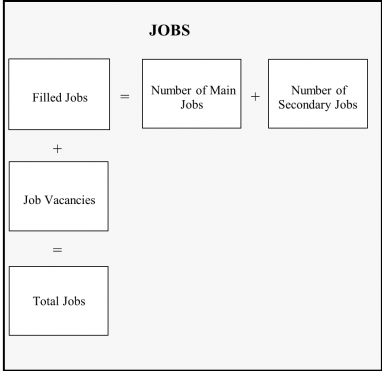
    • The Jobs Quadrant provides data on numbers of filled jobs derived separately from business and household sources, plus data on vacant jobs to provide a total number of jobs in the economy.
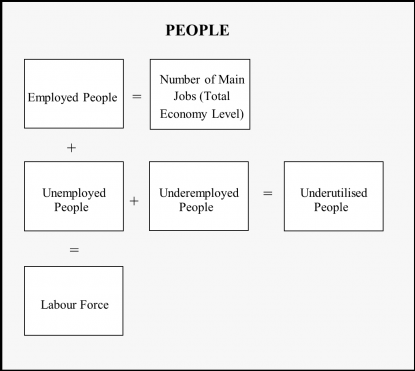
    • The People Quadrant includes data on numbers of employed people, together with data on numbers of unemployed and underemployed people (derived from household sources).
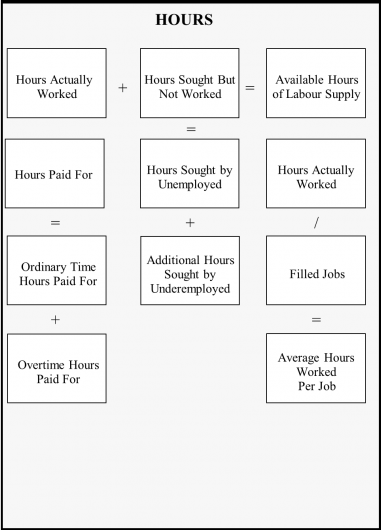
    • The Hours Quadrant provides data on hours worked (from household sources) and hours of work sought by unemployed people and additional hours preferred by underemployed people (from household sources), plus hours paid for (derived from business sources).
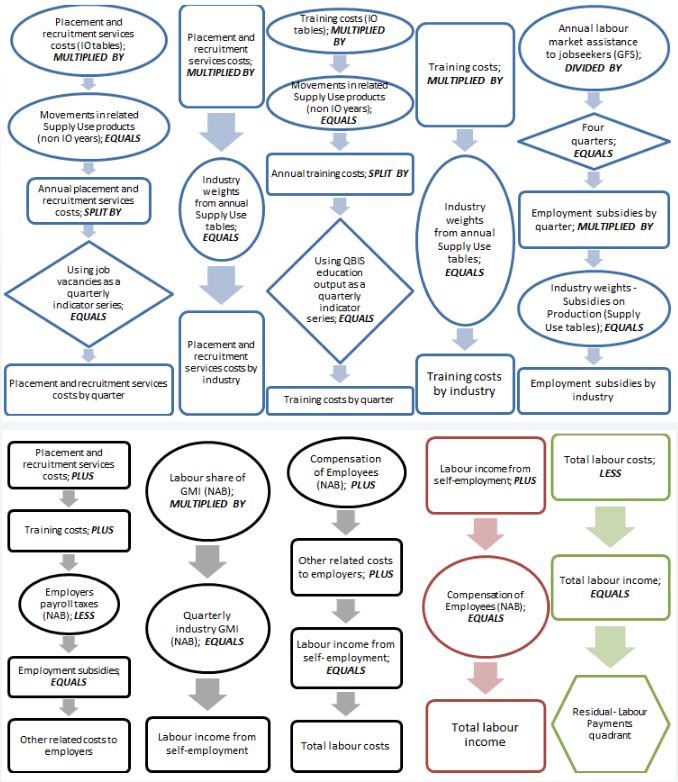
    • The Labour Payments Quadrant provides data on labour income and employment costs (from business sources).

    The Labour Account combines data from the jobs, people, hours and labour payments quadrants to calculate average hours worked, average remuneration (per person and per job), and average labour cost per hour worked.

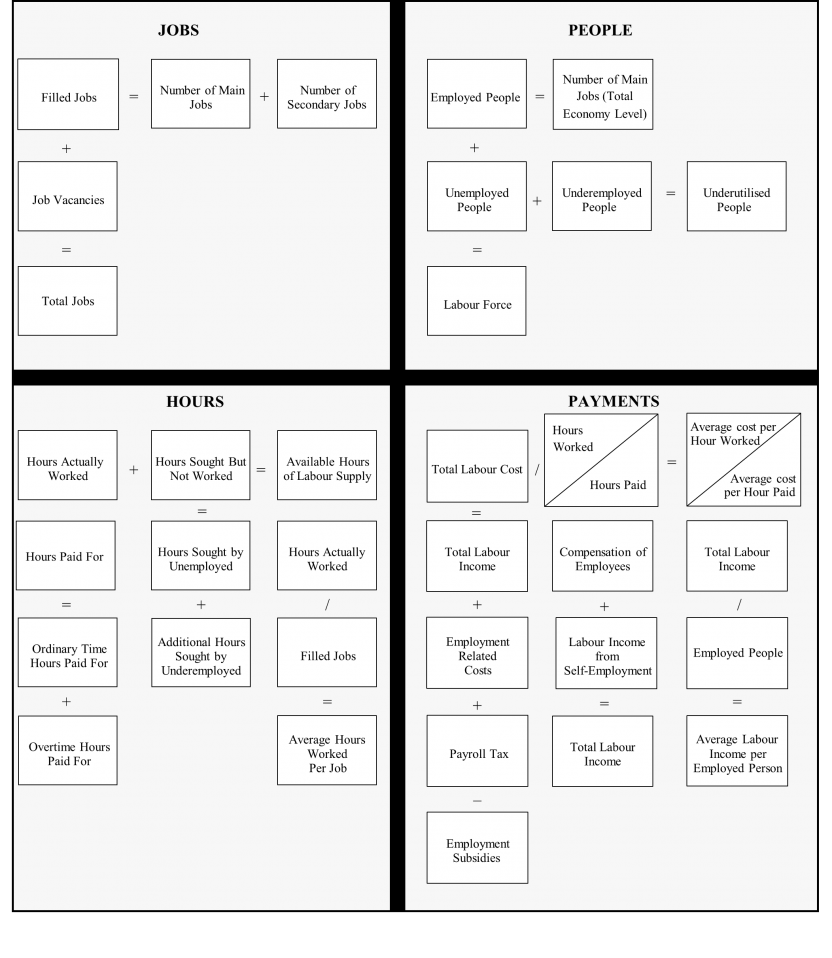
    The four quadrants are linked by a set of identity relationships, which the aggregate statistics must satisfy. These identities are shown below. The identities used in the Australian Labour Account are consistent with the identities used in other countries. Some relationships are direct, such as employed people in the total economy is equal to the number of main jobs, while other relationships are considered indirect or derived, such that the relationship is based on an average or ratio measure such as average hours worked per job, or average labour income per employed person.

    Identity relationship diagram

    Identity relationship diagram

    The Labour Account identity relationship diagram displays the four quadrants (jobs, people, hours and payments) and identifies the relationships between each of these quadrants. These four quadrants are linked by a set of identity relationships which is represented in this identity relationship diagram. Some relationships are direct, such as employed people in the total economy is equal to the number of main jobs, while other relationships are considered indirect or derived, such as average labour income per employed person.

    Conceptual framework

    Labour Account concepts

    The supply of labour relates to the quantum of labour services offered by people (i.e. the number of hours actually worked by employed people, plus the number of hours being sought by those who are unemployed and the number of additional hours preferred by the underemployed). Household surveys are the primary source of data on the supply of labour, supplemented by related administrative data.

    Labour demand relates to the quantum of labour services sought by companies and other institutional units engaged in economic activity, within the scope of the 2008 SNA production boundary. It includes the numbers of hours actually paid for in filled jobs, plus the unmet labour demand by employing units measured through vacant jobs. Surveys of businesses, government and not-for-profit institutions and relevant administrative data sets are the main sources of information on labour demand.

    Production boundary

    Accounts compilation uses some important boundaries to define the scope and treatment of events that occur within the economy. These boundaries are:

    • the production boundary defining the scope of productive economic activity; the asset boundary distinguishing transactions in assets from income and expenditure; and
    • the boundary between current and capital transfers (IMF, 2007, The system of macroeconomic accounts statistics: an overview, Pamphlet series no. 56).

    The definition of the production boundary used in the Australian Labour Account determines the scope of activities covered, and the size of the economy measured in the account.

    The Australian Labour Account includes all people employed in economic activity as defined by the 2008 SNA. Economic activity is the production of goods and services falling within the 2008 SNA production boundary by institutional units resident in the Australian Economic Territory. In the 2008 SNA, production is viewed as a physical process in which labour and assets (capital) are used to transform inputs of energy, materials and services into outputs of other goods and services.

    In its simplest form, economic activity is the production of goods and services, and in the 2008 SNA is always a result of production (ASNA, 2.8).

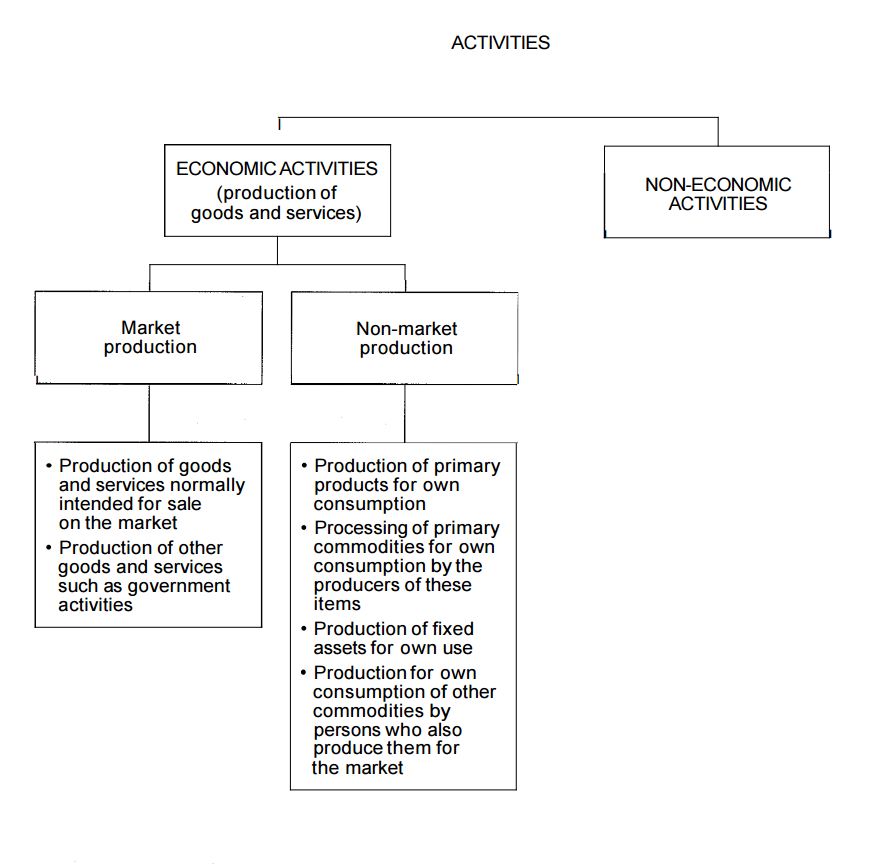
    Economic activity covers all market production and certain types of non-market production, including the production and processing of primary produce by households for their own consumption (e.g. vegetable gardens, fruit trees or eggs from chickens), the construction of dwellings and structures for own use, the production of fixed assets for own use and the production of dwelling services from owner occupied homes.

    Scope – economic activity in terms of 2008 SNA concept of goods and services production

    Scope – economic activity in terms of 2008 SNA concept of goods and services production
    The diagram shows there are economic activities (i.e. related to the production of goods and services) and non-economic activities. Economic activities are either market production or non-market production. Market production is the production of goods and services normally intended for sale on the market; and production of other goods and services such as government activities. Non-market production is the production of primary products for own consumption; processing of primary commodities for own consumption by the producers of these items; production of fixed assets for own use; and production for own consumption of other commodities by persons who also produce them for the market.

    While the 2008 SNA definition of the production of goods and services covers a wide range of activities, many other activities still remain outside its scope. For example, the production of domestic and personal services for consumption within the same household (such as preparing meals and caring for children) is excluded. The production of most domestic and personal services is excluded, as the decision to consume these services within the household is made even before the service is provided, and because of the adverse effects their inclusion would have on the usefulness of the accounts for policy purposes and analysis of inflation and unemployment. The extension of the production boundary to include own account household services would result in virtually the whole adult population being defined as 'economically active', unemployment under the existing International Labour Organisation (ILO) definition would cease to exist, and employment statistics would become meaningless (2008 SNA, 1.42, 6.31; ASNA, 8.3).

    One exception is the production of dwelling services from owner occupied housing. This is a pragmatic compromise required to allow comparison of economic activity between countries with significant differences in rates of home ownership. However, no labour input is associated with this activity.

    Unpaid work and volunteer services

    A distinction can be made between those who have an agreement to provide labour for token remuneration or income in kind, those for whom there is explicitly no remuneration, and those where there is apparently no remuneration but the workers benefit directly from the output to which they contribute. In ILO statistics, all three types of worker are included in the economically active population as employees.

    In the 2008 SNA, the remuneration of those working for token amounts or only income in kind is measured by these costs. No imputation for an additional element of remuneration is included. For example, if doctors or teachers work for only food and lodging, the value of this as income in kind is the only remuneration imputed to them. Such instances may arise in religious institutions, or in the wake of natural disasters. If the unit employing these staff is responsible for whatever little remuneration is received, these people are classed as employees and included in the scope of the Australian Labour Account.

    If staff are purely voluntary, with no remuneration at all, not even in kind, but are working in a recognised institutional unit (business, government agency, not-for-profit organisation) engaged in economic activity, then these individuals are still regarded as being employed in 2008 SNA terms. As they are not paid, there is no related compensation of employees recorded for them. Individuals providing services to groups of other individuals, such as coaching a children’s sports team, without any associated infrastructure, are not regarded as employed but rather engaging in a leisure pursuit (2008 SNA, 19.37 - 19.39).

    Although they fall within scope of the 2008 SNA, the Australian Labour Account does not include estimates of numbers of people engaged by institutional units on a purely voluntary basis. This is consistent with the current treatment in the ASNA, which unlike the 2008 SNA does not allow for the measurement of voluntary contributions of labour.

    If family members contribute to the output of an unincorporated enterprise, the estimate of mixed income is assumed to include an element of remuneration for them, and thus they are all treated as being in the economically active population from a 2008 SNA point of view (2008 SNA, 19.40). The Australian Labour Account includes estimates for contributing family members, consistent with the 2008 SNA.

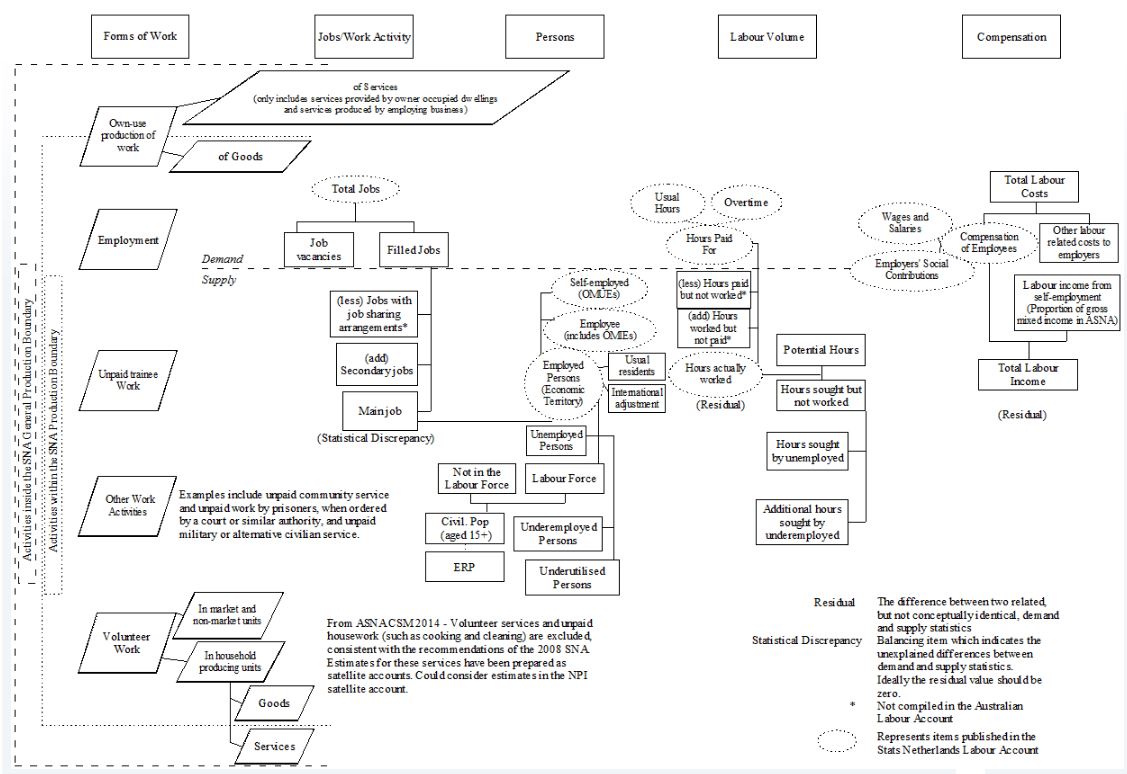
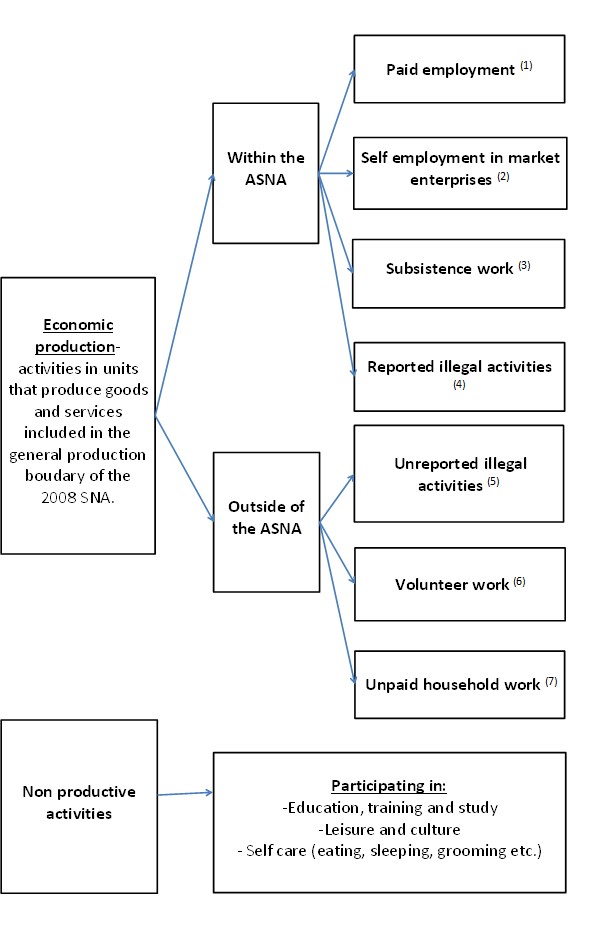
    In scope activities with the ASNA

    In scope activities with the ASNA
    The diagram describes economic production and non-productive activities. Economic production is the activities in units that produce goods and services included in the general production boundary of the System of National Accounts. These are further categorised according to whether they are within scope of the Australian System of National Accounts (ASNA). Activities within scope of the ASNA are: paid employment; self employment in market enterprises; subsistence work; and reported illegal activities. Activities outside of the scope of the ASNA (but within the general production boundary) are: unreported illegal activities; volunteer work; and unpaid household work. Non-productive activities include participating in: education, training and study; leisure and culture; and self care (eating, sleeping, grooming etc.).

    Treatment of illegal activities

    The 2008 SNA treats illegal actions that conform to the characteristics of transactions (notably the characteristic that there is mutual agreement between the parties) in the same way as legal actions. Thus, although the production or consumption of certain goods such as narcotics may be illegal, market transactions in such goods should, in principle, be recorded in the national accounts.

    As such, the work done by people working illegally on a farm (i.e. visa holders working in breach of visa conditions), working in the construction industry without a permit, selling merchandise without a licence, or working ‘cash-in-hand’ for tax evasion purposes or for fear of being reported to immigration officials, falls within the scope of economic activity.

    However, many illegal actions are crimes against people or property that cannot be construed as transactions. For example, theft is not an action into which two units enter by mutual agreement. Conceptually, theft or violence is an extreme form of externality in which damage is inflicted on a household or another institutional unit deliberately, and not merely accidentally or casually. Thus, thefts of goods from households, for example, are not treated as transactions and estimated values are not recorded for them under household expenditures (2008 SNA 3.97; ASNA 3.22-3.23).

    Due to reluctance in reporting illegal activity on the part of those engaged, it is likely that employment related costs, remuneration, employment, jobs and hours worked related to these activities are under-reported in both business and household surveys and administrative records used in compiling both Australian National Accounts and Australian Labour Account statistics.

    Although some illegal activity is within the 2008 SNA production boundary and may be reported to some extent by businesses, Australia does not specifically adjust for employment relating to illegal activity in the ASNA. Similarly, illegal activity is not adjusted for in the Australian Labour Account.

    Scope of the population

    Economically active population

    The Australian Labour Account contains information about the economically active population who provide labour for economic production. The economically active population is defined as all people who, during a specified time, contribute to or are available to contribute to the production of economic goods and services as defined by the 2008 SNA.

    Population age

    The scope of the population in the Australian Labour Account includes all people who contribute to Australian economic activity, irrespective of age. This scope is consistent with the 2008 SNA.

    The ILO standards and guidelines defining the labour force recognise the need to exclude people below a certain age from the measures, without specifying a particular age limit. The responsibility for setting such limits lies with individual countries. Examples of factors influencing the age limit are:

    • legislation governing the minimum school leaving age;
    • labour laws setting the minimum age for entering paid employment;
    • the extent of the contribution to economic activity by young people; and
    • the cost and feasibility of accurately measuring this contribution in household surveys.

    A maximum age limit is not a feature of the international guidelines but, for practical reasons, some countries do use a maximum age limit. The international guidelines also recognise the possible need, in the survey context, to exclude other population groups such as people living permanently or semi-permanently in institutions.

    Australia has adopted an age definition of 15 years and over in the Labour Force Survey, as is allowed within ILO standards and guidelines. Australian labour and compulsory schooling legislation have resulted in low numbers of young people below this age being involved in economic activity. While such legislation varies from state to state, the net result is that age 15 is the lowest practical limit at which it is feasible and cost-effective to measure the participation of young people in economic activity with acceptable accuracy in a household based collection (i.e. the Labour Force Survey).

    Employment data collected in ABS surveys of businesses relate to all people employed in economic activity falling within the scope of the survey, regardless of age.

    Scope differences in ABS surveys are adjusted for in the Australian Labour Account.

    Australian Defence Forces

    The Australian Labour Account includes permanent members of the Australian Defence Forces (ADF). This is consistent with the scope of the 2008 SNA.

    The ILO international standards require that members of the armed forces be classified as employed and recommends that, for analytical purposes, the economically active population be divided into two parts: the armed forces and the economically active civilian population. The guidelines recognise that there may be difficulties in obtaining information about membership in the armed forces from labour force surveys, and that separate use of administrative counts may be necessary.

    As a result of these recognised difficulties in obtaining data, Australia excludes permanent members of the armed forces from the Labour Force Survey and the related labour force estimates. Similarly, ANZSIC Class 7600 (Defence) is out of scope of relevant business surveys. Data on Australian defence force members are included in the Australian Labour Account to adjust for differences in scope between survey data and the ASNA.

    Australian Defence Forces Reservists

    ADF reservists are included in the current collection of the Labour Force Survey, and in the Australian Labour Account. Reservist jobs are considered as secondary jobs, should the reservist have a main job elsewhere.

    Non-private dwellings

    While some household surveys exclude all people living in non-private dwellings, these people are included in the Labour Force Survey and therefore in the Australian Labour Account.

    People living in non-private dwellings include people living in correctional and penal institutions, dormitories of schools and universities, religious institutions, hospitals, boarding houses, hotels and motels and so on. The exclusion of the institutional population in some household surveys is largely due to practical considerations of sampling.

    Institutional units and sectors

    The 2008 SNA defines an institutional unit as an economic entity that is capable, in its own right, of owning assets, incurring liabilities and engaging in economic activities and in transactions with other entities (2008 SNA, 4.2; ASNA, 4.3). There are two types of institutional units: Households and Legal or Social Entities (ASNA 4.6).

    Households

    A household is defined as a group of people who share the same living accommodation, who pool some or all of their income and wealth, and who consume certain types of goods and services collectively, mainly housing and food (2008 SNA, 4.4; ANSA, 4.7). Households are providers of labour services.

    Legal or social entities

    A legal or social entity is defined as one whose existence is recognised by law or society independently of the people or entities that may own or control it (2008 SNA, 4.6; ASNA, 4.10). In the Australian system, the legal entity unit is closest to the 2008 SNA concept of the institutional unit. However, in the ASNA, the unit used is the enterprise, which can be a single legal entity or a group of related legal entities that belong to the same institutional subsector. Four main types of institutional units are recognised in the 2008 SNA and the ASNA: households, non-profit institutions, government units and corporations (including quasi-corporations) (ANSA, 2.3).

    The ASNA recognises corporations (incorporated and unincorporated), co-operatives, non-profit institutions, quasi-corporations and unincorporated government units (departments and agencies) as types of legal or social entity.

    An enterprise is a view of an institutional unit as a producer of goods and services. The term enterprise may refer to a corporation, a quasi-corporation, a non-profit institution or an unincorporated enterprise (2008 SNA, 5.1).

    Most enterprises consist of individual legal or social entities, or in some instances combinations of unincorporated legal or social entities. A household can constitute an enterprise where it undertakes economic activity that falls within the 2008 SNA production boundary.

    An enterprise can be further subdivided into component production units where it engages in distinctive types of productive activity (multiple industries), at separate locations, e.g. a manufacturing plant and a wholesale outlet (2008 SNA, 5.2).

    By creating jobs, enterprises generate demand for labour services.

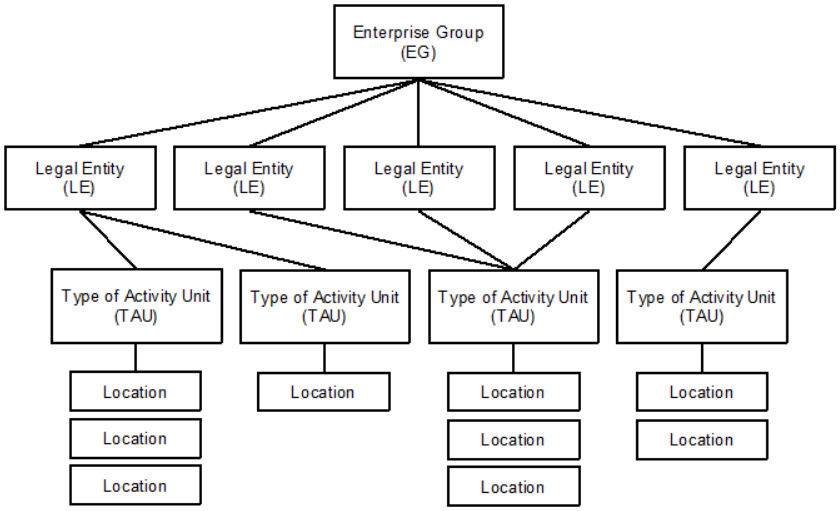
    The ABS has implemented these principles in the ABS Economic Units Model, which is used to determine the productive structure of Australian institutional units (ASNA, 4.31). The model consists of:

    • The Enterprise Group (EG) - essentially equivalent to the 2008 SNA enterprise concept (2008 SNA, 5.1). The group dimension recognises the reality that enterprises can consist of multiple legal or social entities under common control.
    • Legal Entities (LEs) - approximate the 2008 SNA concept of legal and social entities, but is extended to include households engaged in productive economic activity. 
    • Type of Activity Units (TAUs) - incorporate the industry homogeneity element of the 2008 SNA establishment, recognising that distinct activities such as manufacturing and retailing can be co-located. 
    • Location Units - incorporate the location element of the 2008 SNA establishment.

    The Enterprise Group (EG) is an institutional unit that covers all the operations within Australia's economic territory of legal entities under common control. Control is defined in Corporations legislation. Majority ownership is not required for control to be exercised. 

    The Legal Entity (LE) is an institutional unit covering all the operations in Australia of an entity which possesses some or all of the rights and obligations of individual people or corporations, or which behaves as such in respect of those matters of concern for economic statistics. Examples of legal entities include companies, partnerships, trusts, sole (business) proprietorships, government departments and statutory authorities. Legal entities are institutional units. In most cases, the LE is equivalent to a single Australian Business Number (ABN) registration. 

    The Type of Activity Unit (TAU) comprises one or more legal entities, sub-entities or branches of a legal entity that can report productive and employment activities. Type of Activity Units are created if accounts sufficient to approximate Gross Value Added are available at the Australian and New Zealand Standard Industrial Classification (ANZSIC) subdivision level. 

    A Location is a producing unit comprised of a single, unbroken physical area from which an organisation is engaged in productive activity on a relatively permanent basis, or at which the organisation is undertaking capital expenditure with the intention of commencing productive activity on a relatively permanent basis at some time in the future. 

    Institutional sectors

    The institutional sectors of the 2008 SNA group together similar kinds of institutional units. Corporations, non-profit institutions, government units and households are intrinsically different from each other in that their economic objectives, functions and behaviour are different. Likewise, institutional units are allocated to sector according to the nature of the economic activity they undertake (2008 SNA, 4.16-4.17). 2008 SNA defines the following institutional sectors: 

    1. Financial Corporations;
    2. Non-financial Corporations;
    3. General government;
    4. Non-profit institutions serving households (NPISH);
    5. Households; and
    6. Rest of the World.

    In the ASNA, the NPISH sector is combined with the household sector.

    Industry

    An industry consists of all establishments (in the Australian context, Type of Activity Units) in the economy engaged in the same, or similar, types of activity (2008 SNA, 5.2; ASNA, 2.10-2.14). Units in the same industry are generally characterised by common production functions, use of similar types of assets, intermediate inputs or the production of outputs sharing common characteristics (ASNA, 5.1). Typically, goods producing industries are distinguished from service producing industries; extractive industries (agriculture, forestry, fishing and mining) are distinguished from transformative industries (manufacturing and construction) and from distributive industries (transportation, wholesaling and retailing).

    Type of Activity Units are classified to an industry using the Australian and New Zealand Standard Industrial Classification (ANZSIC, 2006 version), which is based on the current International Standard Industrial Classification (ISIC, revision 4).

    In business surveys, data about jobs, both vacant and filled, hours paid for, labour costs and remuneration are collected at the Type of Activity Unit level, and are classified to the industry of the unit. This is also the unit level at which data are collected for compiling production (Gross Value Added) and generation of income accounts.

    The Australian Labour Account provides data for each of the 19 industry divisions that represent the highest level of the ANZSIC and a subset of data for each of the 86 subdivisions. ANZSIC division codes and titles are:

    A Agriculture, Forestry and Fishing
    B Mining
    C Manufacturing
    D Electricity, Gas, Water and Waste Services
    E Construction
    F Wholesale Trade
    G Retail Trade
    H Accommodation and Food Services
    I Transport, Postal and Warehousing
    J Information Media and Telecommunications
    K Financial and Insurance Services
    L Rental, Hiring and Real Estate Services
    M Professional, Scientific and Technical Services
    N Administrative and Support Services
    O Public Administration and Safety
    P Education and Training
    Q Health Care and Social Assistance
    R Arts and Recreation Services
    S Other Services

    Economic territory and residency

    The production of meaningful statistics about the economically active population requires that the economic territory to which the population relates is accurately defined.

    The concept of economic territory in the 2008 SNA is not identical to the concept of country. The most commonly used definition is a territory under the effective economic control of a single government, and as such usually approximates the geographic borders of a country.

    In principal, the economic territory of Australia as defined in the ASNA includes the geographic territory under the effective control of the Australian government, including:

    • any islands belonging to Australia which are subject to the same fiscal and monetary authorities as the mainland;
    • the land area, airspace, territorial waters, and continental shelf lying in international waters over which Australia enjoys exclusive rights or over which it has, or claims to have, jurisdiction in respect of the right to fish or to exploit fuels or minerals below the sea bed; and
    • territorial enclaves in the rest of the world (that is, geographic territories situated in the rest of the world and used, under international treaties or agreements, by general government agencies of the country). Territorial enclaves include embassies or consulates, military bases, scientific stations, etc. It follows that the economic territory of Australia does not include the territorial enclaves used by foreign governments which are physically located within Australia’s geographical boundaries.

    Specifically, the economic territory of Australia consists of geographic Australia including Cocos (Keeling) Islands, Christmas Island, Norfolk Island, Jarvis Bay, Australian Antarctic Territory, Heard Island and McDonald Islands, Territory of Ashmore Reef and Cartier Island, and the Coral Sea Islands.

    Within the Australian labour household surveys context, a distinction must be made between: the territories which determine the estimated resident population of Australia; those which are covered by household survey collection procedures; and those used to benchmark or ‘weight’ household survey estimates (i.e., the population benchmarks). See Information Paper: Improved Methods for Estimating Net Overseas Migration, 2006.

    • The “other territories” of Australia, namely Jervis Bay, Christmas Island, Cocos (Keeling) Island, and Norfolk Island after the 2016 Census, are included in the estimated resident population of Australia, but excluded from household survey collection procedures and population benchmarks.
    • The “external territories” of Australia, namely Territory of Ashmore and Cartier Islands, Coral Sea Islands Territory, Australian Antarctic Territory, and Territory of Heard and McDonald Islands, are not included in the estimated resident population, household survey collection procedures or the population benchmarks.

    Within the Australian labour business surveys context, no further geographical restrictions are imposed. Samples for business surveys are typically selected from the ABS Business Register, and therefore all businesses within the economic territory of Australia may be included, providing they meet other relevant scope restrictions.

    Residency

    Within the 2008 SNA, residency is defined as the economic territory with which an institutional unit or individual has the strongest connection - in other words, its centre of predominant economic interest. Each institutional unit or individual is a resident of one and only one economic territory.

    Actual or intended residence for one year or more is used as an operational definition in many countries (including Australia) to facilitate international comparability.

    Residence of individuals and households

    People are considered to have the strongest connection with the economic territory in which they physically reside. In the broadest sense, the total population consists of either all usual residents of the country (the usually resident or de jure population) or all people present in the country (the de facto population) at a particular time.

    Household surveys use the first population category, the usually resident population. All people who are usually resident in Australia are considered part of the usually resident population, regardless of nationality, citizenship or legal status.

    To determine whether a person is usually resident, Australia has adopted a 12 in 16 month rule. This rule specifies that, to be considered a usual resident, a person must have been (or expect to be) residing in Australia for 12 months or more in a 16 month period. This 12 month period does not need to be consecutive.

    The application of the 12 in 16 month rule in the labour household survey context cannot be so precise. A screening question asks if the respondent has lived or intends to live in Australia for one year or more and, if not, they are excluded from the survey. Labour household surveys also include residents who are temporarily overseas for less than six weeks. However, the 12 in 16 month rule is explicitly applied in the estimated resident population, and the population benchmarks used to weight the LFS. For more information regarding the 12 in 16 month rule, refer to Information Paper: Improved Methods for Estimating Net Overseas Migration, 2006 (cat. no. 3107.0.55.003).

    Residence of students

    In the 2008 SNA, the residence of students is described as:

    "…people who go abroad for full-time study generally continue to be resident in the territory in which they were resident prior to studying abroad. This treatment is adopted even though their course of study may exceed a year. However, students become residents of the territory in which they are studying when they develop an intention to continue their presence in the territory of study after the completion of the studies."

    Within the Australian labour household survey context, there is no special treatment for students and they are treated using the same 12 in 16 month rule. Within the Australian business survey context, there is no distinction made between students and other people, such that they are included if they are an employee, irrespective of their length of stay in the country.

    Residence of enterprises

    Within the labour business survey context, the de facto population is used, that is, all employees are included irrespective of their length of stay in the country. This is consistent with the SNA production boundary.

    As a general principle, an enterprise is resident in an economic territory when it is engaged in a significant amount of production of goods or services from a location in the territory.

    An enterprise is resident in an economic territory when there exists, within the economic territory, some location, dwelling, place of production, or other premises on which or from which the unit engages and intends to continue engaging, either indefinitely or over a finite but long period of time, in economic activities and transactions on a significant scale. The location need not be fixed, so long as it remains within the economic territory.

    Corporations and non-profit institutions normally may be expected to have a centre of economic interest in the economy in which they are legally constituted and registered. Corporations may be resident in economies different from their shareholders, and subsidiaries may be resident in different economies from their parent corporations. When a corporation, or unincorporated enterprise, maintains a branch, office, or production site in another territory to engage in a significant amount of production over a long period of time (usually one year or more) but without creating a corporation for the purpose, the branch, office, or site is considered to be a quasi-corporation (i.e., a separate institutional unit) resident in the territory in which it is located.

    Within the Australian business survey context, residency is determined by deriving the sample selection of business frames from the Australian Business Register, which is an administrative data source maintained by the Australian Taxation Office (ATO). The registration of a business by the ATO is deemed to be a demonstration that the business has a centre of economic interest within Australia.

    Residency in the Australian Context

    Applying residency concepts to survey collections:

    Business surveys:

    • include non-residents living in Australia employed by Australian companies, such as foreign students studying in Australia for periods of less than 12 months.
    • include estimates of non-residents engaged by Australian businesses operating overseas that have no intention to stay in the non-resident country for more than 12 months.

    Household surveys:

    • include Australian residents living in Australia employed by non-resident enterprises, for example Australians engaged by foreign embassies and consulates and by overseas companies that have no intention of staying in Australia for more than 12 months.
    • do not include estimates of non-resident people engaged by Australian businesses operating overseas, that have no intention to stay in the non-resident country for more than 12 months.

    Applying residency concepts in practice, the Australian Labour Account makes the following scope adjustments to household survey estimates:

    • add: non-residents living in Australia employed by Australian companies. Non-residents such as foreign students studying in Australia for periods of less than 12 months, temporary migrants and working tourists are included because they contribute to Australia’s economic production and are included in the Compensation of Employees component of Gross Domestic Product (GDP).
    • subtract: Australian residents living in Australia employed by non-resident enterprises, for example Australians engaged by foreign embassies and consulates and by overseas companies that have no intention of staying in Australia for more than 12 months.

    The Australian Labour Account does not include estimated numbers of non-resident people engaged by Australian businesses operating overseas, but with no intention to stay in the non-resident country for more than 12 months. While conceptually included in the scope of the Australian Labour Account, due to lack of data no estimate has been included for the foreign workers they may employ. 

    The economic territory used in the Australian Labour Account is summarised below.

    Australian Labour Account economic territory

    Australian Labour Account economic territory
    The diagram shows that resident households (all usual residents of Australia as measured through the Estimate Resident Population), PLUS non-residents living in Australia employed by Australia companies, LESS Australian residents living in Australia employed by non-resident enterprises, EQUALS Australian Labour Account economic territory (household side). Resident Australian institutions - those with an active ABN registered in Australia EQUALS Australian Labour Account economic territory (business side).

    Labour Account sources

    Different data sources have been used in compiling the four quadrants of the Australian Labour Account. In general, the same data sources have been used to compile both quarterly and annual labour account estimates. Quarterly survey estimates have also been benchmarked to annual survey estimates where possible.

    Australian Labour Account data at an industry level are derived where possible from data classified by industry reported in both business and household surveys. Where Australian Labour Account data at an industry level are not reported in surveys, the industry detail has been modelled using alternative sources.

    The Australian Labour Account uses both published and unpublished data from ABS and non-ABS various sources. These are detailed below.

    • Australian Business Register
    • Australian Demographic Statistics
    • Australian Industry
    • Australian National Accounts
    • Australian National Accounts Supply-Use tables
    • Balance of Payments
    • Child Employment Survey
    • Department of Defence
    • Economic Activity Survey
    • Government Finance Statistics
    • Internet Vacancy Index (Jobs and Skills Australia)
    • Job Vacancies Survey
    • Labour Force Survey
    • Labour Mobility, Australia
    • Linked Employer Employee Database
    • Migration statistics
    • Overseas Arrivals and Departures
    • Participation, Job Search and Mobility
    • Public Sector Employment and Earnings
    • Quarterly Business Indicators
    • Survey of Education and Work
    • Survey of Employee Earnings and Hours

    For more information on how these sources are used to compile estimates in Labour Accounts, see the chapters for each Labour Account quadrants. 

    Labour Account methods

    Compilation methods

    The Australian Labour Account data tables are compiled using different methods, namely interpolation, extrapolation, backcasting and benchmarking. Methods chosen are based on two factors: the context in which the data were originally collected, and ability to fill data gaps between collection points or reference periods.

    Interpolation

    Interpolation is a method of constructing new data points within the range of a discrete set of known data points. Where interpolation is used in the Australian Labour Account, it is generally designed to create a quarterly series between two annual data points when data with a quarterly frequency are not available. An example of this is measuring the number of public sector jobs, where quarterly data are estimated from two annual data points.

    Extrapolation

    Extrapolation is the process of estimating values of a variable beyond its original observed range. Some estimates in the labour account are derived by extrapolating data using various indicators, as information necessary to compile a comprehensive and complete account may not be sufficiently timely. For example, as there is a time lag between the current reference period and the release of Government Finance Statistics (GFS), data for employment subsidies in the Australian Labour Account are extrapolated forwarded based on the movements of previously observed data.

    Backcasting

    Backcasting is the process of estimating values of a variable prior to its original observed range, usually through analysing the growth rates or proportional distribution of a conceptually related series. In addition, some estimates for earlier time periods in the Australian Labour Account are backcast from partially observed information. For example, data from the Job Vacancies Survey are not available on the current industry classification prior to 2009, however the total number of job vacancies is known. Data on the current industry classification for earlier time periods have been backcast using by applying a concordance between the previous and current industry classifications, with the additional constraint that the known total number of job vacancies must be maintained.

    Benchmarking

    Benchmarking is the processes of combining sub-annual (quarterly) indicator data and annual data, and aligning them to produce quarterly economic data that combine the robustness of the annual ‘benchmark’ source while reflecting the pattern of sub-annual movement. Benchmarks (or annual data) are usually of higher quality because they come from annual surveys, which draw on more complete source data (e.g. balanced and audited company financial accounts), conduct more detailed enquiries, and generally have larger sample sizes. To create a quarterly series, the annual data provides the overall levels, to which a conceptually related quarterly indicator series is benchmarked. An example of this in the Australian Labour Account is estimating private sector filled jobs by benchmarking quarterly jobs data to annual data.

    There are a number of methods used to benchmark flow data, depending on the type of data to be benchmarked. The method used the majority of the time, due to its accuracy and ease of implementation, is the ‘Proportional Denton Method’. This method preserves the movement of the quarterly data by minimising the absolute difference in the relative adjustments of two neighbouring quarters (i.e. keeping the benchmarked data to indicator data ratio as constant as possible over the time series), under the constraint that the sum of the quarters is equal to the annual data for each benchmark year.

    The Australian Labour Account uses a modified Proportional Denton Method to benchmark the Quarterly Business Indicators Survey (QBIS) industry data to the annual industry data from the Economic Activity Survey (EAS).

    The standard Proportional Denton Method is modified for use in the Australian Labour Account in the following ways:

    • the Proportional Denton Method is generally used only in relation to flow data. In the Australian Labour Account, the mathematics underlying the Proportional Denton method have been modified to apply to stock data;
    • the Proportional Denton Method is generally not used to extrapolate data series beyond their observed range. In the Australian Labour Account, annual industry data from the EAS, which are not yet available, have been extrapolated for the latest year as part of the modified Proportional Denton Method by assuming a benchmark data to indicator data ratio of one;
    • in the context of flow data, the annual benchmark data measures a variable over an entire year and so should (theoretically) be equal to the sum of the four indicator data points for that year. In contrast, stock data measure a variable at a single point in time, and the annual stock benchmark data could simply be considered a more accurate measure of the indicator data of that quarter. The modified Proportional Denton Method used in the Australian Labour Account imposes an additional constraint for stock estimates, that the benchmarked quarterly data must be equal to the annual benchmark data in the June quarter of each year while maintaining, as much as possible, the quarterly movements of the indicator data.

    For more information regarding the Proportional Denton Method, refer to paragraph 7.40 in the Australian System of National Accounts: Concepts, Sources and Methods.

    Seasonal adjustment

    Any original time series can be thought of as a combination of three broad and distinctly different types of behaviour, each representing the impact of certain types of real world events on the information being collected: systematic calendar related events, short-term irregular fluctuations and long-term cyclical behaviour.

    Seasonal adjustment is a statistical technique that attempts to measure and remove the effects of systematic calendar related patterns including seasonal variation to reveal how a series changes from period to period. Seasonal adjustment does not aim to remove the irregular or non-seasonal influences, which may be present in any particular data series. This means that movements of the seasonally adjusted estimates may not be reliable indicators of trend behaviour.

    The ABS software for seasonal adjustment is the SEASABS (SEASonal analysis, ABS standards) package, a knowledge based seasonal analysis and adjustment tool. The seasonal adjustment algorithm used by SEASABS is based on the X-11 Variant seasonal adjustment software from the U.S. Census Bureau.

    Trend estimates

    In cases where the removal of only the seasonal element from an original series (resulting in the seasonally adjusted series) may not be sufficient to allow identification of changes in its trend, a statistical technique is used to dampen the irregular element. This technique is known as smoothing, and the resulting smoothed series are known as trend series.

    Smoothing, to derive trend estimates, is achieved by applying moving averages to seasonally adjusted series. A number of different types of moving averages may be used; for quarterly series a seven term Henderson moving average is generally applied by the ABS. The use of Henderson moving averages leads to smoother data series relative to series that have been seasonally adjusted only. The Henderson moving average is symmetric, but asymmetric forms of the average may be applied as the end of a time series is approached. The application of asymmetric weights is guided by an end weight parameter, which is based on the calculation of a noise-to-signal ratio (i.e. the average movement in the irregular component, divided by the average movement in the trend component). While the asymmetric weights enable trend estimates for recent periods to be produced, they result in revisions to the estimates when subsequent observations are available.

    Revisions to trend series may arise from:

    • the availability of subsequent data;
    • revisions to the underlying data;
    • identification of and adjustment for extreme values, seasonal breaks and/or trend breaks;
    • re-estimation of seasonal factors; and
    • changes to the end weight parameter.

    For more information about ABS procedures for deriving trend estimates and an analysis of the advantage of using them over alternative techniques for monitoring trends, see Information Paper: A Guide to Interpreting Time Series - Monitoring Trends.

    In the Australian Labour Account, quarterly tables are produced in original, seasonally adjusted and trend terms. For the purpose of deriving the annual average level from quarterly stocks of jobs and employed people using an arithmetic average, original quarterly series are used.

    Balanced tables

    After adjusting for conceptual and scope differences between data sources, a statistical discrepancy remains between the number of filled jobs as reported by businesses and the number of filled jobs as reported by households.

    These discrepancies represent the cumulative impact of data source error, including survey error, and modelling error. Survey error includes both sampling error and non-sampling error. Sampling error is the predictable variability arising from the use of samples, rather than a complete enumeration of the populations of enterprises and households. Non-sampling error is all other error present in an estimate, and includes:

    • Error arising from the reliability of the survey population and related benchmark data, e.g. the accuracy, completeness and timeliness of the Business Register from which business survey samples are drawn, or the reliability of Estimated Resident Population data used in benchmarking the Labour Force Survey;
    • Error arising from data used in the estimation and imputation procedures applied in both business and household surveys;
    • Error embedded in the estimation and imputation models used in surveys, for example incorrect assumption that missing firm data is similar to that of reporting firms of comparable size in the same industry; and
    • Error made by respondents in reporting data - for example, the Labour Force Survey relies on one responsible adult in each household to accurately report on the employment status of all other adults in the household, including industry of employment and hours worked in the survey reference week. Industry can be misreported where people are employed by labour hire firms, but actually work in other industries such as Mining, Construction or Manufacturing.

    Error can occur in non-survey data sources, such as missing data or misclassification in government administrative records used directly in the Australian Labour Account. For example, error could occur in the industry classification of sponsored visa holders, or in the reported number of people in the permanent defence forces.

    Modelling error reflects errors embedded in the modelling assumptions used in the Australian Labour Account, for example in assuming that the proportion of children aged under 15 years who work has remained constant since 2006, or in assuming that Quarterly Business Indicators Survey employment movements accurately reflect quarterly change in the latest available annual data.

    The balanced Australian Labour Account estimates apply knowledge of the known strengths and weaknesses of data sources and methodologies, to derive a single estimate of the number of filled jobs.

    The balanced estimate of numbers of filled jobs impacts on other data in the Australian Labour Account that incorporate that estimate in their calculation. This includes balanced estimates of numbers of people employed, hours paid for and hours worked.

    Two general observations about data source quality are relevant in deriving a balanced estimate of numbers of filled jobs:

    • Household estimates of numbers of filled jobs are considered more reliable at a total economy level. Household data are mainly sourced from the Labour Force Survey, which applies a consistent methodology and asks a consistent set of questions of a statistically robust sample of people about the number of jobs held by employed people in their household. By contrast, no single business survey covers the whole economy. Estimates of the total number of filled jobs from the business side are derived from three separate surveys (Economic Activity Survey, Public Sector Employment and Earnings, and Quarterly Business Indicators Survey), supplemented by data obtained from the Australian Business Register. Each source has a different methodology, a different sample, and asks different questions. Adjustments are required to counter overlap. Growth in household side filled jobs is more consistent over time with growth in related economic data (Gross Domestic Product and Compensation of Employees) at a total economy level than growth in business side data.
    • Business sources are considered more reliable in estimating the distribution of jobs across industries. The numbers of filled jobs reported by each business survey respondent are automatically coded to the industry classification of that business. This implies that labour input is correctly linked to related production, employment related costs and compensation.

    Whilst additional considerations are taken into account at the industry level, the balanced estimate of filled jobs generally incorporates the advantage of the industry distribution derived from business side data, within a total economy estimate sourced from household side data.

    Revisions in the Australian Labour Account

    Revisions are a change in the value of a published estimate. Revisions arise from the correction of errors, the incorporation of more up-to-date data, reassessment of seasonal factors, and from time to time the introduction of new concepts or improved data sources and methods.

    Revisions are an inevitable consequence of the process of producing the Australian Labour Account. Revisions reflect both the complexity of measurement, and the need to trade off some level of precision in order to provide timely estimates, to maximise their use in analysis of current economic conditions.

    Quarterly revisions

    • Updates to the Estimated Resident Population (ERP), usually affecting the latest eight quarters of data, resulting in quarterly revisions to the Labour Force Survey statistics on people, jobs and hours worked;
    • Revisions to Quarterly Business Indicator Survey statistics on filled jobs, arising from replacement of imputed data with actual responses following late receipt of survey questionnaires; and
    • Revisions to previously published seasonally adjusted and trend series, which will be revised to incorporate the seasonal effects of the latest quarterly data. This process is referred to as concurrent seasonal adjustment.

    Annual revisons

    • Revisions which reflect the cumulative impact of previous revisions to quarterly data;
    • Revisions to Economic Activity Survey statistics on filled jobs, arising from replacement of imputed data with actual responses following late receipt of survey questionnaires;
    • Revisions to Compensation of Employees and Gross Mixed Income following annual benchmarking of the Australian National Accounts, usually affecting the latest three years of quarterly data; and
    • Revisions to expenditure on recruitment services and training, following release of updated Input-Output Tables.

    Other periodic revisions

    • Five yearly post-Census benchmarking of ERP, resulting in revisions to the household Labour Force Survey statistics on people, jobs and hours worked; and
    • Revisions to Compensation of Employees and Gross Mixed Income arising from scheduled National Accounts historical revisions, potentially affecting quarterly data back to 1960.

    Ad hoc revisions

    • All data sources can be subject to revisions arising from the correction of errors. These can include data capture and compilation errors, mistakes in classification, or respondent misreporting; and
    • Australian Labour Account data are also subject to revision arising from internal compilation errors.

    ABS and international data quality assessment frameworks include revisions history as one of the indicators of quality. A revisions history assists users in assessing the probability and potential scale of change to published data. The ABS publishes revisions to previously published data with each quarterly update of the Australian Labour Account.

    Jobs quadrant

    The Jobs quadrant provides data on the number of jobs, both filled and vacant. Estimates from business surveys are balanced with estimates from household surveys.

    Jobs quadrant

    Jobs quadrant

    The diagram shows that in the Jobs quadrant: Number of main jobs plus Number of secondary jobs equals Filled jobs. Filled jobs plus Job vacancies equals Total jobs.

    Jobs concepts

    The concept of a “job” is central to the Australian Labour Account. It is the mechanism through which people engage in production.

    The Oxford English Dictionary has multiple meanings for the word, one of which approximates the concept as it is applied in the Australian Labour Account and the 2008 System of National Accounts (2008 SNA) – “a task or piece of work, especially one that is paid”.

    The 2008 SNA does not explicitly define a job. Rather, it observes the agreement between an employee and the employer defines a job, and each self-employed person has a job (2008 SNA, 19.30). A self-employed person is treated as both the employer and employee. A job is a position held by a person that involves work, duties or responsibilities; it may or may not provide returns of compensation or benefits to the individual.

    As the dictionary definition implies, not all jobs are paid, either in money or in kind. People can be engaged in productive economic activity within an institutional unit for no apparent reward, in which case they are contributing to output but receiving no compensation. The 2008 SNA concept of a job includes these people as volunteer labour (2008 SNA, 19.39).

    Jobs are created by enterprises. In the case of the self-employed person, the International Labour Organisation (ILO) defines these jobs as those where the remuneration is directly dependent upon the profits (or the potential for profits) derived from the goods and services produced (where own consumption is considered to be part of profits). The incumbents make the operational decisions affecting the enterprise, or delegate such decisions while retaining responsibility for the welfare of the enterprise. In this context, "enterprise" includes one person operations.

    In summary, and in the context of the Australian Labour Account, a job is a set of production related tasks that can be assigned to and undertaken by a person, and for which they are usually, but not necessarily, remunerated either in money or in kind.

    Production related tasks are constrained to economic activity within the 2008 SNA production boundary, and jobs are created and maintained by institutional units (Type of Activity Units within Enterprise Groups in the Australian context).

    The Australian Labour Account includes all jobs created and maintained by institutional units (that is, households, legal entities and social entities) resident in Australian economic territory, involving economic activity within the Australian application of the 2008 SNA production boundary.

    Estimates of movements in the number of jobs in the economy provide a measure of labour market performance and capacity.

    Jobs characteristics

    Jobs can be classified according to:

    • inherent job characteristics (e.g. whether the job is full-time or part-time),
    • characteristics of the person holding the job (e.g. whether the job is filled by a self-employed person or an employee), or
    • characteristics of the enterprise creating the job (e.g. the industry or institutional sector to which the job relates).

    Status in employment

    In the Australian context, self-employment according to the ILO definition is not separately identified. Rather, jobs are distinguished according to the status in employment categories of the people filling the job.

    These categories include:

    • Employee
    • Owner manager of incorporated enterprise
    • Owner manager of unincorporated enterprise
    • Contributing family worker

    The closest approximation to the ILO concept of self-employment in the Australian context is the aggregation of the “owner manager” categories of status in employment.

    Employees

    Employees are employed people who do not operate their own incorporated or unincorporated enterprise. An employee works for a public or private employer and receives remuneration in wages, salary, on a commission basis (with or without a retainer), tips, piece rates, or payment in kind.

    Owner managers of incorporated enterprises

    An owner manager of an incorporated enterprise is a person who operates his or her own incorporated enterprise, that is, a business entity which is registered as a separate legal entity to its members or owners (also known as limited liability company).

    An owner manager of an incorporated enterprise (an OMIE) may or may not hire one or more employees in addition to themselves and/or other owners of that business.

    Owner managers of unincorporated enterprises

    In the Australian Labour Account, own-account workers and employers employed in their own enterprises are referred to as Owner Managers of Unincorporated Enterprises (OMUEs). OMUEs are people who operate their own unincorporated enterprise, or engage independently in a profession or trade. An owner manager of an unincorporated enterprise may or may not hire one or more employees in addition to themselves and/or other owners of that business.

    Contributing family workers

    A contributing family worker is a person who works without pay in an economic enterprise operated by a relative. Contributing family workers, including those working without pay in unincorporated enterprises engaged wholly or partly in market production, are also treated as self-employed (2008 SNA, 7.30b).

    The ILO defines a contributing family worker as a person who holds a self-employment job in an enterprise operated by a related person, and who cannot be regarded as a partner because the degree of his or her commitment to the operation of the enterprise, in terms of the working time or other factors to be determined by national circumstances, is not at a level comparable with that of the head of the establishment.

    Internationally the concept is restricted to those living in the same household, however Australia has not applied the same criteria of cohabitation in its implementation. For example, an individual who makes unpaid contributions of labour to a family business operated by their parents, and does not live in the same household as the parents, is still considered to be a contributing family worker.

    Own-account workers engaged in the production of goods exclusively for own final use by their household (such as subsistence farming or do-it-yourself construction of own dwellings), are considered employed according to the definition of employment adopted by Thirteenth International Convention of Labour Statisticians (ICLS). Households producing unpaid domestic or personal services (e.g., housework, caring for family members) for their own final consumption are excluded, as such activities fall outside the 2008 SNA production boundary and are not considered employment.

    Jobs in the Australian Labour Account

    Jobs which are in and out of scope of the Australian Labour Account are summarised in the table below.

    Jobs in scopeJobs out of scope
    Paid employment with formal work agreements – i.e. an employer/employee relationship.Positions which are purely voluntary and no remuneration is received, either in cash or in kind.
    Owner managers of businesses – i.e. self-employed people.Activities relating to the production of unpaid domestic services.
    Unpaid contributions of labour to a family business or farm – i.e. contributing family workers.Activities and positions outside of Australia’s economic territory.
    Activities relating to the production of goods for own consumption.Activities relating to unreported illegal transactions.

    Jobs and people

    The number of jobs in the economy exceeds the number of people employed, to the extent that some employed people have more than one job in the same period. An individual with more than one job may do these successively, as when the person works for part of the week in one job and the rest of the week in another, or in parallel, as when the person has an evening job as well as a daytime job. In addition, the number of jobs in the economy may be reduced when compared to the number of people employed in instances of formal job-sharing arrangements.

    Employers may not be aware of, and in any case are not asked to provide information on, secondary jobs undertaken by their employees. When employers supply information on the number of employees, they actually provide information on the number of jobs they hold. This is because the same employee would be reported separately by each employer. The distinction between the number of jobs and the number of employed people is one issue that is informed by the Australian Labour Account.

    The Australian Labour Account recognises this difference by accounting for multiple job holding, and reports the number of jobs in the Jobs quadrant and employed people in the People quadrant. However, the Australian Labour Account does not compile estimates of formal job-sharing, as there is currently no available data source to measure this, and it is particularly unlikely to be reported accurately by businesses.

    The statistics derived from the Labour Force Survey are designed to produce estimates of the number of people engaged in economic activity. The statistics derived from ABS business surveys count the number of jobs in which people are employed. For example, a person holding multiple jobs with different employers would be counted once in ABS household surveys as an employed person, but in ABS business surveys would be counted multiple times, once by each employer for each job that they held.

    A number of examples illustrate this:

    • if an unemployed person became employed full-time (by starting one full-time job), then the full-time employment estimate from the Labour Force Survey would increase by one (in a business survey, or a 'filled jobs' count, this would lead to an increase in the filled jobs estimate by one);
    • if an unemployed person became employed full-time (by starting two part-time jobs with a total of 35 hours of work or more per week), then the full-time employment estimate from the Labour Force Survey would increase by one (however, in a business survey, or a 'filled jobs' count, this would lead to an increase in the filled jobs estimate by two);
    • if a person who was already employed in one part-time job took on another part-time job, this would have differing impacts on the employment estimates from the Labour Force Survey depending on the total number of hours worked: if the sum of hours worked in the two part-time jobs was fewer than 35 hours per week, the employment estimates from the Labour Force Survey would remain unchanged, but if the sum of hours worked was 35 hours or more, the employment estimates from the Labour Force Survey would show a decrease of one in part-time employment and an increase of one in full-time employment (however, in both cases this would lead to an increase of one in the filled jobs estimate from a business survey);
    • if a person who was employed in three part-time jobs (working a total of more than 35 hours per week) resigned from these and assumed one full-time job, this would have no impact on the employment estimates from the Labour Force Survey (however, this would lead to a decrease of two in the filled jobs estimate - the number of part-time filled jobs would decrease by three while the number of full-time filled jobs would increase by one); and
    • if a person employed in two part-time jobs became unemployed, the employment estimate from the Labour Force Survey would decrease by one (however, this would lead to a decrease of two in the filled jobs estimate from a business survey).

    The proportion of secondary jobs presents the number of secondary jobs as a proportion of the total number of filled jobs for each industry and the total economy. This measure provides insight into the relative number of secondary jobs in each industry, and enables comparisons across industries and with each industry to an economy wide average.

    Proportion of Vacant Jobs

    The proportion of vacant jobs (PVJ) provides a useful labour demand-side view of relative labour demand, at the industry level, presenting the relationship between unmet demand (job vacancies) and met demand (filled jobs) within the Australian Labour Account.

    The PVJ is calculated as the number of vacant jobs as a proportion of total jobs. This derived measure is a function of filled jobs and job vacancies. By bringing together met demand and unmet demand, the PVJ provides new insights into changes in the labour market.

    In addition to providing insights into cyclical labour demand and employment, changes in the PVJ over time can also highlight that some of the following may be occurring:

    • Changing employment capacity – there may be indications that the industry is nearing its full employment potential or, conversely, that there is the possibility of future employment growth;
    • Job churn – the industry may not be maintaining long term employment, resulting in a high number of job vacancies without long term growth in employment;
    • Skill mismatch – current availability of skills may not be able to satisfy employer requirements, resulting in an extended search for appropriately skilled staff; and/or
    • Changing employment conditions or arrangements - the industry may be transitioning from full-time to part-time roles, or a greater use of contractors or use of labour hire firms.

    Understanding changes in the PVJ (and analysing the underlying factors contributing to these changes) will enable Australia to better understand its labour market.

    Jobs sources

    Numbers of filled jobs, from the business sources side, are sourced from the following ABS data:

    • Quarterly estimates of private sector jobs are based on underlying data from the Quarterly Business Indicators Survey (QBIS), published in Business Indicators, Australia.
    • Quarterly estimates of private sector jobs for ANZSIC divisions that are out-of-scope of QBIS are estimated from the Economic Activity Survey (EAS), published in Australian Industry and use quarterly Compensation of Employees as a quarterly indicator series. The ANZSIC divisions include Division A (Agriculture, Forestry and Fishing) and Division O (Public Administration and Safety).
    • Quarterly data for the public sector are based on underlying data from the Public Sector Employment and Earnings (PSEE) and using quarterly public sector Compensation of Employees as a quarterly indicator series.

    Business survey data are supplemented by:

    • ABS business register information.
    • Labour Force Survey estimates of contributing family workers.
    • Estimates of Australian Defence Force personnel.
    • Estimates of child workers.

    The number of filled jobs, from the household survey side, is the sum of the number of main jobs and secondary jobs, less jobs with formal job-sharing arrangements. Estimates for main jobs and secondary jobs are sourced from from the Labour Force Survey. Survey based data are supplemented with defence force information, child workers information, information on non-residents working in Australia, and Australian residents living in Australia employed by overseas companies/business entities to account for survey scope restrictions. There is no information currently available on the number of jobs with formal job-sharing arrangements.

    Numbers of job vacancies are sourced from Job Vacancies, Australia. Data from the Internet Vacancy Index, published by Jobs and Skills Australia, are used to supplement ABS survey data for the out-of-scope ANZSIC Division A (Agriculture, Forestry and Fishing).

    The table below summarises data sources used in compiling estimates of jobs.

    Source dataUse in compiling quarterly data
    Australian IndustryUsed to benchmark quarterly data from Business Indicators, Australia. Also used to compile estimates of private sector filled jobs (business sources) for ANZSIC divisions that are out-of-scope of QBIS, using quarterly Compensation of Employees as quarterly indicator series.
    Quarterly Business Indicators SurveyUsed to compile quarterly estimates of private sector filled jobs (business sources).
    Public Sector Employment and EarningsUsed to compile estimates of public sector filled jobs (business sources), using quarterly Compensation of Employees as the quarterly indicator series.
    Australian Business RegisterUsed for scope adjustments to private sector filled jobs (business sources).
    Department of DefenceUsed to estimate defence jobs for filled jobs (household and business sources).
    Labour Force SurveyUsed to estimate filled jobs (household sources), both main and secondary jobs. Also used to estimate unemployment and jobs held by non-residents working in Australia for filled jobs (household and business sources), and model movements jobs held by child workers for filled jobs before and after 2006 (household and business sources).
    Child Employment SurveyUsed to estimate the base child employment for filled jobs in 2006 (household and business sources).

    Participation, Job Search and Mobility and Labour Mobility, Australia

    Used to convert estimates of jobs held by child workers over at any point over the year to an end of quarter basis for filled jobs (household and business sources).
    Migration, Australia and Overseas Arrivals and Departures, AustraliaUsed to estimate jobs held by non-residents working in Australia.
    Balance of PaymentsUsed to estimate Australian residents living in Australia but employed by overseas companies/business entities.
    Job Vacancies SurveyUsed to compile job vacancies, and total jobs.
    Internet Vacancy Index (Jobs and Skills Australia)Used to compile job vacancies, and total jobs, for ANZSIC Division A (Agriculture, Forestry and Fishing).

    Jobs methods

    The Jobs quadrant provides data on the number of jobs (filled and vacant) as at the end of the quarter. Job statistics are compiled for each ANZSIC industry subdivision and division, and for the economy as a whole. Unless otherwise stated, the methods described apply to both levels of aggregation.

    Total jobs

    Total jobs is the sum of filled jobs and job vacancies.

    Filled jobs

    Filled jobs (business sources)

    The number of filled jobs, from the business sources side, is equivalent to the number of people employed in enterprises resident in the Australian economic territory and engaged in economic activity within the scope of the National Accounts production boundary. People counted include employees, working proprietors and partners, employees absent on paid or prepaid leave, employees on workers' compensation who continue to be paid through the payroll, and contract workers paid through the payroll.

    Filled jobs (business sources), for each quarter, is estimated by aggregating:

    • For the private sector, the number of employees as at the end of each quarter, sourced from the annual Economic Activity Survey (EAS) and published in Australian Industry;
    • For the public sector, the number of employees as at the end of each quarter, derived using underlying data from Public Sector Employment and Earnings (PSEE). PSEE data used in the Australian Labour Account exclude units in the non-financial and financial sectors, as they are also in scope of the EAS; and
    • Quarterly estimates of underlying Quarterly Business Indicator Survey (QBIS) data from Business Indicators, Australia to represent private sector employment in ANZSIC Division K (Finance and Insurance Services), which is out of scope of the EAS.

    These three surveys cover most of the ANZSIC industries, except for:

    • Class 6310 Life Insurance;
    • Class 6330 Superannuation Funds; and
    • Class 7600 Defence.

    Units in ANZSIC Class 6330 Superannuation Funds are funds set up to provide retirement benefits. Conceptually they are considered to be non-employing units, and therefore would not contribute to Australian Labour Account estimates. As such, no estimate for employment in this industry has been included.

    Scope adjustments are made for the following sectors and populations:

    Add:

    • the number of jobs in ANZSIC Class 6310 (Life Insurance), sourced from underlying data from the ABS Business Register. This industry is not included in the EAS or QBIS;
    • the number of jobs held by members of the permanent defence forces as at the end of each quarter, sourced from underlying ABS National Accounts data. All defence force personnel in Class 7600 (Defence) are assumed to work in the Public Administration and Safety industry (ANZSIC Division O);
    • the number of unpaid contributing family worker (jobs) for the quarter, sourced from the Labour Force Survey, as unpaid employees are out of scope of ABS business surveys; and 
    • the estimate of the number of jobs held by children aged 5 to 14 (child workers) (see the People quadrant for details on how the child worker adjustment is modelled). Status of employment splits are applied to separately identify employees. Employees are excluded from this adjustment given they are in scope of both EAS and QBIS.

    Deduct:

    • the number of people engaged in ANZSIC subdivision 28 Water Supply, Sewerage and Drainage in the public sector (as measured on the ABS Business Register). This is done because businesses in this subdivision are in sample of both EAS and PSEE. ABS Business Register data are available from June 2007. For earlier time periods, the data is extrapolated using movements in filled jobs for the Electricity, Gas, Water and Waste Services industry division.
    Calculation of filled jobs (business sources) by industry

    Data derived from an annual survey are generally considered to be of higher quality than quarterly data due to the larger sample sizes, and are generally subject to less volatility than quarterly run surveys. Annual source data provide overall levels, known as annual benchmarks, from which quarterly estimates by industry divisions and subdivisions are compiled. This ensures consistency between the quarterly and annual labour accounts.

    For all ANZSIC industry divisions except A (Agriculture, Forestry and Fishing); K (Financial and Insurance Services) and O (Public Administration and Safety), a mathematical technique (the modified Proportional Denton Method) is used to benchmark quarterly stocks of private sector jobs reported in QBIS to annual data from EAS. This ensures the benchmarked quarterly levels are identical each June quarter, while maintaining the observed quarterly pattern from QBIS as much as possible.

    For the most recent quarters, for which EAS year-end data are not available, the previous year-end EAS numbers are extrapolated, also using the modified Proportional Denton Method. Extrapolated data are calculated for up to 6 quarters, due to the 18-month lag in the delivery of EAS data.

    For Division A (Agriculture, Forestry and Fishing) and Division O (Public Administration and Safety), for which QBIS data are not available, EAS estimates of the number of jobs is used as an annual benchmark, with quarterly Compensation of Employees used as a quarterly indicator series.

    For Division K (Finance and Insurance Services) for which EAS data are not available, employment data reported in QBIS are used directly as the quarterly estimate of private sector job holding.

    To calculate the number of public sector filled jobs, underlying data from Public Sector Employment and Earnings (PSEE) are used as an annual benchmark, with quarterly public sector Compensation of Employees used as a quarterly indicator series.

    EAS data are not available on a consistent industry classification prior to 2009-10. For time periods prior to June 2010, filled jobs as measured from business sources are derived as follows: 

    • From December quarter 2001 to June quarter 2010: seasonally adjusted movements in Compensation of Employees (which have been price deflated using the Wage Price Index), are applied to the June 2010 level.
    • From September quarter 1994 to December quarter 2001, movements in the number of employees from Wage and Salary Earners, Australia are applied to the December 2001 level. These data relate to both the public and private sectors for each industry division except for Division A (Agriculture, Forestry and Fishing), which is limited to the public sector only. Applying movements from the Agriculture industry based on the public sector data produces large movements, given the small level associated with the indicator series. Movements from the Transport and Storage industry are instead used as a proxy, given the strong links in production and supply chains between agriculture and transport. As the data are also on a historical industry classification basis, conversion factors based on employees from the Labour Force Survey are applied to approximate the current industry classification.

    Filled jobs (household sources)

    The number of filled jobs, from the household side, is equal to the number of people employed in main jobs and secondary jobs sourced from the household Labour Force Survey.

    Filled jobs (household sources), for each quarter, are estimated by aggregating:

    • the number of main jobs reported in the end of quarter reference month (i.e. March, June, September and December) in the household Labour Force Survey and published in Labour Force Australia, and
    • the number of secondary jobs reported in the end of quarter reference month in the household Labour Force Survey.

    The following scope adjustments are made:

    Add:

    • the number of people employed in the permanent defence forces as at the end of each quarter, to the estimate of main jobs. Defence force personnel are not in scope of the Labour Force Survey, and these data are sourced from underlying ABS National Accounts data. All defence force personnel are assumed to work in ANZSIC Division O (Public Administration and Safety). Permanent defence force personnel are also assumed to work solely in their main job and not have multiple jobs;
    • the number of jobs held by children aged 5 to 14 years (child workers) to the estimate of main jobs. It is assumed that child workers do not work more than one job. Estimates of the employment rate of children aged 5 to 14 years are modelled based on data sourced from the Child Employment Survey and the Labour Force Survey (LFS). The Child Employment Survey was conducted once, in 2006, so movements in LFS data are used to extrapolate the estimates across time. LFS data is also used to model the industry of employment. The Child Employment Survey measured employment on the basis of having worked at any point over the 12 months to date. Those employment estimates are converted to an end‑of‑quarter basis using data from the Participation, Job Search and Mobility Survey (PJSM). The LFS and PJSM data used are restricted to people aged 15 years on the assumption that their characteristics are the most comparable, of any age group with consistently measured employment, to the population aged 5 to 14 years. Status of employment splits are applied to separately identify employees. Employees are excluded from this adjustment given they are in scope of both EAS and QBIS; 
    • an estimate of the number of main jobs held by non-resident visitors to Australia who are employed by Australian resident enterprises to the estimate of main jobs (see Non-resident visitors section below); and
    • an estimate of the number of secondary jobs held by non-resident visitors employed by Australian resident enterprises to the number of secondary jobs.

    Non-resident visitors

    Time periods from March 2006 onwards

    The Labour Force Survey excludes from its scope non-resident visitors who intend spending less than 12 months in Australia, some of whom are employed during their stay by Australian resident enterprises. As non-resident visitors are included in the scope of business surveys (EAS and QBIS), only household side labour force data are adjusted to include non-resident visitors who are employed.

    Data on the number of non-resident visitors who are present in Australia at the end of the reference quarter but who are not included in the Estimated Resident Population are based on estimates of Net Overseas Migration and Overseas Arrivals and Departures. NOM data is available from March 2006 to five quarters prior to the current quarter, and OAD data is available for the entire Labour Account series. Movements in OAD data are used to extrapolate the NOM data where necessary.

    Of interest for the Labour Account scope adjustments, are non-residents who have entered the country with a visa that has an associated work entitlement. Information about the main reason for journey is collected, as is information on whether an individual is the primary or a secondary applicant to the visa. The visa classes, reasons for journey and applicant splits, that form the basis of modelled job estimates, are detailed below.

    Visa subclasses used in the Australian Labour Account

    Non-residents are filtered into five groups based on their visa class: student visa holders, sponsored visa holders, 444 visa holders, working holiday visa holders, and other non-student visa holders.

    Non-residents: main jobs

    To estimate the number of main jobs held by non-resident student visa holders, an employment rate for holders of student visas is sourced from the Survey of Education and Work (SEW). The SEW data used in this calculation is limited to those student visa holders who arrived in Australia within the past two years. The method assumes that similar rates of employment apply to non-resident students as for resident students who recently arrived from overseas. SEW data is available annually from 2013 to the current year. The annual dataset is converted into a quarterly series using employment estimates (for the domestic student population) from the Labour Force Survey. Movements in the Labour Force Survey series are also applied to the level in 2013 to produce estimates prior to 2013. The quarterly employment rate series is then multiplied by the number of student visa holders to estimate the number of main jobs held by non-resident student visa holders.

    To estimate the number of main jobs held by non-resident sponsored visa holders, an employment rate of 100% is assumed to apply for primary visa holders, while the secondary visa holders (that have working rights) are grouped with other non-student visa holders. This is because the skilled migration visas require that the primary applicant is employed for the duration of their presence while holding the visa.

    To estimate the number of main jobs held by non-resident working holiday visa holders (working holiday makers), an equivalent method as for students is applied. For working holiday makers, the SEW data is restricted to non-student visa holders (excluding NZ citizens), and the LFS data is restricted to non-students.

    To estimate the number of main jobs held by non-resident holders of a 444 visa (New Zealand citizens), an equivalent method as for students is applied. For 444 visa holders, the SEW data is restricted to New Zealand (NZ) citizens, and the LFS data is restricted to non-students.

    To estimate the number of main jobs held by non-resident other non-student visa holders, an equivalent method as for working holiday makers is applied.

    Non-residents: secondary jobs

    To estimate the number of secondary jobs held by non-resident student visa holders, the estimated number of employed non-resident student visa holders is multiplied by the proportion of employed resident students who hold multiple jobs, which is sourced from the Labour Force Survey. This method assumes the same proportion of multiple job holding for non-resident students as for the domestic student population.

    Sponsored visa holders are assumed to hold no secondary jobs due to the restrictions associated with their visa.

    To estimate the number of secondary jobs held by non-resident non-student visa holders (excluding sponsored visa holders), the estimated number of employed non-resident non-student visa holders (excluding sponsored visa holders) is multiplied by the proportion of employed resident non-students who hold multiple jobs, which is sourced from the Labour Force Survey. This method assumes the same proportion of multiple job holding for non-resident non-students as for the domestic non-student population.

    There is a time lag in the estimation of Net Overseas Migration (NOM) data. Consequently, estimates of short term visitors for the latest quarters are extrapolated by applying movements in Overseas Arrivals and Departures (OAD) data to estimates of NOM. The movements are applied after matching visa codes and reasons for journey between the NOM and OAD series.

    Time periods from September 1994 to December 2005 

    OAD and NOM data with both visa type and reason for journey are not available for the entire time series of the Australian Labour Account. For earlier time periods, the following data are available:

    • NOM data classified by reason for journey by visa type is available from March 2006
    • OAD data classified by reason for journey by visa type is available from September 2004
    • OAD data classified by reason for journey only is available from September 1993.

    As with the current end of the NOM series, estimates for the periods prior to March 2006 are modelled from OAD data by applying movements with matching visa codes and reasons for journey category to the estimates of March 2006.

    The resulting series are aggregated to students, non-students and sponsored visa holders in the same way as for the rest of the time series.

    Disaggregation to industry

    Jobs held by non-residents are apportioned across industry subdivisions in the following ways:

    1. Main jobs held by student visa holders are classified to industry subdivision using proportions derived from the Survey of Education and Work for employed student visa holders. The SEW data are converted to quarterly series and extrapolated using LFS data in a similar manner as outlined above for determining the rate of employment.
    2. Main jobs held by sponsored visa holders are classified to industry division using proportions derived from data on the industry of sponsoring businesses published by the Department of Home Affairs for 2016-17 and 2017-18. Division estimates are extrapolated where not available, and apportioned to industry subdivision, using LFS data restricted to non-students employed full-time.
    3. Main jobs held by working holiday visa holders are classified to industry division using proportions derived from data on the industry of businesses employing working holiday makers published by the Australian Taxation Office. Division estimates are extrapolated where not available, and apportioned to industry subdivision, using LFS data restricted to employed non-students.
    4. Main jobs held by holders of a 444 visa (New Zealand citizens) are classified to industry subdivision using proportions derived from the Survey of Education and Work for employed New Zealand citizens. The SEW data are converted to quarterly series and extrapolated using LFS data in a similar manner as outlined above for determining the rate of employment.
    5. Main jobs held by other non-student visa holders are classified to industry subdivision using proportions derived from the Survey of Education and Work for employed non-student visa holders. The SEW data are converted to quarterly series and extrapolated using LFS data in a similar manner as outlined above for determining the rate of employment.
    6. Secondary jobs held by student visa holders are classified to industry subdivision based on the LFS rate of multiple job holding of resident students with a main job in that subdivision.
    7. Secondary jobs held by non-student visa holders are classified to industry subdivision based on the LFS rate of multiple job holding of resident non-students with a main job in that subdivision.
    Calculation of filled jobs (household sources) by industry

    The Labour Force Survey collects quarterly data on the industry of the main job held by employed people. For each employed person, it also collects the number of secondary jobs held (second, third, fourth or more). The Labour Force Survey does not record the industry of secondary jobs. To calculate the number of filled jobs and people employed at an industry level requires the allocation of each secondary job to an industry.

    This is done in the Australian Labour Account by first obtaining the total number of multiple job holders and the number of second, third and fourth jobs from the Labour Force Survey. Employed people who indicate they hold more than four jobs are assumed to hold only four jobs, as no further information on the number of jobs actually held is available. At this stage of compilation, multiple job holders and second, third and fourth jobs are classified by the industry of main job for each employed person.

    Data from the ABS Linked Employer Employee Dataset (LEED) are then used to determine the proportions of the industry of employment of second, third and fourth jobs for multiple job holders, and applied to industry of main job Labour Force Survey data. These proportions are extracted as at the end date for each quarter from the LEED, and are updated as new data points become available. Industry proportions from the earliest available LEED are applied to earlier time periods in the Australian Labour Account, and similarly the latest available proportions are applied to subsequent time periods where necessary.

    Where relevant, data are sourced from information collected in the Labour Force Survey in the last month of the relevant quarter, and apportioned across industry divisions and subdivisions using the related quarterly labour force industry data. For example, estimates in the September quarter Australian Labour Account are sourced from September month Labour Force data, which are then distributed across industry divisions and subdivisions from the industry distribution of quarterly data captured in the August Labour Force Survey published in Labour Force, Australia, Detailed, Quarterly.

    Sector of Filled Jobs

    One commonly used sector classification in labour statistics is the public and private sector classification. In this classification, the public sector includes all government units, such as government departments, non-market non-profit institutions that are controlled and mainly financed by government, and corporations and quasi-corporations that are controlled by government. The private sector refers to enterprises that are not controlled by Commonwealth, state/territory or local governments (that is, any enterprise that is not part of the public sector).

    The Australian Labour Account publishes estimates of private and public sector filled jobs. These are compiled by applying proportions from business sources (with data from the Economic Activity Survey representing the private sector, and data from the Public Sector Employment and Earnings representing the public sector) to balanced numbers of filled jobs for each industry.

    Job sharing

    There is currently no household side information available on the number of jobs with job sharing arrangements. As a result, the total number of filled jobs is equivalent to the sum of reported main jobs and secondary jobs, plus scope adjustments. As with the business side, shared jobs on the household side would be counted as many times as there are people engaged in such arrangements.

    Annual jobs methods

    The Jobs quadrant contains stock data, which are data that measure certain attributes at a point in time. To determine an annual estimate of jobs in this quadrant, an average level is derived using a simple arithmetic average of the four quarterly estimates. Refer to Labour Account Methods for an example of this method.

    The annual estimate of jobs is an approximate estimate of the number of jobs at any point in time during the year.

    Job vacancies

    A job vacancy is a job available for immediate filling on the survey reference date and for which recruitment action has been taken. Recruitment action includes efforts to fill vacancies by advertising, by on site or online notices, by notifying employment agencies or trade unions and by contacting, interviewing or selecting applicants already registered with the enterprise or organisation.

    Estimates of job vacancies exclude:

    • jobs not available for immediate filling on the survey reference date;
    • jobs for which no recruitment action has been taken;
    • jobs which became vacant on the survey date and were filled on the same day;
    • jobs of less than one day's duration;
    • jobs only available to be filled by internal applicants within an organisation;
    • jobs to be filled by employees returning from paid or unpaid leave or after industrial disputes;
    • vacancies for work to be carried out by contractors; and
    • jobs for which a person has been appointed but has not yet commenced duty.

    Total quarterly job vacancies are calculated as:

    • the sum of the number of vacant positions reported in the ABS Job Vacancies Survey for the relevant quarterly reference date/month (3rd Friday of February, May, August and November) and published in Job Vacancies, Australia (ABS cat. no. 6354.0); plus
    • the number of job advertisements from Jobs and Skills Australia Internet Vacancy Index (as at the 1st day of the third month of the reference quarter; i.e. 1 March, 1 June, 1 September, 1 December), for the following Australian and New Zealand Standard Classification of Occupations (ANZSCO) occupation codes: 12 Farmers and Managers; 36 Skilled Animal and Horticultural Workers; and 84 Farm, Forestry and Garden Workers.

    Internet Vacancy Index data are added to capture vacancies available in employing enterprises primarily engaged in Agriculture, Forestry and Fishing, which are out of scope of the quarterly ABS Job Vacancies Survey.

    Industry detail at the ANZSIC subdivision level is not available directly from either the ABS Job Vacancies Survey or Jobs and Skills Australia Internet Vacancy Index, and is modelled in the Australian Labour Account using the following methods:

    • For subdivisions within Division A (Agriculture, Forestry and Fishing), information from Jobs and Skills Australia Internet Vacancy Index for agricultural occupations at four digit ANZSCO level are aggregated to approximate these ANZSIC subdivisions; and
    • For all remaining subdivisions, ANZSIC division level information from the Job Vacancies Survey is disaggregated to subdivision level using data from the Labour Force Survey relating to employees by subdivision (excluding Owner Managers of Unincorporated Enterprises).

    Data from the ABS Job Vacancies Survey are available on the current ANZSIC 2006 industry classification from November 2009 onwards, and data on an ANZSIC 1993 basis and the total number of job vacancies are available for earlier time periods. Data for each ANZSIC 2006 industry division for earlier time periods are estimated by applying a concordance between the ANZSIC 1993 and ANZSIC 2006 industry classifications. The known total number of job vacancies is maintained using this approach. Data at the industry division level are then distributed to industry subdivision by applying proportions from the LFS employees (excluding Owner Managers of Unincorporated Enterprises) series.

    The Job Vacancies Survey was suspended for five periods between August 2008 and August 2009 inclusive, as a result of a series of cuts to the ABS forward work program. The ABS has used econometric modelling techniques using a full-time equivalent flow series to estimate total job vacancies for the missing period. It should be noted that the modelled data are not part of the Job Vacancies Survey series and are not available in the related publication or the Australian Labour Account. However, modelled data for the gap period have been used in the production of seasonally adjusted and trend time series data.

    Job vacancies for each industry for the period September 2008 and September 2009 have been estimated by applying the movement from the LFS number of employees (excluding Owner Managers of Unincorporated Enterprises) to subdivision level job vacancies data on an ANZSIC 2006 basis from December 2009. These industry estimates are constrained to the modelled total number of job vacancies for this period.

    Data from the Jobs and Skills Australia are available from January 2006 onwards. Data for earlier time periods are estimated by applying the movement in the number of employees (excluding Owner Managers of Unincorporated Enterprises) for each Agriculture subdivision from the LFS to the 2006 level.

    Jobs quadrant calculations

    Jobs quadrant sources and calculations

    Jobs quadrant sources and calculations

    The diagram shows that: Job Vacancy Survey (ABS) data plus Internet Vacancy Index (DoE) data - Div A equals Total job vacancies; QBIS data (Div K) plus EAS data (Div A and O with COE as quarterly indicator series) plus QBIS data (for remaining Divs, benchmarked to annual EAS data) equals Total filled jobs (business sources), private sector; PSEE data (with COE as quarterly indicator series) plus Total filled jobs (business sources), private sector equals Total filled jobs (business sources); Industry scope adjustments (ABS) plus Defence personnel (NAB) plus Contributing family workers (LFS) plus Child workers (not working for an employer) equals Adjustments to filled jobs (business sources); Total filled jobs (business sources) plus Adjustments to filled jobs (business sources) equals Labour Account filled jobs (business sources); Labour Account filled jobs (business sources) plus Total job vacancies equals Labour Account total jobs (business sources). Labour Force Survey (LFS) main jobs (monthly) multiplied by Labour Force Survey (LFS) main jobs (quarterly industry proportions) equals Labour Account Labour Force Survey main jobs; Labour Force Survey (LFS) secondary jobs (monthly) multiplied by secondary jobs proportions (LEED) equals Labour Account Labour Force Survey secondary jobs; Defence personnel (NAB) plus Non residents employed in Australia adjustment (ABS) plus Child workers (all employed children) less Residents employed overseas adjustment (BoP) equals Adjustments to filled jobs (household surveys); Labour Account Labour Force Survey main jobs plus Labour Account Labour Force Survey secondary jobs plus Adjustments to filled jobs (household surveys) equals Labour Account filled jobs (household surveys); Labour Account filled jobs (business sources) less Labour Account filled jobs (household sources) equals Statistical discrepancy (jobs).

    People quadrant

    The People quadrant provides statistics on employed people, people looking for and available for employment (unemployed people), and underemployed people.

    People quadrant

    People quadrant

    The diagram shows that: Employed people equals Number of main jobs (Total economy level). Unemployed people plus Underemployed people equals Underutilised people. Employed people plus Unemployed people equals Labour Force.

    People concepts

    The official measure of the population of Australia is based on the concept of usual residence. It refers to all people, regardless of nationality, citizenship or legal status, who usually live in Australia, with the exception of foreign diplomatic personnel and their families.

    The Australian Labour Account uses a practical application of the ‘12/16’ rule to establish usual resident status for non-resident visa holders with working rights. A person is regarded as a usual resident if they have been (or expect to be) residing in Australia for a period of 12 months or more. This 12 month period does not have to be continuous and is measured over a 16 month period. For more information on the ‘12/16 month rule’ methodology, see the Technical Note in Migration, Australia, 2008-09.

    The scope of the population in the Australian Labour Account includes all people who contribute to Australian economic activity, irrespective of age.

    People sources

    Labour statistics represented in the People quadrant are mostly sourced from estimates calculated from the monthly Labour Force Survey. Labour Force Survey data are supplemented with defence force information, child workers information and information on non-residents. 

    Data from the ABS Linked Employer Employee Dataset (LEED) are used to determine industry of employment of secondary job holders, and applied to Labour Force Survey data to calculate total jobs in each industry. This information is used to adjust the Labour Force Survey estimate of employed people in each industry, by excluding multiple job holding within the same industry from the total number of filled jobs.

    The table below summarises data sources used in compiling quarterly and industry estimates of people.

    Source dataUse in compiling quarterly data
    Labour Force SurveyUsed to compile estimates of employed people, unemployed people, underemployed people, people not in the labour force and the civilian population. Also used to model movements of employed children under 15 years before and after 2006.
    Department of DefenceUsed to estimate employed defence personnel.
    Child Employment SurveyUsed to estimate the base employed children under 15 years in 2006.

    Participation, Jobs Search and Mobility and Labour Mobility, Australia

    Used to convert estimates of employed children under 15 years who worked at any point over the year to an end of quarter basis.
    Australian Demographic StatisticsUsed to estimate employed children under 15 years.
    Migration, Australia and Overseas Arrivals and Departures, AustraliaUsed to estimate employed non-residents.
    Balance of PaymentsUsed to estimate employed Australian residents living in Australia and employed by overseas companies/business entities.

    People methods

    The People quadrant provides data on the number of employed, unemployed and underemployed people for each quarter. People statistics are compiled for all industries (at both the division and subdivision level) and for the economy as a whole. Unless otherwise stated, the methods described apply to both levels of aggregation.

    Labour Account employed people

    Similar adjustments to those made in compiling the Jobs quadrant are made to adjust the employed people estimate from the Labour Force Survey to align with 2008 SNA production and residence concepts. These include adding estimates of:

    • permanent defence force personnel sourced from the Department of Defence;
    • the number of employed children aged 5 to 14 (child workers). Estimates of the employment rate of children aged 5 to 14 years are modelled based on data sourced from the 2006 Child Employment Survey, Participation, Job Search and Mobility survey, and the Labour Force Survey (LFS). The Child Employment Survey measured employment at any point over the previous 12 months. Those employment estimates are converted to an end‑of‑quarter stock using data from the Participation, Job Search and Mobility Survey (PJSM). The Child Employment Survey was conducted once, in 2006, so movements in LFS data are used to extrapolate the estimates across time. LFS data is also used to model the industry of employment. The LFS and PJSM data used are restricted to people aged 15 years on the assumption that their characteristics are the most comparable of any age group with consistently measured employment, to the population aged 5 to 14 years; 
    • non-residents employed in Australia by Australian businesses who are classified into five groups: 
      • Student visa holders: To estimate the number of employed student visa holders, the annual rate of employment sourced from the Survey of Education and Work (SEW), apportioned into quarters using quarterly estimates of employed resident student population from the Labour Force Survey (LFS), is multiplied by the number of non-resident student visa holders; 
      • Sponsored visa holders: To estimate the number of employed primary sponsored visa holders, it is assumed that all visa holders in this group are employed because skilled migration visas require the applicants to be employed for the duration of their presence while holding the visa. Secondary sponsored visa holders are group with other non-student visa holders.
      • 444 visa holders (New Zealand (NZ) citizens): To estimate the number of employed NZ citizens, the annual rate of employment of NZ citizens sourced from SEW, apportioned quarterly using non-student population from the LFS, is applied to the number of 444 visa holders;
      • Working holiday visa holders: To estimate the number of employed working holiday visa holders, the annual rate of employment of non-student visa holders (excluding NZ citizens) sourced from SEW, apportioned quarterly using non-student population from the Labour Force Survey, is applied to the number of working holiday visa holders;
      • Other non-student visa holders: the method used is the same as for estimating employed working holiday visa holders; and
    • Australian residents employed overseas.

    At an industry level, similar assumptions are made with respect to multiple job holding for these groups as for employed people generally, with the exception of the following groups:

    • permanent defence forces, whose employment conditions are presumed to exclude secondary jobs;
    • sponsored visa holders, who visa conditions exclude additional jobs; and
    • employed children under 15 years, who are also assumed to work only one job.

    Similar to the Jobs quadrant, the People quadrant, where relevant, uses data sourced from information collected in the Labour Force Survey in the last month of the relevant quarter, and apportions this across industry divisions and subdivisions using the related quarterly labour force industry data. For example, estimates in the September quarter labour account are sourced from September month Labour Force data, which are then distributed across industry divisions and subdivisions from the industry distribution of quarterly data captured in the August Labour Force Survey.

    Calculation of employed people by industry

    At an industry level, the number of employed people is the sum of those holding main jobs in the industry, plus those holding secondary jobs after adjusting for double counting (i.e. for people holding multiple jobs in the same industry). The Labour Force Survey captures data quarterly on the industry of the main job held by employed people. For each employed person, it also records the number of secondary jobs held (second, third, fourth or more). The Labour Force Survey does not record the industry of secondary jobs.

    Data from the ABS Linked Employer Employee Dataset (LEED) are then used to determine the proportions of the industry of employment of second, third and fourth jobs for multiple job holders, and applied to industry of main job Labour Force Survey data. These proportions are used to allocate the relevant quarterly Labour Force Survey secondary job holdings to each industry, to estimate the total number of filled jobs in each industry.

    These proportions are extracted as at the end date for each quarter from the LEED, and are updated as new data points become available. Industry proportions from the earliest available LEED are applied to earlier time periods in the Australian Labour Account, and similarly the latest available proportions are applied to subsequent time periods where necessary.

    To estimate the number of people employed in each industry, instances where the industry of second job is the same as the industry of main job are identified. These jobs are removed to derive a count of the number of additional people employed in each industry, and added to LFS main job data. 

    The Labour Force Survey provides an estimate of employed people in each industry of main job. The Australian Labour Account produces the total number of people employed in each industry from an industry perspective. As a result, the sum of employed people in the Australian Labour Account across industry divisions does not equal the total number of people employed in the whole economy. 

    The purpose of adjusting the Labour Force Survey number of people employed in each industry of main job is to provide information on the total number of people employed in each industry in a time series. This could be used to assess training programs or policy changes targeting a particular industry, to provide a more realistic picture of the number of people who may be impacted by any such change. 

    For people out of scope of the Labour Force Survey,

    • personnel defence force personnel are classified to industry Public Administration and Safety (ANZSIC division O) and subdivision Defence (ANZSIC subdivision 76)
    • employed children aged 5-14 years are classified to industry of employed people aged 15 years of age;
    • non-residents are classified according to their main and secondary jobs as detailed in the methods in Jobs quadrant.

    Multiple Job Holders 

    The Labour Force Survey identifies multiple job holders as employed people who, during the reference week, worked in more than one job and that was not the result of changing jobs. Multiple job holding is the main reason why estimates of employment from the Labour Force Survey cannot be equated to estimates of jobs. Also, in the Labour Force Survey, industry classification for multiple job holders is based on their main job.

    In the Linked Employer Employee Dataset (LEED), multiple job holders are people who have two or more concurrent jobs at any point during the financial year. Industry information is available for each individual job.

    The Australian Labour Account uses both Labour Force Survey and LEED data, and can use this information to provide data on the number of multiple job holders. This is distinct from the number of secondary jobs for each industry, which is presented in the Jobs quadrant.

    Estimates of multiple job holders in the Australian Labour Account are compiled by applying proportions from business/ administrative data sources (the LEED) to balanced numbers of main jobs for each industry, while controlling to the proportion of multiple job holding at the total economy level taken from the Labour Force Survey. 

    Additional estimates of people

    The People quadrant includes additional related estimates at both total economy and industry levels for:

    • Unemployed People;
    • Underemployed People;
    • Underutilised People; and
    • People not in the Labour Force (total economy only).

    It should be noted that industry estimates for the unemployed population are based on industry of last job worked (within the past two years) from the Labour Force Survey, and do not necessarily equate to the industries in which the unemployed are currently seeking work, nor do they include those who have never held a job previously. As such, care should be exercised when interpreting estimates of unemployed people (and therefore underutilised people and the total labour force) on an industry basis.

    Annual estimates of people

    The People quadrant contains stock data, which are data that measure certain attributes at a point in time. To determine an annual estimate of people in this quadrant, an average level is derived using a simple arithmetic average of the four quarterly estimates. Refer to Labour Account Methods for an example of this method.

    The annual estimate of employed people is an approximate estimate of the number of people employed at any point in time during the year.

    People quadrant calculations

    People quadrant sources and calculations

    People quadrant sources and calculations

    The diagram shows that: Labour Force Survey (LFS) main jobs by status in employment (monthly) multiplied by Labour Force Survey (LFS) main jobs by status in employment (quarterly industry proportions) equals Labour Force Survey employed people by industry by quarter. Defence personnel (NAB) plus Non residents employed in Australia adjustment (ABS) plus Child workers (all employed children) plus Secondary employment (Jobs quadrant) less Residents employed overseas adjustment (BoP) equals Adjustments to employed people. Labour Force Survey (LFS) employed people by industry by quarter plus Adjustments to employed people equals Labour Account employed people by industry by quarter. Labour Force Survey (LFS) unemployed (monthly) multiplied by Labour Force Survey (LFS) unemployed by industry of last job (quarterly industry proportions) equals Labour Force Survey unemployed people by industry of last job by quarter. Labour Force Survey (LFS) Underemployed (monthly) multiplied by Labour Force Survey (LFS) underemployed by industry of main job (quarterly industry proportions) equals Labour Force Survey underemployed people by industry of main job by quarter. Labour Force Survey unemployed people by industry of last job by quarter plus Labour Force Survey underemployed people by industry of main job by quarter equals Labour Force Survey underutilised people by industry by quarter. Labour Force Survey unemployed people by industry of last job by quarter plus Labour Account employed people by industry by quarter equals Labour Account Labour Force total by industry by quarter.

    Hours quadrant

    The Hours (labour volume) quadrant describes the relationship between the hours of labour that are supplied by individuals, and the hours of labour that are used or demanded by businesses. These data have a direct link to the Australian National Accounts and productivity statistics.

    Hours quadrant

    Hours quadrant

    The diagram shows that: Hours actually worked plus Hours sought but not worked equals Available hours of labour supply. Hours paid for equals Ordinary time hours paid for plus Overtime hours paid for. Hours sought but not worked equals Hours sought by unemployed plus Additional hours preferred by underemployed. Hours actually worked divided by Filled jobs equals Average hours worked per job.

    Hours concepts

    Labour volume is expressed as hours worked, and has been defined in International Labour Organisation (ILO) conventions in terms of the time when (paid) employees are at the disposal of an employer; that is, when employees are available to receive work orders from an employer or person in authority, with hours worked covering all jobs. During such periods of availability, workers are expected to be ready to work if work is possible, requested or necessary. This general concept is made meaningful for the self-employed if it is taken to mean time when the self-employed are available to do their work, such as being at the disposal of clients, ready to receive purchase orders or available to make sales, etc. Further information is available in the ILO resolution concerning the measurement of working time (Eighteenth International Conference of Labour Statisticians, 2008).

    The Labour Account produces estimates of two of the measures of earnings: hours actually worked; and Hours paid for. For information on the underlying concepts of hours worked, including the various measures of hours worked, see the Hours of work chapter.

    Actual hours worked and hours paid for

    Actual hours worked and hours paid for
    The diagram shows that Actual hours worked less unpaid overtime and extra shifts and including Paid overtime and extra shifts, plus paid holidays, sick leave etc. equals Hours paid for.

    Hours sources

    The number of hours actually worked is sourced from the Labour Force Survey. An adjustment is made in the Labour Account to account for hours worked by people who are out of scope of the LFS, namely:

    • defence force personnel (who are out-of-scope of the LFS)
    • child workers
    • non-residents living in Australia employed by Australian companies, and
    • Australian residents living in Australia but employed by overseas companies.

    The number of hours sought by unemployed people, and the hours preferred of underemployed people, is sourced from the Labour Force Survey Detailed from 2014 onwards. For earlier periods, a derived average number of hours sought per unemployed person is applied to the relevant number of unemployed people. A similar method is applied to derive the number of additional hours preferred by underemployed people.

    Average weekly ordinary and overtime hours paid for by all employees are sourced from the two-yearly Survey of Employee Earnings and Hours (EEH).

    The table below summarises data sources used in compiling quarterly estimates in the hours quadrant.

    Source dataUse in compiling quarterly data
    Survey of Employee Earnings and HoursUsed to estimate hours paid for.
    Labour Force SurveyUsed to estimate hours actually worked, hours sought by unemployed people and additional hours preferred by underemployed people.
    Linked Employer Employee DatasetUsed to determine the industry proportions of hours actually worked in secondary jobs.
    Department of DefenceUsed to estimate hours actually worked by permanent defence personnel.
    Child Employment SurveyUsed to estimate the base number of hours worked by children under 15 years in 2006.

    Participation, Jobs Search and Mobility and Labour Mobility, Australia

    Used to convert estimates of hours worked by children under 15 years at any point over the year to an end of quarter.
    Migration, Australia and Overseas Arrivals and Departures, AustraliaUsed to estimate hours worked by non-resident students, sponsored visa holders, New Zealand citizens and other non-residents in Australia.
    Survey of Education and WorkUsed to estimate hours worked by recent migrants in Australia.
    Balance of PaymentsUsed to estimate hours worked by Australian residents living in Australia but employed by overseas companies/business entities.

    Hours methods

    Hours actually worked

    Hours actually worked are collected in the Labour Force Survey. Respondents report the hours worked in their main job and the hours worked in all their jobs in the survey reference week. Estimates of hours actually worked during the reference week are used to estimate total hours worked by industry of main jobs across a quarter which are published, by market/non-market sector, in Labour Force, Australia. 

    The estimates of hours actually worked in the Labour Account differ from the LFS estimates due to scope adjustments (detailed later). There are additional differences, when comparing industry estimates of hours worked, that arise as a consequence of the time periods measured and the attribution of industry for secondary jobs.

    The LFS measures industry of main job only in the middle month of each quarter. The Labour Account presents estimates which represent the entirety of the quarter. Consequently, the data used in the Labour Account has industry of main job imputed (based on longitudinal data) for the start and end months of a quarter. The three monthly estimates of hours actually worked in the reference week are then summed together to derive estimates of hours worked across the quarter by industry divisions and subdivisions.

    Similarly, estimates of hours worked in the LFS are attributed to industry on the basis of an employed person’s industry of main job. The Labour Account is intended to measure hours worked in the industry of each job a person works. Consequently, hours worked in the Australian Labour Account is consistent with the LFS estimate of total hours worked in a year (plus scope adjustments) but reallocates hours worked across industry divisions and subdivisions to account for those hours worked in secondary jobs that are held in different industries.

    There is no single source of information to determine the industry allocation of hours worked in secondary jobs. Estimates of hours worked in secondary jobs by industry of secondary job are determined by combining information form the Labour Force Survey (LFS), and the Linked Employer-Employee Dataset (LEED). The method used is detailed below:

    1. Estimate total hours actually worked in the quarter by summing the hours actually worked in all jobs in the reference week from each month of the quarter
    2. Apportion hours worked between main and secondary jobs based on LFS data.
    3. Allocate hours worked in main jobs across industry based on LFS data.
    4. Apportion hours worked in secondary jobs across industry based on LEED multiple‑job holding data.

    Scope adjustments

    Hours actually worked in all jobs derived from the Labour Force Survey are adjusted to align with the production and residency boundaries of the Australian System of National Accounts (ASNA) by including estimates of hours worked by children under 15 years of age, members of the permanent defence forces and non-residents employed by Australian resident enterprises, and excluding hours worked by Australian residents employed by non-resident enterprises. The estimated numbers of jobs held by people in each category are taken from the Jobs quadrant.

    Estimates of the number of hours actually worked by non-residents living in Australia employed by Australian resident enterprises are estimated using data from the Survey of Education and Work about recent migrants combined with LFS data and estimates of the stock of non-residents present in Australia by visa type. The number of hours worked is estimated based:

    • For non-resident students on the average hours worked by recent student migrants and is capped at twenty hours per week (a work condition of student visas).
    • For sponsored visa holders on the average hours worked by resident non-students who work full-time.
    • For New Zealand citizens (444 visa holders) on the average hours worked by recent New Zealand migrants.
    • For other non-residents on the average hours actually worked by recent non-student migrants.

    Hours worked by child workers are derived based on data from the 2006 Survey of Child Workers. The hours actually worked are calculated by multiplying the estimate of jobs held by child workers (as described in the Jobs quadrant) by estimates of average hours worked by age cohort calculated from the Child Workers Survey. This method assumes that the average hours worked by children under 15 years remains constant through time.

    Hours worked by permanent defence force personnel are estimated by multiplying the average hours worked by the civilian population by the count of permanent defence personnel.

    Hours worked by the adjusted scope populations are allocated to industry as described in the table below.

    Scope adjustmentAllocation to industry
    Permanent defence force personnelHours are allocated to Defence (ANZSIC Subdivision 76) within Public Administration and Safety (ANZSIC Division O).
    Australian residents working in Australia employed by non-resident enterprisesHours are deducted from the Public Administration and Safety (ANZSIC Division O) industry, as most people in this category are locally engaged by foreign embassies, consulates etc.
    Non-resident studentsHours are allocated using the same proportions as for main jobs held by non-resident students, i.e. based on the industries in which recent student migrants work (sourced from the Survey of Education and Work (SEW)).
    Sponsored visa holdersHours are allocated based on data published by the Department of Home Affairs on the industry of employment of 457 and 482 visa holders.
    Working holiday visa holdersHours are allocated based on data published by the Australian Tax Office on Working Holiday Makers.

    Non-resident New Zealand citizens (444 visa holders)

    Hours are allocated using the same proportions as for main jobs held by non-resident NZ citizens, i.e. based on the industries in which recent NZ migrants work (sourced from the Survey of Education and Work (SEW)).
    Other non-residentsHours are allocated using the same proportions as for main jobs held by other non-residents, i.e. based on the industries in which recent migrants (not previously covered) work (sourced from the Survey of Education and Work (SEW)).
    Child workers under 15 yearsHours are allocated using the same proportions as for the estimates of jobs held by children, i.e. based on 15-year-old employed people from the LFS. Child workers under 15 years are assumed to hold only main jobs.

    Hours sought (or preferred) but not worked

    Hours sought but not worked are estimated by aggregating hours sought by the unemployed and additional hours preferred by the underemployed. Hours sought by unemployed people are the hours unemployed people could work if they were employed. Additional hours preferred by underemployed people are the potential hours of employed people that are not fully utilised. They include hours that employed people want to and are available to work above their usual hours, as well as hours not worked in the survey reference week due to economic reasons (such as being stood down).

    Both series are sourced from the Labour Force Survey. Input data from the Labour Force Survey are not available prior to 2014. For earlier time periods, an average hours sought estimate based on data from 2014 to 2017 is multiplied by the number of unemployed and underemployed people. Data are extrapolated to derive quarterly estimates from the Labour Force Survey reference week estimates.

    It should be noted that industry estimates for the unemployed population (and therefore the hours sought by those unemployed people) are based on industry of last job worked (within the past two years) from the Labour Force Survey. This does not necessarily equate to the industries in which unemployed people are currently seeking work, nor do they include those who have never held a job previously. Similarly, it is assumed that any additional hours preferred by the underemployed are preferred in the same industry as the main job of each underemployed person. As such, care should be exercised when interpreting estimates of hours sought or additional hours preferred on an industry basis.

    No adjustments have been made to align the Labour Force Survey hours sought with the ASNA residency and production boundaries, as there is no reliable information to derive estimates of additional hours of work sought non-residents nor children under 15. It is also implicitly assumed that defence force personnel are fully employed.

    Available hours of labour supply

    Available hours of labour supply are the total number of hours for which people in the labour force are prepared to make themselves available for work. It is the sum of hours actually worked in all jobs, including adjustments for scope, and hours sought but not worked.

    Hours paid for

    Total hours paid for, at both an industry and total economy level, is calculated by adding quarterly estimates of ordinary and overtime hours paid. In addition, ordinary time hours paid is calculated for Owner Managers of Unincorporated Enterprises (OMUEs) separately to other employed people.

    Hours paid for – Employees and Owner Managers of Incorporated Enterprises

    In calculating hours paid for, for Employees and Owner Managers of Incorporated Enterprises, average weekly ordinary time hours paid and average weekly overtime hours paid for each industry are derived from underlying data from the EEH. To calculate both overtime and ordinary hours paid for, average weekly measures are multiplied by the number of filled jobs (less OMUEs) in each industry. The filled jobs data are taken from the Jobs quadrant, while the number of Owner Managers of Unincorporated Enterprises is taken from the People quadrant. As the survey data reflects a ‘typical week’, quarterly estimates of total ordinary and overtime hours paid for are derived by multiplying the average weekly data by 13 weeks. Similar to the hours paid for, for Owner Managers of Unincorporated Enterprises, figures estimated at an industry level are summed to produce a ‘whole of economy’ total.

    Prior to 2014, the two average weekly hours series for ordinary time hours paid and paid overtime were only available for non-managerial employees (refer to Labour Payments Concepts for a definition). From 2014, these series are available for all employees, which includes managerial employees. The all employees series are used in Australian Labour Account hours paid for estimates where available. To align the non-managerial employees with all employees for years prior to 2014, the movements of non-managerial employees is applied to the level of hours paid for all employees.

    In addition, as the EEH is a biennial survey, average weekly hours paid data for years where EEH survey data are not available are linearly interpolated from the two neighbouring years. For example, average weekly hours paid data for 2013 are calculated as the midpoint of EEH data for 2012 and 2014. EEH data are also not available on the current industry classification basis prior to 2008. Data for earlier time periods have been estimated by matching current and historical industry classifications, as much as possible, at the industry subdivision level.

    As Division A is out of scope of the Survey of Employee Earnings and Hours, the calculation of hours paid for the Agriculture Forestry and Fishing Industry (ANZSIC Division A) uses the average hours paid for Division I (Transport, Postal and Warehousing).

    Hours paid for – Owner Managers of Unincorporated Enterprises

    For OMUEs, it is assumed that hours paid for are equivalent to the number of hours actually worked, as OMUEs would generally have no entitlement to any form of paid leave.

    Hours quadrant calculations

    Hours quadrant sources and calculations

    Hours quadrant sources and calculations

    The diagram shows that: Average weekly ordinary hours paid for by industry (EEH) multiplied by 13 weeks per quarter equals Ordinary hours paid by industry (non OMUEs). Average weekly hours worked by OMUEs by industry (LFS) multiplied by Number of OMUEs per industry (LFS) multiplied by 13 weeks per quarter equals Ordinary hours paid by industry (OMUEs). Ordinary hours paid by industry (non OMUEs) plus Ordinary hours paid by industry (OMUEs) equals Labour Account total ordinary hours paid by industry. Average weekly overtime hours paid for by industry (EEH) multiplied by Labour Account filled jobs (business sources) by industry (less OMUEs from LFS) multiplied by 13 weeks per quarter equals Labour Account overtime hours paid by industry. Labour Account total ordinary hours paid by industry plus Labour Account overtime hours paid by industry equals Labour Account total hours paid by industry.

    Hours quadrant sources and calculations
    The diagram shows that: Weekly hours worked in main jobs by industry (LFS) plus Weekly hours worked in secondary jobs by industry (LFS and LEED) equals Industry proportions of hours worked (LFS and LEED) multiplied by Total hours actually worked (LFS) equals Hours actually worked by industry. Hours worked by short-term arrivals (non students) plus Hours worked by short-term arrivals (students) plus hours worked by children less Hours worked by residents overseas equals Adjustment to hours worked. Hours actually worked by industry plus Adjustment to hours worked equals Labour Account hours worked by industry. Labour Account total hours paid less Labour Account hours worked equals Residual - Hours quadrant.
    Hours quadrant sources and calculations
    The diagram shows that: Average weekly hours sought by unemployed persons by industry (LFS) multiplied by Number of unemployed persons multiplied by 13 weeks per quarter equals Hours sought by unemployed by industry. Average weekly additional hours sought by underemployed persons by industry (LFS) multiplied by Number of underemployed persons multiplied by 13 weeks per quarter equals Additional hours sought by underemployed by industry. Hours sought by unemployed plus Additional hours sought by underemployed equals Available hours of labour supply.

    Payments quadrant

    The Labour Payments quadrant accounts for the costs incurred by enterprises in employing labour and the income received by people from its provision.

    Payments quadrant

    Payments quadrant

    The diagram shows that: Total Labour cost divided by Hours worked equals Average cost per hour worked. Total Labour cost divided by Hours paid equals Average cost per hour paid. Total Labour cost equals Total labour income plus Employment related costs plus Payroll tax less Employment subsidies. Compensation of employees plus Labour income from self-employment equals Total labour income. Total labour income divided by Employed people equals Average labour income per employed person.

    Payment concepts

    The conceptual framework for statistical measures of employee remuneration in Australia (in the context of the broader concept of labour costs) are discussed in the Earnings chapter. The narrowest concept outlined in the international guidelines is that of 'Earnings'. Concepts of 'Wages and salaries', 'Employee income', 'Compensation of Employees' and 'Labour costs' all include and extend upon the concept of 'Earnings'.

    The statistical measure of labour costs is based on the concept of labour as a cost to the employer and relates to:

    • all cash and in-kind payments of wage and salaries to employees;
    • all contributions by employers in respect of their employees to social security, private pension, casualty insurance, life insurance and similar schemes; and
    • all other costs borne by employers in the employment of labour that are not related to employee compensation (such as costs of training, welfare services to employees, payroll taxes etc.).

    Measures of labour costs should be net of any subsidies, rebates or allowances from governments for wage and salary payments to employees, or for other labour costs borne by employers.

    The definition of labour costs from the 1966 International Conference of Labour Statisticians, paragraph 39 is ‘...remuneration for work performed, payments in respect of time paid for but not worked, bonuses and gratuities, the cost of food, drink and other payments in kind, cost of workers' housing borne by employers, employers' social security expenditures, cost to the employer for vocational training, welfare services and miscellaneous items, such as transport of workers, work clothes and recruitment together with taxes...’.

    Payments sources

    Labour payments data are primarily sourced from underlying data from the Australian National Accounts (see Chapter 11 of the Australian System of National Accounts: Concepts, Sources and Methods for details on how data are compiled for National Accounts).

    Data components of other labour related costs to employers are sourced from the Australian National Accounts: Input-Output Tables, Product Details and underlying information from ABS Supply-Use tables.

    The table below summarises data sources used in compiling quarterly estimates in the Labour Payments quadrant.

    Source dataUse in compiling quarterly data
    Australian National AccountsUsed to estimate compensation of employees, labour income from self-employment, payroll taxes, training and recruitment costs.
    Australian National Accounts Supply-Use tablesUsed to allocate estimate of compensation of employees, labour income from self-employment, training and recruitment costs and employment subsidies to industry subdivision.
    Government Finance StatisticsUsed to estimate employment subsidies.
    Job Vacancies SurveyUsed to apportion annual estimates of recruitment costs into quarters.
    Quarterly Business Indicator SurveyUsed to apportion annual estimates of training costs into quarters.

    Payments methods

    Total labour income

    Total labour income is the sum of:

    • Compensation of employees; and
    • Labour income from self-employment.

    Total labour costs

    Total labour costs is the sum of:

    • Total labour income; and
    • Other employment related costs.

    Estimates of Compensation of employees at a total economy and industry division level are derived from underlying Australian National Accounts data. Division level data from the Australian National Accounts is further disaggregated to industry subdivision in each quarter using Compensation of employees information from the ABS Supply-Use tables for most industries. For some industries, the Supply-Use industries are more aggregated than industry subdivision. For these industries, information from the annual Economic Activity Survey or the proportion of filled jobs from business sources is used to disaggregate data to industry subdivision. One exception is Division S (Other Services), which uses information relating to earnings in all jobs from the household Characteristics of Employment Survey to disaggregate data to industry subdivision, as subdivision 96 (Private Households Employing Staff) is out of scope of all business collections.

    Quarterly Compensation of Employees data are not available prior to September 2002. For earlier time periods, data at industry division level are backcast by applying movement in gross earnings from Wage and Salary Earners, Australia to the September 2002 level. These data relate to both the public and private sectors for each industry division except for Division A (Agriculture, Forestry and Fishing), which is limited to the public sector only. As the data are also on a historical industry classification basis, conversion factors (based on annual Australian National Accounts Compensation of Employees benchmark data) are also applied to approximate the current industry classification. These backcast quarterly data are then benchmarked to published annual levels.

    Labour income from self-employment is an estimate of the share of Gross Mixed Income (GMI) attributable to the provision of labour. GMI is the surplus or deficit accruing from production by unincorporated enterprises that includes both the return on labour and return on capital.

    The calculation of the labour share of GMI on an annual basis for each industry follows the method described in compiling Productivity Statistics outlined in Chapter 19 (Productivity Measures) of the Australian System of National Accounts: Concepts, Sources and Methods. This method assumes that self-employed proprietors receive the same average compensation per hour as wage and salary earners, and can be summarised as comprising the following steps:

    1. Average hourly income of wage and salary earners in each industry is calculated by dividing Compensation of Employees by the estimated number of hours worked in all jobs by employees in the industry (excluding the self-employed).
    2. This hourly rate is then multiplied by the estimated number of hours worked by self-employed people (OMUEs) whose main job is classified to the industry. This information is derived by expanding the average number of hours worked in the reference weeks recorded in the Labour Force Survey by the number of weeks in the quarter and aggregating for the year.
    3. This estimate is then multiplied by a scaling factor, to constrain to total industry GMI reported in the National Accounts. The scaling factor represents the ratio of the sum of the independently calculated labour and capital shares of GMI, for each industry, to the independently calculated estimate of total industry GMI reported in the National Accounts. This difference can arise from the use of different sources and methods to derive estimates of returns to labour and capital, to the method used by national accounts in calculating total GMI.
    4. As productivity statistics are not compiled for industries with significant “non-market” components, no GMI scaling factor is applied to estimated self-employed labour income for Division P (Education and Training) and Division Q (Health Care and Social Assistance).
    5. No GMI is estimated for Division D (Electricity, Gas, Water and Waste Services), Division K (Financial and Insurance Services) and Division O (Public Administration and Safety), as there are no owner managed unincorporated enterprises (OMUEs) classified to these industries.

    The Australian Labour Account calculates quarterly labour income from self-employment for each industry division by taking the scaled labour share of GMI from underlying Australian National Accounts productivity data, as calculated using the steps described above, and applying this share to the total level of quarterly GMI for each industry division. This approach ensures consistency between Australian Labour Account estimates of labour income from self-employment and Australian National Accounts GMI data.

    As productivity statistics are not compiled for Division P (Education and Training) and Division Q (Health Care and Social Assistance), the scaled labour share of GMI for Division M (Professional, Scientific and Technical Services) is applied to total quarterly GMI for these industries. In addition, the scaled labour share of GMI for Division I (Transport, Postal and Warehousing) is used to represent Division A (Agriculture, Forestry and Fishing) while the scaled labour share of GMI for Division A is further investigated.

    As industry productivity statistics are only compiled annually, the same annual scaled labour share of GMI is applied to each quarterly GMI measure for the financial year.

    To disaggregate quarterly estimates of labour income from self-employment for each industry division to subdivision level, Gross Operating Surplus information from the ABS Supply-Use tables is used for most industries. For some industries, the Supply-Use industries are more aggregated than industry subdivision. For these industries, information from the annual Economic Activity Survey is used.

    Quarterly GMI data are not available prior to September 2001. For earlier time periods, data at the industry division level are backcast by applying movements in original Gross Value Added (chain volumes) to the September 2001 level. These backcast data are then benchmarked to annual scaled GMI. For Division P (Education and Training) and Division Q (Health Care and Social Assistance), labour income from self-employment is backcast directly by applying movements in Gross Value Added (chain volumes).

    Other employment costs

    Other employment costs are the sum of

    • Employers payroll taxes;
    • Payment for recruitment services;
    • Training costs; less
    • Employment subsidies.
    Employers payroll taxes

    Estimates for employers’ payroll taxes at industry division level are taken from underlying Australian National Accounts estimates. Division level data from the Australian National Accounts is further disaggregated to industry subdivision in each quarter using Compensation of Employees information from the ABS Supply-Use tables for most industries. For some industries, the Supply-Use industries are more aggregated than industry subdivision. For these industries, information from the annual Economic Activity Survey is used.

    Payment for Recruitment services and Training costs

    Estimates of annual total expenditure on recruitment services are calculated as the sum of Intermediate Use (purchase price) and Government Final Consumption Expenditure sourced from the Australian National Accounts: Input-Output Tables, Product Details for Input-Output Product Classification (IOPC) 72110010 (Employment placement and recruitment services). Total quarterly job vacancies from the Job Vacancy Survey are used as a quarterly indicator series to distribute this annual total across the four financial year quarters.

    Training Costs are similarly derived and sourced from the Input-Output tables, using the following IOPC codes:

    • IOPC 81010010 Technical, vocational and other non-tertiary education services;
    • IOPC 81020010 Tertiary higher education services (including undergraduate and postgraduate);
    • IOPC 82120010 Arts education services (excluding vocational);
    • IOPC 82190011 Adult, community and other education services; and
    • IOPC 82200010 Education support services.

    Total wages and salaries for Division P (Education and Training) from Business Indicators, Australia are used as a quarterly indicator series to distribute this annual total across the four financial year quarters. As these data are not available prior to March 2001, data for earlier time periods are backcast by applying movements in private sector gross earnings from Wage and Salary Earners, Australia to the March 2001 level.

    As Input-Output tables are only available infrequently for earlier periods and with a significant time lag for more recent periods, estimates of total annual expenditure on recruitment services and training costs for the intervening and out years are compiled using underlying data from the Supply-Use tables, based on applying movements in the following Supply-Use Product Classification (SUPC) codes:

    • SUPC 72005 Employment placement and recruitment services;
    • SUPC 80205 Technical, vocational and tertiary education services; and
    • SUPC 80310 Arts, adult and other education services.

    Supply-Use tables also provide proportions used to allocate total quarterly expenditure on recruitment services and training costs to industry subdivision. These proportions are based on total intermediate use of these products for each Supply-Use industry, with information from the Economic Activity Survey used for those industries where Supply-Use industries are more aggregated than industry subdivision.

    Employment subsidies

    Employment subsidies are payments made by government, typically to employers. They may be based on the size of the total workforce, the employment of particular types of people such as those who are physically handicapped or who have been unemployed for long periods. These subsidies may also be intended to cover some or all of the costs of training schemes organised or financed by employers.

    Information on employment subsidies is sourced from data provided by the Department of Finance to compile estimates for the publication Government Finance Statistics, Australia – specifically, data relating to “labour market assistance to jobseekers”. As data for the current year employment subsidies estimate is not available at the time of publication of the Australian Labour Account, annual data for the current year are modelled based on previous years’ movements.

    Typically, only annual data are available for estimates of employment subsidies. Therefore, quarterly estimates of employment subsidies are derived by evenly distributing the annual estimate across the four quarters. However, additional subsidies payable for a specific purpose may be added in targeted quarters to specific industries. 

    Employment subsidies data from Government Finance Statistics, Australia are not available prior to 2010-11. Estimates for earlier time periods are modelled based on movements in a similar GFS data item, namely “Commonwealth subsidies paid to other”, where “other” refers to other than public trading enterprises.

    To allocate employment subsidies to industry subdivision, data from the Supply-Use tables for subsidies on production by Supply-Use industry are used to derive industry proportions, with information from the Economic Activity Survey used for those industries where Supply-Use industries are more aggregated than industry subdivision.

    Payments quadrant calculations

    Payments quadrant sources and calculations

    Payments quadrant sources and calculations
    The diagram shows that: Placement and recruitment services costs (IO tables) multiplied by Movements in related supply use products (non 10 years) equals Annual placement and recruitment services split by Using job vacancies as a quarterly indicator series equals Placement and recruitment services costs by quarter. Placement and recruitment services costs multiplied by Industry weights from annual supply use tables equals Placement and recruitment services costs by industry. Training costs (IO tables) multiplied by Movements in related supply use products (non 10 years) equals Annual training costs split by Using QBIS education outputs as a quarterly quarterly indicator series equals Training costs by quarter. Training costs multiplied by Industry weights from annual supply use tables equals Training costs by industry. Annual labour market assistance to jobseekers (GFS) divided by Four quarters equals Employment subsidies by quarter multiplied by Industry weights - subsidies on production (supply use tables) equals Employment subsidies by industry. Placement and recruitment services costs plus Training costs plus Employers payroll taxes (NAB) less Employment subsidies equals Other related costs to employers. Labour share of GMI (NAB) multiplied by Quarterly industry GMI (NAB) equals Labour income from self-employment. Compensation of employees (NAB) plus Other related costs to employers plus Labour income from self-employment equals Total labour costs. Labour income from self-employment plus Compensation of employees (NAB) equals Total labour income. Total labour costs less Total labour income equals Residual - Payments quadrant.