[1] Personal information is collected consistent with the ABS Privacy Policy for Statistical Information and the ABS Privacy Policy for Managing and Operating Our Business.
Operating context
This is not the latest release View the latest release
ABS Corporate Plan
Reference period
2025-26
Released
29/08/2025
Environment
Our operating environment continues to present challenges and opportunities as we fulfil our national leadership role in data, information and insights.
Evolving user demands
The demand for data continues to grow, reflecting the increasing value placed on providing quality, timely and frequent data and insights. This is generating a significant increase in demand for ABS services and, while this demand is often supported by additional investment, the ABS needs to prioritise its efforts as the growth in opportunities exceed the capacity of the ABS.
We are adapting to Australia’s evolving needs by expanding the range and quality of our statistical data and information and we continue to embrace new technologies and explore alternate sources of data. The secure linkage of administrative and alternate sources of data is providing a new evidence base for policy, community insights and program evaluation.
Declining response rates
The ABS is modernising how it collects data through its Data Acquisition Modernisation Program, in response to the long-term gradual decline in response rates across business and household surveys. This will improve the user experience and reduce the time it takes individuals, businesses and households to provide information, making it easier for Australians to participate in our surveys. As part of this program we’re delivering modern systems and processes that strengthen frontline operations, streamline staff workflows and ensure data collection is secure and sustainable.
We are also exploring alternative data sources and collection methods to reduce survey burden. This includes supplementing or replacing surveys with administrative data, implementing methodological changes such as sample redesign and reducing collection frequency.
Supporting the Government through data leadership
The ABS is committed to supporting the Australian Government’s Data and Digital Government Strategy, which sets a vision for delivering simple, secure and connected public services for all people and businesses through world class data and digital capabilities. The ABS plays a key role in delivering and supporting several initiatives defined in this Strategy, including the National Disability Data Asset, the Life Course Data Initiative and the Australian National Data Integration Infrastructure.
As Head of the APS Data Profession, the Australian Statistician plays a central role in delivering the APS Data Professional Stream Strategy. Through this initiative, we are actively building data capability across the public service, supporting agencies to strengthen data literacy and meet growing demand for data-informed decision-making.
Capability
Our organisational capability is the combination of our people, culture, processes, systems and knowledge. Our organisational capabilities directly contribute to our ability to deliver our purpose.
Building a future ready ABS
The ABS has a capable, diverse and highly engaged workforce. Our people are in high demand, with their skills making them attractive in both the public and private sector. The ABS value proposition for staff continues to be based on making a significant contribution to the Australian community, flexible approaches to working, the provision of development opportunities and a strong and highly regarded graduate recruitment and development program.
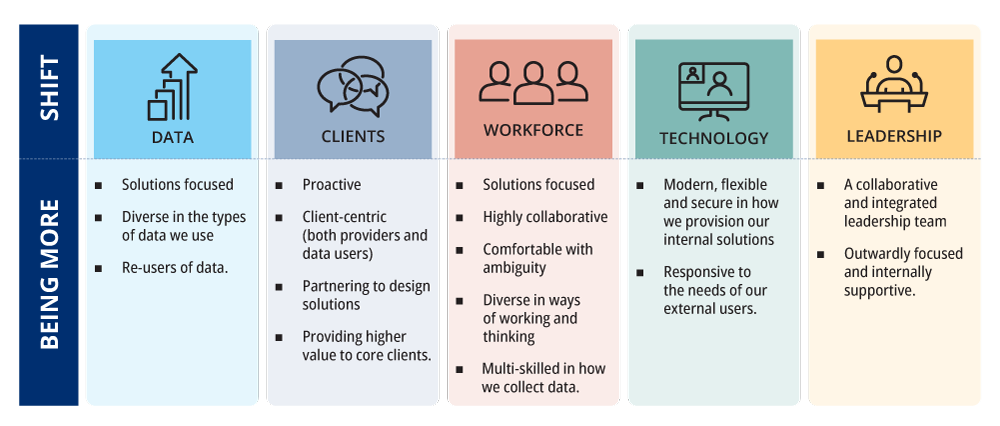
The ABS is modernising and shifting the way we operate — with data, clients, our workforce, technology and our leadership. These shifts will remain the focus of the modernisation program and how we evolve to anticipate and respond to our operating environment.
Five capability shifts to build a future ready ABS
Image
Description
This image describes the five ways in which the ABS is making shifts to deliver on its strategic priorities and respond to changing priorities and opportunities.
The image describes how the ABS will source and protect data, engage with its clients, shape its workforce, modernise its technologies and strengthen its leadership. The image is divided into five columns.
- Data: The ABS will shift towards being more solutions focused, diverse in the types of data it uses and will maximise the reuse of data.
- Clients: The ABS will shift towards being more proactive, client-centric, active in partnering to design enhanced solutions and will provide higher value to core clients.
- Workforce: The ABS will shift towards being more solutions focussed, highly collaborative, comfortable with ambiguity, diverse in ways of working and thinking and multi-skilled in how it collects data.
- Technology: The ABS will shift towards being more modern, flexible and secure in how we provision our internal solutions and responsive to the needs of our external users.
- Leadership: The ABS will shift towards being more collaborative and have integrated leadership teams, outwardly focused and internally supportive.
In support of these key shifts, we are undertaking a range of initiatives:
- Phase 2 of our Big Data, Timely Insights (BDTI) Program is moving key statistical production processes to a modern and secure cloud environment, reducing risks to the production and accuracy of Australia’s economic statistics. Over the next two years, core tools for data editing, visualisation, business rules management, aggregation and seasonal adjustment will be cloud-based, with four business collections and the Consumer Price Index (CPI) transitioning to this new system.
- Our Data Acquisition Modernisation Program will modernise our data sourcing capabilities and accelerate the use of digital collections, making it easier for individuals and businesses participating in our surveys to engage with the ABS.
- The ABS is strengthening its data science and analytics capability to support future-ready statistical production by enhancing our solution development tools using mathematical code. We are also expanding professional development to equip our staff with the skills needed to work confidently with emerging platforms and technologies.
- We continue to develop our statistical offerings to meet emerging policy needs and deliver greater value to clients. This includes finalising the transition to a complete monthly CPI on 26 November 2025; enhancing regional labour market statistics to support the National Workforce Strategy, continuing to address gaps in labour market data identified in the Employment White Paper - Working Future; ceasing the Retail Business Survey in favour of a new approach using the Monthly Household Spending Indicator based on bank transactions data; and delivering new and more timely insights through an expanded digital-first General Social Survey on the wellbeing of Australians.
- In alignment with the APS Strategic Commissioning Framework, we are committed to ensuring our core work is undertaken by APS staff. We have set a target to keep the amount of core work outsourced to less than 1% of our Full-Time Equivalent workforce. This target reflects our commitment to maintaining our core work in-house and harnessing APS expertise and knowledge.
- We are updating our ICT Strategy to guide the digitalisation of our processes and services through contemporary, flexible technology solutions that meet external user needs, while also investing in tools internally to enhance staff experience, productivity and collaboration.
- We continue to take deliberate steps and make strategic investments to strengthen leadership across the ABS — fostering collaboration, building integrated teams and cultivating a culture that is outwardly focused and internally supportive. These efforts ensure our leaders are equipped to guide our people and advance Australia’s data capabilities.
Risk oversight and management
Our risk management approach is founded on the principle of continuous improvement, with a focused effort to enhance and strengthen our enterprise risk practices. Central to this effort is the recognition that engaging with risk is an essential component needed to deliver relevant, timely and high-quality statistics.
Risk management framework
The ABS Risk Management Framework outlines how we manage risks to achieve better outcomes for the Australian community. It helps us establish and maintain appropriate systems and controls for risk oversight and management in line with Australian Government requirements, including the Commonwealth Risk Management Framework.
The Australian Statistician holds the overarching responsibility for the ABS Risk Management Framework and chairs the ABS Executive Board, which monitors our enterprise risk and determines our risk appetite and tolerance. The Chief Risk Officer supports the ABS Executive Board by reviewing enterprise risk and ensuring the effectiveness of our management of risk. The ABS Audit and Risk Committee gives independent advice to the Australian Statistician on the appropriateness of the ABS Risk Management Framework and internal controls.
Our enterprise risk management function supports the Australian Statistician and ABS Executive Board. This includes reporting on enterprise risk and guiding business units and transformation programs to proportionately manage their risks.
Managers at all levels are accountable for managing risks to their objectives by establishing and monitoring controls proportionate to the level of risk.
In December 2024 the ABS Executive Board agreed to strengthen governance arrangements by introducing the Operations and Risk Committee (ORC) as a new sub-committee of the ABS Executive Board. This change gives greater senior oversight of key organisational risks and enables Program Managers to play a greater role in organisational stewardship.
The ORC gives strategic advice on frameworks for enterprise risk, information management systems, property, security and financial management.
Our risk culture supports innovative projects by encouraging calculated risk-taking, finding opportunities and applying informed risk management practices.
Enterprise risks
The ABS has identified eight enterprise risks that reflect our current strategic and operating environment (refer to table below).
Our enterprise risks will be subject to in-depth analysis over the next 12 months with consultation across the ABS to inform and refine causes, consequences, existing controls and risk treatments for each risk. The outcomes of this analysis will inform the development of a refreshed approach to risk management that is balanced, responsive and proportionate.
We are embedding consistent risk management across all program areas with alignment of objectives to the ABS Risk Management Framework. All program areas will find, assess and manage risks relevant to their operations, contributing to a cohesive and comprehensive risk management strategy across the organisation.
| Enterprise risk | Risk overview |
|---|---|
| Statistical quality and integrity | The ABS fails to meet the expectations of key data users and produces substandard statistics, undermining our role as a national statistical authority. |
| Privacy and information security | The ABS fails to protect public data and is vulnerable to internal or external threats. |
| Data quality and provider participation | Declining survey participation rates and poor stakeholder management limits the ABS’ access to critical data sources. |
| Critical program delivery | The ABS fails to successfully deliver a critical program adversely affecting trust with government and strategic goals. |
| IT system capability and continuity | The ABS fails to simplify and evolve a fit for purpose, secure IT ecosystem, preventing the publication of key statistics. |
| Financial sustainability | The ABS fails to effectively manage its financial processes, assets, projects, investments and is unable to maintain a sustainable financial position. |
| Health, safety and wellbeing | The ABS fails to create a safe working environment. |
| People capability | The ABS is unable to effectively manage the capability and capacity of the workforce to deliver on legislative obligations and strategic objectives. |
Emerging risks
The ABS faces an emerging risk in maintaining the pace of modernisation to meet evolving economic conditions and community expectations. Many improvements require significant upfront investment to deliver long-term benefits and must be funded through ABS appropriations. Continued investment is needed to modernise ABS data acquisition systems, transition to cloud infrastructure while maintaining legacy systems and support the growing demand for integrated data sources. Without funding, these pressures may impact the ABS’s ability to deliver timely high-quality statistical outputs. Funding is also required to reduce reliance on traditional survey methods and address long-term declines in survey response rates.
Cyber security continues to emerge as a significant enterprise risk that needs robust processes and ABS Executive Board oversight to find, analyse and manage these risks. We are implementing a cyber security governance, risk and compliance tool to improve the efficiency of the current accreditation process, reducing the time involved. This tool will help us maintain security compliance of critical systems more consistently, with better oversight, including the reuse of risk assessments for foundational infrastructure.
As part of the Australian Government’s approach to climate risk management in the public sector we find, assess, prioritise, manage and disclose climate risks. We also implement opportunities to embed climate risk management within our enterprise risk management framework.
Collaboration and cooperation
Our relationships with our key stakeholders are critical in delivering the data, statistics and insights needed to inform Australia’s important decisions.
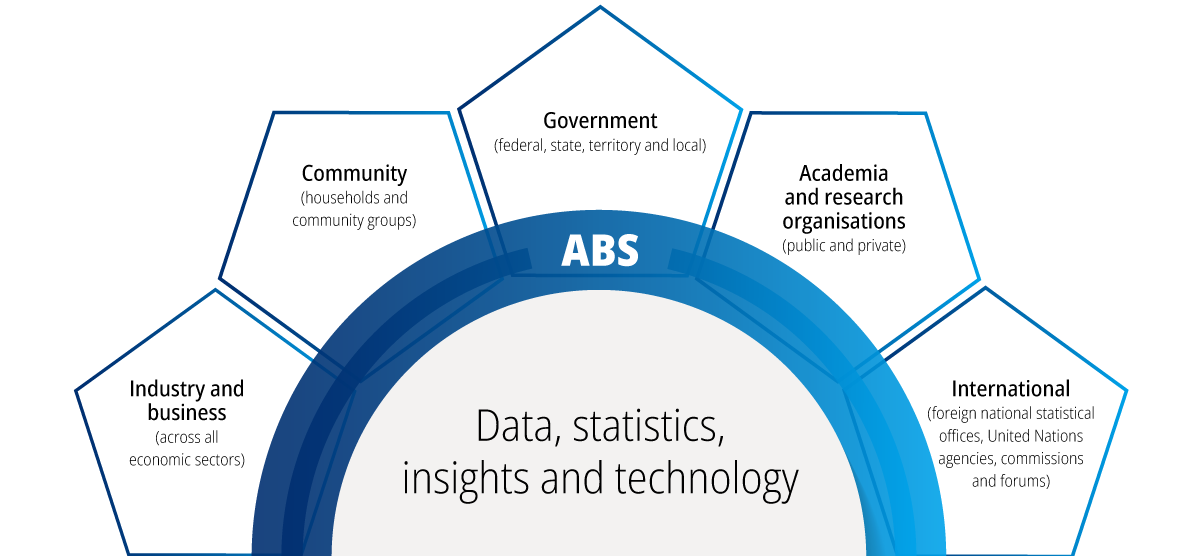
We collaborate with a diverse range of stakeholders across Australia and around the world.
ABS' key stakeholders
Image
Description
This image describes ABS' key stakeholder groups, which are:
- industry and business (across all economic sectors)
- community (households and community groups)
- government (federal, state, territory and local)
- academia and research organisations (public and private)
- international (foreign national statistical offices, United Nations agencies, commissions and forums).
Government and research institutions
Our partnerships with government and research institutions are crucial in the dynamic statistical environment. These collaborations enable us to integrate data from various sources, supporting the effective use of public data while reducing the burden on providers. This includes working with:
- Public bodies that contribute data to and are users of ABS data including federal, local, state and territory government departments, universities, other research institutions and public corporations.
- Policy-setting and decision-making bodies that rely on ABS data such as The Treasury, Reserve Bank of Australia, Department of Social Services, Services Australia, Productivity Commission and Commonwealth Grants Commission.
- The Australian university sector to develop and quality assure the methodological solutions that underpin our statistics and processes.
- The wider Australian community through the Statistical Society of Australia and the Australian Mathematical Science Institute to strengthen numeracy, data literacy and the role of official statistics in society.
We rely on the Australian Business Register, managed by the Australian Tax Office — it is the lifeblood of our industry statistics. It ensures that the ABS has a comprehensive list of economically active businesses classified by industry, from which we can draw samples to collect information and accurately measure what is happening in Australia’s economy.
Led by the National Indigenous Australians Agency and in collaboration with all APS agencies, we are committed to the implementation of the Framework for Governance of Indigenous Data. We have commenced developing our implementation plan guided by four principles. This includes adhering to the four guidelines to build strong governance over Indigenous data holdings: partnering with Aboriginal and Torres Strait Islander people; building data-related capabilities; providing knowledge of data assets; and creating an inclusive data system.
Key programs of work with other government and research institutions are discussed in Key activities.
Community and industry
We rely on households and businesses across all sectors of the economy to deliver our purpose. We collect personal information[1] for the analysis and production of statistics and to help manage and operate our business. We only collect the information necessary for our operations and regularly review our processes to ensure the information we collect is protected in the best possible ways.
We collaborate and consult with community groups and other industry bodies when proposing changes to our statistical collections, using direct and public communication channels to offer all stakeholders an opportunity to give feedback.
We work with ABS Round Table for Aboriginal and Torres Strait Islander Statistics to ensure that our statistical programs are conducted in a culturally safe manner and take into account the priorities, values and diversity of Aboriginal and Torres Strait Islander peoples.
International engagements
We are an active member of the United Nations Statistical Commission (UNSC) and maintain numerous enduring international relationships. Through these connections we share our experience and collaborate on research and development initiatives. Our key international engagements include:
- Working to support Australia’s commitments to observe international standards and address data gaps across a range of economic and financial statistics. The ABS chairs the International Monetary Fund (IMF) Data Gaps and Reporting Committee, which coordinates Australian cross-agency actions and reporting for the G20 Data Gaps Initiative and IMF Special Data Dissemination Standard.
- Actively contributing as a Bureau member of both the Organisation for Economic Co-operation and Development (OECD) Committee on Statistics and Statistical Policy and the United Nations Economic Commission for Europe (UNECE) Conference of European Statisticians. Through these roles, we collaborate with global counterparts to address emerging statistical issues and support the development of internationally endorsed guidelines. The Australian Statistician also participates in the annual UNSC meetings, helping to shape global statistical standards and advance concepts and methodologies.
- Collaborating with the United Nations Statistics Division leading the drafting of the International Merchandise Trade Statistics Manual to advance the development of the international frameworks for measuring international trade.
- Supporting the Department of Foreign Affairs and Trade in enhancing regional statistical capability and institutional strengthening through programs in Indonesia, Timor-Leste, Papua New Guinea, Fiji and across the Pacific.