[1] Personal information is collected consistent with the ABS Privacy Policy for Statistical Information and the ABS Privacy Policy for Managing and Operating Our Business.
Latest release
ABS Corporate Plan
The ABS Corporate Plan outlines the role of the ABS as a national statistical agency and the future directions of the organisation.
Reference period
2025-26
29/08/2025
Message from the Australian Statistician

Australian Statistician, Dr David Gruen AO
As Australia’s national statistical agency we are an official source of independent and reliable data and insights. We tell the story of Australia - its economy, its people, its challenges and opportunities.
For over 120 years our data has helped shape decisions that affect every Australian. We collect and analyse a wide range of social, economic, business, population and environmental data to deliver meaningful insights that bring numbers to life. We’re evolving how we collect, analyse and share data to better meet the changing needs of governments, communities and businesses. As Australia becomes more digitally connected and data-driven we’re modernising our systems and approaches to deliver faster, more relevant insights that support informed decisions and improve outcomes for all Australians.
In 2026 we’ll conduct a secure and trusted Census of Population and Housing (the Census)—an opportunity to tell Australia’s story and guide future planning. Over the next year we’ll finalise preparations to ensure it’s an easy and secure experience for all Australians.
We continue to work with other data providers and custodians to unlock new data sources and enhance the availability and usability of alternative data sources for statistics, and to generate new insights. Our Big Data, Timely Insights (BDTI) program is rebuilding core statistical tools and processes in a cloud-based data analytics environment. This initiative will enable us to deliver a complete monthly measure of the Consumer Price Index (CPI) starting on 26 November 2025, offering more timely and detailed insights into Australia’s economic conditions.
We are modernising our data acquisition processes to respond to the global long-term decline in survey response rates and to adopt a digital-first approach to data collection. This involves reforming and modernising data sourcing methods, creating simple, safe and user-friendly digital experiences, and using data from administrative and other sources.
We play a key role in uplifting Australia’s data capabilities. By building and maintaining partnerships with both government and the private sector we aim to build data integration capability, linking public and private datasets for policy relevant research. We will continue to lead the Australian Public Service (APS) Data Profession with the goal to attract, develop and retain the data capabilities of our data professionals and the APS more broadly.
We remain committed to continuous improvement—adapting our data, technology, workforce and leadership to deliver trusted insights for today and tomorrow.
The ABS Corporate Plan 2025–26 is our key planning document. It gives an overview of ABS’ operating environment, key priorities, challenges, activities, statistical outputs and how we will measure our success.
As the accountable authority of the ABS, I present the ABS Corporate Plan 2025–26, which covers the periods of 2025–26 to 2028–29, as required under section 35(1)(b) of the Public Governance, Performance and Accountability Act 2013.
I look forward to reporting to the Australian Parliament and the public on our performance in delivering on this Plan in the ABS Annual Report 2025–26.
Dr David Gruen AO
Australian Statistician
About the ABS
We are Australia’s national statistical agency and an official source of independent, reliable information. We tell the story of Australia, its economy and its people by bringing life and meaning to numbers.
Our purpose
To inform Australia’s important decisions by delivering relevant, trusted and objective data, statistics and insights.
Our outcome
Decisions on important matters made by governments, business and the broader community are informed by objective, relevant and trusted official statistics produced through the collection and integration of data, its analysis, and the provision of statistical information.
Our role
The ABS is Australia’s national statistical agency, an independent statutory authority in the Treasury portfolio. We provide trusted official statistics on a wide range of economic, social, population and environmental matters of importance to Australia.
We lead the use of public data for statistical purposes and work to improve the Australian Government’s data and statistical capabilities. We work in partnership with the other government agencies and organisations to expand the range and quality of statistical data, and information available to governments and the community.
The ABS advises official bodies on producing and using data and statistics, formulating standards, working with states and territories and liaising internationally with other national statistical organisations.
Our legislation
Our main functions, duties and powers are set out in the:
- Australian Bureau of Statistics Act 1975, which establishes the ABS as an independent statutory authority and legislates its main function as the central statistical authority for the Government and a provider of services for state and territory governments.
- Census and Statistics Act 1905, which empowers the Australian Statistician to collect and publish statistical information on a broad range of demographic, economic, environmental and social topics and has strong provisions to maintain the confidentiality of information collected under the Act.
In addition, the Census and Statistics (Information Release and Access) Determination 2018 enables the Statistician to release information collected under the Census and Statistics Act 1905 when specific conditions are met.
The ABS must comply with the governance and accountability system defined by the Public Governance, Performance and Accountability Act 2013.
The ABS must also comply with a range of legislation including:
Operating context
Environment
Our operating environment continues to present challenges and opportunities as we fulfil our national leadership role in data, information and insights.
Evolving user demands
The demand for data continues to grow, reflecting the increasing value placed on providing quality, timely and frequent data and insights. This is generating a significant increase in demand for ABS services and, while this demand is often supported by additional investment, the ABS needs to prioritise its efforts as the growth in opportunities exceed the capacity of the ABS.
We are adapting to Australia’s evolving needs by expanding the range and quality of our statistical data and information and we continue to embrace new technologies and explore alternate sources of data. The secure linkage of administrative and alternate sources of data is providing a new evidence base for policy, community insights and program evaluation.
Declining response rates
The ABS is modernising how it collects data through its Data Acquisition Modernisation Program, in response to the long-term gradual decline in response rates across business and household surveys. This will improve the user experience and reduce the time it takes individuals, businesses and households to provide information, making it easier for Australians to participate in our surveys. As part of this program we’re delivering modern systems and processes that strengthen frontline operations, streamline staff workflows and ensure data collection is secure and sustainable.
We are also exploring alternative data sources and collection methods to reduce survey burden. This includes supplementing or replacing surveys with administrative data, implementing methodological changes such as sample redesign and reducing collection frequency.
Supporting the Government through data leadership
The ABS is committed to supporting the Australian Government’s Data and Digital Government Strategy, which sets a vision for delivering simple, secure and connected public services for all people and businesses through world class data and digital capabilities. The ABS plays a key role in delivering and supporting several initiatives defined in this Strategy, including the National Disability Data Asset, the Life Course Data Initiative and the Australian National Data Integration Infrastructure.
As Head of the APS Data Profession, the Australian Statistician plays a central role in delivering the APS Data Professional Stream Strategy. Through this initiative, we are actively building data capability across the public service, supporting agencies to strengthen data literacy and meet growing demand for data-informed decision-making.
Capability
Our organisational capability is the combination of our people, culture, processes, systems and knowledge. Our organisational capabilities directly contribute to our ability to deliver our purpose.
Building a future ready ABS
The ABS has a capable, diverse and highly engaged workforce. Our people are in high demand, with their skills making them attractive in both the public and private sector. The ABS value proposition for staff continues to be based on making a significant contribution to the Australian community, flexible approaches to working, the provision of development opportunities and a strong and highly regarded graduate recruitment and development program.
The ABS is modernising and shifting the way we operate — with data, clients, our workforce, technology and our leadership. These shifts will remain the focus of the modernisation program and how we evolve to anticipate and respond to our operating environment.
Five capability shifts to build a future ready ABS
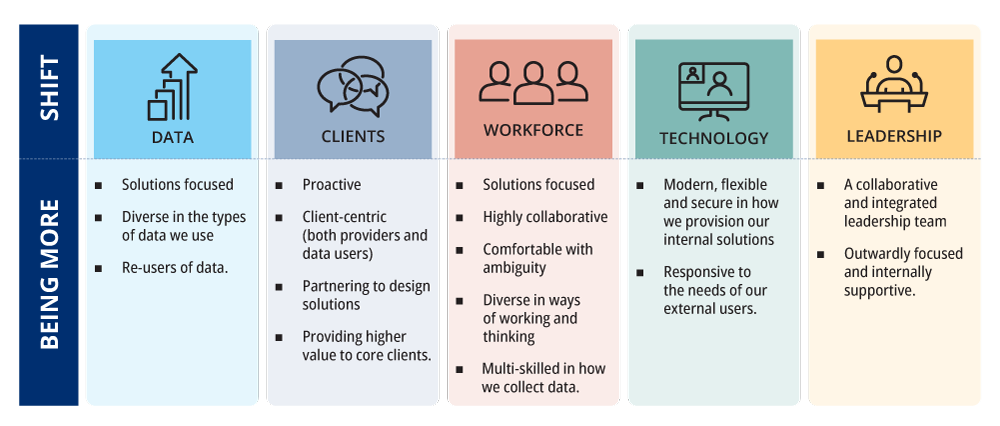
This image describes the five ways in which the ABS is making shifts to deliver on its strategic priorities and respond to changing priorities and opportunities.
The image describes how the ABS will source and protect data, engage with its clients, shape its workforce, modernise its technologies and strengthen its leadership. The image is divided into five columns.
- Data: The ABS will shift towards being more solutions focused, diverse in the types of data it uses and will maximise the reuse of data.
- Clients: The ABS will shift towards being more proactive, client-centric, active in partnering to design enhanced solutions and will provide higher value to core clients.
- Workforce: The ABS will shift towards being more solutions focussed, highly collaborative, comfortable with ambiguity, diverse in ways of working and thinking and multi-skilled in how it collects data.
- Technology: The ABS will shift towards being more modern, flexible and secure in how we provision our internal solutions and responsive to the needs of our external users.
- Leadership: The ABS will shift towards being more collaborative and have integrated leadership teams, outwardly focused and internally supportive.
In support of these key shifts, we are undertaking a range of initiatives:
- Phase 2 of our Big Data, Timely Insights (BDTI) Program is moving key statistical production processes to a modern and secure cloud environment, reducing risks to the production and accuracy of Australia’s economic statistics. Over the next two years, core tools for data editing, visualisation, business rules management, aggregation and seasonal adjustment will be cloud-based, with four business collections and the Consumer Price Index (CPI) transitioning to this new system.
- Our Data Acquisition Modernisation Program will modernise our data sourcing capabilities and accelerate the use of digital collections, making it easier for individuals and businesses participating in our surveys to engage with the ABS.
- The ABS is strengthening its data science and analytics capability to support future-ready statistical production by enhancing our solution development tools using mathematical code. We are also expanding professional development to equip our staff with the skills needed to work confidently with emerging platforms and technologies.
- We continue to develop our statistical offerings to meet emerging policy needs and deliver greater value to clients. This includes finalising the transition to a complete monthly CPI on 26 November 2025; enhancing regional labour market statistics to support the National Workforce Strategy, continuing to address gaps in labour market data identified in the Employment White Paper - Working Future; ceasing the Retail Business Survey in favour of a new approach using the Monthly Household Spending Indicator based on bank transactions data; and delivering new and more timely insights through an expanded digital-first General Social Survey on the wellbeing of Australians.
- In alignment with the APS Strategic Commissioning Framework, we are committed to ensuring our core work is undertaken by APS staff. We have set a target to keep the amount of core work outsourced to less than 1% of our Full-Time Equivalent workforce. This target reflects our commitment to maintaining our core work in-house and harnessing APS expertise and knowledge.
- We are updating our ICT Strategy to guide the digitalisation of our processes and services through contemporary, flexible technology solutions that meet external user needs, while also investing in tools internally to enhance staff experience, productivity and collaboration.
- We continue to take deliberate steps and make strategic investments to strengthen leadership across the ABS — fostering collaboration, building integrated teams and cultivating a culture that is outwardly focused and internally supportive. These efforts ensure our leaders are equipped to guide our people and advance Australia’s data capabilities.
Risk oversight and management
Our risk management approach is founded on the principle of continuous improvement, with a focused effort to enhance and strengthen our enterprise risk practices. Central to this effort is the recognition that engaging with risk is an essential component needed to deliver relevant, timely and high-quality statistics.
Risk management framework
The ABS Risk Management Framework outlines how we manage risks to achieve better outcomes for the Australian community. It helps us establish and maintain appropriate systems and controls for risk oversight and management in line with Australian Government requirements, including the Commonwealth Risk Management Framework.
The Australian Statistician holds the overarching responsibility for the ABS Risk Management Framework and chairs the ABS Executive Board, which monitors our enterprise risk and determines our risk appetite and tolerance. The Chief Risk Officer supports the ABS Executive Board by reviewing enterprise risk and ensuring the effectiveness of our management of risk. The ABS Audit and Risk Committee gives independent advice to the Australian Statistician on the appropriateness of the ABS Risk Management Framework and internal controls.
Our enterprise risk management function supports the Australian Statistician and ABS Executive Board. This includes reporting on enterprise risk and guiding business units and transformation programs to proportionately manage their risks.
Managers at all levels are accountable for managing risks to their objectives by establishing and monitoring controls proportionate to the level of risk.
In December 2024 the ABS Executive Board agreed to strengthen governance arrangements by introducing the Operations and Risk Committee (ORC) as a new sub-committee of the ABS Executive Board. This change gives greater senior oversight of key organisational risks and enables Program Managers to play a greater role in organisational stewardship.
The ORC gives strategic advice on frameworks for enterprise risk, information management systems, property, security and financial management.
Our risk culture supports innovative projects by encouraging calculated risk-taking, finding opportunities and applying informed risk management practices.
Enterprise risks
The ABS has identified eight enterprise risks that reflect our current strategic and operating environment (refer to table below).
Our enterprise risks will be subject to in-depth analysis over the next 12 months with consultation across the ABS to inform and refine causes, consequences, existing controls and risk treatments for each risk. The outcomes of this analysis will inform the development of a refreshed approach to risk management that is balanced, responsive and proportionate.
We are embedding consistent risk management across all program areas with alignment of objectives to the ABS Risk Management Framework. All program areas will find, assess and manage risks relevant to their operations, contributing to a cohesive and comprehensive risk management strategy across the organisation.
| Enterprise risk | Risk overview |
|---|---|
| Statistical quality and integrity | The ABS fails to meet the expectations of key data users and produces substandard statistics, undermining our role as a national statistical authority. |
| Privacy and information security | The ABS fails to protect public data and is vulnerable to internal or external threats. |
| Data quality and provider participation | Declining survey participation rates and poor stakeholder management limits the ABS’ access to critical data sources. |
| Critical program delivery | The ABS fails to successfully deliver a critical program adversely affecting trust with government and strategic goals. |
| IT system capability and continuity | The ABS fails to simplify and evolve a fit for purpose, secure IT ecosystem, preventing the publication of key statistics. |
| Financial sustainability | The ABS fails to effectively manage its financial processes, assets, projects, investments and is unable to maintain a sustainable financial position. |
| Health, safety and wellbeing | The ABS fails to create a safe working environment. |
| People capability | The ABS is unable to effectively manage the capability and capacity of the workforce to deliver on legislative obligations and strategic objectives. |
Emerging risks
The ABS faces an emerging risk in maintaining the pace of modernisation to meet evolving economic conditions and community expectations. Many improvements require significant upfront investment to deliver long-term benefits and must be funded through ABS appropriations. Continued investment is needed to modernise ABS data acquisition systems, transition to cloud infrastructure while maintaining legacy systems and support the growing demand for integrated data sources. Without funding, these pressures may impact the ABS’s ability to deliver timely high-quality statistical outputs. Funding is also required to reduce reliance on traditional survey methods and address long-term declines in survey response rates.
Cyber security continues to emerge as a significant enterprise risk that needs robust processes and ABS Executive Board oversight to find, analyse and manage these risks. We are implementing a cyber security governance, risk and compliance tool to improve the efficiency of the current accreditation process, reducing the time involved. This tool will help us maintain security compliance of critical systems more consistently, with better oversight, including the reuse of risk assessments for foundational infrastructure.
As part of the Australian Government’s approach to climate risk management in the public sector we find, assess, prioritise, manage and disclose climate risks. We also implement opportunities to embed climate risk management within our enterprise risk management framework.
Collaboration and cooperation
Our relationships with our key stakeholders are critical in delivering the data, statistics and insights needed to inform Australia’s important decisions.
We collaborate with a diverse range of stakeholders across Australia and around the world.
ABS' key stakeholders
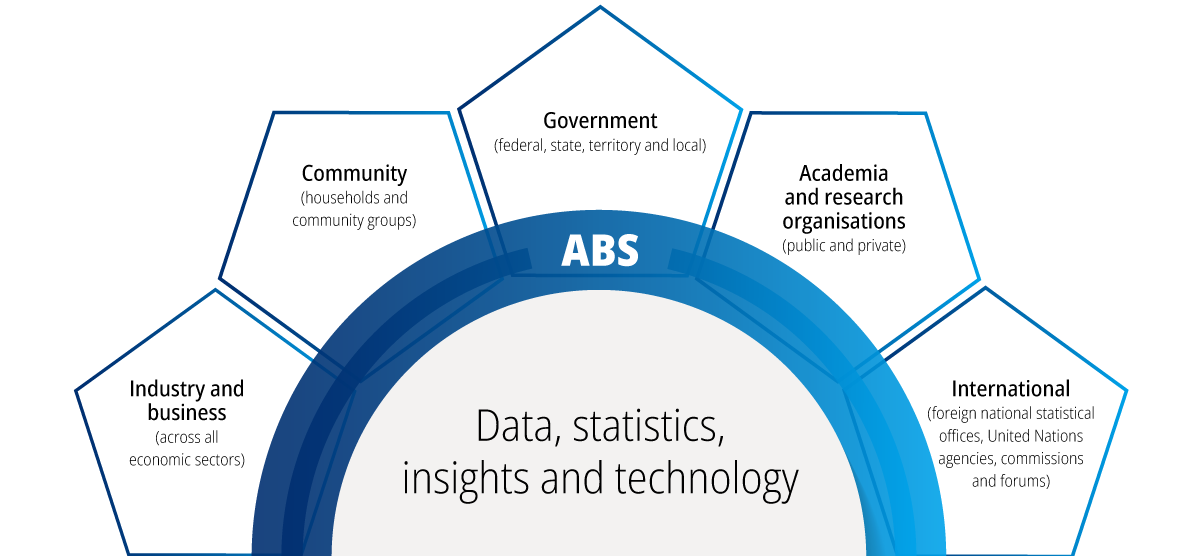
This image describes ABS' key stakeholder groups, which are:
- industry and business (across all economic sectors)
- community (households and community groups)
- government (federal, state, territory and local)
- academia and research organisations (public and private)
- international (foreign national statistical offices, United Nations agencies, commissions and forums).
Government and research institutions
Our partnerships with government and research institutions are crucial in the dynamic statistical environment. These collaborations enable us to integrate data from various sources, supporting the effective use of public data while reducing the burden on providers. This includes working with:
- Public bodies that contribute data to and are users of ABS data including federal, local, state and territory government departments, universities, other research institutions and public corporations.
- Policy-setting and decision-making bodies that rely on ABS data such as The Treasury, Reserve Bank of Australia, Department of Social Services, Services Australia, Productivity Commission and Commonwealth Grants Commission.
- The Australian university sector to develop and quality assure the methodological solutions that underpin our statistics and processes.
- The wider Australian community through the Statistical Society of Australia and the Australian Mathematical Science Institute to strengthen numeracy, data literacy and the role of official statistics in society.
We rely on the Australian Business Register, managed by the Australian Tax Office — it is the lifeblood of our industry statistics. It ensures that the ABS has a comprehensive list of economically active businesses classified by industry, from which we can draw samples to collect information and accurately measure what is happening in Australia’s economy.
Led by the National Indigenous Australians Agency and in collaboration with all APS agencies, we are committed to the implementation of the Framework for Governance of Indigenous Data. We have commenced developing our implementation plan guided by four principles. This includes adhering to the four guidelines to build strong governance over Indigenous data holdings: partnering with Aboriginal and Torres Strait Islander people; building data-related capabilities; providing knowledge of data assets; and creating an inclusive data system.
Key programs of work with other government and research institutions are discussed in Key activities.
Community and industry
We rely on households and businesses across all sectors of the economy to deliver our purpose. We collect personal information[1] for the analysis and production of statistics and to help manage and operate our business. We only collect the information necessary for our operations and regularly review our processes to ensure the information we collect is protected in the best possible ways.
We collaborate and consult with community groups and other industry bodies when proposing changes to our statistical collections, using direct and public communication channels to offer all stakeholders an opportunity to give feedback.
We work with ABS Round Table for Aboriginal and Torres Strait Islander Statistics to ensure that our statistical programs are conducted in a culturally safe manner and take into account the priorities, values and diversity of Aboriginal and Torres Strait Islander peoples.
International engagements
We are an active member of the United Nations Statistical Commission (UNSC) and maintain numerous enduring international relationships. Through these connections we share our experience and collaborate on research and development initiatives. Our key international engagements include:
- Working to support Australia’s commitments to observe international standards and address data gaps across a range of economic and financial statistics. The ABS chairs the International Monetary Fund (IMF) Data Gaps and Reporting Committee, which coordinates Australian cross-agency actions and reporting for the G20 Data Gaps Initiative and IMF Special Data Dissemination Standard.
- Actively contributing as a Bureau member of both the Organisation for Economic Co-operation and Development (OECD) Committee on Statistics and Statistical Policy and the United Nations Economic Commission for Europe (UNECE) Conference of European Statisticians. Through these roles, we collaborate with global counterparts to address emerging statistical issues and support the development of internationally endorsed guidelines. The Australian Statistician also participates in the annual UNSC meetings, helping to shape global statistical standards and advance concepts and methodologies.
- Collaborating with the United Nations Statistics Division leading the drafting of the International Merchandise Trade Statistics Manual to advance the development of the international frameworks for measuring international trade.
- Supporting the Department of Foreign Affairs and Trade in enhancing regional statistical capability and institutional strengthening through programs in Indonesia, Timor-Leste, Papua New Guinea, Fiji and across the Pacific.
Footnotes
Show all
Key activities
Our three key activities set out how we achieve the outcome mandated by the Australian Government in our Portfolio Budget Statements (PBS) and reflect how our functions contribute to achieving our purpose.
Key activity 1: Produce high-quality statistics and insights
As Australia’s national statistical agency, we collect and analyse a suite of social, economic, business, population and environmental data to offer valuable statistics and insights to inform Australia’s important decisions.
Our data and statistics play an important role in supporting evidence-based decision making across government, business and the community. They underpin fiscal and monetary policy, inform the delivery of programs and services essential to the wellbeing of Australians and contribute to informed public discussion. The ABS Forward Work Program outlines our planned statistical releases and data developments over the next four years, ensuring our outputs remain relevant and responsive to evolving needs.
In August 2026 we will deliver a secure and trusted Census, employing over 30,000 field staff. It has been estimated to return $6 in economic value for every dollar invested through improved services, infrastructure and policy planning.
A major field test of the Census digital service and field operations was completed in 2025 and preparations are on track for the Census in 2026. The 2026 Census will collect data on sexual orientation and gender (for people aged 16+) for the first time. Census data will be available from June 2027, along with the results of the Post Enumeration Survey and rebased population estimates.
Enhancements to statistical collections
We continue to enhance the range of our statistical releases and data collections to increase the value of our statistics. This includes:
- Completing the transition to a complete monthly Consumer Price Index (CPI) on 26 November 2025. The monthly CPI will serve as Australia’s headline measure of inflation, providing more timely and comprehensive insights into economic conditions impacting Australian households and businesses.
- By December 2026 enhanced regional labour market statistics including expanded data for women will support the National Workforce Strategy. It will provide a broader range of reliable regional labour market indicators supporting local decision-making during natural disasters or uncertain economic conditions.
- Addressing gaps in labour market data identified in the Employment White Paper - Working Future to strengthen decision making in areas such as employment outcomes and barriers, quality of employment, job security, job mobility, career progression, value of unpaid care and employment outcomes for Aboriginal and Torres Strait Islander peoples.
- Modernising agricultural statistics by replacing large agricultural surveys, including the 5 yearly Agricultural Census, with data from government, industry and commercial sources. This reduces reporting burden on farmers and will enable and improve regional detail and timeliness of data releases.
- Replacing the Retail Business Survey with the Monthly Household Spending Indicator using bank transactions data, which will give users a more comprehensive view of household consumption and eliminate the need for businesses to respond to the Retail Business Survey. Consequently, the Retail Trade publication was ceased following the July 2025 release.
- In 2025–26, a revised Business Characteristics Survey will be launched, incorporating stakeholder feedback to improve data on business traits, innovation and digital activity.
- By June 2030, we will launch a cloud-based Business Characteristics Asset with near real-time insights on business formation and resilience which will include new information on small businesses. Migrating to a cloud-based system will enable more flexible, targeted and high-quality insights to meet user needs.
- Building a cloud-based Business Rules Management System to replace legacy technology, increasing visibility of business rules and enable self-service authoring. This system integrates with other cloud-based editing tools, with the first business statistics collection onboarded in July 2025.
- Delivering timely insights from an annual digital-first General Social Survey covering wellbeing, topics like life satisfaction, volunteering, discrimination, financial stress, mental health and participation in cultural activities. The results will be released in mid-2026 to support Measuring What Matters – Australia’s national well-being framework.
- Collaborating with the Australian Prudential Regulation Authority (APRA) to use its data transformation program to improve insights on financial entities it supervises, reducing provider burden, lowering ABS survey costs, while safeguarding national and international accounts statistics. In 2025–26, we will access new insurance data and assess the superannuation data for national and international statistics.
- Expanding the National Ecosystem Accounts to inform government policy, planning and decision-making in the Nature Positive Plan. The ABS will partner with the Department of Climate Change, Energy, the Environment and Water and the Commonwealth Scientific and Industrial Research Organisation (CSIRO) to add new measures using available data and based on user needs.
Integrated data assets
We build valuable integrated data assets for research in the public interest by linking over 70 administrative datasets from across government and the private sector. There are currently over 2,000 researchers using these data assets.
The Person Level Integrated Data Asset (PLIDA) combines datasets on healthcare, education, government payments, personal income tax and population. There are 27 datasets currently linked in PLIDA, with up to 62 expected to be available by the end of 2025. The Business Longitudinal Analysis Data Environment (BLADE) is a business-centred integrated data asset that combines tax, trade and intellectual property data with our survey data. There are 31 datasets currently linked in BLADE, with up to 34 expected to be available by the end of 2025.
By maintaining and regularly updating these assets, we can respond effectively to evolving research demands, enabling users to undertake important research about people and businesses over time. We collaborate with a range of government and private sector parties to develop and maintain our data integration and assets. This includes:
- Delivering the Life Course Data Initiative (LCDI) in partnership with the Australian Capital Territory and South Australian (SA) Governments, through the SA Government and University of Adelaide’s BetterStart initiative. The LCDI is capturing data insights to inform policy responses to address entrenched disadvantage. The pilot phase highlights the value of integrated cross-domain and multi-government level data to support policy and program design, monitoring and evaluation.
- Supporting the Treasury Competition Review Taskforce by linking surveys and new administrative datasets to the BLADE. The Review aims to evaluate competition laws, policies and institutions to ensure they are suitable for the modern economy, focusing on reforms that boost productivity and increase wages.
- Collaborating with the Department of Social Services and state and territory criminal justice departments to transition the Criminal Justice Data Asset from proof of concept to production. This supports the National Plan to End Violence against Women and Children and the National Agreement on Closing the Gap. The data asset will facilitate national analysis of the passage of individuals through the criminal justice system, informing government policy, program development, evaluation and research.
- Expanding the National Disability Data Asset with extra data releases through 2025–26, integrating information from various government agencies across Australia to better understand and address the needs of people with disabilities.
- Partnering with Jobs and Skills Australia to enhance the Vocational Education and Training (VET) National Data Asset, integrating government administrative data to track the employment and study outcomes of VET students and the performance of the VET system.
- Partnering with the Bureau of Meteorology, CSIRO and Geoscience Australia through the Australian Climate Service to deliver climate risk data and insights. In collaboration with the National Emergency Management Agency, we are developing the National Insurance Dataset to understand insurance affordability and target policy solutions for natural hazard risks.
Statistical standards and infrastructure
We continue to support the development and adoption of statistical standards and infrastructure to enable the production of high-quality statistics that are contemporary and internationally comparable. This includes:
Implementing the Occupation Standard Classification for Australia (OSCA) across ABS collections, starting with the 2026 Census and labour force statistics from August 2026. This update will ensure that analyses based on labour force and Census data reflect contemporary occupations in the Australian labour market, enabling trend analysis over time.
We will establish procedures for regularly maintaining OSCA, with updates planned over the five years leading up to the 2031 Census. This will support a shared understanding of Australia’s evolving workforce and the occupations driving employment and economic growth.
- Implementing the 2025 System of National Accounts and the 7th Edition of the Balance of Payments and International Investment Position Manual. We are currently developing options and timelines for adopting these updated standards for key economic statistics.
This work will enhance our statistical measurement of international and national accounts, providing new insights into economic activity, including the rise of digitalisation, data and artificial intelligence, the net-zero transition, natural capital depletion and shifting international trade dynamics.
Key activity 2: Exercise leadership in strengthening Australia’s data capabilities
We are at the forefront of data innovation - responding to today’s challenges and partnering to deliver rich, new information solutions, technologies and capability for Australia’s future.
We contribute to the uplift of Australia’s data capabilities through cross-sector partnerships and collaboration.
The Australian Statistician contributes to the National Data Advisory Council, advising on ethical and effective use of public sector data. We also actively engage in key APS data governance groups - including the Secretaries’ Digital and Data Committee and Deputy Secretaries Data Group to support coordinated planning, investment and delivery of trusted, secure data systems across government.
Data platforms and capabilities
We are responsible for delivering and operating key data platforms and capabilities that provide the evidence base for policy, insights and program evaluation. Our key capabilities include:
- Secure Environment for Accessing Data (SEADPod) service: A protected analytical environment enabling secure collaboration on sensitive data up to the Protected level.
- Australian National Data Integration Infrastructure : A technical platform providing a secure framework for linking and integrating government datasets to support evidence-based research and policymaking.
- Whole of Australian Government Coding Service: A newly develop coding service that makes classifying data to the latest standard occupation classification easier, faster and cheaper.
Data integration
We are committed to maximising the value of data and statistics, by partnering with government and private sector entities. Building data integration capabilities that link public and private datasets enables policy-relevant research and new insights into Australia’s communities, economy, and environment. By reusing existing data, we can reduce the amount or frequency of information needed from our surveys, saving time for households and businesses and using public funds more effectively.
Data governance
We value data as an asset and ensure it is accessed, integrated and shared responsibly, in line with data management best practice. We are particularly focused on supporting data governance related to Indigenous data.
We will begin delivering on our commitment to implement actions under the Australian Government’s Framework for Governance of Indigenous Data. This includes adhering to the four guidelines to build strong governance over Indigenous data holdings: partnering with Aboriginal and Torres Strait Islander people, building data-related capabilities, providing knowledge of data assets and creating an inclusive data system.
As co-chair of the Data Policy Partnership, with the New South Wales Coalition of Aboriginal Peak Organisations, we are working to improve shared access to information at a regional level, particularly for Aboriginal and Torres Strait Islander communities. The Data Policy Partnership will serve as the main national governance body for Closing the Gap-related data, explore options for establishing a Bureau of Indigenous Data (as recommended by the Productivity Commission Review of the National Agreement). It will consider the scope, roles, responsibilities and resources needed to support Indigenous data governance and Closing the Gap data development. The Data Policy Partnership aims to support Indigenous data development, governance, sharing and sovereignty.
APS data capability
We lead the APS Data Profession, enhancing the data capabilities of the APS workforce to attract, develop and retain the capabilities of data professionals in line with the APS Data, Digital and Cyber Workforce Plan 2025-30.
Over the next four years we will focus on refining capability building, expanding data stewardship and sustaining the Data Profession. Through various initiatives, we aim to grow the Data Professional Stream, retain skills, modernise capabilities and broaden the professional workforce. This will include:
- Continuing to build data capability through the delivery of the facilitated Data in Leadership course.
- Maintaining engagement with APS employees in data roles through our Members Community Platform, which provides information via discussion threads, document libraries and events such as the Data Capability Seminar Series and data focused In Conversation podcasts.
- Leading APS-wide graduate recruitment for the Data Profession, recruiting on behalf of over 35 agencies.
- Strengthening data capability by releasing new Data Profession artefacts, including Data Literacy Pathways, an updated Data Capability Framework aligned with the Skills Framework for the Information Age and a data Employee Value Proposition.
- Enhancing leadership in data through revised data literacy eLearning courses for all APS employees, including Senior Executive Service (SES). This course is being redeveloped to focus on SES accountabilities, data management skills and public sector craft and will be launched in late 2025.
We will increase our focus on building Indigenous data literacy by supporting the development of an Indigenous Data Profession Career Pathway and strengthen numeracy, data literacy across the wider Australian community through the Statistical Society of Australia and the Australian Mathematical Science Institute.
Key activity 3: Strengthen relationships and reduce load on data providers
We are changing the way we do things so that we can continue to produce high quality statistics while making it easier for people and businesses to give us information.
We continue to strengthen relationships with all levels of government, academia, business and the not-for-profit sector to generate statistical information that informs and assesses the effectiveness of economic, social and environmental policies. We consult key clients and users of ABS data and statistics to ensure our statistical products are relevant and valued. For example, we conduct an annual survey of our DataLab users, providing an opportunity for feedback on areas that are working well, suggestions for improvement and recommendations for new features.
Our outposted officer network facilitates access to statistics, develops statistical capability and aims to strengthen statistical coordination with federal, state and territory government host agencies. These officers offer statistical expertise within the host agencies, fostering the use of data in decision-making.
Data Acquisition Modernisation Program
We are committed to reducing the burden on people and businesses who give us data, by ensuring our data collection methods are modern, effective and efficient. We strive to collect information in the most efficient and timely manner, with minimal impact on businesses and households.
Our Data Acquisition Modernisation Program is transforming how we collect data by delivering secure, people-centred digital services. We place people at the heart of our data collections by making it easier for people and businesses to engage with us by:
- Modernising and improving the digital experience and sustainability of key surveys, including the Labour Force Survey, the Monthly Population Household Surveys, the Wage Price Index, the Building Activity Survey and the Employee Earnings and Hours Survey.
- Modernising our Contact Centre to improve the experience for our workforce and customers.
- Continuing to modernise and replace legacy IT systems by transitioning platforms and processes to a secure and scalable cloud environment.
- Streamlining systems and processes to improve current field workforce remuneration.
- Creating a modern, authoritative and consistent source of auxiliary data attached to the ABS Address Register that will enable more efficient sample design.
This will result in a more responsive, cost-effective data collection process, freeing up staff to focus on quality assurance and meaningful engagement with people and businesses who may need more support to provide their information.
Whole of Australian Government Coding Service
We continue to reform and modernise the way data is sourced, creating simple, safe and easy digital experiences while using data from administrative and other sources.
We will use our new Whole of Australian Government Coding Service to improve the efficiency of our statistical collections. Starting in 2025–26, we will use this Service to code various statistics, beginning with the Causes of Death collection and the 2026 Census. By 2028–29, all occupation, industry, religious affiliation, language spoken at home, ancestry, education and country of birth statistics collected by the ABS will be coded using this tool.
This will make classifying data to the latest official standard classifications easier, faster and cheaper, ensuring consistent data coding across the Australian data landscape. Consequently, data assets will be more coherent for research and analysis, providing better information for policymakers.
Performance information
The Commonwealth Performance Framework, established under the Public Governance, Performance and Accountability Act 2013, encompasses a cycle of performance planning, monitoring and reporting. The Portfolio Budget Statements (PBS) and Corporate Plan are our key forward planning publications and outline how we will measure and assess our performance. The Annual Report is our main reporting publication and provides the assessment of our performance and achievements.
The ABS Enterprise Performance Framework outlines our approach to meeting our legislative requirements, the Commonwealth Performance Framework and other guidance material.
We regularly review our performance measures to ensure they reflect our purpose and remain relevant and appropriate. The changes made to performance information for this Corporate Plan are detailed in the changes to performance measures page.
Key activity 1: Produce high-quality statistics and insights
Performance measure 1.1:
Trust in ABS statistics - level of trust in the ABS and its statistics
Our data informs important decisions made by government, business and the community. It underpins sound fiscal and monetary policy decisions and informs the delivery of programs and services vital to the health and wellbeing of the people of Australia. Our data also supports a functioning democracy, contributing to fair electoral boundaries and informed community debate.
It is crucial that we uphold an exceptional level of trust in both our institution and the statistics and insights we offer. This trust is essential for maintaining high response rates, ensuring our statistics are of high quality and reflective of the Australian society and economy and we remain the main source of data for Australia’s important decisions.
| Method #1 | Target | Years measured |
|---|---|---|
| Community Trust in ABS Statistics Survey (CTASS) | At least 85% level of trust in the ABS and ABS statistics | Not measured in this Corporate Plan period |
| Details | |
|---|---|
| Type | Quantitative / output |
| Methodology | The CTASS assesses trust among members of the general community and informed users and is conducted every five years by an independent third-party provider. The CTASS was last conducted in 2025, with results reported in the Annual Performance Statement 2024–25. It will next be conducted in 2030 with results reported in the Annual Performance Statement 2029–30. |
| Target rationale | The CTASS is conducted every 5 years, before the Census of Population and Housing to gauge public sentiment as distinct to awareness of the Census. This frequency will be maintained. The next survey collection will be undertaken in 2030. As a result, this method will not be assessed in the Corporate Plan 2025–26 period. |
| Method #2 | Target | Years measured |
|---|---|---|
| Number of statistics released on the ABS website are free of significant errors | 100% of statistics are released on the ABS website are free of significant errors | 2025–26 to 2028–29 |
| Details | |
|---|---|
| Type | Quantitative / output |
| Methodology | The number of statistics released on our website free of significant errors, expressed as a proportion of all statistical releases published on our website. Significant errors are errors in statistical releases published on our website, either identified by our staff or by users, that could mislead important or large groups of users regarding the value of a statistical indicator of national or state importance, resulting in a high impact on the quality of decisions based on that data. |
| Target rationale | We have a low tolerance for risks that may lead to significant statistical errors that have the potential to erode the integrity and reliability of our statistical data and institutional trust. Stringent controls and validation processes are in place to ensure all published statistics are of the highest standard and free from significant errors. |
Performance measure 1.2:
International compliance - ABS statistics meet the standards for National and International Accounts, Labour Force, Unemployment, Consumer Price Index and Estimated Resident Population
Compliance with international standards set by an independent body (in this instance the International Monetary Fund) supports a high degree of trust in the quality and impartiality of our statistics, along with the ability to confidently compare Australia’s results to international comparators.
Meeting the standards also reflects the timeliness with which we publish specific statistics. The use of our statistics to inform important government, business and household decisions is demonstrated through the regular use by government of these statistics.
| Method | Target | Years measured |
|---|---|---|
| Compliance with the International Monetary Fund (IMF) Special Data Dissemination Standard (SDDS) [1] | IMF assess the ABS to be 100% compliant with the SDDS for in-scope collections | 2025–26 to 2028–29 |
| Details | |
|---|---|
| Type | Quantitative / output |
| Methodology | The annual SDDS assessment is made on a calendar year basis and typically available on the IMF website in the first or second quarter of the following calendar year. During this process, the IMF assesses us on our compliance with the SDDS for in-scope collections. |
| Target rationale | The target is aligned with our overarching performance criterion published in the PBS 2025–26. |
Alignment
Performance measure 1.3:
Conduct the Census - implementation of the Census to deliver trusted data
Information from the Census helps governments, businesses and not-for-profit organisations across the country make informed decisions. The Census provides accurate population estimates for Australia in each state, territory and local government area. It informs decisions on electoral boundaries and underpins funding to states, territories and local governments. It informs decisions for services and infrastructure such as roads, childcare, hospitals and schools for every community in Australia. The Census is also a vital tool for a myriad of investment decisions made by businesses across all sectors of the economy and is used by community groups to inform support for some of the most vulnerable people in Australia.
| Methods | Targets | Years measured |
|---|---|---|
| Successful completion of the 2025 Census Operational Readiness Exercise (ORE) | Census ORE is completed and the evaluation report is agreed and accepted by the 2026 Census Executive Board | 2025–26 |
|
| 2026–27 |
|
| |
|
| |
| Completion of the release of data on all 2026 Census topics | Data is publicly released on all prescribed 2026 Census topics | 2027–28 |
| Finalise the proposed 2031 Census topics | Publish the proposed 2031 Census topics on the ABS website | 2028–29 |
| Details | |
|---|---|
| Type | Qualitative / quantitative / output |
| Methodology | The Census is the biggest and most comprehensive survey we undertake, collecting detailed information on every person and household in Australia. The successful completion of the major phases of the Census demonstrates our capability to conduct a large-scale data collection, ensuring high-quality and reliable statistics that inform critical decisions for Australia’s future. |
| Target rationale | The Census is a five-year project. Each year, there are different major milestones. For this reason, each year of the Census cycle will have different targets, to represent the key milestones for that phase of the Census cycle. |
Performance measure 1.4:
Access to ABS data and statistics - access to data products and services
Measurement of access to our data and statistics indicates the level of interest, demand and usage. There are five key channels for media, academics, government and the public to access our data. The increasing use of these data sources combined indicates a growth in trust in our data by stakeholders and the public.
Measurement of the use of these channels allows us to assess how different groups interact with our data. Different users come to us for a variety of reasons; the information they seek to address their needs can be as simple as a single number, or as complex as statistical analysis.
| Method | Targets | Years measured |
|---|---|---|
Composite index of channel access:
| 1% increase on benchmark | 2025–26 |
| 1% increase on benchmark | 2026–27 | |
| 1% increase on benchmark | 2027–28 | |
| 1% decrease on benchmark | 2028–29 |
| Details | |
|---|---|
| Type | Quantitative / output |
| Methodology | An index that combines channel access, with each channel having the same weight. Access (as measured by a raw count) for each channel is converted into a composite index that can be compared to the benchmark (previous) year. The change (increase or decrease) in the composite index value for the combined channels will be reported as the actual result against the target. The results are interpreted as the percentage change against the benchmark year. For each of the 5 channels, the count for the current year is divided by the count in the previous (benchmark) year. The composite index is calculated by taking the average of the 5 channels and multiplying by 100. Individual channel results may fluctuate. |
| Target rationale | The benchmark is set to the value of 100 in 2024–25 and from 2025–26 is benchmarked to the previous year’s actual results. Increases or decreases of the target are made with consideration of expected changes in our operating environment, such as the release of 2026 Census data, leading to shifts in the demand and access to our data. |
Key activity 2: Exercise leadership in strengthening Australia’s data capabilities
Performance measure 2.1:
Adoption of secure data infrastructure - providing secure data management and data sharing capabilities to support the Australian Government and state and territory governments
We lead the use of public data for statistical purposes and work to improve the Australian Government’s data and statistical capabilities. We achieve this, in part, by providing secure data management and data sharing capabilities to support the Australian Government and state and territory governments to make better use of their data.
The Secure Environment for Analysing Data (SEAD) was designed to meet demand for secure cloud-based data access services across the Australian Government, facilitating policy and research outcomes. Measuring the adoption of SEAD services gives insight into how we support the capability uplift across other official bodies by enabling them to make better use of their data.
| Method | Targets | Years measured |
|---|---|---|
| Number of agreements for Secure Environment for Analysing Data (SEAD) services | 14 agreements[2] | 2025–26 |
| 16 agreements | 2026–27 | |
| 18 agreements | 2027–28 | |
| 20 agreements | 2028–29 |
| Details | |
|---|---|
| Type | Quantitative / output |
| Methodology | SEAD gives government agencies (both federal and state level) a secure, self-contained environment called a ‘SEADpod’, operating independently within our DataLab cloud infrastructure. Agencies can adopt a SEADpod and manage their data, users, projects and outputs via self-service features, maintaining control in accordance with their own legislative, policy and risk requirements. We maintain and develop the underlying system. A SEAD agreement (either external to the ABS (Memorandum of Understanding) or internal within the ABS (Service Level Agreement)) covers the provisioning of one SEADpod, unless otherwise specified. Terms are clearly outlined within the agreements. |
| Target rationale | The adoption of SEADpods is expected to maintain a steady growth of 2 agreements per year. |
Performance measure 2.2:
Engagement with the APS Data Profession - enhancing our engagement with Australian Public Servants who use data for informed decision-making
We are leading the APS Data Profession, with the Australian Statistician as the Head of Profession. The Data Profession aims to uplift the data capability of the APS workforce through defining data capabilities, creating career pathways and providing access to development opportunities. The Profession aims to ensure the APS workforce can attract, develop and retain the data capabilities needed to harness the unprecedented growth in the availability and use of data.
| Method | Targets | Years measured |
|---|---|---|
| 5% increase on benchmark | 2025–26 |
| 5% increase on benchmark | 2026–27 | |
| 5% increase on benchmark | 2027–28 | |
| 5% increase on benchmark | 2028–29 |
| Details | |
|---|---|
| Type | Quantitative / effectiveness |
| Methodology | Members of the APS Data Profession have exclusive access to the MCP. The MCP allows data professionals to connect, collaborate, ask questions, engage in discussions, find events and share learning resources to grow data capabilities. This delivers on the APS Data Professional Strategy[3] by establishing a community for knowledge sharing, best practices and targeted training. The number of members of and interactions with the MCP demonstrates the engagement and positive cultural shift needed to shape the capabilities and effectiveness of the APS. |
| Target rationale | The uptake and engagement with the MCP over the Corporate Plan period are expected to maintain a steady growth of 5% each year. Results are benchmarked to the previous financial year. The benchmark value is set to 100. |
Key activity 3: Strengthen relationships and reduce load on data providers
Performance measure 3.1:
Efficiency of statistical operations - improving data collection and processing methods
We are actively pursuing innovative solutions to make the collection of statistical information more efficient for the agency, as well as less burdensome for data providers. Although multiple initiatives are currently being pursued, the Whole of Australian Government Coding Service will deliver efficiencies through automated and standardised coding, reducing the inputs needed to produce its increasingly diverse suite of high-quality statistical products.
| Method | Targets | Years measured |
|---|---|---|
| Use of Whole of Australian Government Coding Service to improve the efficiency of statistical operations | 10% reduction in human effort (hours and minutes) to code occupation data in the Causes of Death statistical collection compared to using the legacy index coder | 2025–26 |
| $4 million saving compared to the 2021 Census coding of occupation, industry, education and other in scope topics | 2026–27 | |
| Target not available – will be outlined in the ABS Corporate Plan 2026–27 | 2027–28 | |
| All occupation, industry, religious affiliation, language spoken at home, ancestry, education and country of birth statistics collected by the ABS are coded using the Whole of Australian Government Coding Service | 2028–29 |
| Details | |
|---|---|
| Type | Quantitative / efficiency |
| Methodology | The Whole of Australian Government Coding Service is being used across a range of our statistical collections to improve the efficiency of statistical operations for and coherence between, Australia’s occupation data assets. The Service will reduce time and effort spent on data processing and enhance the quality and usability of data collections. |
| Target rationale | The Whole of Australian Government Coding Service will be implemented across a range of ABS statistical collections, beginning with the Causes of Death and the 2026 Census. Targets for 2025–26 and 2026–27 have been set to align with the expected realisation of benefits associated with using the Coding Service. The target for 2027–28 will be developed after the completion of the Strategy for Topic Coding Service 2025–26 to 2029–30. This will be published in the The target for 2028–29 is aligned to the Strategy for Topic Coding Service 2025–26 to 2029–30, which was finalised in June 2025. |
Performance measure 3.2:
Data collection effort and respondent experience – improve data collection methods and the experience for business and households
A principal objective with data providers is to impose the lowest level of burden possible whilst meeting our obligations to offer government and the community high-quality official statistics. We frequently review data collection methods to ensure we collect information efficiently and are increasing the use of admin data, including data collected by government and businesses, to reduce the need to conduct surveys.
This performance measure demonstrates our priority to reduce provider burden and deliver on the commitment made to the Australian Government in 2020–21 to reduce total hours of respondent burden.
| Method #1 | Targets | Years measured |
|---|---|---|
| Total time taken for survey respondents to complete business surveys | No target – benchmark year | 2025–26 |
| 5% decrease on benchmark | 2026–27 | |
| 10% decrease on benchmark | 2027–28 | |
| 12% decrease on benchmark | 2028–29 |
| Details | |
|---|---|
| Type | Quantitative / efficiency |
| Methodology | This method allows us to evaluate burden placed on businesses to acquire the data needed to fulfil statistical production requirements. ‘Total time taken’ gives a general sense of the burden experienced by respondents, is consistent with other National Statistical Offices’ measurement of provider burden and can be tracked over time. |
| Target rationale | A new baseline has been implemented in 2025–26. The new methodology for ensuring consistency in reporting time taken will make the performance figures incomparable to the previous benchmark set in the ABS Corporate Plan 2020–21. Targets for 2026–27 and 2027–28 have been set in line with the existing level of ambition from the previous targets. A smaller incremental target for 2028–29 has been set based on the likely level of investment we will be able to make to reduce provider burden, given broader priorities and commitments. |
| Method #2 | Targets | Years measured |
|---|---|---|
| Percentage of households responding online | 42% of households complete the Monthly Population Survey online[4] | 2025–26 |
| 50% of households complete the Monthly Population Survey online | 2026–27 | |
| 55% of households complete the Monthly Population Survey online | 2027–28 | |
| 65% of households complete the Monthly Population Survey online | 2028–29 |
| Details | |
|---|---|
| Type | Quantitative / efficiency |
| Methodology | Measures the proportion of households completing the Monthly Population Survey (MPS) online, as opposed to other methods. Uptake of the online forms for the MPS gives an indication of the success of our initiatives to modernise data acquisition process and improve respondent experience through a digital first approach to collect data from Australians. |
| Target rationale | Targets are aligned to commitments made in the Data Acquisition Modernisation investment process, to support uptake of online completion of the MPS. They reflect the figures as per the program benefits baseline measures and final benefits realisation outcomes. It is expected that the number of households responding online will accelerate from 2026–27 after the uplift to online data collection platforms for the MPS in June 2026. |
Footnotes
Show all
Forward Work Program
The Forward Work Program outlines the schedule of statistical releases over the next 4 years. It is developed through extensive consultation with government entities, key stakeholders, including users of statistics, other government organisations and a diverse range of non-government organisations such as community groups and industry bodies.
We review and make changes to the Forward Work Program to ensure it continues to appropriately measure the Australian economy, environment and society.
Statistical releases are classified into 3 tiers to help with prioritising resources.
| Tier 1 | Statistics representing the foundation work of a national statistical organisation. |
|---|---|
| Tier 2 | Important areas of statistics where there is a significant government outlay or where there is a significant public policy interest. |
| Tier 3 | Other important statistical work currently undertaken to meet identified user requirements. |
Economy
| Release | Tier | 2025–26 | 2026–27 | 2027–28 | 2028–29 | Release frequency |
|---|---|---|---|---|---|---|
| Business Indicators, Australia | T1 | ✔ | ✔ | ✔ | ✔ | Quarterly |
| Counts of Australian Businesses, including Entries and Exits | T1 | ✔ | ✔ | ✔ | ✔ | Quarterly and yearly |
| Monthly Business Turnover Indicator | T2 | ✔ | ✔ | ✔ | ✔ | Monthly |
| Private New Capital Expenditure and Expected Expenditure, Australia | T1 | ✔ | ✔ | ✔ | ✔ | Quarterly |
| Release | Tier | 2025–26 | 2026–27 | 2027–28 | 2028–29 | Release frequency |
|---|---|---|---|---|---|---|
| Assets and Liabilities of Australian Securitisers | T1 | ✔ | ✔ | ✔ | ✔ | Quarterly |
| Household Expenditure Survey, Australia: Summary of results | T1 | ✔ | Irregular | |||
| Household Income and Wealth, Australia[1] Survey: Survey of Income and Housing | T1 | ✔ | Two-yearly | |||
| Lending Indicators | T1 | ✔ | ✔ | ✔ | ✔ | Quarterly |
| Monthly Household Spending Indicator[2] | T1 | ✔ | ✔ | ✔ | ✔ | Monthly |
| Release | Tier | 2025–26 | 2026–27 | 2027–28 | 2028–29 | Release frequency |
|---|---|---|---|---|---|---|
| Government Finance Statistics: | ||||||
| T2 | ✔ | ✔ | ✔ | ✔ | Yearly |
| T1 | ✔ | ✔ | ✔ | ✔ | Quarterly |
| Taxation Revenue, Australia | T2 | ✔ | ✔ | ✔ | ✔ | Yearly |
| Release | Tier | 2025–26 | 2026–27 | 2027–28 | 2028–29 | Release frequency |
|---|---|---|---|---|---|---|
| Balance of Payments and International Investment Position, Australia | T1 | ✔ | ✔ | ✔ | ✔ | Quarterly |
| Foreign Currency Exposure, Australia | T2 | ✔ | Four-yearly | |||
| International Investment Position, Australia: Supplementary Statistics | T2 | ✔ | ✔ | ✔ | ✔ | Yearly |
| International Trade: | ||||||
| T1 | ✔ | ✔ | ✔ | ✔ | Monthly |
| ||||||
| T2 | ✔ | ✔ | ✔ | ✔ | Yearly |
| T2 | ✔ | ✔ | ✔ | ✔ | Yearly |
| Release | Tier | 2025–26 | 2026–27 | 2027–28 | 2028–29 | Release frequency |
|---|---|---|---|---|---|---|
| Australian Defence Industry Account, experimental estimates | T3 | ✔ | ✔ | ✔ | ✔ | Yearly |
| Australian National Accounts: | ||||||
| T1 | ✔ | ✔ | ✔ | ✔ | Quarterly |
| T1 | ✔ | ✔ | ✔ | ✔ | Yearly |
| T1 | ✔ | ✔ | ✔ | ✔ | Quarterly |
| T2 | ✔ | ✔ | ✔ | ✔ | Yearly |
| T1 | ✔ | ✔ | ✔ | ✔ | Yearly |
| Australian System of National Accounts | T1 | ✔ | ✔ | ✔ | ✔ | Yearly |
| Modellers’ Database | T3 | ✔ | ✔ | ✔ | ✔ | Quarterly |
| Tourism Satellite Account: | ||||||
| T2 | ✔ | ✔ | ✔ | ✔ | Yearly |
| T3 | ✔ | ✔ | ✔ | ✔ | Quarterly |
| Release | Tier | 2025–26 | 2026–27 | 2027–28 | 2028–29 | Release frequency |
|---|---|---|---|---|---|---|
| Consumer Price Index: | ||||||
| T1 | ✔ | Quarterly | |||
| T1 | ✔ | ✔ | ✔ | ✔ | Monthly |
| T1 | ✔ | Monthly | |||
| International Trade Price Indexes, Australia | T1 | ✔ | ✔ | ✔ | ✔ | Quarterly |
| Producer Price Indexes, Australia | T1 | ✔ | ✔ | ✔ | ✔ | Quarterly |
| Selected Living Cost Indexes, Australia | T1 | ✔ | ✔ | ✔ | ✔ | Quarterly |
| Total Value of Dwellings | T2 | ✔ | ✔ | ✔ | ✔ | Quarterly |
| Wage Price Index, Australia | T1 | ✔ | ✔ | ✔ | ✔ | Quarterly |
Labour
| Release | Tier | 2025–26 | 2026–27 | 2027–28 | 2028–29 | Release frequency |
|---|---|---|---|---|---|---|
| Average Weekly Earnings, Australia | T1 | ✔ | ✔ | ✔ | ✔ | Six-monthly |
Characteristics of Employment, Australia
| T2 | ✔ | ✔ | ✔ | ✔ | Yearly |
| Employee Earnings and Hours, Australia | T1 | ✔ | ✔ | Two-yearly | ||
| Industrial Disputes, Australia | T3 | ✔ | ✔ | ✔ | ✔ | Quarterly |
| Monthly Employee Earnings Indicator | T2 | ✔ | ✔ | ✔ | ✔ | Quarterly |
| Personal Income in Australia | T3 | ✔ | ✔ | ✔ | ✔ | Yearly |
| Work-Related Injuries[5] | T3 | ✔ | Four-yearly |
| Release | Tier | 2025–26 | 2026–27 | 2027–28 | 2028–29 | Release frequency |
|---|---|---|---|---|---|---|
| Barriers and Incentives to Labour Force Participation, Australia | T2 | ✔ | ✔ | ✔ | ✔ | Quarterly and yearly |
| Labour Force: | ||||||
| T1 | ✔ | ✔ | ✔ | ✔ | Monthly and quarterly |
| T1 | ✔ | ✔ | ✔ | ✔ | Monthly and quarterly |
| T1 | ✔ | ✔ | ✔ | ✔ | Monthly |
| T2 | ✔ | ✔ | ✔ | ✔ | Yearly |
Participation, Job Search and Mobility, Australia
| T2 | ✔ | ✔ | ✔ | ✔ | Yearly |
| Public Sector Employment and Earnings | T1 | ✔ | ✔ | ✔ | ✔ | Yearly |
| Retirement and Retirement Intentions, Australia | T2 | ✔ | ✔ | Two-yearly |
| Release | Tier | 2025–26 | 2026–27 | 2027–28 | 2028–29 | Release frequency |
|---|---|---|---|---|---|---|
| Labour Account, Australia | T1 | ✔ | ✔ | ✔ | ✔ | Quarterly |
| Release | Tier | 2025–26 | 2026–27 | 2027–28 | 2028–29 | Release frequency |
|---|---|---|---|---|---|---|
| Job Vacancies, Australia | T2 | ✔ | ✔ | ✔ | ✔ | Quarterly |
| Jobs in Australia | T2 | ✔ | ✔ | ✔ | ✔ | Yearly |
| Multiple job-holders | T2 | ✔ | ✔ | ✔ | ✔ | Quarterly |
| Payroll Jobs[7] | T2 | ✔ | Quarterly |
Industry
| Release | Tier | 2025–26 | 2026–27 | 2027–28 | 2028–29 | Release frequency |
|---|---|---|---|---|---|---|
| Australian Agriculture: | ||||||
| T2 | ✔ | ✔ | ✔ | ✔ | Yearly |
| T2 | ✔ | ✔ | ✔ | ✔ | Yearly |
| T2 | ✔ | ✔ | ✔ | ✔ | Yearly |
| Livestock Products, Australia | T2 | ✔ | ✔ | ✔ | ✔ | Quarterly |
| Release | Tier | 2025–26 | 2026–27 | 2027–28 | 2028–29 | Release frequency |
|---|---|---|---|---|---|---|
| Building Activity, Australia | T1 | ✔ | ✔ | ✔ | ✔ | Quarterly |
| Building Approvals, Australia | T1 | ✔ | ✔ | ✔ | ✔ | Monthly |
| Construction Work Done, Australia, Preliminary | T1 | ✔ | ✔ | ✔ | ✔ | Quarterly |
| Engineering Construction Activity, Australia | T1 | ✔ | ✔ | ✔ | ✔ | Quarterly |
| Release | Tier | 2025–26 | 2026–27 | 2027–28 | 2028–29 | Release frequency |
|---|---|---|---|---|---|---|
| Energy Account, Australia | T2 | ✔ | ✔ | ✔ | ✔ | Yearly |
| Release | Tier | 2025–26 | 2026–27 | 2027–28 | 2028–29 | Release frequency |
|---|---|---|---|---|---|---|
| Australian Industry | T1 | ✔ | ✔ | ✔ | ✔ | Yearly |
| Estimates of Industry Level KLEMS Multifactor Productivity | T2 | ✔ | ✔ | ✔ | ✔ | Yearly |
| Estimates of Industry Multifactor Productivity | T2 | ✔ | ✔ | ✔ | ✔ | Yearly |
| Release | Tier | 2025–26 | 2026–27 | 2027–28 | 2028–29 | Release frequency |
|---|---|---|---|---|---|---|
| Mineral and Petroleum Exploration, Australia | T2 | ✔ | ✔ | ✔ | ✔ | Quarterly |
| Release | Tier | 2025–26 | 2026–27 | 2027–28 | 2028–29 | Release frequency |
|---|---|---|---|---|---|---|
| Retail Trade, Australia[8] | T1 | ✔ | Monthly |
| Release | Tier | 2025–26 | 2026–27 | 2027–28 | 2028–29 | Release frequency |
|---|---|---|---|---|---|---|
| Characteristics of Australian Business | T2 | ✔ | ✔ | Two-yearly | ||
| Research and Experimental Development: | ||||||
| T2 | ✔ | ✔ | Two-yearly | ||
| T2 | ✔ | ✔ | Two-yearly | ||
| T2 | ✔ | ✔ | Two-yearly |
| Release | Tier | 2025–26 | 2026–27 | 2027–28 | 2028–29 | Release frequency |
|---|---|---|---|---|---|---|
| Overseas Arrivals and Departures, Australia | T1 | ✔ | ✔ | ✔ | ✔ | Monthly |
People
| Release | Tier | 2025–26 | 2026–27 | 2027–28 | 2028–29 | Release frequency |
|---|---|---|---|---|---|---|
| Aboriginal and Torres Strait Islander Life Expectancy | T2 | ✔ | Five-yearly | |||
| Estimates and Projections, Aboriginal and Torres Strait Islander Population[9] | T2 | Five-yearly | ||||
| Estimates of Aboriginal and Torres Strait Islander Australians[10] | T2 | ✔ | ✔ | Five-yearly | ||
| Housing Statistics for Aboriginal and Torres Strait Islander Peoples | T2 | ✔ | Five-yearly |
| Release | Tier | 2025–26 | 2026–27 | 2027–28 | 2028–29 | Release frequency |
|---|---|---|---|---|---|---|
| Corrective services, Australia | T3 | ✔ | ✔ | ✔ | ✔ | Quarterly |
| Crime victimisation, Australia | T3 | ✔ | ✔ | ✔ | ✔ | Yearly |
| Criminal courts, Australia | T3 | ✔ | ✔ | ✔ | ✔ | Yearly |
| Federal Defendants, Australia | T3 | ✔ | ✔ | ✔ | ✔ | Yearly |
| Legal Assistance Services[11] | T3 | ✔ | Yearly | |||
| Personal Fraud | T3 | ✔ | ✔ | ✔ | ✔ | Yearly |
| Personal Safety, Australia[12] | T3 | ✔ | Four-yearly | |||
| Prisoners in Australia | T3 | ✔ | ✔ | ✔ | ✔ | Yearly |
| Recorded Crime – Offenders | T3 | ✔ | ✔ | ✔ | ✔ | Yearly |
| Recorded Crime - Victims | T3 | ✔ | ✔ | ✔ | ✔ | Yearly |
| Release | Tier | 2025–26 | 2026–27 | 2027–28 | 2028–29 | Release frequency |
|---|---|---|---|---|---|---|
| Education and Work, Australia | T2 | ✔ | ✔ | ✔ | ✔ | Yearly |
| Preschool Education | T3 | ✔ | ✔ | ✔ | ✔ | Yearly |
| Qualifications and Work | T3 | ✔ | Four-yearly | |||
| Schools | T3 | ✔ | ✔ | ✔ | ✔ | Yearly |
| Work-Related Training and Adult Learning Survey, Australia | T3 | ✔ | Four-yearly |
| Release | Tier | 2025–26 | 2026–27 | 2027–28 | 2028–29 | Release frequency |
|---|---|---|---|---|---|---|
| Estimating Homelessness: Census | T1 | ✔ | Five-yearly | |||
Housing Occupancy and Costs[13] Survey: Survey of Income and Housing | T1 | ✔ | Two-yearly |
| Release | Tier | 2025–26 | 2026–27 | 2027–28 | 2028–29 | Release frequency |
|---|---|---|---|---|---|---|
| Cultural and creative activities | T3 | ✔ | Four-yearly | |||
| Gender Indicators | T3 | ✔ | ✔ | ✔ | ✔ | Yearly |
| General Social Survey: Summary Results, Australia | T1 | ✔ | ✔ | ✔ | ✔ | Yearly |
How Australians Use Their Time Survey: Time Use Survey | T1 | ✔ | ✔ | Two-yearly | ||
| Marriages and Divorces | T3 | ✔ | ✔ | ✔ | ✔ | Yearly |
| Migrant Settlement Outcomes | T3 | ✔ | ✔ | ✔ | ✔ | Yearly |
| Participation in Selected Cultural Activities | T3 | ✔ | Irregular | |||
| Permanent migrants in Australia | T2 | ✔ | Five-yearly | |||
| Socio-Economic Indexes for Areas (SEIFA), Australia | T2 | ✔ | Five-yearly | |||
| Temporary Visa Holders in Australia | T2 | ✔ | Five-yearly |
| Release | Tier | 2025–26 | 2026–27 | 2027–28 | 2028–29 | Release frequency |
|---|---|---|---|---|---|---|
| 2021 Census overcount and undercount[14] | T1 | ✔ | Five-yearly | |||
| Australia’s Population by Country of Birth | T2 | ✔ | ✔ | ✔ | ✔ | Yearly |
| Births, Australia | T1 | ✔ | ✔ | ✔ | ✔ | Yearly |
| Deaths, Australia | T1 | ✔ | ✔ | ✔ | ✔ | Yearly |
| Historical Population[15] | T3 | Five-yearly | ||||
| Household and Family Projections, Australia | T3 | ✔ | Five-yearly | |||
| Life Expectancy | T1 | ✔ | ✔ | ✔ | ✔ | Yearly |
| Overseas Migration | T1 | ✔ | ✔ | ✔ | ✔ | Yearly |
| Census of Population and Housing [16] | T1 | ✔ | ✔ | Five-yearly | ||
| Population Projections, Australia | T2 | ✔ | Five-yearly | |||
| National, State and Territory Population[17] | T1 | ✔ | ✔ | ✔ | ✔ | Quarterly |
| Regional Population | T1 | ✔ | ✔ | ✔ | ✔ | Yearly |
| Regional Population by age and sex | T1 | ✔ | ✔ | ✔ | ✔ | Yearly |
Health
| Release | Tier | 2025–26 | 2026–27 | 2027–28 | 2028–29 | Release frequency |
|---|---|---|---|---|---|---|
| Causes of Death, Australia | T2 | ✔ | ✔ | ✔ | ✔ | Yearly |
| Provisional Mortality Statistics | T2 | ✔ | ✔ | ✔ | ✔ | Two-monthly |
| Release | Tier | 2025–26 | 2026–27 | 2027–28 | 2028–29 | Release frequency |
|---|---|---|---|---|---|---|
| Disability, Ageing and Carers | T2 | ✔ | Six-yearly |
| Release | Tier | 2025–26 | 2026–27 | 2027–28 | 2028–29 | Release frequency |
|---|---|---|---|---|---|---|
| Apparent Consumption of Selected Foodstuffs, Australia | T3 | ✔ | ✔ | ✔ | ✔ | Yearly |
| Intergenerational Health and Mental Health Study: | ||||||
| T1 | ✔ | Irregular | |||
| T1 | ✔ | Irregular | |||
| National Health Survey[18] | T2 | ✔ | Three-yearly |
| Release | Tier | 2025–26 | 2026–27 | 2027–28 | 2028–29 | Release frequency |
|---|---|---|---|---|---|---|
| Patient Experiences | T3 | ✔ | ✔ | ✔ | ✔ | Yearly |
Environment
| Release | Tier | 2025–26 | 2026–27 | 2027–28 | 2028–29 | Release frequency |
|---|---|---|---|---|---|---|
| National Ecosystem Accounts, experimental estimates | T3 | ✔ | ✔ | ✔ | ✔ | Yearly |
| National Land Account, experimental estimates | T2 | ✔ | ✔ | ✔ | ✔ | Yearly |
| Water Account, Australia, experimental estimates | T2 | ✔ | ✔ | ✔ | ✔ | Yearly |
Wellbeing
| Release | Tier | 2025–26 | 2026–27 | 2027–28 | 2028–29 | Release frequency |
|---|---|---|---|---|---|---|
| Measuring What Matters | T1 | ✔ | ✔ | ✔ | ✔ | Yearly |
Data Assets
The ABS builds and maintains integrated data assets for research in the public interest. Data integration involves combining de-identified data from two or more sources at the unit level (person, business, location) in a secure environment. Approved users can gain access to these assets through DataLab and Tablebuilder.
| Release | Tier | 2025–26 | 2026–27 | 2027–28 | 2028–29 | Release frequency[19] |
|---|---|---|---|---|---|---|
| Australian Census Longitudinal Dataset (ACLD) | T2 | ✔ | Five-yearly | |||
| Australian Census and Migrants Integrated Dataset[20] (ACMID) | T2 | ✔ | Five-yearly | |||
| Australian Census Temporary Entrants Integrated Dataset[21] (ACTEID) | T3 | ✔ | Five-yearly | |||
| Business Longitudinal Analytical Data Environment (BLADE) | T1 | Continuously | ||||
| Linked Employer-Employee Database (LEED)[22] | T1 | ✔ | ✔ | ✔ | Yearly | |
| National Disability Data Asset (NDDA) | T1 | Continuously | ||||
| Person-Level Integrated Data Asset (PLIDA) | T1 | Continuously |
Footnotes
Show all
Changes to performance measures
We have made minor changes to our performance measures to continually improve the way we measure our performance. A summary of changes is outlined below.
Summary of changes to performance measures
Key activity 1: Produce high-quality statistics and insights
| 2024–25 Corporate Plan performance measure and method | 2025–26 Corporate Plan performance measure and method | Changes made | Rationale | ||
|---|---|---|---|---|---|
| 1.1 Trust in ABS statistics | 1.1 Trust in ABS statistics | Retained | Not applicable. | ||
| Community Trust in ABS Statistics Survey (CTASS) | Community Trust in ABS Statistics Survey (CTASS) | Retained | Not applicable. | ||
| Number of statistics released free of significant errors | Number of statistics released on the ABS website are free of significant errors | Amended | Change to the wording of the method and target to include the reference to errors released ‘on the ABS website’ and to the definition of a significant error to improve clarity of measurement. | ||
| 1.2 International compliance | 1.2 International compliance | Retained | Not applicable. | ||
| Compliance with International Monetary Fund (IMF) Special Data Dissemination Standard (SDDS) | Compliance with International Monetary Fund (IMF) Special Data Dissemination Standard (SDDS) | Retained | Not applicable. | ||
| 1.3 Conduct the Census | 1.3 Conduct the Census | Retained | Not applicable. | ||
| Finalise 2026 Census topics | Not applicable | Removed | Methods and targets reflect the major phases of the Census. Activity will not be undertaken in this Corporate Plan period. | ||
| Successful completion of the 2025 Census Operational Readiness Exercise (ORE) | Successful completion of the 2025 Census Operational Readiness Exercise (ORE) | Amended | The 2025–26 target has been revised to clarify the title of the Census governance forum as the 2026 Census Executive Board. | ||
| Response rate to the 2026 Census | Response rate to the 2026 Census | Retained | Not applicable. | ||
| Independent survey of user sentiment towards the 2026 Census | Independent survey of user sentiment towards the 2026 Census | Retained | Not applicable. | ||
| Validation of the quality of 2026 Census data by the Independent Assurance Panel | Validation of the quality of 2026 Census data by the Independent Statistical Assurance Panel | Amended | Minor wording change to the method to include the word ‘Statistical’ to correctly reflect the assurance panel title. | ||
| Completion of the release of data on all 2026 Census topics | Completion of the release of data on all 2026 Census topics | Retained | Not applicable. | ||
| Not applicable | Finalise the proposed 2031 Census topics | New | Methods and targets reflect the major phases of the Census. New method and target introduced to reflect 2031 Census activity to be undertaken in 2028–29. | ||
| 1.4 Access to ABS data and statistics | 1.4 Access to ABS data and statistics | Retained | Not applicable. | ||
Composite index of channel access:
| Composite index of channel access:
| Amended | Methodology has been updated to move to annual re-benchmarking (previous benchmark was 2020–21 = 100). Targets have been revised to ensure the expected growth is reflective of performance from the previous year. As a result of annual benchmarking, the rate of growth is reduced compared to the expected growth against the previous benchmark set in 2020–21. Targets are reflected as a percentage change on benchmark. Previously targets were reflected as an index value. | ||
Key activity 2: Exercise leadership in strengthening Australia’s data capabilities
| 2024–25 Corporate Plan performance measure and method | 2025–26 Corporate Plan performance measure and method | Changes made | Rationale | ||
|---|---|---|---|---|---|
| 2.1 Adoption of secure data infrastructure | 2.1 Adoption of secure data infrastructure | Retained | Not applicable. | ||
| Number of agreements in place for Secure Environment for Analysing Data (SEAD) services | Number of agreements for Secure Environment for Analysing Data (SEAD) services | Amended | The method and target descriptions have been updated. Previously described as ‘agreements in place’, the words ‘in place’ have been removed to accurately reflect the methodology, which is a cumulative count of agreements, including those that are currently active and those that have ceased. The targets have been revised from 2026–27 (2026–27 from 18 to 16; 2027–28 from 22 to 18) to give a more accurate reflection of the cadence of uptake after an initial surge after the service was introduced in 2022. | ||
| 2.2 Engagement with the APS Data Profession | 2.2 Engagement with the APS Data Profession | Retained | Not applicable. | ||
| Number of Member Community Platform (MCP) members and interactions with the MCP | 1. Number of Member Community Platform (MCP) members 2. Number of interactions with the MCP | Amended | The method has been updated to clarify that the indicators are measured independently. | ||
Key activity 3: Strengthen relationships and reduce load on data providers
| 2024–25 Corporate Plan performance measure and method | 2025–26 Corporate Plan performance measure and method | Changes made | Rationale | ||
|---|---|---|---|---|---|
| 3.1 Efficiency of statistical operations | 3.1 Efficiency of statistical operations | Amended | The measure description has been updated to include reference to ‘processing’ as well as ‘collection’ methods to better reflect the activities aligning to Key activity 3: Strengthen relationships and reduce load on data providers. | ||
| Case study showing efficiencies made in collecting data for statistical purposes | Not applicable | Removed | Case study -Whole of Australian Government Coding Capability project to deliver a modern machine learning statistical coding capability to a minimum of 3 Australian Government or state government agencies by June 2025 has been removed. The performance of Whole of Australian Government Coding Capability will continue to be measured, through a newly established method, focused on measuring efficiency and quality benefits and utilisation across ABS statistical collections. The title of the tool was updated to ‘Whole of Australian Government Coding Service’. Case study - Replacing the legacy system XIAM with OKTA to improve security and provide a simplified and contemporary experience has been removed because the implementation phase of the project coming to an end. | ||
| Not applicable | Use of the Whole of Australian Government Coding Service to improve efficiency of statistical operations | New | New method instated to measure efficiencies realised by coding data using the Whole of Australian Government Coding Service across ABS statistical collections. | ||
| 3.2 Data collection effort and respondent experience | 3.2 Data collection effort and respondent experience | Retained | Not applicable. | ||
| Total time taken for survey respondents to complete business surveys | Total time taken for survey respondents to complete business surveys | Amended | New methodology has been implemented to address inconsistent calculation of provider burden across business collections. A new baseline been established as performance results are no longer comparable to the previous benchmark set in the ABS Corporate Plan 2020–21. | ||
| Percentage of households responding online | Percentage of households responding online | Amended | Targets have been revised to reflect performance trends in recent years and the commitments made in the Data Acquisition Modernisation investment process. They reflect the figures as per the Program benefits baseline measures and final benefits realisation outcomes. | ||
List of requirements
This Corporate Plan has been prepared in accordance with the requirements of the Public Governance, Performance and Accountability Act 2013 and Public Governance, Performance and Accountability Rule 2014. The below table details the requirements met.
| Topic | Requirement |
|---|---|
|
|
| Purpose | The purposes of the entity. |
|
|
| Key activities |
|
| Performance | Details of how the entity’s performance in achieving the entity’s purposes will be measured and assessed through:
|