The Australian Apprenticeship Priority List (AAPL) produced by DEWR uses the occupation classification to identify priority occupations for apprenticeship funding and program design.
About
Discover OSCA: origins, impact on policy and practice, adoption and OSCA user stories
Release date and time
18/08/2025 10:00am AEST
Occupation Standard Classification for Australia (OSCA)
The Occupation Standard Classification for Australia (OSCA) provides a basis for the standardised collection, analysis and dissemination of occupation data for Australia. It provides an integrated framework for storing, organising and reporting occupation-related information in both statistical and other analytical applications.
It describes data for governments, industry and businesses to inform and shape educational pathways, skilled migration programs and workforce strategies that support Australia’s workforce to remain adaptable and equipped with the right skills.
Origins of OSCA
In 2022, the Australian Government announced $23.7 million funding over four years for the ABS to undertake a comprehensive update of the Australian and New Zealand Standard Classification of Occupations (ANZSCO) and commence an ongoing maintenance program in 2025. This comprehensive review followed two targeted reviews of ANZSCO in 2021 and 2022 which resulted in Australian updates to the classification. ANZSCO was jointly managed by the Australian Bureau of Statistics (ABS) and Stats NZ Tatauranga Aotearoa (Stats NZ) since it was first published in 2006. During the comprehensive review, a joint media release announced the decision by both countries to produce their own country-specific occupation classifications.
OSCA replaced the Australian and New Zealand Standard Classification of Occupations (ANZSCO) for use in Australia. In New Zealand, the National Occupation List (NOL) has been released by Stats NZ. A correspondence from OSCA 2024 to the NOL v1.0 is now available, helping users to compare occupations across both classifications.
The comprehensive review included plans for a maintenance strategy to eliminate the need for another comprehensive review. The ABS will publish regular updates to OSCA in accordance with the OSCA maintenance strategy.
OSCA maintenance
The OSCA Maintenance Strategy provides a framework to ensure OSCA reflects the modern Australian Labour Market. The strategy includes:
- a plan to make 2 occupation updates and 1 structure update every 5 years
- guiding principles: transparency, objectivity, statistical integrity and engagement
- update types: occupation and structure
- maintenance schedule
- consultation model
- dissemination plan.
Policy and practice
Workforce development, policy and analysis
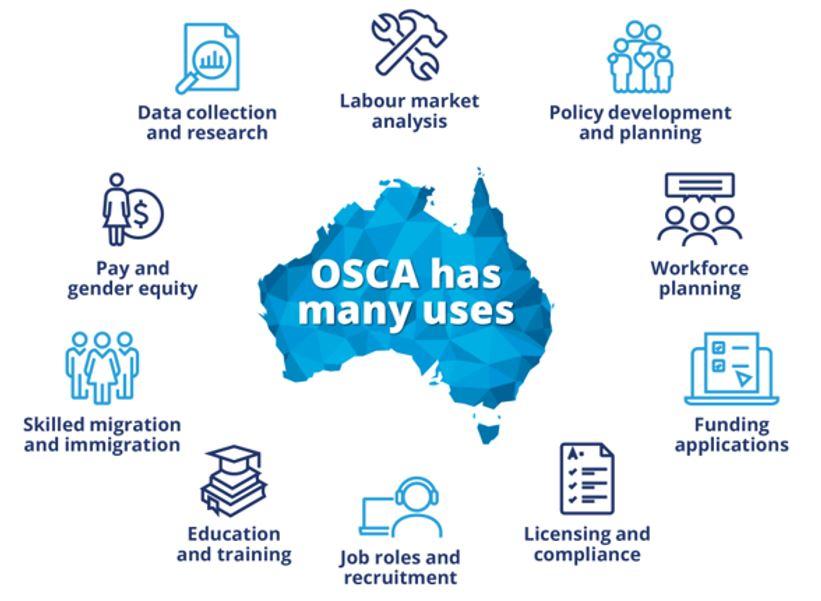
| OSCA has many uses | |
|---|---|
| Data collection and research | Licensing and compliance |
| Ensures consistency in the collection and reporting of job data. ABS collections include the Census of Population and Housing, Labour Force, Australia and Employee Earnings and Hours survey | Provides clear definitions of occupations, their tasks, and required skills enable licensing bodies to assess compliance with legal professional standards |
| Labour market analysis | Job roles and recruitment |
| Used by Jobs and Skills Australia (JSA) to track employment trends, skill shortages and workforce demographics | Used by employers to match candidates to roles based on skill levels and qualifications, supporting clearer role descriptions |
| Policy development and planning | Education and training |
| Supports government decisions on Vocational Education and Training (VET) or skilled migration programs | Aligning skill levels with qualifications, OSCA helps define career pathways and training programs to meet industry and regulatory standards |
| Workforce planning | Skilled migration and immigration |
| Provides occupational data that helps governments and industries identify skills shortages and plan for future labour needs. It informs Jobs and Skills Councils' workforce plans reported to Jobs and Skills Australia. | Provides clearer, Australia-specific occupation definitions that better reflect labour market needs, making it easier for visa applicants to match their qualifications and experience to eligible roles |
| Funding applications | Pay and gender equity |
| Offers a standardised way to describe occupations, which supports evidence-based cases for workforce development and training grants | Provides greater visibility and granularity of detail for occupations with a higher proportion of females |
Adoption of OSCA
How OSCA is used
OSCA will be progressively adopted across government. While the ABS is responsible for maintaining OSCA, it is not responsible for adoption of OSCA by external stakeholders. The ABS encourages adoption of OSCA in key policy and administrative contexts such as skills priority lists, visa programs, tax data systems and skills assessment services. Some examples of OSCA adoption are provided below.