Jobs and Income of Employed Persons TableBuilder provides data in two main categories: Persons and Jobs.
Person level data:
- Demographic information
- Geographic information
- Employee characteristics
- Income
- Migrant characteristics
Job level data:
- Job characteristics
- Employer characteristics
- Income
From the 2022-23 reference year additional categorical data items were created to indicate applicable population status for continuous data items.
The following spreadsheet contains the full Jobs and Income of Employed Persons data item list. Data items from the LEED which are not included in the TableBuilder product, may be available on request. For inquiries about these and related statistics, contact the Customer Assistance Service via the ABS website Contact Us page. The ABS Privacy Policy outlines how the ABS will handle any personal information that you provide to us.
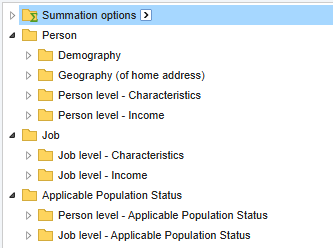
Data items are grouped under broad headings and subheadings, as shown in the image below. These groups expand further for more specific and detailed analysis.
Summation options
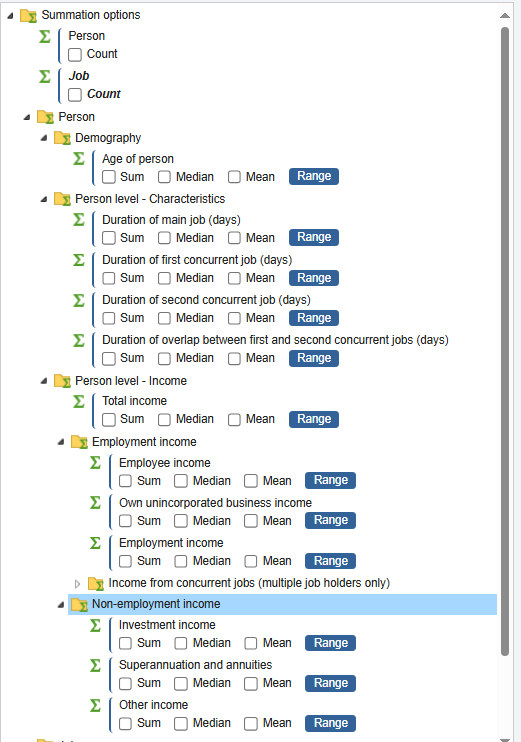
Summation options are built in to allow you to choose the type of information displayed in the table. These options include sum, mean and median for income based variables, measures of job duration, overlap between jobs, and age, as well as the basic summation options choosing between job and person counts.
The level relevant to each data item, persons or jobs, should be kept in mind when extracting and analysing data. The actual population count for each data item is equal to the total cumulative frequency minus the Not applicable category.
The expanded Job level summation options are pictured below:
Geography
All geographic information in the LEED is based on a person’s home address as reported on their Individual Tax Return form. Addresses are coded to the 2021 Australian Statistical Geography Standard, for Statistical Areas, State Electoral Divisions and Commonwealth Electoral Divisions. Addresses are coded to the 2023 standard for Local Government Areas. Information is also available for the Socio-Economic Indexes for Areas decile of a person's Statistical Area Level 2 (SA2) region. If a geography variable is missing, if possible it is imputed from the individual's most recent Pay As You Go (PAYG) payment summary.
Industry
Industry is available at Broad and Fine levels (Industry divisions, subdivisions, groups and classes). Industry information is either provided by the Australian Business Register or determined through the profiling process. An entity is classified to an industry using the Australian and New Zealand Standard Industrial Classification.
Occupation
Occupation of main job is classified by Occupation type and Skill level. Occupation classifications refer to the collection of jobs sufficiently similar in title and tasks, skill level and skill specialisation. A person's occupation is identified from the main job on their individual tax return, which is defined by the Australian and New Zealand Standard Classification of Occupations.
Migrants
The Migrant data used in LEED are sourced from the Person Level Integrated Data Asset (PLIDA). The Migrant data are a suite of administrative datasets (visa grants and settlements database) from the Department of Home Affairs. These data pertain to permanent migrants and temporary entrants to Australia, as well as Australian citizens who have travelled into or out of Australia. For more information on the migrants' variables in this TableBuilder product, see the Jobs in Australia and Personal Income in Australia methodologies.
Missing
The Missing category represents the number of incomplete records for which the data items are not present due to administrative tax data constraints and the linking and imputation processes.
Not applicable
The Not applicable category generally represents the population excluded from a derived data item. For example, the maximum number of concurrent jobs is not applicable for people without a second job.