Tourism Satellite Account

Latest release

Estimates of tourism’s direct contribution to the economy including GDP, value added, employment and consumption by product and industry

Reference period
2024-25 financial year
Release date and time
17/12/2025 11:30am AEDT

Key statistics

In 2024-25,

  • tourism gross domestic product (GDP) was $81.1b in current prices
  • tourism GDP rose 0.7% in chain volume terms
  • international tourism consumption rose by $2.6b in chain volume terms
  • domestic tourism consumption rose by $1.2b in chain volume terms
  • tourism filled jobs rose 2.0% to 696,000.

Key tourism events in Australia, 2024-25

  • Tourism growth was driven by increases in short-term international visitors.
  • Domestic tourism growth slowed, with fewer overnight trips, offset by a higher number of day trips.
  • Food and beverages, and takeaway and restaurant meals were the products with the highest growth due to the increase in day trips and increasing prices.
  • The Accommodation industry drove the increase in jobs. A number of new large-scale hotels opened during 2024-25.
  • Domestic airline closures impacted transport jobs.
Key tourism indicators, comparison of 2024-25 with 2023-24(a)
  2023-24
($m)
2024-25
($m)
Change
(%)
Gross Domestic Product (GDP)Current prices78,17981,1393.8
Chain volume measures78,17978,7420.7
Gross Value Added (GVA)Current prices66,95769,5163.8
Chain volume measures66,95767,4680.8
Domestic consumption in purchasers' pricesCurrent prices165,693168,8421.9
Chain volume measures165,693166,9220.7
International consumption in purchasers' pricesCurrent prices38,41242,29410.1
Chain volume measures38,41241,0056.8
Filled jobs '000 6826962.0

(a) As the reference period for chain volume measures is 2023-24, chain volume measures and current prices are identical in 2023-24.
Tourism gross domestic product

Direct tourism

All references to "tourism" are referring to "direct tourism" unless otherwise specified. A direct tourism impact occurs where there is a direct (physical and economic) relationship between the visitor and producer of a good or service. For more information, refer to the Methodology section.

In 2024-25,

  • tourism GDP rose 3.8% to $81.1b in current price terms. Of this, tourism GVA was $69.5b and tourism net taxes on products $11.6b
  • tourism GDP rose 0.7% in chain volume terms and accounts for 2.9% of the economy.

Tourism gross value added

In 2024-25, tourism gross value added in current price terms increased $2.6b (up 3.8%) to $69.5b, the highest level in the time series. The largest contributors to the increase were:

  • Education and training, up $0.6b (+12.8%) to $5.3b
  • Ownership of dwellings, up $0.4b (+5.8%) to $7.7b
  • Other retail trade, up $0.3b (+3.9%) to $8.9b.

(a) Ownership of dwellings in the tourism sector encompasses both the use of vacation homes by their owners and the rental of these properties to tourists. In addition, it includes the leasing of residences to short-term international students and working holidaymakers.

Tourism consumption

In 2024-25,

  • in current prices, domestic consumption increased 1.9% to $168.8b, the highest level in the time series
  • in chain volume terms, domestic consumption increased 0.7%
  • in current prices, international consumption increased 10.1% to $42.3b, the highest level in the time series
  • in chain volume terms, international consumption increased 6.8%. 

Contribution to tourism consumption

  • Food, alcohol and other beverage products rose by $1.0b (4.2%).
  • Takeaway and restaurant meals rose by $1.0b (3.2%).
  • Education services rose by $0.9b (13.4%).

Tourism employment

In 2024-25,

  • tourism accounted for 4.4% of the filled jobs in the whole economy
  • the largest increases in filled jobs occurred in Accommodation (up 11,700 jobs), Education and training (up 3,100 jobs), and Sports and recreation services (up 2,100 jobs)
  • increases were recorded in both full-time filled jobs (up 1.4% to 348,300 jobs) and part-time filled jobs (up 2.7% to 347,700 jobs)
  • filled jobs worked by males increased more than those filled by females with increases of 3.1% to 336,900 jobs and 1.0% to 359,100 jobs respectively.

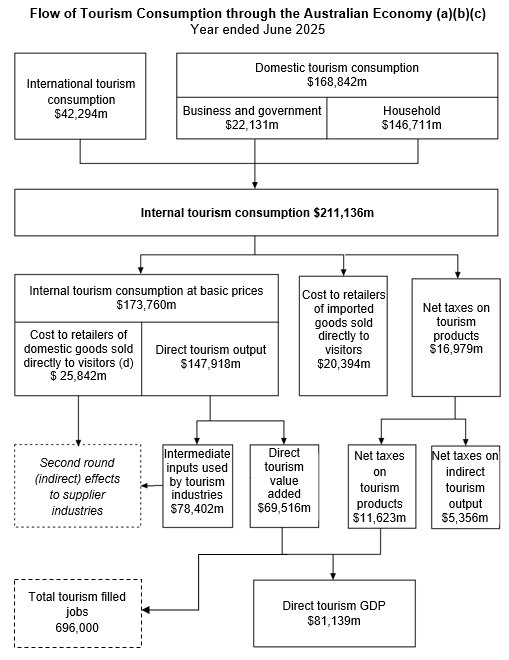
Flow of tourism consumption through the economy

The contribution of tourism to the Australian economy has been measured using the demand generated by visitors and the supply of tourism products by domestic producers.

The diagram below provides a graphical depiction of the flow of tourism consumption through the Australian economy in 2024-25. What the diagram highlights is that, unlike traditional ANZSIC industries in the Australian National Accounts, tourism is not measured by the output of a single industry, but rather from the demand side i.e. the activities of visitors. It is the products that visitors consume that define what the tourism economy produces. The diagram shows how the value of internal tourism consumption (as measured by the sum of international and domestic tourism consumption in purchasers' prices, that is, the price the visitor pays) is disaggregated to either form part of tourism GVA/tourism GDP, is excluded as it forms part of the "second round" indirect effects of tourism, or is output that was not domestically produced.

The image is a graphical depiction of the flow of tourism consumption through the Australian economy.

A flow chart representing the flow of tourism consumption through the Australian economy, year ending June 2025. Note, totals may not add due to rounding; tourism consumption is measured in purchasers’ prices unless otherwise specified. Other monetary aggregates are measured in basic prices; all figures in this diagram are in current price terms unless otherwise specified. Domestic tourist consumption to the value of $168,842 million is comprised of business and government, to the value of $22,131 million, and household, to the value of $146,711 million. International tourism consumption, to the value of $42,294 million, combines with domestic tourist consumption to create internal tourism consumption, to the value of $211,136 million. Internal tourism consumption splits into three values; internal tourism consumption at basic prices, to the value of $173,760 million; cost to retailers of imported goods sold directly to visitors, to the value of $20,394 million, and net taxes on tourism products to the value of $16,979 million. Internal tourism consumption at basic prices is comprised of cost to retailers of domestic goods sold directly to visitors, including wholesale and transport margins supplied domestically, to the value of $25,842 million; and direct tourism output, to the value of $147,918 million. Direct tourism output flows into two values; intermediate inputs used by tourism industries, to the value of $78,402 million; and direct tourism value added, to the value of $69,516 million. Cost to retailers of domestic goods sold directly to visitors and intermediate inputs used by tourism industries connect to second round (indirect) effects to supplier industries. Net taxes on tourism products flows into two values; net taxes on tourism products, to the value of $11,623 million; and net taxes on indirect tourism output to the value of $5,356 million. Direct tourism value added and net taxes on tourism products combine to create direct tourism GDP, to the value of $81,139 million. Direct tourism value added is used to estimate total tourism employment, to the value of 696,000 filled jobs.

Changes in this issue

Transition from the National Visitor Survey to Domestic Tourism Statistics

The 2024–25 TSA is the first to incorporate the Domestic Tourism Statistics (DoTS) dataset, replacing the previously used National Visitor Survey (NVS). To maintain a consistent time series, DoTS estimates have been backcasted, resulting in revisions to the TSA data series.

Due to data limitations and the complexity of measuring differences in visitor expenditure caused by methodological changes, caution is advised when interpreting comparisons that include backcasted spend data, particularly at detailed product and industry levels.

Changes to Tourism Employment Ratios

Enhancements have been made to employment ratios for the education and sports and recreation industries to better reflect their relevance to the visitor economy. These improvements ensure the ratios more accurately represent tourism-related employment.

For further details on these changes, refer to the History of changes section in the Methodology.

Tourism industry classification changes

All other industries has been changed to Other tourism Industries.

Data downloads

Tourism Satellite Account data cubes

Data are in current prices unless specified

Data files

Inquiries

For further information about these and related statistics, please contact the Customer Assistance Service via the ABS website Contact Us page. The ABS Privacy Policy outlines how the ABS will handle any personal information that you provide to us. 

Previous catalogue number

This release previously used catalogue number 5249.0.

Back to top of the page