Latest release

Household surveys

Labour Statistics: Concepts, Sources and Methods
Reference period
2023

Household surveys and population censuses constitute the primary sources of ABS labour statistics on people and households. In addition to information about current and previous labour force participation, information collected also includes demographic data, such as age, sex, family characteristics and country of birth. Labour statistics collected about people provide insight into the supply of labour to the Australian labour market.

Household surveys falling within the labour statistics program include:

The ABS household survey program also includes other social surveys that contain a labour force status module. Other labour-related data include:

For specific information on each of these surveys, refer to the relevant methodology pages for each statistical release.

Scope and coverage

Collection methodologies

Sample design

MPS and SSS master samples

Benchmarks

Non-response

Labour Force Survey

The Labour Force Survey (LFS) provides Australia's official measure of employment, unemployment and labour force participation. The data captured in this survey are some of Australia’s key economic statistics, providing insight into the Australian economy and Australian people.

About the Labour Force Survey

The Labour Force Survey
FrequencyMonthly
Responding sample sizeApprox. 26,000 households (52,000 people)
ScopeUsual resident civilians 15 years and over
Response rateApprox. 93%
PublicationLabour Force, Australia; Labour Force, Australia - Detailed; Labour Force Status of Families, Australia; Longitudinal Labour Force, Australia;
Data availabilityQuarterly from 1966-1977 and monthly from 1978 onwards; Longitudinal Labour Force, Australia is available monthly from October 1982

Each month, The LFS collects data on the labour force activity of persons around 52,000 people in 26,000 households. The information is collected through a household sample survey conducted by trained interviewers either face-to-face or over the phone, or via online self-completion form. The survey is detailed, including around 70 questions.

The scope of the LFS is limited to the usually resident civilian population of Australia, aged 15 years and over. As such, the survey includes residents who are temporarily overseas (less than 6 weeks), but excludes members of the permanent defence forces. The ABS then weights the people in the survey sample to the most recent population figures, to provide a representative picture of the whole population.

In addition to data on employment and unemployment, the LFS also collects information on underutilisation, hours worked, job searching and retrenchments, as well as socio-demographic characteristics.

The Labour Force Survey Standard Products and Data Item Guide is a useful reference for users seeking different data variables from the Labour Force Survey. The guide is divided into two sections:

  • Section 1: Labour Force Survey standard product data - The first section alphabetically lists and explains the data items in Labour Force Survey standard products and where to find them.
  • Section 2: Detailed information on Labour Force Survey standard products - The second section lists the Labour Force Survey standard products, and specifies the data items contained within each spreadsheet and data cube.

Sample rotation

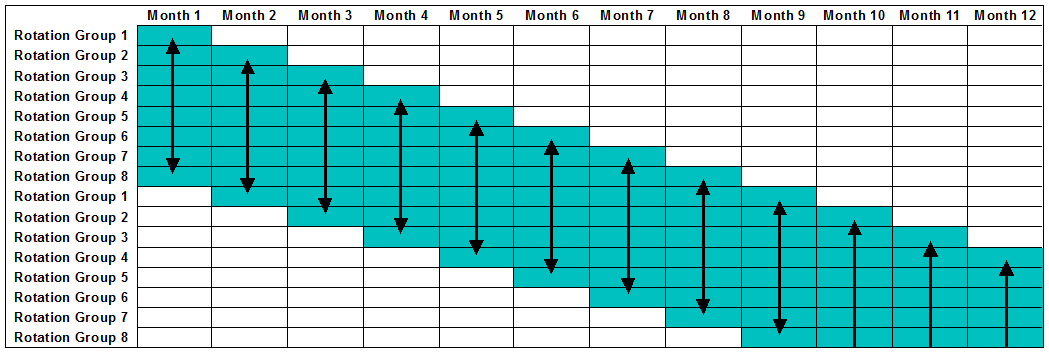
The LFS sample can be thought of as comprising eight sub-samples (or rotation groups), with each subsample remaining in the survey for eight months. A new rotation group is introduced each month to replace an outgoing rotation group, generally from the same geographic area.

Sample rotation enables reliable measures of monthly change in labour force statistics to be compiled, while ensuring the sample reflects changes in the household population.

Figure 1: Sample rotation

Figure 1: Sample rotation
As shown in Figure 1, the LFS sample can be thought of as comprising eight sub-samples (or rotation groups), with each subsample remaining in the survey for eight months. A new rotation group is introduced each month to replace an outgoing rotation group, generally from the same geographic area. Sample rotation enables reliable measures of monthly change in labour force statistics to be compiled, while ensuring the sample reflects changes in the household population.

For more information about the Labour Force Survey, see the Labour Force, Australia methodology page.

Using labour force data

Time-series data

Data collected regularly over time may display seasonal and irregular patterns. This raw data, known as the original series, can be very volatile, making it difficult to identify underlying trends. The ABS therefore publishes two additional data series to aid time-series analysis: seasonally adjusted and trend data in addition to the original (unadjusted) survey estimates.

Trend data helps to determine the underlying path of the series, by smoothing out any irregularities. It is calculated as a 13 month moving average, using data from 6 months prior to and following the reference period.

Seasonally adjusted data has been modified to remove any patterns caused by regularly repeating cycles in the real world, such as the Christmas period, harvesting season, and school holidays. This series aids in short-term forecasting and allows series to be compared between periods; however, can still be volatile.

Reliability

As the LFS is a sample survey, the data are subject to sampling and non-sampling error. The ABS takes data quality seriously and makes every effort to minimise error where possible, achieving a response rate of 93%. While the sample is designed to ensure sampling error is as low as possible at the national and state/territory level, it can be higher for labour force regions or for detailed population breakdowns.

International comparisons of Labour Force Surveys

International comparisons of labour statistics are essential in providing a global context to economic analysis, social research and policy formation and evaluation. When comparing data across countries, consideration must be given to the differences in how labour concepts are measured. Since 1919, the International Labour Organisation (ILO) has maintained and developed a system of international labour standards. The ABS provides data about the Australian labour for to groups such as the Organisation for Economic Co-operation and Development (OECD) and ILO, who collate data from multiple countries on a similar basis to allow such cross-country comparisons to occur.

When comparing data across countries, consideration should also be given to differences in the collection methodologies of each country’s labour force survey.

Comparison of Labour Force Surveys
 AustraliaCanadaNew ZealandUnited KingdomUnited States
SurveyLabour Force SurveyLabour Force SurveyHousehold Labour Force SurveyLabour Force SurveyCurrent Population Survey
OrganisationAustralian Bureau of StatisticsStatistics CanadaStatistics New ZealandOffice for National StatisticsBureau of Labour Statistics
FrequencyMonthlyMonthlyQuarterlyQuarterlyMonthly
ScopeUsually resident, civilians aged 15+Civilian non-institutionalised population aged 15+Usually resident, civilian non-institutional populations aged 15+Permanent residents aged 16-74 yearsUsually resident, civilian non-institutional populations aged 16+
Sample SizeApprox. 26 000 dwellings (52 000 persons)Approx. 56 000 dwellings (100 000 persons)Approx. 15 000 dwellings (30 000 persons)Approx. 40 000 dwellings (100 000 persons)Approx. 60 000 dwellings (112 000 persons)
Population (June, 2016)24.21 mill.36.71 mill.4.70 mill.58.38 mill.325.34 mill.
% population in survey0.21%0.27%0.64%0.17%0.03%
Working age population (2016)0.33%0.42%0.98%0.24%0.05%
Sample rotationRotating panel sample design. Selected households remain in the survey for eight consecutive months. A new rotation group is introduced each month to replace an outgoing group (one-eighth of the sample).Rotating panel sample design. Selected households remain in the survey for six consecutive months. A new rotation group is introduced each month to replace an outgoing group (one-sixth of the sample).Rotating panel sample design. Selected households remain in the survey for eight consecutive quarters. A new rotation group is introduced each quarter, from the same Primary Sampling Unit, to replace an outgoing group (one-eighth of the sample).Rotating panel sample design. Selected households respondents are questioned five times at 13 week intervals (consecutive) and one-fifth of the sample is replaced each quarter.Eight representative rotation groups, each in the sample for eight months total. Each rotation group is included in the sample for two four month periods, separated by an eight month period not in the sample. 75% of the sample is common from month-to-month and 50% one year apart for the same month.
Collection methodologyPersonal interview, telephone interview, and online form. Data is collected for each in-scope household member from 'Any Responsible Adult'.Personal or telephone interview (in English or French). Data collected from a knowledgeable household respondent. Proxy reporting accounts for 65% of collected information.First interview conducted in person with subsequent interviews via telephone, unless personal interview requested by respondent.First interview conducted in person, with subsequent interviews via telephone. 35.0% of the interviews in 2015 were carried out by proxy.Personal interview conducted in first and fifth month (after 8 month dormant period). Other interviews via telephone. Data collected from a responsible adult household respondent.
Response ratesApprox. 93%Approx. 90%Approx. 78%Approx. 49%Approx. 87%
TopicsEmployment, unemployment, underemployment, labour underutilisation, participation, working time, job search, last job and economic inactivity by socio-demographic groups and by region.Employment, unemployment, underemployment, labour underutilisation, working time, weekly earnings and economic inactivity by socio-demographic groups and by Provinces.Employment, unemployment, underemployment, labour underutilisation, working time and economic inactivity by socio-demographic groups and by region.Employment, unemployment, underemployment, labour underutilisation and economic inactivity by socio-demographic groups.Employment, unemployment, underemployment, labour underutilisation, working time and economic inactivity by socio-demographic groups and by States.

For more information on Labour Force Surveys in other countries, see:

For further information, please email labour.statistics@abs.gov.au

Labour force supplementary surveys

A supplementary topic was included with the Labour Force Survey (LFS) for the first time in November 1961, and this concept was gradually extended so that the majority of months in each year included supplementary questions on one or more topics.

Each Labour Force Supplementary Survey (LFSS) comprises a series of additional questions asked at the end of each LFS interview. The survey methodology does not differ greatly among the supplementary surveys, and in many aspects is the same as the LFS methodology (outlined in the section: Labour Force Survey). This section describes the broad survey methodology of the supplementary surveys. They should be used in conjunction with the subsections of this section, which outline elements of the methodology which are unique to each supplementary survey.

From July 2014, the ABS improved and consolidated the content of the LFS and labour supplementary surveys. See Information Paper: Outcomes of the Labour Household Surveys Content Review, 2012 and Forthcoming changes to ABS Labour Force and Supplementary Surveys for more information.

The Characteristics of Employment Survey (COE) combines the key elements from the previous separate Employee Earnings, Benefits and Trade Union Membership Survey (EEBTUM), Forms of Employment Survey (FOES) and Working Time Arrangements Survey, to provide a comprehensive and coherent dataset on characteristics of persons' employment.

The Participation, Job Search and Mobility (PJSM) Survey combines the key elements from the previous separate Persons Not in the Labour Force Survey (PNILF), Underemployed Workers Survey (UEW), Job Search Experience Survey (JSE) and Labour Mobility Survey (LM), to provide a comprehensive and coherent dataset on persons' experiences relating to job search, job change and increasing participation.

Objectives of the labour force supplementary surveys

The LFSSs form an important component of the ABS's household surveys program, which aims: 

  • to provide a range of statistics required to monitor the social and economic wellbeing of Australians, with particular reference to important sub-groups of the population; and
  • to support the development, implementation and evaluation of policies and programs of key Commonwealth and State government agencies.

The information requirements of ABS household surveys are determined on the basis of submissions from users on their needs for and uses of household survey data. They also reflect ABS deliberations on what is required of a national statistics program in the various subject fields, based on user contact and consultation.

In the field of labour statistics, supplementary surveys provide detailed information on a range of labour topics and interest groups such as:

  • labour force - labour force experience,
  • employment - underemployment; multiple job holding; forms of employment,
  • employees - earnings; trade union membership; benefits; and working arrangements,
  • unemployment - job search experience; successful and unsuccessful job search,
  • persons not in the labour force - discouraged job seekers; other persons with marginal attachment to the labour force, and
  • persons retrenched or made redundant from work.

Current supplementary survey statistical releases

Publication FrequencyDescription
Characteristics of Employment, Australia AnnualThe Characteristics of Employment (COE) survey is conducted annually in August as a supplement to the monthly Labour Force Survey (LFS). From 2020, statistics from COE are published in three topic-based releases. Data from the biennial labour hire workers module in COE contributes to the multi-source Labour Hire Workers publication.
 Employee earningsAnnual 
 Working arrangementsAnnual 
 Trade union membershipBiennial 
Participation, Job Search and Mobility, Australia AnnualThe Participation, Job Search and Mobility (PJSM) survey is conducted annually in February as a supplement to the monthly Labour Force Survey (LFS). From 2021, statistics from PJSM are published in three topic-based releases.
 Potential workersAnnual 
 Job mobilityAnnual 
 Underemployed workersAnnual 
Education and Work, Australia AnnualThe Survey of Education and Work (SEW) is conducted annually in May as a supplement to the monthly Labour Force Survey (LFS). 

Historical supplementary survey statistical releases

PublicationCatalogue NumberDescription
Employee Earnings, Benefits and Trade Union Membership, Australia6310.0This product has been replaced by Characteristics of Employment. Archive of statistics from this survey is available from 1975-2013.
Forms of Employment, Australia6359.0This product has been replaced by Characteristics of Employment. Australia. Archive of statistics from this survey is available from 1998-2013.
Locations of Work, Australia6275.0This product has been replaced by Characteristics of Employment. Archive of statistics from this survey is available from 1989-2008.
Working Time Arrangements, Australia6342.0This product has been replaced by Characteristics of Employment. Archive of statistics from this survey is available from 1993-2012.
Job Search Experience, Australia6222.0This product has been replaced by Participation, Job Search and Mobility, Australia. Archive of statistics from this survey is available from 1976-2013.
Labour Force Experience, Australia6206.0This product has been replaced by Participation, Job Search and Mobility, Australia. Archive of statistics from this survey is available from 1968-2011.
Labour Mobility, Australia6209.0This product has been replaced by Participation, Job Search and Mobility, Australia. Archive of statistics from this survey is available from 1972-2013.
Persons Not in the Labour Force, Australia6220.0This product has been replaced by Participation, Job Search and Mobility, Australia. Archive of statistics from this survey is available from 1975-2013.
Persons Not in the Labour Force, Underemployed Workers and Job Search Experience, Australia6226.0.55.001This product has been replaced by Participation, Job Search and Mobility, Australia. Originally, this product replaced the publications in 2014: Persons Not in the Labour Force, Australia; Underemployed Workers, Australia; and Job Search Experience, Australia.
Underemployed Workers, Australia6265.0This product has been replaced by Participation, Job Search and Mobility, Australia. Archive of statistics from this survey is available from 1985-2013.
Characteristics of Recent Migrants, Australia6250.0Survey was last conducted in 2020.
Child Employment, Australia6211.0Survey was last conducted in 2006.
Multiple Jobholding, Australia6216.0Survey was last conducted in 2001. This product has been replaced by Multiple job-holders, which is a multi-source release, combining data from the Labour Force Survey, the Australian Labour Account and Jobs in Australia.
Pregnancy and Employment Transitions, Australia4913.0Survey was last conducted in 2017.

Labour Multipurpose Household Survey topics

The Multipurpose Household Survey (MPHS) was introduced in 2004–05. The MPHS is conducted each financial year throughout Australia as a supplement to the ABS' monthly Labour Force Survey (LFS). The MPHS topic questions are asked each month from July to June in a personal interview. The MPHS is designed to provide statistics annually for a number of small, self-contained topics.

The MPHS collects detailed information on a number of labour market issues, including:

In addition to the labour-related topics mentioned above, the MPHS program also includes other social topics not related to labour statistics, such as:

  • Crime victimisation;
  • Participation in sport and physical activity;
  • Environmental views and behaviours;
  • Patient experiences in Australia; and
  • Household use of information technology.

For all MPHS topics, general demographic information such as age, sex, labour force characteristics, education and income are also available.

This section describes the broad survey methodology of the MPHS. For information on the four labour related MPHS topics that have been conducted to date, see the following sub sections: Barriers and Incentives to Labour Force Participation; Retirement and Retirement Intentions; Work-Related Injuries; and Qualifications and Work.

Objectives of the Multipurpose Household Survey

The MPHS topics are an important part of the ABS household surveys program, which aims to:

  • provide a range of statistics needed to monitor the social and economic wellbeing of Australians, with particular reference to important sub-groups of the population; and
  • support the development, implementation and evaluation of policies and programs of key Commonwealth and State government agencies.

The information requirements of MPHS topics are determined on the basis of submissions from users on their needs for, and uses of, household survey data. They also reflect ABS deliberations on what is required of a national statistics program in the various subject fields, based on user contact and consultation.

The MPHS is a flexible multi-topic survey vehicle, which is used to collect and output data in a timely fashion. The MPHS includes a number of topics that require personal interview (rather than using the any responsible adult (ARA) method), and are therefore unsuited to the monthly supplementary survey program. The MPHS has a shorter development and output time than the special social surveys to achieve flexibility in responding to user demands as they arise, and to allow the ABS to respond to emerging demand and contemporary priorities in a timely way (publications are usually available within six months of the completion of data collection).

The MPHS is conducted as a supplement to the monthly LFS. Each month one eighth of the households in the LFS sample are rotated out of the survey. Generally, around 80% of these rotating-out households are then selected for the MPHS each month. In these households, after the LFS has been fully completed for each person in scope and coverage, a person aged 15 years and over is selected at random (based on a computer algorithm) and asked the additional MPHS topic questions in a personal interview. In cases where the MPHS topic is age sensitive, permission is sought from a parent or guardian before conducting the personal interview with a person aged 15 – 17. If permission is not given, the parent or guardian may be asked on behalf of the 15 – 17 year old, but are not asked questions relating to opinions/perceptions.

Unlike LFS which collects information from all members of the household from any responsible adult, the MPHS uses a randomly selected member of the household to answer questions about themselves.

Data are collected using Computer Assisted Interviewing (CAI), whereby responses are recorded directly onto an electronic questionnaire in a notebook during a telephone, face-to-face personal interview or online self-completion.

Data for MPHS topics are collected each month over a financial year. This reduces the impact of any seasonal effects on the data.

Census of Population and Housing

The Census of Population and Housing is conducted every five years to measure the number of people in Australia on Census night, their key characteristics and the households and dwellings in which they live. By collecting lots of information in a standardised way, from the country as a whole, the Census provides a rich and detailed snapshot of Australia. Australia's seventeenth (and most recent) national Census was conducted on 10 August 2021.

The Census and the Labour Force Survey (LFS) both measure information about the labour market activity of persons aged 15 years and over. While both collections measure the same concepts surrounding the labour force in Australia, there are a number of differences between the two that should be considered when comparing the data, as statistics produced from these collections are not the same.

Labour-related topics on the 2016 Census include: labour force status, status in employment, employment type, occupation, industry of employment, hours worked, place of work and method of travel to work. For unemployed persons, information is collected on whether looking for full-time or part-time work.

Purpose of Census and the Labour Force Survey

Understanding differences between the LFS and Census