About the Intergenerational Health and Mental Health Study
Purpose
The Intergenerational Health and Mental Health Study (IHMHS) was the largest health study undertaken by the ABS in Australian history.
National health surveys are globally recognised for their significant role in monitoring population health status and health risk factors, including trends over time. The information collected in the IHMHS provides detailed insights into:
- the impact of mental and behavioural conditions and other long-term health conditions on people in Australia
- the use of health services and barriers to access
- risk factors underlying chronic conditions
- food consumption and physical activity
- undiagnosed health conditions and nutritional deficiencies
- biomedical factors that contribute to poor health outcomes
- lived experiences of suicide and related services.
Over 55,000 Australians took part in the IHMHS between 2020 and 2024. The information collected supports the creation, delivery and evaluation of health policies and research that will help Australians live longer, healthier lives.
Structure
The IHMHS covered all people in Australia, including people living in very remote areas and discrete Aboriginal and Torres Strait Islander communities. It was comprised of seven surveys:
- National Study of Mental Health and Wellbeing (NSMHW) 2020–22
- National Health Survey (NHS) 2022
- National Aboriginal and Torres Strait Islander Health Survey (NATSIHS) 2022–23
- National Nutrition and Physical Activity Survey (NNPAS) 2023
- National Aboriginal and Torres Strait Islander Nutrition and Physical Activity Survey (NATSINPAS) 2023
- National Health Measures Survey (NHMS) 2022–24
- National Aboriginal and Torres Strait Islander Health Measures Survey (NATSIHMS) 2022–24.
Surveys in the IHMHS
Image
Description
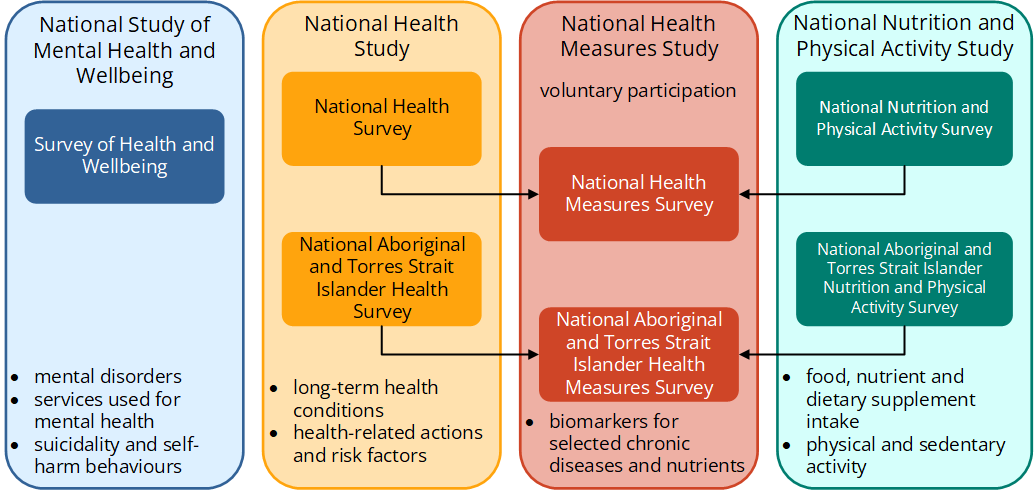
The IHMHS includes seven national surveys grouped into four studies.
- The National Study of Mental Health and Wellbeing includes content on mental disorders, services used for mental health, suicidality and self-harm behaviours.
- The National Health Study includes the National Health Survey and the National Aboriginal and Torres Strait Islander Health Survey. They include content on long-term health conditions, health-related actions, and risk factors.
- The National Nutrition and Physical Activity Study includes the National Nutrition and Physical Activity Survey and the National Aboriginal and Torres Strait Islander Nutrition and Physical Activity Survey. They include content on food, nutrient and dietary supplement intake, and physical and sedentary activity.
- The National Health Measures Study includes the National Health Measures Survey and the National Aboriginal and Torres Strait Islander Health Measures Survey. They include content on biomarkers for selected chronic diseases and nutrients. It is drawn from voluntary participants from other IHMHS health or nutrition and physical activity studies.
The NHMS 2022–24 was comprised of volunteering participants from either the NHS 2022 or the NNPAS 2023. The NATSIHMS 2022–24 was comprised of volunteering participants from either the NATSIHS 2022–23 or the NATSINPAS 2023.
There is no Aboriginal and Torres Strait Islander peoples component for the NSMHW 2020–22.
History of collection
The ABS previously conducted a similar set of surveys as part of the Australian Health Survey 2011–13. This collection was similar in size and scope, but did not include a survey designed specifically to collect information on mental disorders and their impacts. For more information, see Australian Health Survey: Users' Guide 2011–13 (cat. no. 4363.0.55.001).
The ABS has also conducted some components of the IHMHS individually on previous occasions. The NHS was conducted on a 3-year cycle between 2001 and 2022. Prior to this, it was conducted in 1989–90 and 1995. The NATSIHS has been previously conducted in 2018–19, 2012–13, and 2004–05. The NHS 2001 also included an Aboriginal and Torres Strait Islander sample.
Other IHMHS surveys are not collected regularly. Nutrition and physical activity surveys (NNPAS and NATSINPAS), and health measures surveys (NHMS and NATSIHMS) were last conducted in 2011–12. The NSMHW was last conducted in 2007.
National Health Survey 2022
The National Health Survey 2022 was conducted from January 2022 to April 2023 and is the most recent in a series of Australia-wide health surveys. Data was collected people aged zero years and over across Australia, excluding very remote areas and discrete Aboriginal and Torres Strait Islander communities.
The survey focused on the health status of Australians and health-related aspects of their lifestyles. Information was collected on long-term and chronic health conditions, as well as health risk factors such as smoking and vaping, alcohol consumption, and physical activity.
Prescription medications data was sourced from the Pharmaceutical Benefits Scheme (PBS) through linkage to the Person Level Integrated Data Asset, instead of being collected directly from survey respondents. Appropriate permissions were obtained to source the PBS data for this purpose.
For key statistics, see National Health Survey, 2022.
For more information on the scope, geography, collection method, reporting guidelines used and history of changes, see National Health Survey methodology, 2022.
National Aboriginal and Torres Strait Islander Health Survey 2022–23
The National Aboriginal and Torres Strait Islander Health Survey (NATSIHS) 2022–23 was conducted from August 2022 to March 2024. Data was collected from Aboriginal and Torres Strait Islander people aged zero years and over around Australia, in both non-remote and remote areas, including discrete Aboriginal and Torres Strait Islander communities.
The survey focused on the health of Aboriginal and Torres Strait Islander people and was developed following extensive consultation to identify priority data requirements and data gaps. Information was collected on long-term and chronic health conditions, as well as health risk factors such as smoking and vaping, alcohol consumption, and physical activity.
The survey was designed to provide reliable estimates at the national and state/territory levels and by remoteness. Estimates for the Australian Capital Territory are not able to be published separately but are included in national estimates.
For main findings, see National Aboriginal and Torres Strait Islander Health Survey, 2022-23.
For more information on the scope, geography, collection method, reporting guidelines used and history of changes, see National Aboriginal and Torres Strait Islander Health Survey methodology, 2022-23.
National Nutrition and Physical Activity Survey 2023
The National Nutrition and Physical Activity Survey (NNPAS) 2023 was conducted from January 2023 to March 2024 and collected information from people aged two years and over across Australia, excluding very remote areas and discrete Aboriginal and Torres Strait Islander communities.
Information was collected about nutritional intakes (including foods, nutrients and dietary supplements consumed) using dietary recall and additional self-reported questions.
Dietary intake information was collected using Intake24, which is a dietary recall assessment tool that was modified to reflect Australian conditions. It involves a structured interview, where participants are asked to recall all the food and drinks they consumed in the 24 hours prior to interview.
Participants were asked to complete a second day of dietary recall eight days after their interview. This will support the analysis of:
- usual nutrient intakes
- food consumption against the 2013 Australian Dietary Guidelines.
Physical and sedentary activity information was collected from respondents using a combination of measured and self-reported data. To measure physical and sedentary activity, participants aged 5 years and over were asked to wear an activity wristband. Additional self-report questions were asked of participants about sleep. Children’s self-reported physical and sedentary activity information was also collected.
Similar nutrition and physical activity data was previously collected in the NNPAS 2011–13.
For main findings, see National Nutrition and Physical Activity Survey, 2023.
National Aboriginal and Torres Strait Islander Nutrition and Physical Activity Survey 2023
The National Aboriginal and Torres Strait Islander Nutrition and Physical Activity Survey (NATSINPAS) 2023 was conducted from January 2023 to March 2024. Data was collected from Aboriginal and Torres Strait Islander people aged 2 years and over around Australia, in both non-remote and remote areas, including discrete Aboriginal and Torres Strait Islander communities.
The survey was developed following extensive consultation to identify priority data requirements and data gaps.
Information was collected about nutritional intakes (including foods, nutrients and dietary supplements consumed) of Aboriginal and Torres Strait Islander people. Additional information was collected on:
- access and barriers to healthy and nutritious foods
- access and barriers to drinking tap water
- influences on dietary choices.
Dietary intake information was collected using Intake24, which is a dietary recall assessment tool that was modified to reflect Australian conditions. It involves a structured interview, where participants are asked to recall all the food and drinks they consumed in the 24 hours prior to interview.
Physical and sedentary activity information was collected from respondents using a combination of measured and self-reported data. To measure physical and sedentary activity, participants aged 5 years and over were asked to wear an activity wristband. Additional self-report information was collected from participants on physical and sedentary activity, and sleep.
Similar nutrition and physical activity data was previously collected in the NATSINPAS 2012–13.
For more findings, see National Aboriginal and Torres Strait Islander Nutrition and Physical Activity Survey, 2023.
National Health Measures Survey 2022–24
The National Health Measures Survey (NHMS) 2022–24 was conducted from January 2022 to April 2024 and involved the collection of biomedical samples from participants aged 5 years and over across Australia, excluding very remote areas and discrete Aboriginal and Torres Strait Islander communities.
It measured specific biomarkers for chronic disease and nutrition status, from tests on blood and urine samples from volunteering participants selected in either the National Health Survey 2022 or the National Nutrition and Physical Activity Survey 2023.
Biomarkers collected include:
- chronic disease biomarkers, including tests for diabetes, cardiovascular disease, kidney disease and liver function
- nutrient biomarkers, including tests for iron, folate, vitamin B12, iodine, vitamin D, sodium and potassium levels.
In addition to chronic disease and nutrient biomarkers, the NHMS 2022–24 included tests for per- and polyfluoroalkyl substances, which are chemical contaminants found in the environment.
Participants’ self-reported information on health conditions and health risk factors, such as diet, physical activity and smoking, was taken from their responses in the other IHMHS surveys. For more information, see Overlap between surveys in the IHMHS.
This was the second time the ABS collected voluntary biomedical data in the NHMS. It was previously collected in 2011–13.
For main findings, see National Health Measures Survey, 2022–24.
For more information on the scope, geography, collection method, reporting guidelines used and history of changes, see National Health Measures Survey methodology, 2022–24.
Australian Health Biobank
Participants over the age of 18 in the National Health Survey 2022 and the National Nutrition and Physical Activity Survey 2023 were given the option to provide a sample for storage in the Australian Health Biobank (AHB).
The AHB is funded by the Department of Health and Aged Care who have contracted the Commonwealth Scientific and Industrial Research Organisation (CSIRO) to act as the AHB Custodian. For more information on the AHB, visit the CSIRO Australian Health Biobank webpage.
National Aboriginal and Torres Strait Islander Health Measures Survey 2022–24
The National Aboriginal and Torres Strait Islander Health Measures Survey (NATSIHMS) 2022–24 was conducted from August 2023 to April 2024 and involved the collection of biomedical samples from Aboriginal and Torres Strait Islander participants aged 5 years and over across Australia, in both non-remote and remote areas, including discrete Aboriginal and Torres Strait Islander communities.
It measured specific biomarkers for chronic disease and nutrition status, from tests on blood and urine samples from volunteering participants selected in either the National Aboriginal and Torres Strait Islander Health Survey 2022–23 or the National Aboriginal and Torres Strait Islander Nutrition and Physical Activity Survey 2023.
Biomarkers collected include:
- chronic disease biomarkers, including tests for diabetes, cardiovascular disease, kidney disease and liver function
- nutrient biomarkers, including tests for iron, folate, vitamin B12, iodine, vitamin D, sodium and potassium levels.
Per- and polyfluoroalkyl substances were not tested in this survey following consultation with Aboriginal and Torres Strait Islander people.
Participants’ self-reported information on health conditions and health risk factors, such as diet, physical activity and smoking, was taken from their responses in the other IHMHS surveys. For more information, see Overlap between surveys in the IHMHS.
For main findings, see National Aboriginal and Torres Strait Islander Health Measures Survey, 2022–24.
For more information on the scope, geography, collection method, reporting guidelines used and history of changes, see National Aboriginal and Torres Strait Islander Health Measures Survey methodology, 2022–24.
Overlap between surveys in the IHMHS
Content overlap between the NHS 2022 and the NNPAS 2023
Several topics were collected in both the National Health Survey (NHS) 2022 and the National Nutrition and Physical Activity Survey (NNPAS) 2023. Content common to both surveys is therefore available in the National Health Measures Survey 2022–24. The following diagram shows the overlap in topics between the NHS 2022 and the NNPAS 2023.
Content overlap between the NHS 2022 and the NNPAS 2023
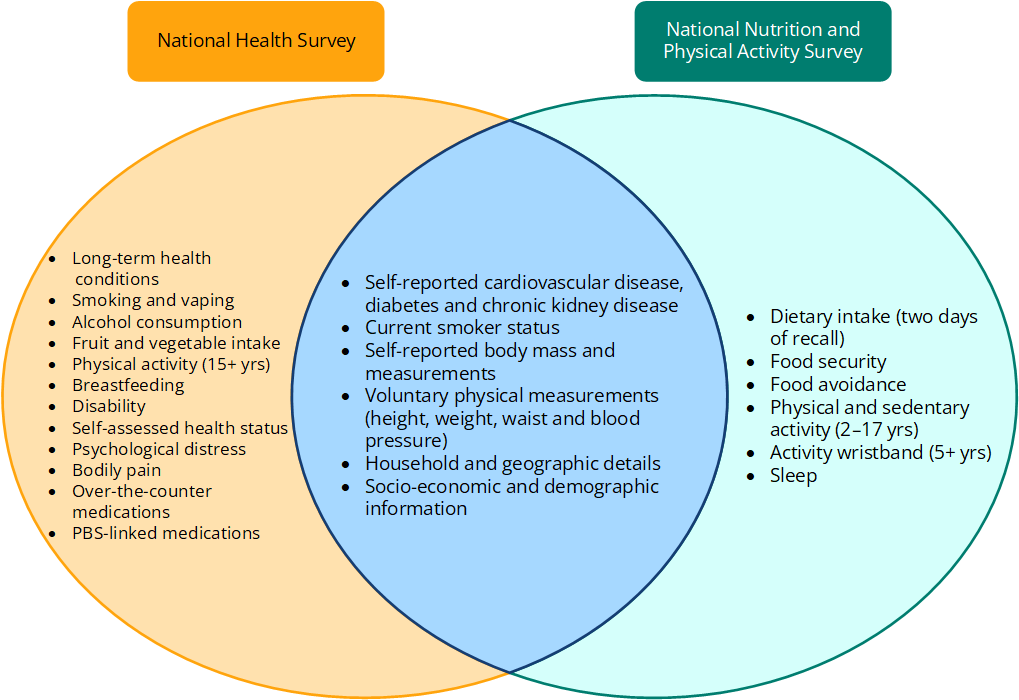
Content that overlaps between the NHS 2022 and the NNPAS 2023 includes:
- self-reported cardiovascular disease, diabetes, and chronic kidney disease
- current smoker status
- self-reported body mass and measurements
- voluntary physical measurements (height, weight, waist and blood pressure)
- household and geographic details
- socio-economic and demographic information.
Content available in the NHS 2022 only includes:
- long-term health conditions
- smoking and vaping
- alcohol consumption
- fruit and vegetable consumption
- physical activity (15+ years)
- breastfeeding
- disability
- self-assessed health status
- psychological distress
- bodily pain
- over-the-counter medications
- PBS-linked medications.
Content available in the NNPAS 2023 only includes:
- dietary intake (two days of recall)
- food security
- food avoidance
- physical and sedentary activity (2–17 years)
- activity wristband (5+ years)
- sleep.
Content overlap between the NATSIHS 2022–23 and the NATSINPAS 2023
Several topics were collected in both the National Aboriginal and Torres Strait Islander Health Survey (NATSIHS) 2022–23 and the National Aboriginal and Torres Strait Islander Nutrition and Physical Activity Survey (NATSINPAS) 2023. Content common to both surveys is therefore available in the National Aboriginal and Torres Strait Islander Health Measures Survey 2022–24. The following diagram shows the overlap in topics between the NATSIHS 2022–23 and the NATSINPAS 2023.
Content overlap between the NATSIHS 2022–23 and the NATSINPAS 2023
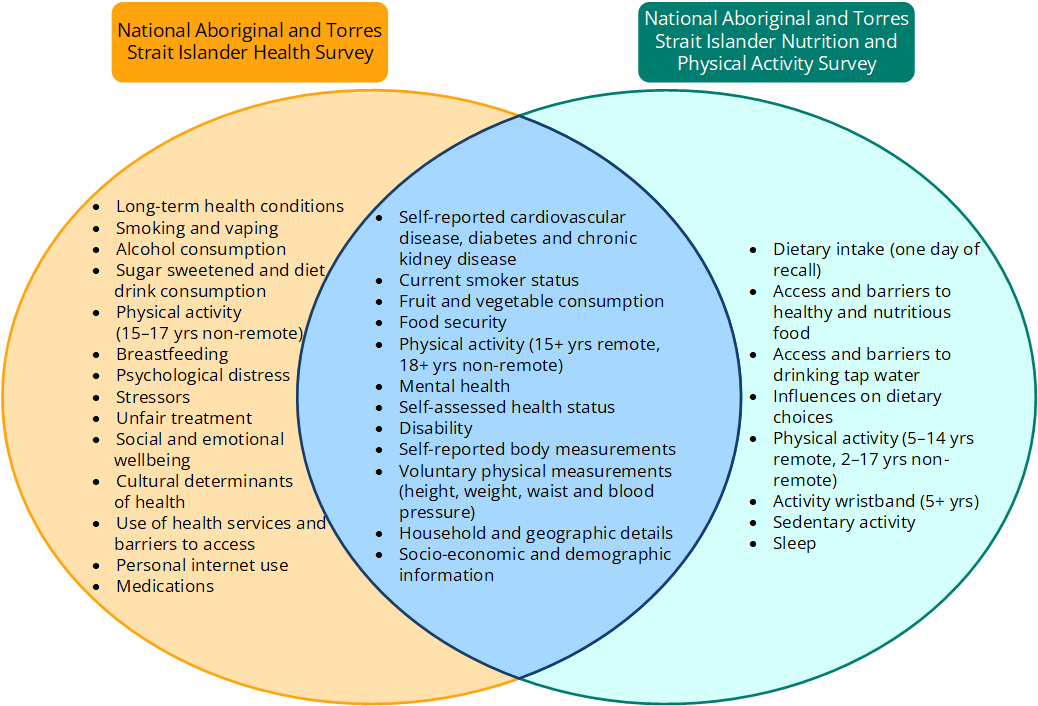
Content that overlaps between the NATSIHS 2022–23 and the NNPAS 2023 includes:
- self-reported cardiovascular disease, diabetes, and chronic kidney disease
- current smoker status
- fruit and vegetable consumption
- food security
- physical activity (15+ years remote, 18+ years non-remote)
- mental health
- self-assessed health status
- disability
- self-reported body measurements
- voluntary physical measurements (height, weight, waist and blood pressure)
- household and geographic details
- socio-economic and demographic information.
Content available in the NATSIHS 2022–23 only includes:
- long-term health conditions
- smoking and vaping
- alcohol consumption
- sugar sweetened and diet drink consumption
- physical activity (15–17 years non-remote)
- breastfeeding
- psychological distress
- stressors
- unfair treatment
- social and emotional wellbeing
- cultural determinants of health
- use of health services and barriers to access
- personal internet use
- medications.
Content available in the NATSINPAS 2023 only includes:
- dietary intake (one day of recall)
- access and barriers to healthy and nutritious food
- access and barriers to drinking tap water
- influences on dietary choices
- physical activity (5–14 years remote, 2–17 years non-remote)
- activity wristband (5+ years)
- sedentary activity
- sleep.
Content comparison between the NHS 2022 and the NATSIHS 2022–23
Whilst content for the NHS 2022 and the NATSIHS 2022–23 were designed separately, and responses were not combined, users may be interested in topics collected in both surveys. The diagram below compares the content between these surveys.
Content comparison between the NHS 2022 and the NATSIHS 2022–23
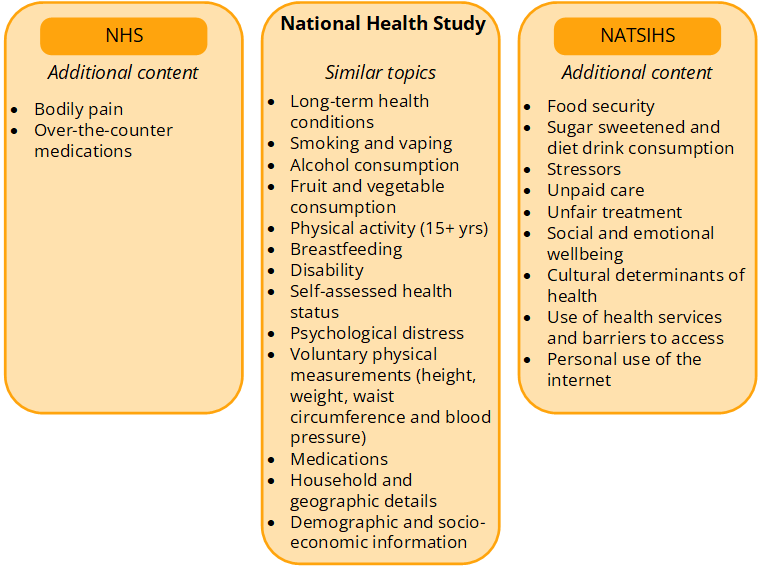
Survey topics that were similar between the NHS 2022 and NATSIHS 2022–23 were:
- long-term health conditions
- smoking and vaping
- alcohol consumption
- fruit and vegetable consumption
- physical activity (15+ years)
- breastfeeding
- disability
- self-assessed health status
- psychological distress
- voluntary physical measurements (height, weight, waist circumference and blood pressure)
- medications
- household and geographic details
- demographic and socio-economic information.
Additional content unique to the NHS 2022 included:
- bodily pain
- over-the-counter medications.
Additional content unique to the NATSIHS 2022–23 included:
- food security
- sugar sweetened and diet drink consumption
- stressors
- unpaid care
- unfair treatment
- social and emotional wellbeing
- cultural determinants of health
- use of health services and barriers to access
- food security
- sugar sweetened and diet drink consumption
- stressors
- unpaid care
- unfair treatment
- social and emotional wellbeing
- cultural determinants of health
- use of health services and barriers to access
- personal use of the internet.
Content comparison between the NNPAS 2023 and the NATSINPAS 2023
Whilst content for the NNPAS 2023 and the NATSINPAS 2023 were designed separately, and responses were not combined, users may be interested in topics collected in both surveys. The diagram below compares the content between these surveys.
Content comparison between the NNPAS 2023 and the NATSINPAS 2023
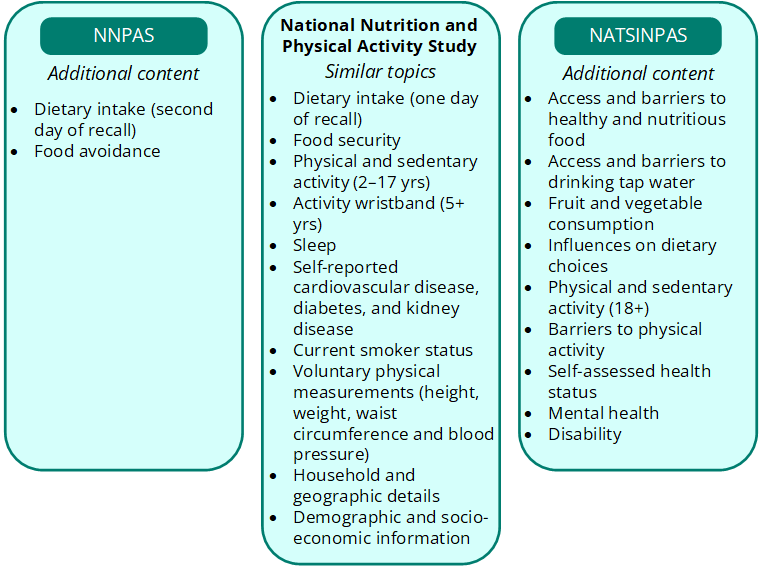
Survey topics that were similar between the NNPAS 2023 and NATSINPAS 2023 were:
- dietary intake (one day of recall)
- food security
- physical and sedentary activity (2-17 years)
- activity wristband (5+ years)
- sleep
- self-reported cardiovascular disease, diabetes, and kidney disease
- current smoker status
- voluntary physical measurements (height, weight, waist and blood pressure)
- household and geographic details
- demographic and socio-economic information.
Additional content unique to the NNPAS 2023 included:
- dietary intake (second day of recall)
- food avoidance.
Additional content unique to the NATSINPAS 2023 included:
- access and barriers to healthy and nutritious food
- access and barriers to drinking tap water
- fruit and vegetable consumption
- influences on dietary choices
- physical and sedentary activity (18+ years)
- barriers to physical activity
- self-assessed health status
- mental health
- disability.
National Study of Mental Health and Wellbeing 2020–22
The National Study of Mental Health and Wellbeing (NSMHW) 2020–22 was run with two cohorts and collected information about mental health prevalence in Australia for people aged 16–85 years. The first cohort was surveyed between December 2020 and July 2021. The second cohort was surveyed between December 2021 and October 2022.
The survey uses the Composite International Diagnostic Instrument (CIDI) 3.0, which is a diagnostic tool developed by the World Health Organization for assessing mental disorders. The CIDI asks respondents about symptoms and experiences over their lifetime as well as in the last 12 months and assesses these against diagnostic criteria for mental disorders.
Key content
- Prevalence of mental disorders
- Use of health and social support services
- Suicidality and self-harm
- Aspects of disordered eating
- General health and wellbeing, including psychological distress, social connectedness, and functioning
- Demographic and socio-economic information
- Household and geographic details
As part of the NSMHW 2020–22, there was a 12-month follow-up phone interview survey for participants who agreed to participate. Respondents were asked about mental health service use and associated outcomes.
There is no Aboriginal and Torres Strait Islander peoples component for this study.
The ABS previously conducted this survey in 2007. The 2020–22 survey is broadly comparable with the 2007 cycle.
For main findings, see National Study of Mental Health and Wellbeing, 2020-2022.
For more information on the scope, geography, collection method, reporting guidelines used and history of changes, see National Study of Mental Health and Wellbeing methodology, 2020-2022.