More information
Example
| Mnemonic | Variable | Release | |
|---|---|---|---|
| CALTHD | Count of adults (15 years and over) with selected long-term health condition(s) in household | June 2022 | New |
| CCLTHD | Count of children with selected long-term health condition(s) in household | June 2022 | New |
| CLTHP | Count of selected long-term health conditions | June 2022 | New |
| COARASP | Whether has arthritis and asthma | June 2022 | New |
| COARDBP | Whether has arthritis and diabetes | June 2022 | New |
| COARHDP | Whether has arthritis and heart disease | June 2022 | New |
| COARMHP | Whether has arthritis and mental health condition | June 2022 | New |
| COASHDP | Whether has asthma and heart disease | June 2022 | New |
| COASLCP | Whether has asthma and lung condition | June 2022 | New |
| COCNHDP | Whether has cancer and heart disease | June 2022 | New |
| CODBHDP | Whether has diabetes and heart disease | June 2022 | New |
| CODBKDP | Whether has diabetes and kidney disease | June 2022 | New |
| COHDKDP | Whether has heart disease and kidney disease | June 2022 | New |
| COHDMHP | Whether has heart disease and mental health condition | June 2022 | New |
| COLCMHP | Whether has lung condition and mental health condition | June 2022 | New |
| CPLTHD | Count of persons with selected long-term health condition(s) in household | June 2022 | New |
| CPLTHRD | Count of persons with selected long-term health condition(s) in household (ranges) | June 2022 | New |
| HARTP | Whether has arthritis | June 2022 | New |
| HASTP | Whether has asthma | June 2022 | New |
| HCANP | Whether has cancer (including remission) | June 2022 | New |
| HDEMP | Whether has dementia (including Alzheimer's) | June 2022 | New |
| HDIAP | Whether has diabetes (excluding gestational diabetes) | June 2022 | New |
| HHEDP | Whether has heart disease (including heart attack or angina) | June 2022 | New |
| HKIDP | Whether has kidney disease | June 2022 | New |
| HLTHP | Whether has one or more long-term health condition(s) | June 2022 | New |
| HLUNP | Whether has lung condition (including COPD and emphysema) | June 2022 | New |
| HMHCP | Whether has mental health condition (including depression or anxiety) | June 2022 | New |
| HOLHP | Whether has other long-term health condition(s) | June 2022 | New |
| HSTRP | Whether has had a stroke | June 2022 | New |
| LTHP | Type of long-term health condition | June 2022 | New |
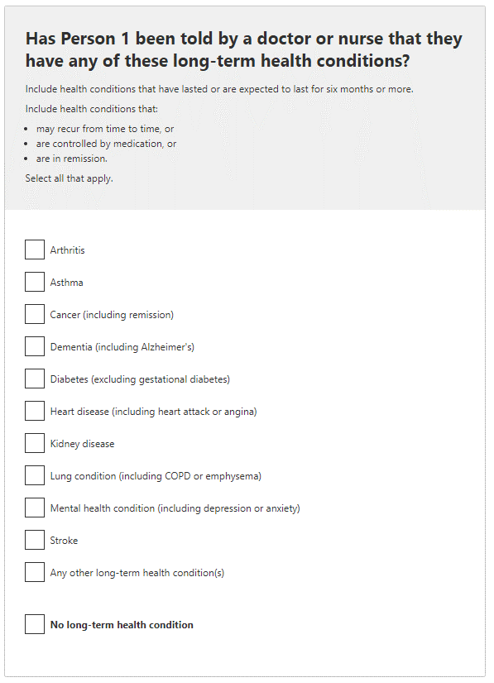
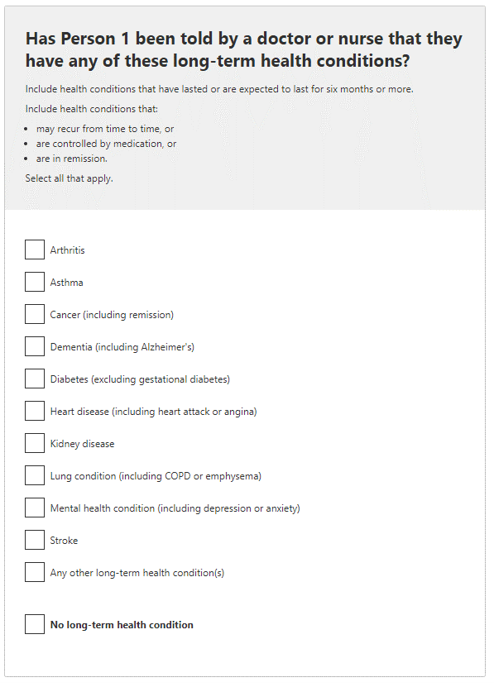
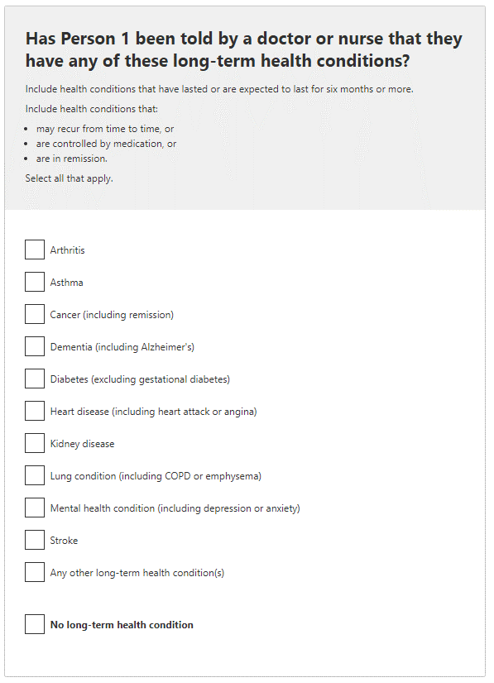
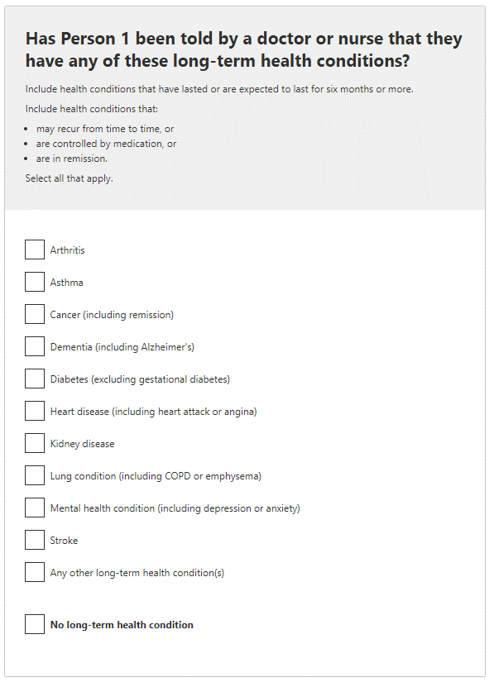
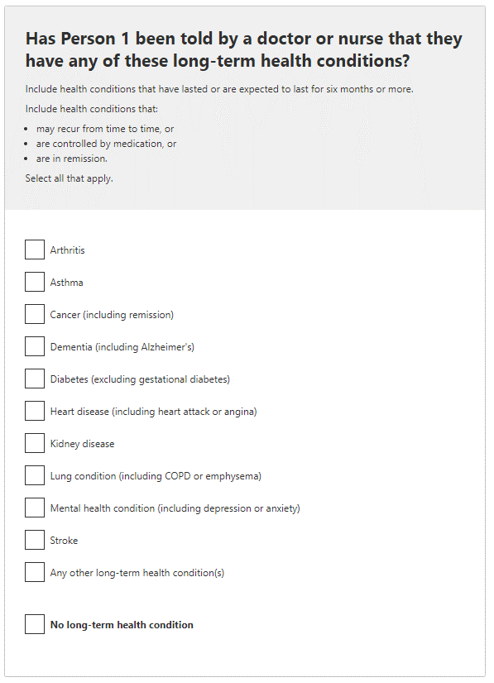
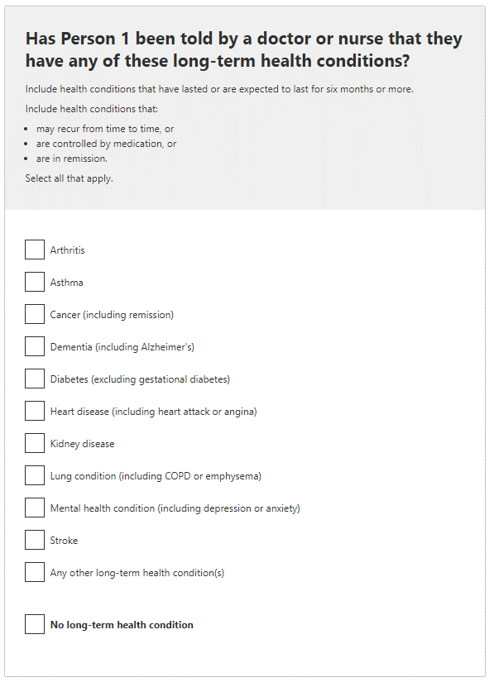
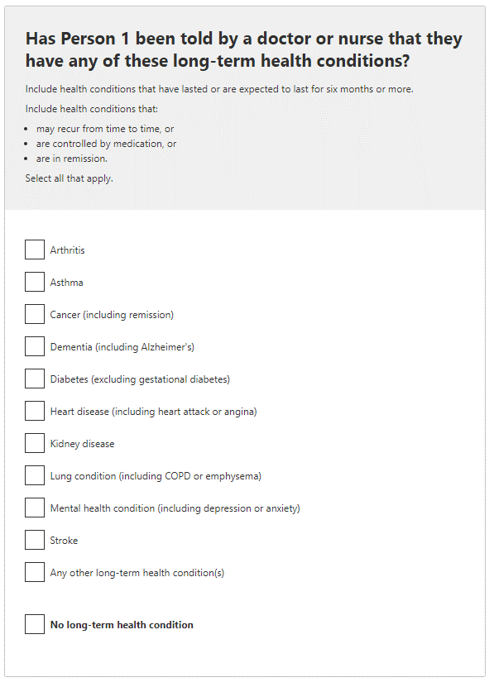
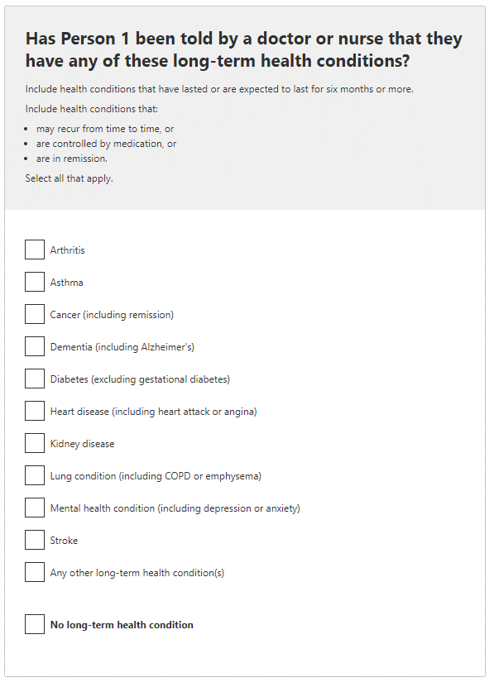
This variable counts the number of adults aged 15 years and over in a household who reported they had at least one of the selected long-term health conditions. Selected long-term health conditions include:
‘Any other long-term health condition(s)’ are excluded from the count.
Occupied private dwellings
| Code | Category |
|---|---|
| 0 | No adults reported a selected long-term health condition |
| 1 | One adult reported a selected long-term health condition |
| 2 | Two adults reported a selected long-term health condition |
| 3 | Three adults reported a selected long-term health condition |
| 4 | Four adults reported a selected long-term health condition |
| 5 | Five or more adults reported a selected long-term health condition |
| 6 | Some adults in household had not stated long-term health condition |
| & | All adults in household not stated |
| @ | Not applicable |
Number of categories: 9
Not applicable (@) comprises:
This variable is derived from responses to the long-term health conditions question and the Age (AGEP) variable. It counts the number of people aged 15 years and over in a household who have marked one of the following long-term health conditions:
If all people aged 15 years or over in the household did not answer the long-term health conditions question, this variable is set to ‘Not stated’.
If some people aged 15 years or over in the household did not answer the long-term health conditions question, this variable is set to category 6, ‘Some adults in household had not stated long-term health condition’.
If a person marks only ‘Any other long-term health condition(s)’, they are not counted as having a long-term health condition in this variable. These people are counted in category 0 'No adults reported a selected long-term health condition'.
Visitor only households and other non-classifiable households are excluded. People away from the dwelling on Census Night are excluded from this variable.
This is a new variable for 2021.
Count of adults (15 years and over) with selected long-term health condition(s) in household (CALTHD) should be used carefully when comparing to other health data from within the ABS and for external organisations or agencies. Relevant definitions and response categories can differ between different statistical collections and may not match Census definitions. For more information, see Comparing ABS long-term health conditions data sources.
This variable does not have a non-response rate as it is created during Census processing by using responses from more than one question on the Census form. The proportion of dwellings where either all people in the household did not answer the long-term health conditions question, or some people in the household did not answer the long-term health conditions question, was 6.3%.
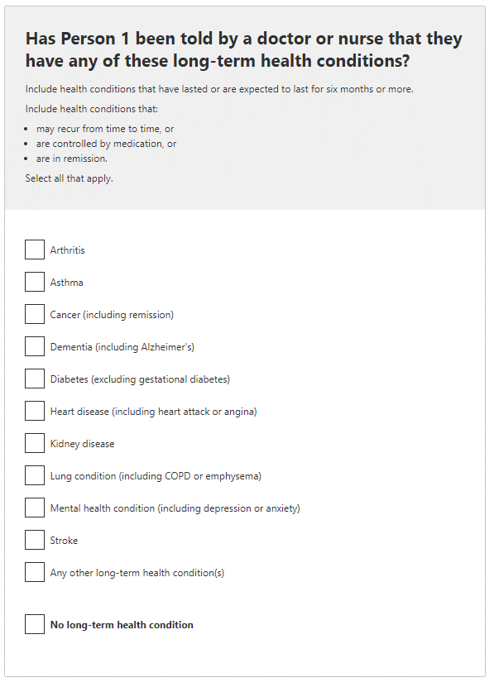
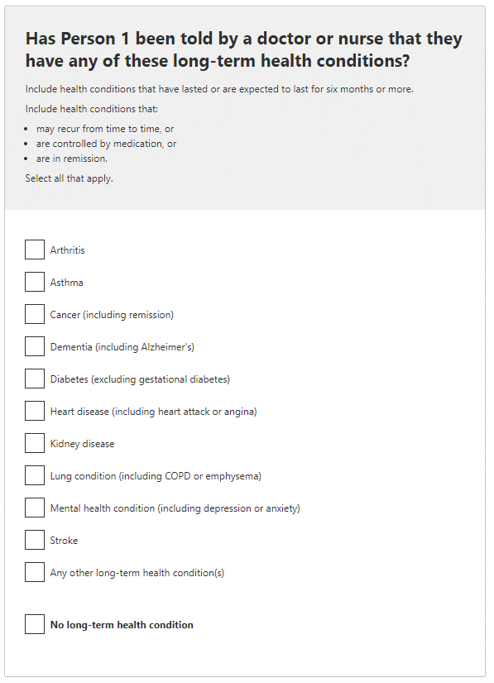
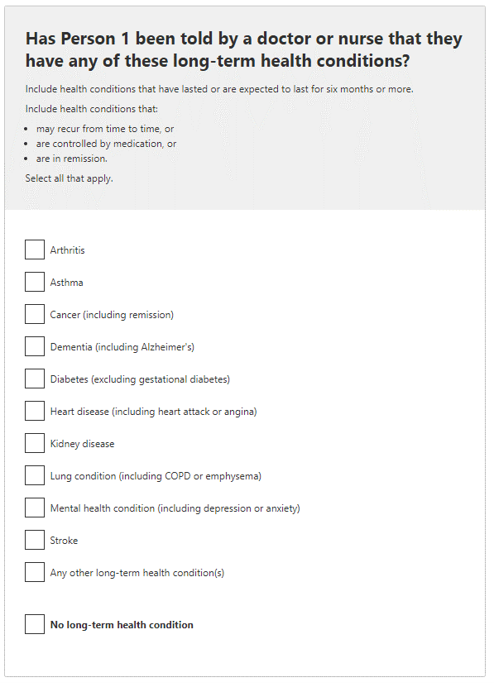
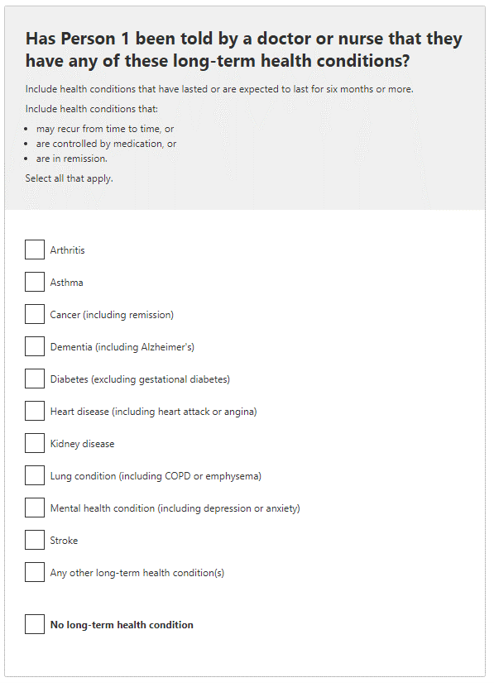
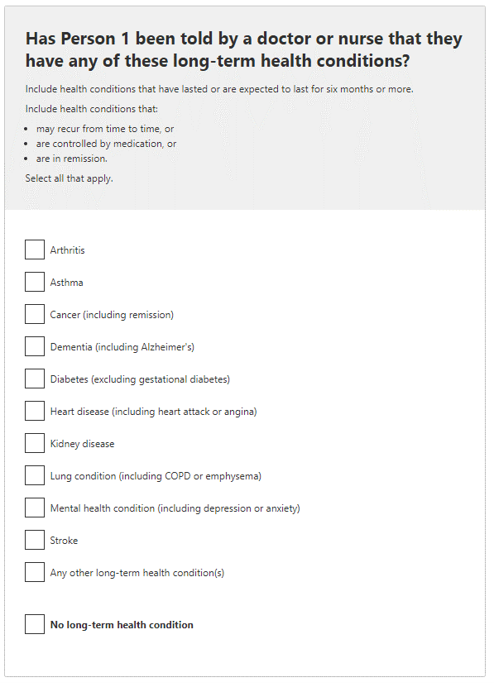
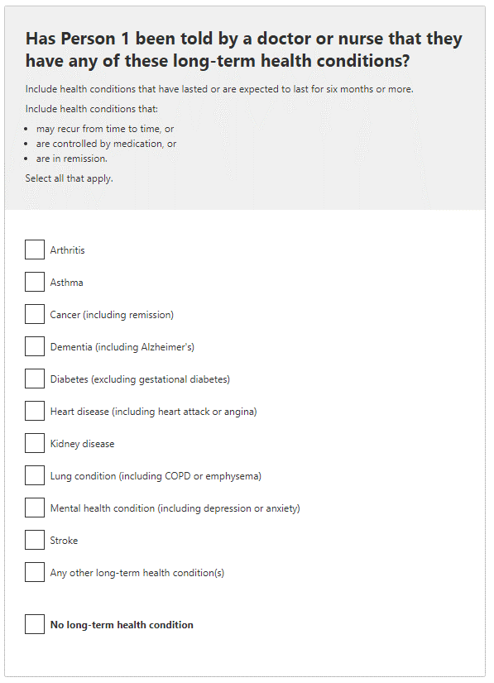
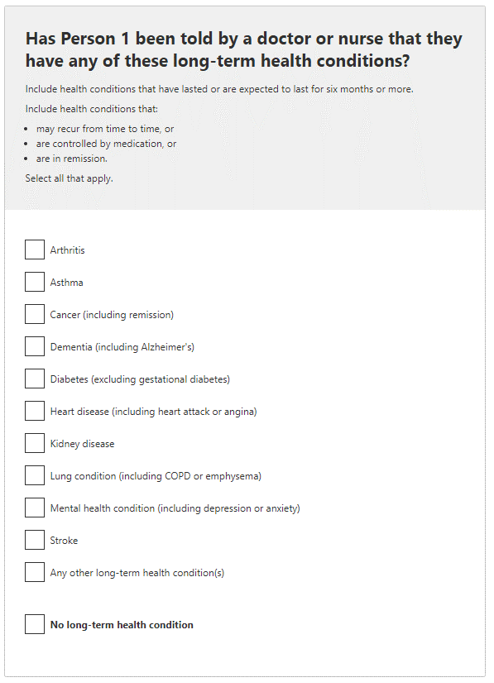
This variable counts the number of children under 15 years in a household who reported they had at least one of the selected long-term health conditions. Selected long-term health conditions include:
‘Any other long-term health condition(s)’ are excluded from the count.
Occupied private dwellings with children
| Code | Category |
|---|---|
| 0 | No children reported a selected long-term health condition |
| 1 | One child reported a selected long-term health condition |
| 2 | Two children reported a selected long-term health condition |
| 3 | Three children reported a selected long-term health condition |
| 4 | Four children reported a selected long-term health condition |
| 5 | Five or more children reported a selected long-term health condition |
| 6 | Some children in household had a not stated long-term health condition |
| & | All children in household not stated |
| @ | Not applicable |
Number of categories: 9
Not applicable (@) comprises:
This variable is derived from responses to the long-term health conditions question and the Age (AGEP) variable. It counts the number of people aged under 15 years in a household who have marked one of the following long-term health conditions:
If all people under 15 years in the household did not answer the long-term health conditions question, this variable is set to ‘Not stated’.
If some people aged under 15 years in the household did not answer the long-term health conditions question, this variable is set to category 6, ‘Some children in household had not stated long-term health condition’
If a person marks only ‘Any other long-term health condition(s)’, they are not counted as having a long-term health condition in this variable. These people are counted in category 0 'No children reported a selected long-term health condition'.
Visitor only households, other non-classifiable households and lone person households are excluded. People away from the dwelling on Census Night are excluded from this variable.
This is a new variable for 2021.
Count of children with selected long-term health condition(s) in household (CCLTHD) should be used carefully when comparing to other health data from within the ABS and for external organisations or agencies. Relevant definitions and response categories can differ between different statistical collections and may not match Census definitions. For more information, see Comparing ABS long-term health conditions data sources.
This variable does not have a non-response rate as it is created during Census processing by using responses from more than one question on the Census form. The proportion of dwellings where either all people in the household did not answer the long-term health conditions question, or some people in the household did not answer the long-term health conditions question, was 5.6%.
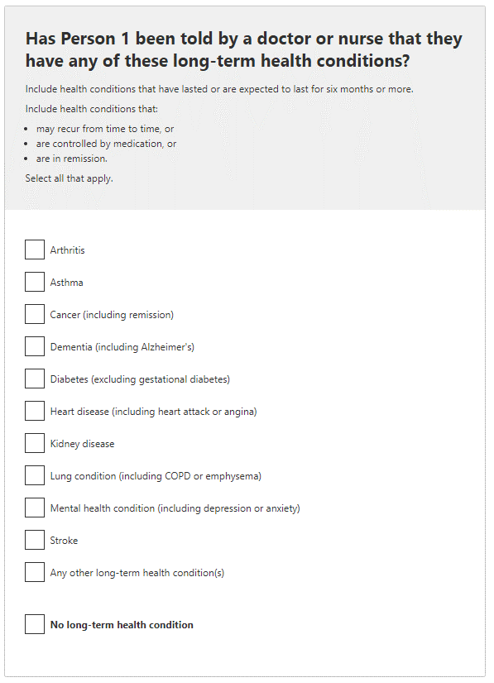
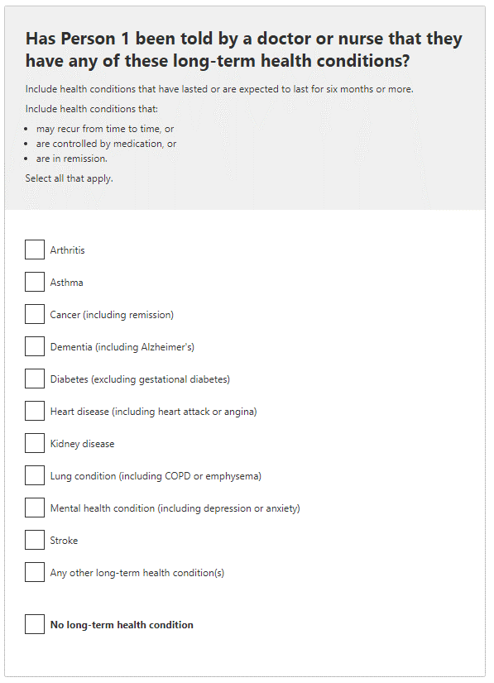
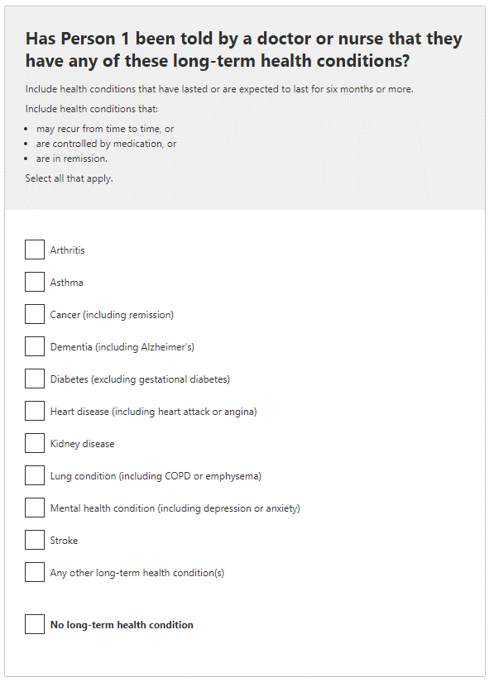
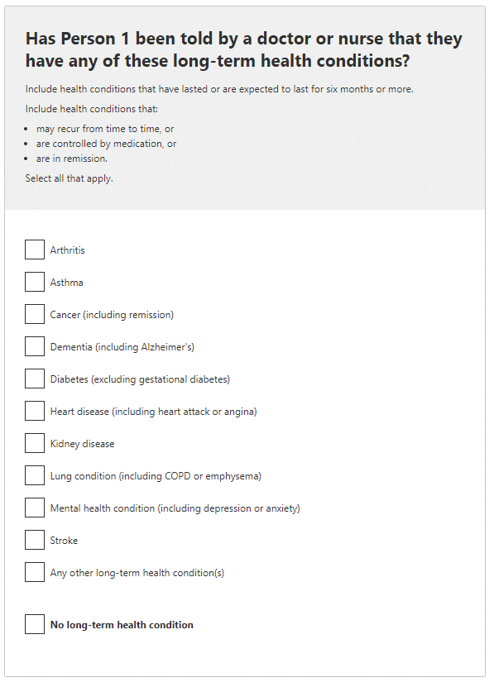
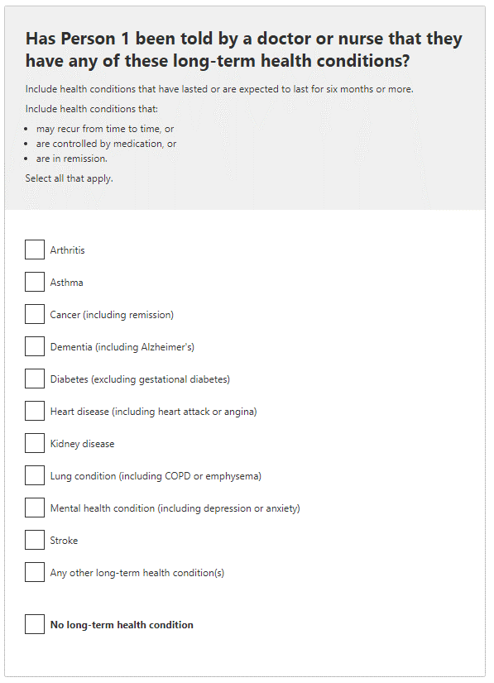
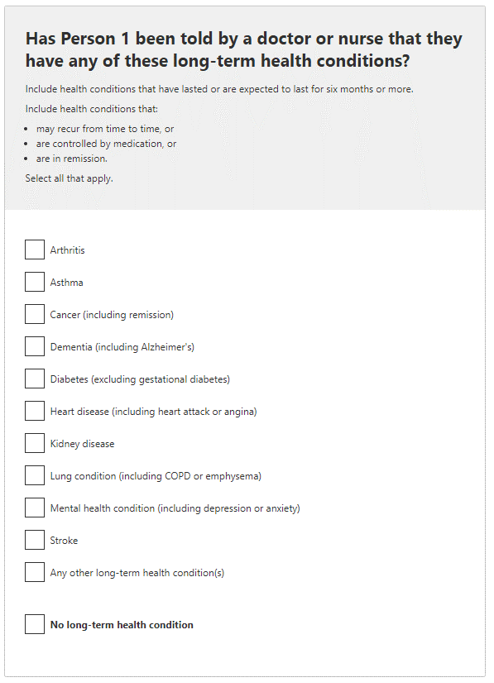
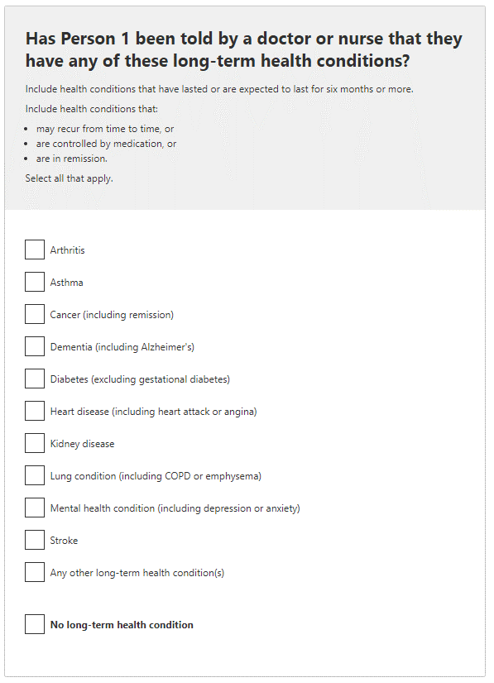
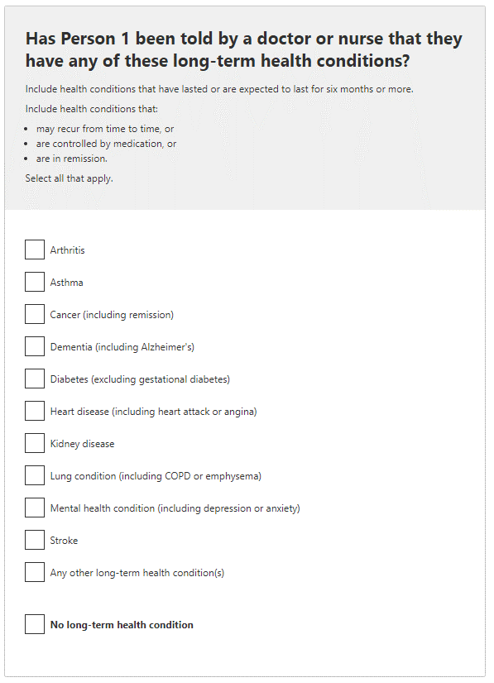
This variable describes the number of selected long-term health conditions a person has reported. The selected long-term health conditions include:
‘Any other long-term health condition(s)’ are excluded from the count.
All persons
| Code | Category |
|---|---|
| 0 | None of the selected conditions |
| 1 | One condition |
| 2 | Two conditions |
| 3 | Three or more conditions |
| & | Not stated |
| V | Overseas visitor |
Number of categories: 6
See Understanding supplementary codes for more information.
This variable is derived from responses to the Long-term health conditions question. It counts the number of selected long-term conditions a person reports.
If a person marks only ‘Any other long-term health condition(s)’ on the Census form, they are not counted as having a long-term health condition in this variable. These people are counted in category 0, 'None of the Selected Conditions'. However, if a person selects, for example, ‘Asthma’ and ‘Any other long-term health condition(s)’ on the Census form, they would be included in category 1, ‘One condition’.
People who report over three conditions are grouped together in category 3, ‘Three or more conditions’.
This is a new variable for 2021.
The count of selected long-term health condition responses, including no conditions, are not comparable to similar counts derived from other health collections such as the National Health Survey (NHS) and National Aboriginal and Torres Strait Islander Health Surveys (NATSIHS). Different sets of selected health conditions questions are asked in these other collections. For more information, see Comparing ABS long-term health conditions data sources.
The non-response rate for Count of long-term health conditions (CLTHP) was 8.1% in 2021.
This variable describes whether a person has reported having both arthritis and asthma.
All persons
| Code | Category |
|---|---|
| 1 | Has arthritis and asthma |
| 2 | Does not have arthritis and asthma |
| & | Not stated |
| V | Overseas visitor |
Number of categories: 4
See Understanding supplementary codes for more information.
This variable is derived from responses to the long-term health conditions question and aims to capture people who have specific combinations of health conditions (known as comorbidity).
Where a respondent selects ‘Arthritis’ and ‘Asthma’ they are coded to '1 Has arthritis and asthma’. The respondent could also have other long-term health conditions, but those conditions are not recorded in this variable. All other combinations of responses, including ‘No long-term health condition’ are coded to '2 Does not have arthritis and asthma’.
If a person has more than one specified combination of long-term health conditions, they will be captured in more than one comorbidity health variable.
This is a new variable for 2021.
Long-term health conditions data from Census is not intended to provide prevalence estimates. Prevalence estimates of long-term health conditions should be sourced from the National Health Survey (NHS) or National Aboriginal and Torres Strait Islander Health Survey (NATSIHS).
If a person has more than one specified combination, they will be captured in more than one comorbidity health variable.
This variable does not have a non-response rate as it is created during Census processing by using responses from more than one question on the Census form. For the item non-response rate for the health question, see CLTHP.
This variable describes whether a person has reported having both arthritis and diabetes (excluding gestational diabetes).
All persons
| Code | Category |
|---|---|
| 1 | Has arthritis and diabetes |
| 2 | Does not have arthritis and diabetes |
| & | Not stated |
| V | Overseas visitor |
Number of categories: 4
See Understanding supplementary codes for more information.
This variable is derived from responses to the long-term health conditions question and aims to capture people who have specific combinations of health conditions (known as comorbidity).
Where a respondent selects ‘Arthritis’ and ‘Diabetes (excluding gestational diabetes)’ they are coded to category 1 'Has arthritis and diabetes’. The respondent could also have other long-term health conditions, but those conditions are not recorded in this variable. All other combinations of responses, including ‘No long-term health condition’ are coded to category 2 'Does not have arthritis and diabetes’.
If a person has more than one specified combination of long-term health conditions, they will be captured in more than one comorbidity health variable.
This is a new variable for 2021.
If a person has more than one specified combination, they will be captured in more than one comorbidity health variable.
This variable does not have a non-response rate as it is created during Census processing by using responses from one or more questions on the Census form. For the item non-response rate for the health question, see CLTHP.
This variable describes whether a person has reported having both arthritis and heart disease (including heart attack or angina).
All persons
| Code | Category |
|---|---|
| 1 | Has arthritis and heart disease |
| 2 | Does not have arthritis and heart disease |
| & | Not stated |
| V | Overseas visitor |
Number of categories: 4
See Understanding supplementary codes for more information.
This variable is derived from responses to the long-term health conditions question and aims to capture people who have specific combinations of health conditions (known as comorbidity).
When a respondent selects ‘Arthritis’ and ‘Heart disease (including heart attack or angina)’ they are coded to 1 ‘Has arthritis and heart disease’. The respondent could also have other long-term health conditions, but those conditions are not recorded in this variable. All other combinations of responses, including ‘No long-term health condition’ are coded to 2 ‘Does not have arthritis and heart disease’.
If a person has more than one specified combination of long-term health conditions, they will be captured in more than one comorbidity health variable.
This is a new variable for 2021.
If a person has more than one specified combination, they will be captured in more than one comorbidity health variable.
This variable does not have a non-response rate as it is created during Census processing by using responses from one or more questions on the Census form. For the item non-response rate for the health question, see CLTHP.
This variable describes whether a person has reported having both arthritis and a mental health condition (including depression and anxiety).
All persons
| Code | Category |
|---|---|
| 1 | Has arthritis and mental health condition |
| 2 | Does not have arthritis and mental health condition |
| & | Not stated |
| V | Overseas visitor |
Number of categories: 4
See Understanding supplementary codes for more information.
This variable is derived from responses to the long-term health conditions question and aims to capture people who have specific combinations of health conditions (known as comorbidity).
Where a respondent selects ‘Arthritis’ and ‘Mental health condition (including depression and anxiety)’ they are coded to 1 ‘Has arthritis and mental health condition’. The respondent could also have other long-term health conditions, but those conditions are not recorded in this variable. All other combinations of responses, including ‘No long-term health condition’ are coded to 2 ‘Does not have arthritis and mental health condition’.
If a person has more than one specified combination of long-term health conditions, they will be captured in more than one comorbidity health variable.
This is a new variable for 2021.
If a person has more than one specified combination, they will be captured in more than one comorbidity health variable.
This variable does not have a non-response rate as it is created during Census processing by using responses from one or more questions on the Census form. For the item non-response rate for the health question, see CLTHP.
This variable describes whether a person has reported having both asthma and heart disease (including heart attack or angina).
All persons
| Code | Category |
|---|---|
| 1 | Has asthma and heart disease |
| 2 | Does not have asthma and heart disease |
| & | Not stated |
| V | Overseas visitor |
Number of categories: 4
See Understanding supplementary codes for more information.
This variable is derived from responses to the long-term health conditions question and aims to capture people who have specific combinations of health conditions (known as comorbidity).
Where a respondent selects ‘Asthma’ and ‘Heart disease (including heart attack or angina)’ they are coded to 1 ‘Has asthma and heart disease’. The respondent could also have other long-term health conditions, but those conditions are not recorded in this variable. All other combinations of responses, including ‘No long-term health condition’ are coded to 2 ‘Does not have asthma and heart disease’.
If a person has more than one specified combination of long-term health conditions, they will be captured in more than one comorbidity health variable.
This is a new variable for 2021.
If a person has more than one specified combination, they will be captured in more than one comorbidity health variable.
This variable does not have a non-response rate as it is created during Census processing by using responses from one or more questions on the Census form. For the item non-response rate for the health question, see CLTHP.
This variable describes whether a person has reported having both asthma and a lung condition (including COPD or emphysema).
All persons
| Code | Category |
|---|---|
| 1 | Has asthma and lung condition |
| 2 | Does not have asthma and lung condition |
| & | Not stated |
| V | Overseas visitor |
Number of categories: 4
See Understanding supplementary codes for more information.
This variable is derived from responses to the long-term health conditions question and aims to capture people who have specific combinations of health conditions (known as comorbidity).
Where a respondent selects ‘Asthma’ and ‘Lung condition (including COPD or emphysema)’ they are coded to 1 ‘Has asthma and lung condition’. The respondent could also have other long-term health conditions, but those conditions are not recorded in this variable. All other combinations of responses, including ‘No long-term health condition’ are coded to 2 ‘Does not have asthma and lung condition’.
If a person has more than one specified combination of long-term health conditions, they will be captured in more than one comorbidity health variable.
This is a new variable for 2021.
If a person has more than one specified combination, they will be captured in more than one comorbidity health variable.
This variable does not have a non-response rate as it is created during Census processing by using responses from one or more questions on the Census form. For the item non-response rate for the health question, see CLTHP.
This variable describes whether a person has reported having both cancer (including remission) and heart disease (including heart attack or angina).
All persons
| Code | Category |
|---|---|
| 1 | Has cancer and heart disease |
| 2 | Does not have cancer and heart disease |
| & | Not stated |
| V | Overseas visitor |
Number of categories: 4
See Understanding supplementary codes for more information.
This variable is derived from responses to the long-term health conditions question and aims to capture people who have specific combinations of health conditions (known as comorbidity).
Where a respondent selects ‘Cancer (including remission)’ and ‘Heart disease (including heart attack or angina)’ they are coded to 1 ‘Has cancer and heart disease’. The respondent could also have other long-term health conditions, but those conditions are not recorded in this variable. All other combinations of responses, including ‘No long-term health condition’ are coded to 2 ‘Does not have cancer and heart disease’.
If a person has more than one specified combination of long-term health conditions, they will be captured in more than one comorbidity health variable.
This is a new variable for 2021.
If a person has more than one specified combination, they will be captured in more than one comorbidity health variable.
This variable does not have a non-response rate as it is created during Census processing by using responses from one or more questions on the Census form. For the item non-response rate for the health question, see CLTHP.
This variable describes whether a person has reported having both diabetes (excluding gestational diabetes) and heart disease (including heart attack or angina).
All persons
| Code | Category |
|---|---|
| 1 | Has diabetes and heart disease |
| 2 | Does not have diabetes and heart disease |
| & | Not stated |
| V | Overseas visitor |
Number of categories: 4
See Understanding supplementary codes for more information.
This variable is derived from responses to the long-term health conditions question and aims to capture people who have specific combinations of health conditions (known as comorbidity).
Where a respondent selects ‘Diabetes (excluding gestational diabetes)’ and ‘Heart disease (including heart attack or angina)’ they are coded to 1 ‘Has diabetes and heart disease’. The respondent could also have other long-term health conditions, but those conditions are not recorded in this variable. All other combinations of responses, including ‘No long-term health condition’ are coded to 2 ‘Does not have diabetes and heart disease’.
If a person has more than one specified combination of long-term health conditions, they will be captured in more than one comorbidity health variable.
This is a new variable for 2021.
If a person has more than one specified combination, they will be captured in more than one comorbidity health variable.
This variable does not have a non-response rate as it is created during Census processing by using responses from one or more questions on the Census form. For the item non-response rate for the health question, see CLTHP.
This variable describes whether a person has reported having both diabetes (excluding gestational diabetes) and kidney disease.
All persons
| Code | Category |
|---|---|
| 1 | Has diabetes and kidney disease |
| 2 | Does not have diabetes and kidney disease |
| & | Not stated |
| V | Overseas visitor |
Number of categories: 4
See Understanding supplementary codes for more information.
This variable is derived from responses to the long-term health conditions question and aims to capture people who have specific combinations of health conditions (known as comorbidity).
Where a respondent selects ‘Diabetes (excluding gestational diabetes)’ and ‘Kidney disease’ they are coded to 1 ‘Has diabetes and kidney disease’. The respondent could also have other long-term health conditions, but those conditions are not recorded in this variable. All other combinations of responses, including ‘No long-term health condition’ are coded to 2 ‘Does not have diabetes and kidney disease’.
If a person has more than one specified combination of long-term health conditions, they will be captured in more than one comorbidity health variable.
This is a new variable for 2021.
If a person has more than one specified combination, they will be captured in more than one comorbidity health variable.
This variable does not have a non-response rate as it is created during Census processing by using responses from one or more questions on the Census form. For the item non-response rate for the health question, see CLTHP.
This variable describes whether a person has reported having both heart disease (including heart attack or angina) and kidney disease.
All persons
| Code | Category |
|---|---|
| 1 | Has heart disease and kidney disease |
| 2 | Does not have heart disease and kidney disease |
| & | Not stated |
| V | Overseas visitor |
Number of categories: 4
See Understanding supplementary codes for more information.
This variable is derived from responses to the long-term health conditions question and aims to capture people who have specific combinations of health conditions (known as comorbidity).
Where a respondent selects ‘Heart disease (including heart attack or angina)’ and ‘Kidney disease’ they are coded to 1 ‘Has heart disease and kidney disease’. The respondent could also have other long-term health conditions, but those conditions are not recorded in this variable. All other combinations of responses, including ‘No long-term health condition’ are coded to 2 ‘Does not have heart disease and kidney disease’.
If a person has more than one specified combination, they will be captured in more than one comorbidity health variable.
This is a new variable for 2021.
If a person has more than one specified combination, they will be captured in more than one comorbidity health variable.
This variable does not have a non-response rate as it is created during Census processing by using responses from one or more questions on the Census form. For the item non-response rate for the health question, see CLTHP.
This variable describes whether a person has reported having both heart disease (including heart attack or angina) and a mental health condition (including depression and anxiety).
All persons
| Code | Category |
|---|---|
| 1 | Has heart disease and mental health condition |
| 2 | Does not have heart disease and mental health condition |
| & | Not stated |
| V | Overseas visitor |
Number of categories: 4
See Understanding supplementary codes for more information.
This variable is derived from responses to the long-term health conditions question and aims to capture people who have specific combinations of health conditions (known as comorbidity).
Where a respondent selects ‘Heart disease (including heart attack or angina)’ and ‘Mental health condition (including depression and anxiety) they are coded to 1 ‘Has heart disease and mental health condition’. The respondent could also have other long-term health conditions, but those conditions are not recorded in this variable. All other combinations of responses, including ‘No long-term health condition’ are coded to 2 ‘Does not have heart disease and mental health condition’.
If a person has more than one specified combination, they will be captured in more than one comorbidity health variable.
This is a new variable for 2021.
If a person has more than one specified combination, they will be captured in more than one comorbidity health variable.
This variable does not have a non-response rate as it is created during Census processing by using responses from one or more questions on the Census form. For the item non-response rate for the health question, see CLTHP.
This variable describes whether a person has reported having both a lung condition (including COPD and emphysema) and a mental health condition (including depression and anxiety).
All persons
| Code | Category |
|---|---|
| 1 | Has lung condition and mental health condition |
| 2 | Does not have lung condition and mental health condition |
| & | Not stated |
| V | Overseas visitor |
Number of categories: 4
See Understanding supplementary codes for more information.
This variable is derived from responses to the long-term health conditions question and aims to capture people who have specific combinations of health conditions (known as comorbidity).
Where a respondent selects ‘Lung condition (including COPD and emphysema)’ and ‘Mental health condition (including depression and anxiety)’ they are coded to 1 ‘Has lung condition and mental health condition’. The respondent could also have other long-term health conditions, but those conditions are not recorded in this variable. All other combinations of responses, including ‘No long-term health condition’ are coded to 2 ‘Does not have lung condition and mental health condition’.
If a person has more than one specified combination, they will be captured in more than one comorbidity health variable.
This is a new variable for 2021.
If a person has more than one specified combination, they will be captured in more than one comorbidity health variable.
This variable does not have a non-response rate as it is created during Census processing by using responses from one or more questions on the Census form. For the item non-response rate for the health question, see CLTHP.
This variable counts the number of people in a household who reported they had at least one of the selected long-term health conditions. Selected long-term health conditions include:
‘Any other long-term health condition(s)’ are excluded from the count.
Occupied private dwellings
| Code | Category |
|---|---|
| 00 | No persons in household reported a long-term health condition |
| 01 | One person in household reported a long-term health condition |
| 02 | Two persons in household reported a long-term health condition |
| 03 | Three persons in household reported a long-term health condition |
| 04 | Four persons in household reported a long-term health condition |
| 05 | Five persons in household reported a long-term health condition |
| 06 | Six persons in household reported a long-term health condition |
| 07 | Seven persons in household reported a long-term health condition |
| 08 | Eight persons in household reported a long-term health condition |
| 09 | Nine persons in household reported a long-term health condition |
| 10 | Ten or more persons in household reported a long-term health condition |
| 11 | Some persons in household had not stated a long-term health condition |
| && | All persons in household not stated |
| @@ | Not applicable |
Number of categories: 14
Not applicable (@@) comprises:
This variable is derived from responses to the long-term health conditions question. It counts the number of people in a household who have marked one of the following long-term health conditions:
If all people in the household did not answer the long-term health conditions question, this variable is set to ‘All persons in household not stated’.
If some people in the household did not answer the long-term health conditions question, this variable is set to category 11, ‘Some persons in household had not stated a long-term health condition’.
If a person marks only ‘Any other long-term health condition(s)’, they are not counted as having a long-term health condition in this variable. These people are counted in category 00 'No persons in the household have a long-term health condition'.
Visitor only households and Other non-classifiable households are excluded. Persons temporarily absent are excluded from this variable.
This is a new variable for 2021.
Count of persons with selected long-term health condition(s) in household (CPLTHD) should be used carefully when comparing to other health data from within the ABS and for external organisations or agencies. Relevant definitions and response categories can differ between different statistical collections and may not match Census definitions. For more information, see Comparing ABS long-term health conditions data sources.
This variable does not have a non-response rate as it is created during Census processing by using responses from more than one question on the Census form. The proportion of dwellings where either all people in the household did not answer the long-term health conditions question, or some people in the household did not answer the long-term health conditions question, was 7.3%.
This variable counts the number of people in a household who reported they had at least one of the selected long-term health conditions in ranges. Selected long-term health conditions include:
‘Any other long-term health condition(s)’ are excluded from the count.
Occupied private dwellings
| Code | Category |
|---|---|
| 0 | No persons in household reported a long-term health condition |
| 1 | One person in household reported a long-term health condition |
| 2 | Two persons in household reported a long-term health condition |
| 3 | Three persons in household reported a long-term health condition |
| 4 | Four persons in household reported a long-term health condition |
| 5 | Five or more persons in household reported a long-term health condition |
| 6 | Some persons in household had not stated a long-term health condition |
| & | All persons in household not stated |
| @ | Not applicable |
Number of categories: 9
Not applicable (@) comprises:
This variable is derived from responses to the long-term health conditions question. It counts the number of people in a household who have marked one of the following long-term health conditions:
If all people in the household did not answer the long-term health conditions question, this variable is set to ‘All persons in household not stated’.
If some people in the household did not answer the long-term health conditions question, this variable is set to category 6, ‘Some persons in household had not stated a long-term health condition’.
If a person marks only ‘Any other long-term health condition(s)’, they are not counted as having a long-term health condition in this variable. These people are counted in category 0 'No persons in household reported a long-term health condition'.
Visitor only households and Other non-classifiable households are excluded. Persons temporarily absent are excluded from this variable.
This is a new variable for 2021.
Count of persons with selected long-term health condition(s) in household (ranges) (CPLTHRD) should be used carefully when comparing to other health data from within the ABS and for external organisations or agencies. Relevant definitions and response categories can differ between different statistical collections and may not match Census definitions. For more information, see Comparing ABS long-term health conditions data sources.
This variable does not have a non-response rate as it is created during Census processing by using responses from more than one question on the Census form.
The proportion of dwellings where either all people in the household did not answer the long-term health conditions question, or some people in the household did not answer the long-term health conditions question, was 7.3%.
This variable describes whether a person reported that they have arthritis.
All persons
| Code | Category |
|---|---|
| 011 | Has arthritis |
| 012 | Does not have arthritis |
| &&& | Not stated |
| VVV | Overseas visitor |
Number of categories: 4
See Understanding supplementary codes for more information.
This variable is derived from responses to the long-term health conditions question. It counts the number of people who marked ‘Arthritis’ on the form.
This is a new variable for 2021.
The question does not distinguish between osteoarthritis and rheumatoid arthritis therefore this variable will include respondents reporting both forms of arthritis.
Long-term health conditions data from Census is not intended to provide prevalence estimates. Prevalence estimates of chronic health conditions should be sourced from the National Health Survey (NHS) or National Aboriginal and Torres Strait Islander Health Surveys (NATSIHS).
This variable does not have a non-response rate as it is created during Census processing by using responses from one or more questions on the Census form. For the item non-response rate for the Health question, see CLTHP.
This variable describes whether a person has been told by a doctor or nurse that they have asthma. This variable does not indicate whether a person has multiple long-term health conditions.
All persons
| Code | Category |
|---|---|
| 021 | Has asthma |
| 022 | Does not have asthma |
| &&& | Not stated |
| VVV | Overseas visitor |
Number of categories: 4
See Understanding supplementary codes for more information.
This variable is derived from responses to the long-term health conditions question. It counts the number of people who marked ‘Asthma’ on the form.
This is a new variable for 2021.
Long-term health conditions data from Census is not intended to provide prevalence estimates. Prevalence estimates of chronic health conditions should be sourced from the National Health Survey (NHS) or National Aboriginal and Torres Strait Islander Health Surveys (NATSIHS).
This variable does not have a non-response rate as it is created during Census processing by using responses from one or more questions on the Census form. For the item non-response rate for the Health question, see CLTHP.
This variable describes whether a person has been told by a doctor or nurse that they have cancer. This variable does not indicate whether a person has multiple long-term health conditions.
All persons
| Code | Category |
|---|---|
| 031 | Has cancer (including remission) |
| 032 | Does not have cancer (including remission) |
| &&& | Not stated |
| VVV | Overseas visitor |
Number of categories: 4
See Understanding supplementary codes for more information.
This variable is derived from responses to the long-term health conditions question. It counts the number of people who marked ‘Cancer (including remission)’ on the form.
This is a new variable for 2021.
Long-term health conditions data from Census is not intended to provide prevalence estimates. Prevalence estimates of chronic health conditions should be sourced from the National Health Survey (NHS) or National Aboriginal and Torres Strait Islander Health Surveys (NATSIHS).
Respondents may have reported both malignant and benign neoplasms (cancers) in response to this question.
This variable does not have a non-response rate as it is created during Census processing by using responses from one or more questions on the Census form. For the item non-response rate for the Health question, see CLTHP.
This variable describes whether a person has been told by a doctor or nurse that they have dementia (including Alzheimer’s). This variable does not indicate whether a person has multiple long-term health conditions.
All persons
| Code | Category |
|---|---|
| 041 | Has dementia (including Alzheimer’s) |
| 042 | Does not have dementia (including Alzheimer's) |
| &&& | Not stated |
| VVV | Overseas visitor |
Number of categories: 4
See Understanding supplementary codes for more information.
This variable is derived from responses to the long-term health conditions question. It counts the number of people who marked ‘Dementia (including Alzheimer’s)’ on the form.
This is a new variable for 2021.
Long-term health conditions data from Census is not intended to provide prevalence estimates. Prevalence estimates of chronic health conditions should be sourced from the National Health Survey (NHS) or National Aboriginal and Torres Strait Islander Health Surveys (NATSIHS).
This variable does not have a non-response rate as it is created during Census processing by using responses from one or more questions on the Census form. For the item non-response rate for the Health question, see CLTHP.
This variable describes whether a person has been told by a doctor or nurse that they have diabetes (excluding gestational diabetes). This variable does not indicate whether a person has multiple long-term health conditions.
All persons
| Code | Category |
|---|---|
| 051 | Has diabetes (excluding gestational diabetes) |
| 052 | Does not have diabetes (excluding gestational diabetes) |
| &&& | Not stated |
| VVV | Overseas visitor |
Number of categories: 4
See Understanding supplementary codes for more information.
This variable is derived from responses to the long-term health conditions question. It counts the number of people who marked ‘Diabetes (excluding gestational diabetes)’ on the form.
This is a new variable for 2021.
The Census Health question does not distinguish between type 1 and type 2 diabetes. Therefore, this variable will include respondents reporting both forms of diabetes.
Long-term health conditions data from Census is not intended to provide prevalence estimates. Prevalence estimates of chronic health conditions should be sourced from the National Health Survey (NHS) or National Aboriginal and Torres Strait Islander Health Surveys (NATSIHS).
This variable does not have a non-response rate as it is created during Census processing by using responses from one or more questions on the Census form. For the item non-response rate for the Health question, see CLTHP.
This variable describes whether a person has been told by a doctor or nurse that they have heart disease (including heart attack or angina). This variable does not indicate whether a person has multiple long-term health conditions.
All persons
| Code | Category |
|---|---|
| 061 | Has heart disease (including heart attack or angina) |
| 062 | Does not have heart disease (including heart attack or angina) |
| &&& | Not stated |
| VVV | Overseas visitor |
Number of categories: 4
See Understanding supplementary codes for more information.
This variable is derived from responses to the long-term health conditions question. It counts the number of people who marked ‘Heart disease (including heart attack or angina)’ on the Census form.
This is a new variable for 2021.
Long-term health conditions data from Census is not intended to provide prevalence estimates. Prevalence estimates of chronic health conditions should be sourced from the National Health Survey (NHS) or National Aboriginal and Torres Strait Islander Health Surveys (NATSIHS).
This variable does not have a non-response rate as it is created during Census processing by using responses from one or more questions on the Census form. For the item non-response rate for the Health question, see CLTHP.
This variable describes whether a person has been told by a doctor or nurse that they have kidney disease. This variable does not indicate whether a person has multiple long-term health conditions.
All persons
| Code | Category |
|---|---|
| 071 | Has kidney disease |
| 072 | Does not have kidney disease |
| &&& | Not stated |
| VVV | Overseas visitor |
Number of categories: 4
See Understanding supplementary codes for more information.
This variable is derived from responses to the long-term health conditions question. It counts the number of people who marked ‘Kidney disease’ on the Census form.
This is a new variable for 2021.
Long-term health conditions data from Census is not intended to provide prevalence estimates. Prevalence estimates of chronic health conditions should be sourced from the National Health Survey (NHS) or National Aboriginal and Torres Strait Islander Health Surveys (NATSIHS).
This variable does not have a non-response rate as it is created during Census processing by using responses from one or more questions on the Census form. For the item non-response rate for the Health question, see CLTHP.
This variable identifies the population who has at least one long-term health condition (including any other long-term health conditions) and the population who reported they did not have a long-term health condition.
All persons
| Code | Category |
|---|---|
| 121 | Does not have a long-term health condition |
| 122 | Has one or more long-term health condition(s) |
| &&& | Not stated |
| VVV | Overseas visitor |
Number of categories: 4
See Understanding supplementary codes for more information.
This variable is derived from responses to the long-term health conditions question. It counts the number of people who marked that they have one or more long-term health conditions (including ‘Any other long-term health condition(s)’). It also counts the number of people who marked ‘No long-term health condition’.
For a count of the number of selected long-term health conditions a person has, refer to Count of selected long-term health conditions (CLTHP).
This is a new question for the 2021 Census.
There are no data use considerations for this variable.
This variable does not have a non-response rate as it is created during Census processing by using responses from one or more questions on the Census form. For the item non-response rate for the Health question, see CLTHP.
This variable describes whether a person has been told by a doctor or nurse that they have a lung condition (including Chronic Obstructive Pulmonary Disorder (COPD) or emphysema). This variable does not indicate whether a person has multiple long-term health conditions.
All persons
| Code | Category |
|---|---|
| 081 | Has a lung condition (including COPD or emphysema) |
| 082 | Does not have a lung condition (including COPD or emphysema) |
| &&& | Not stated |
| VVV | Overseas visitor |
Number of categories: 4
See Understanding supplementary codes for more information.
This variable is derived from responses to the long-term health conditions question. It counts the number of people who marked ‘Lung condition (including COPD or emphysema)’ on the form.
This is a new variable for 2021.
Long-term health conditions data from Census is not intended to provide prevalence estimates. Prevalence estimates of chronic health conditions should be sourced from the National Health Survey (NHS) or National Aboriginal and Torres Strait Islander Health Surveys (NATSIHS).
This variable does not have a non-response rate as it is created during Census processing by using responses from one or more questions on the Census form. For the item non-response rate for the Health question, see CLTHP.
This variable describes whether a person has been told by a doctor or nurse that they have a mental health condition (including depression or anxiety). This variable does not indicate whether a person has multiple long-term health conditions.
All persons
| Code | Category |
|---|---|
| 091 | Has a mental health condition (including depression or anxiety) |
| 092 | Does not have a mental health condition (including depression or anxiety) |
| &&& | Not stated |
| VVV | Overseas visitor |
Number of categories: 4
See Understanding supplementary codes for more information.
This variable is derived from responses to the long-term health conditions question. It counts the number of people who marked ‘Mental health condition (including depression or anxiety)’ on the form.
This is a new variable for 2021.
Long-term health conditions data from Census is not intended to provide prevalence estimates. Prevalence estimates of chronic health conditions should be sourced from the National Health Survey (NHS) or National Aboriginal and Torres Strait Islander Health Surveys (NATSIHS).
This variable does not have a non-response rate as it is created during Census processing by using responses from one or more questions on the Census form. For the item non-response rate for the Health question, see CLTHP.
This variable describes whether a person has been told by a doctor or nurse that they have a long-term health condition that is not:
This variable does not indicate whether a person has multiple long-term health conditions.
All persons
| Code | Category |
|---|---|
| 111 | Has one or more other long-term health conditions |
| 112 | Does not have any other long-term health conditions |
| &&& | Not stated |
| VVV | Overseas visitor |
Number of categories: 4
See Understanding supplementary codes for more information.
This variable is derived from responses to the long-term health conditions question. It counts the number of people who marked ‘Any other long-term health condition(s)’.
This is a new variable for 2021.
There are no data use considerations for this variable.
This variable does not have a non-response rate as it is created during Census processing by using responses from one or more questions on the Census form. For the item non-response rate for the Health question, see CLTHP.
This variable describes whether a person has been told by a doctor or nurse that they have had a stroke. This variable does not indicate whether a person has multiple long-term health conditions.
All persons
| Code | Category |
|---|---|
| 101 | Has had a stroke |
| 102 | Has not had a stroke |
| &&& | Not stated |
| VVV | Overseas visitor |
Number of categories: 4
See Understanding supplementary codes for more information.
This variable is derived from responses to the long-term health conditions question. It counts the number of people who marked ‘Stroke’ on the form.
This is a new variable for 2021.
Long-term health conditions data from the Census is not intended to provide prevalence estimates. Prevalence estimates of chronic health conditions should be sourced from the National Health Survey (NHS) or National Aboriginal and Torres Strait Islander Health Surveys (NATSIHS).
This variable does not have a non-response rate as it is created during Census processing by using responses from one or more questions on the Census form. For the item non-response rate for the Health question, see CLTHP.
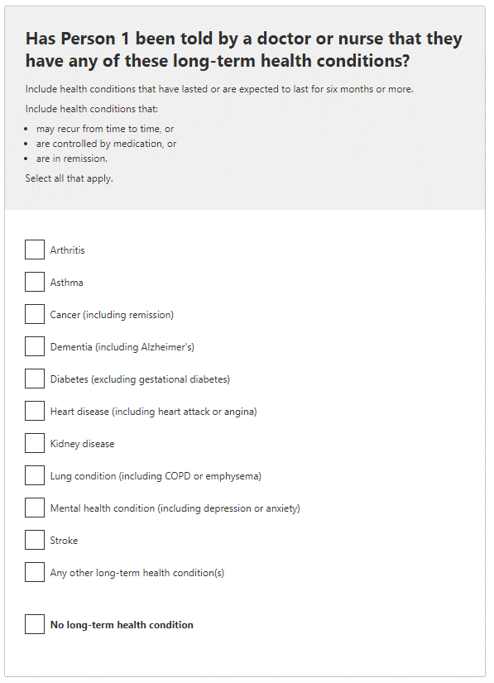
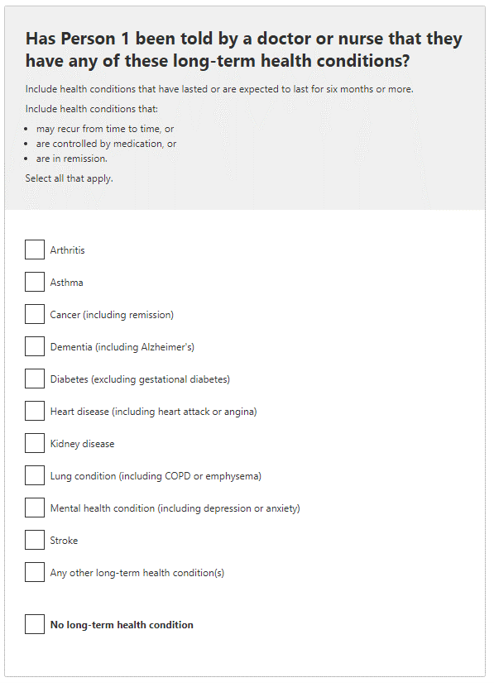
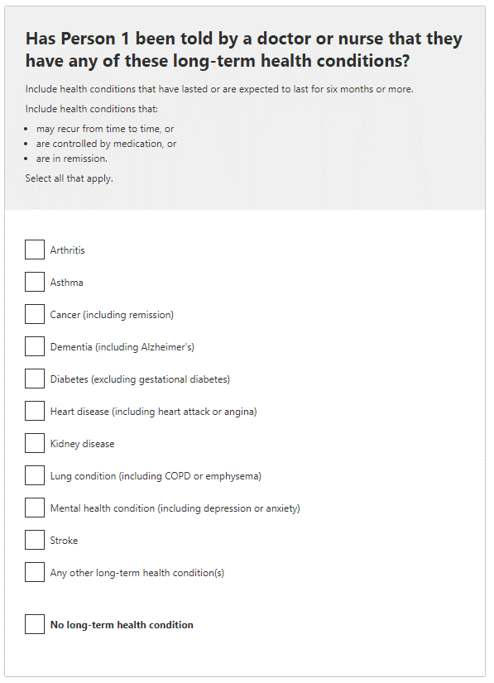
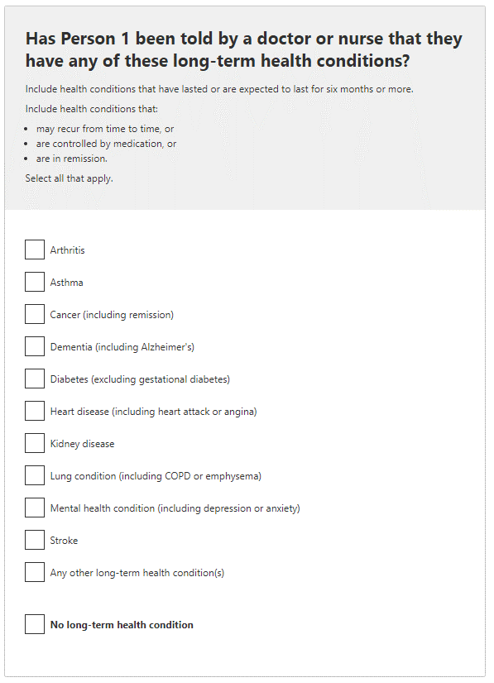
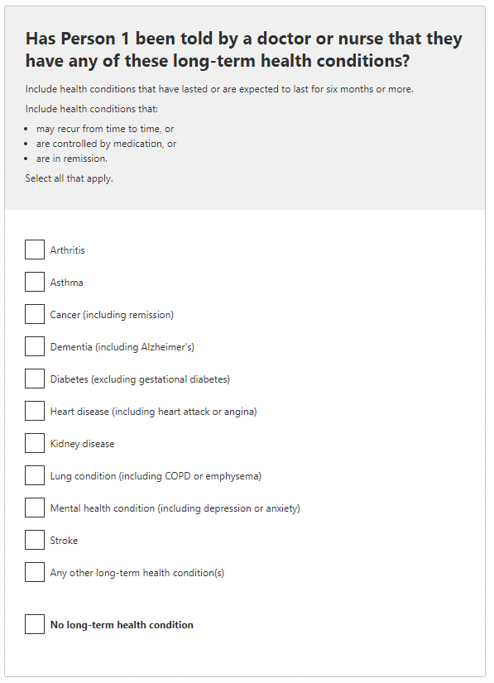
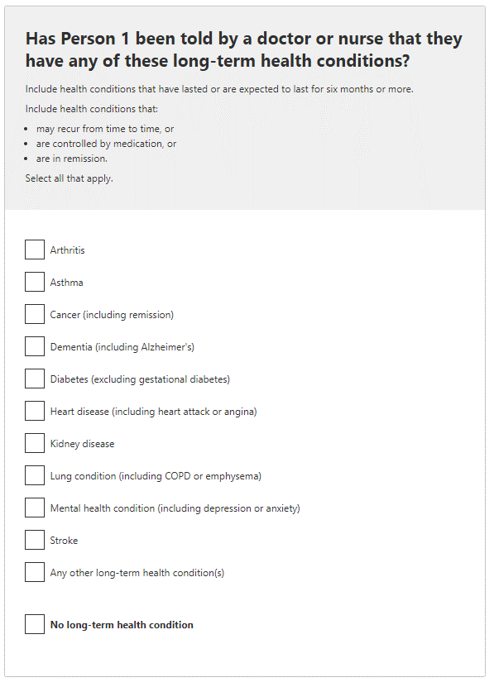
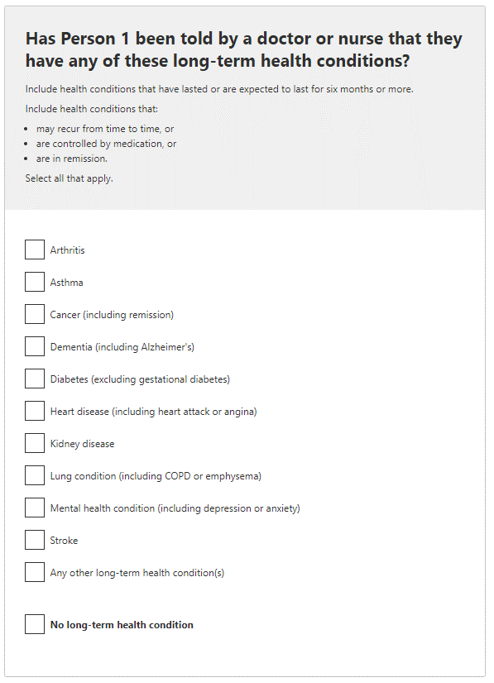
This variable records the type of selected long-term health condition(s) a person has reported. Respondents can record multiple long-term health conditions including:
All persons
| Code | Category |
|---|---|
| 011 | Arthritis |
| 021 | Asthma |
| 031 | Cancer (including remission) |
| 041 | Dementia (including Alzheimer’s) |
| 051 | Diabetes (excluding gestational diabetes) |
| 061 | Heart disease (including heart attack or angina) |
| 071 | Kidney disease |
| 081 | Lung condition (including COPD or emphysema) |
| 091 | Mental health condition (including depression or anxiety) |
| 101 | Stroke |
| 111 | Any other long-term health condition(s) |
| 121 | No long-term health condition(s) |
| &&& | Not stated |
| VVV | Overseas visitor |
Number of categories: 14
See Understanding supplementary codes for more information.
Data for this variable is derived from the long-term health conditions question. If the respondent marks ‘No long-term health condition’ and also marks other fields, the ‘No long-term health condition’ response is ignored.
As respondents can select multiple conditions, the count of components for this variable will not equal the total number of people.
This is a new variable for 2021.
The rationale for including the long-term health conditions topic in the 2021 Census was to:
Long-term health condition information collected in the 2021 Census will not have the same level of detail as the larger health collections such as the National Health Survey (NHS) and National Aboriginal and Torres Strait Islander Health Surveys (NATSIHS). Long-term health conditions data from Census is not intended to provide prevalence estimates. Prevalence estimates of chronic health conditions should be sourced from the NHS or NATSIHS.
As Type of long-term health condition allows for multiple responses, proportions of people with a particular condition should be derived using the total population in the denominator for the relevant aggregation, and not the sum of all conditions.
This variable does not have a non-response rate as it is created during Census processing by using responses from one or more questions on the Census form. For the item non-response rate for the health question, see CLTHP.