Household consumption of illicit tobacco and nicotine products

Released
3/06/2026
Released
03/06/2026 11:30am AEST

Preface

Public commentary highlighting the rapid growth of the illicit tobacco market raised questions on how to interpret this trend in economic data. The ABS clarified that illicit tobacco is not captured in the data, and in response to sustained user interest, initiated work in mid-2025 to identify data and methods to assess the economic impact. 

The Illicit Tobacco and E-cigarette (ITEC) Commissioner is the Commonwealth’s lead coordinator and public source for national illicit tobacco market estimates. This article complements the ITEC Commissioner’s analysis and will provide input for the next report. Our estimates are experimental as the methodology and data sources are subject to ongoing evaluation and possible change. 

Introduction

The Australian National Accounts (the ‘accounts’) shows that household spending on legally purchased cigarettes and tobacco has almost halved since 2020. At the same time, evidence from a range of sources suggests that consumers are shifting away from legally purchased tobacco toward illicit sources, rather than smoking less overall.[1]

Illegal activity, including the illicit tobacco trade, is not included within the scope of the accounts. While international statistical standards recommend including illegal markets in measures of economic activity, many countries, including Australia, have not done so due to significant measurement difficulties.

To better understand the impact of illicit tobacco in the accounts, the ABS has developed experimental estimates of illicit tobacco consumption. These estimates use an innovative method based on nicotine metabolite concentrations detected in wastewater samples. 

This article outlines how illicit tobacco activity would be conceptually treated in the accounts, describes the experimental method used to estimate consumption of illicit tobacco, and provides insights into household spending patterns. For clarity, illicit tobacco in this article refers to illicit cigarettes, loose leaf tobacco, e-cigarettes (including vapes) and other nicotine products.

Key findings:

  • The quantity of nicotine consumed in Australia increased by almost 40% from 2017 to 2025, with most of the increase occurring since 2021. Population growth over the period 2017-25 was 14%. 
  • The increase was underpinned by a large rise in illicit cigarettes as well as increases in e-cigarettes and other nicotine products. Consumption from illicit sources as a share of total tobacco consumed rose from 12% in 2017 to 80% in 2025.
  • Prices for legal tobacco products have almost tripled since December 2016 driven by annual tobacco excise increases, while estimated prices of illicit tobacco products have remained relatively constant.
  • The dollar value of household spending on cigarettes and tobacco peaked in December 2020 before returning to levels similar to December 2016. The decline in spending alongside a rise in quantity reflects the shift towards cheaper illicit sources. 
  • In the accounts, volume measures differ from quantities, as they estimate what total spending would have been at a fixed set of relative prices. The inclusion of illicit tobacco moderates the decline in the volume of household consumption expenditure on cigarettes and tobacco. 

Concepts

International statistical standards, including the System of National Accounts and OECD guidance on the non‑observed economy, recommend that illegal activities be included within the production boundary of the national accounts, especially when these activities make a material contribution to the accounts.[2][3] Conceptually, this ensures comprehensive measurement of economic production, income generation and consumption irrespective of legal status.

Under this framework, household purchases of illicit tobacco products would be recorded in household final consumption expenditure (HFCE) at purchasers’ prices, while associated margins, wages and operating surplus would contribute to gross value added within relevant industries. The key difference from legal cigarettes lies in taxation, which results in substantially different price levels and tax receipts for legal and illicit cigarette products. 

In practice, many countries, including Australia, exclude illegal activities from their official national accounts due to significant measurement difficulties. Illicit markets operate in the shadows, resulting in limited observable data on import values, prices, quantities, intermediate inputs and income flows.

Illicit tobacco products enter the Australian economy primarily through imports and are intentionally concealed to evade customs controls and taxation. This lack of observability severely constrains the measurement of associated wholesale and retail activity, labour income and operating surplus, even where household consumption can be approximated using alternative data sources.

As a result, while the illicit tobacco trade is conceptually within the production boundary, it remains outside the official accounts as part of the non-observed economy.

The experimental estimates presented in this article focus on HFCE for analytical purposes only and have not been incorporated within the official national accounts. These estimates have been developed to assess the impact of illicit tobacco on economic statistics in response to strong user interest. These results do not replace official estimates of HFCE cigarettes and tobacco.

Explainer Box A – Treatment of illicit tobacco products

While many consumers may see legal and illegal tobacco products as substitutable, in economic statistics they are treated as distinct products because they are:

  • Sold at very different prices
  • Purchased from a different set of retail outlets and sourced from a different distribution network
  • Legal tobacco is sold under strict taxation, health and safety regulatory settings while illicit tobacco has none of these settings
  • Sold under different legal arrangements, with illicit tobacco possession coming with a range of potential penalties

The ABS experimental method defines four distinct product groups within HFCE cigarettes and tobacco: legal tobacco, illicit cigarettes (including loose leaf), e‑cigarettes, and other recreational nicotine products.[4] In these experimental estimates, these are treated as separate products.

A precedent for this approach is the treatment of household solar generation and grid-supplied electricity as distinct products within HFCE, even though the underlying good is the same. They are separate products because the good is supplied through different mechanisms. 

Method

Wastewater can be used to detect concentrations of nicotine metabolite, which are the molecules produced by the human body when nicotine is consumed and excreted into the wastewater stream. The experimental method uses quarterly wastewater data sourced from the Australian Criminal Intelligence Commission. Samples are collected from 60 wastewater treatment plants, covering all capital cities and some regional areas across Australia, representing approximately 60% of Australia’s total population.

While wastewater data provide reliable estimates of total nicotine consumption, they do not identify which products the nicotine came from. Information from existing survey and administrative data sources, such as supermarket scanner data and ATO tax data, are used to establish nicotine consumption from legal tobacco products. The Kalman filter approach (refer to Appendix 1) is used to allocate the remaining unobserved nicotine consumption across all product types and quantities. 

The four product types are balanced against each other to add up to the total nicotine metabolite mass detected from the total sample, allowing for an overall wastewater measurement error factor. 

Among the four product types, some contain higher nicotine concentrations than others (for example, e‑cigarettes, including vapes, relative to tobacco), resulting in higher metabolite output per dollar spent. Experimentally derived ratios are used to estimate nicotine consumption (milligrams of nicotine) for each product group from the corresponding metabolite mass (milligrams of metabolite) detected in the wastewater stream.

These quantities are then converted to current price values by anchoring to a reference period and extrapolating over time using price and quantity movements. Separate price indexes are applied to each product group to reflect differences in pricing behaviour:

  • Legal tobacco products – Tobacco Consumer Price Index 
  • Illicit cigarette products – Tobacco Import Price Index 
  • E-cigarettes and related products – Chemical materials and products n.e.s Import Price Index
  • Other recreational nicotine products – Chemical materials and products n.e.s Import Price Index

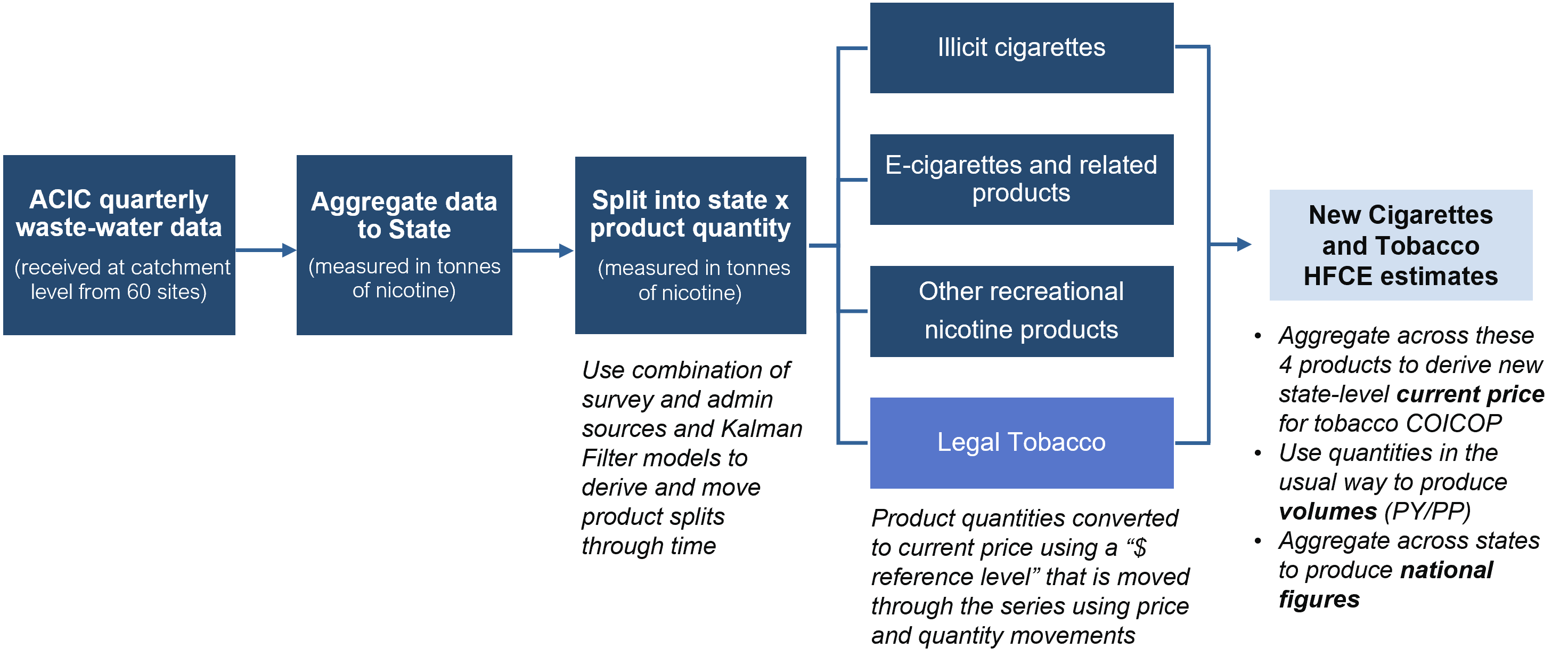
These inputs are used to construct estimates for HFCE on cigarettes and tobacco in current price value terms for each product group by state and territory. These estimates are subsequently aggregated to produce national HFCE on cigarettes and tobacco.

Figure 1. Flow chart of the experimental HFCE cigarettes and tobacco estimation methodology

Flow chart of the experimental HFCE cigarettes and tobacco estimation methodology

ACIC quarterly waste-water data (received at catchment level from 60 sites)

Aggregate data to State (measured in tonnes of nicotine)

Split into state x product quantity (measured in tonnes of nicotine) 

Use combination of survey and admin sources and Kalman Filter models to derive and move product splits through time

  1. Illicit cigarettes
  2. E-cigarettes and related products
  3. Other recreational nicotine products
  4. Legal Tobacco

Product quantities converted to current price using a “$ reference level” that is moved through the series using price and quantity movements

New Cigarettes and Tobacco HFCE estimates

  • Aggregate across these 4 products to derive new state-level current price for tobacco COICOP
  • Use quantities in the usual way to produce volumes (PY/PP)
  • Aggregate across states to produce national figures

Key assumptions

The experimental estimates rely on several simplifying assumptions including: 

Wastewater readings:

  • Wastewater samples taken during collection weeks from various locations are representative of the whole reference period.
  • Any differences in wastewater sampling, processing and concentration measurement methods between plants/laboratories do not introduce significant bias into aggregate HFCE on cigarettes and tobacco by state and territory.
  • That all human nicotine metabolite waste is represented in wastewater.

Current price estimation:

  • Nicotine excreted per purchased product does not change substantially over time (e.g. wastage fraction of nicotine is relatively stable).
  • Household consumption expenditure on nicotine products occurs in the same reference period as it is ingested and metabolised.
  • The product composition within a nicotine product category does not substantially change over time.
  • Nicotine ingested through products outside the four categories is negligible.[5]
  • Wastewater measurement model linearisation does not introduce substantial bias into current price estimates (measurement function is relatively stable).

Price index selection:

  • Supermarket scanner data adequately captures price movements across the whole of the legal tobacco market, including within other retail stores such as tobacconists and service stations.
  • Price movement of illicit tobacco products are the same across states and territories. 
  • Legal tobacco import prices excluding tobacco excise is representative of illegal tobacco import prices.
  • Illicit tobacco consumer prices are modelled using a fixed percentage margin over import prices. This approach does not capture potential price changes in response to external factors, such as supply disruptions from policing activity.
  • The bias introduced by modelling the retail price of e-cigarettes and other nicotine products by their relevant import price is small enough to be ignored, noting their relatively small share.

These assumptions are necessary given current data limitations and are assessed through sensitivity analysis. A sensitivity analysis showing how results respond to changes in various assumptions is included in the current price analysis section below.

The statistical method and assumptions used to produce these experimental estimates were peer reviewed by the ITEC Commissioner, the Department of Home Affairs and the Australian Tax Office. 

Analysis

Consumption of cigarettes and tobacco in quantities

Experimental estimates indicate that the quantity of total tobacco products consumed has increased in recent years.[6] Greater accessibility and affordability of illicit tobacco products are likely to have enabled higher tobacco consumption. In 2025, illicit sources accounted for 80% of all nicotine consumption.

As household consumption of legal tobacco quantities continues to decline, ongoing substitution toward illicit tobacco products has more than offset these reductions, resulting in higher overall consumption of tobacco products. Since 2017, the quantities of total nicotine consumed increased by almost 40%, while quantities of legal tobacco consumed fell to less than a third of their 2017 level. Over this period the population of Australia grew by 14%.

The ABS estimate of nicotine consumption is different to published estimates from other studies. The Illicit Tobacco and E-cigarette Commissioner’s Report, published in 2025, estimated that illicit tobacco comprised 50-60% of the total tobacco market in 2024-25.[7] ABS estimates differ due to broader scope (includes all forms of nicotine – including cigarettes, vapes, Nicotine Replacement Therapy, nicotine pouches, prescription nicotine, nicotine gums etc.) and the use of more recent data. Quantities of nicotine in wastewater have increased since the ITEC Commissioner’s report was published. On a comparable scope and period to the ITEC Commissioner’s report, the ABS estimate is 69%. 

The quantity of tobacco consumed per person increased 22% since 2017. Per capita results are broadly consistent across states and territories, suggesting that substitution toward illicit products is a structural, nationwide shift rather than a pattern driven by local factors. It is not possible to discern whether the rise in per capita consumption reflects a rise in the number of people consuming tobacco and/or existing smokers consuming more.

Consumption of cigarettes and tobacco in current prices

Household spending on total tobacco products is estimated to have peaked at $6.4 billion in December quarter 2020, before declining to $4.8 billion, similar to December quarter 2016 levels. Recent declines in total tobacco expenditure contrast with rising consumption quantities, as consumers substitute high‑priced legal tobacco with cheaper illicit products. In 2025, illicit products accounted for less than 40% of household expenditure on tobacco products despite making up 80% of the total quantity of tobacco consumed. 

The estimated average quarterly spend on total tobacco products was $172 per person in December quarter 2025, lower than the average spend of $178 per person in December quarter 2016. 

Sensitivity analysis

Sensitivity analysis was undertaken to test how results respond to changes in key assumptions, including reference value calculation, wastewater measurement error, nicotine excretion ratios, product allocation across and within nicotine categories, and choice of price indexes. Results provide a confidence bound and indicate that while the level of estimated expenditure varies across scenarios, the overall trend of rising share of illicit tobacco consumption is robust.

Price indexes for legal and illicit tobacco products

Since 2016, prices for legal tobacco products have almost tripled, increasing by an average of 12% each year. These increases are largely the result of successive annual tobacco excise rises applied to legal tobacco, rather than material changes in production costs or product quality. 

In contrast, price growth for illicit tobacco products is estimated to have been relatively low. Illicit cigarette prices are modelled using the tobacco import price index, with sales margins assumed to be a fixed percentage of the import price. This approach does not capture the impact of external factors on prices, including supply disruptions from policing activity. Relatively low-price growth for illicit tobacco products has translated into real price declines. 

Explainer Box B – Illicit tobacco and the Consumer Price Index (CPI)

The ABS does not intend to introduce illicit tobacco products into the CPI. The role of the CPI in indexation and monetary policy setting, and the fact the CPI is not revised, means a very high standard is placed on having precise measures of price change at the time of publication. Price data for illicit cigarettes does not meet the high level of precision required.

Theoretically, if illicit tobacco were included in the CPI, it would be treated as a separate product for reasons outlined in Box A. As such, prices for legal tobacco would continue to be measured relative to previous‑period prices for legal tobacco, while prices for illicit tobacco would be measured relative to previous‑period prices for illicit cigarettes. This would result in two separate price movements: rapidly rising prices for legal tobacco and relatively stable prices for illicit tobacco.

In this example, the impact of substitution would occur through weights rather than prices. As households increasingly purchase illicit tobacco, its weight in the CPI basket would rise, while the weight for legal tobacco would fall. The aggregate tobacco CPI would therefore grow more slowly than the legal tobacco price index alone, reflecting changes in consumption patterns, not cheaper legal tobacco. 

Internal analysis using experimental estimates of illicit tobacco consumption indicate that including illicit tobacco in the CPI would have a negligible impact on quarterly inflation (rounds to zero to 1 decimal place).

Consumption of cigarettes and tobacco in chain volume measures

Although Australians are consuming more tobacco in physical quantities, the economic volume of tobacco consumption has declined (Box C). The experimental chain volume measure fell by 47% since December quarter 2016, as households shifted from higher-priced, legal tobacco to cheaper illicit products with lower economic value. This compares with a 73% fall in the official estimates for cigarettes and tobacco, indicating that the inclusion of illicit products has moderated the decline in the series by around 26 percentage points since December quarter 2016.

Explainer Box C – Quantities versus volumes in cigarette and tobacco consumption

In the System of National Accounts, volume measures are related to quantities, but they are not the same thing. Quantity is a straight count of physical units, whereas volume is a measure of ‘real’ economic activity derived from values by removing price effects. The quantity of tobacco consumed is important from a public health perspective, but it is the volume of this consumption that matters for economic measurement. 

Volume measures in economic statistics differ from quantities in three key aspects:

  1. First, composition shifts. Volume measures reflect the mix of goods and services being produced or consumed, not just the number of units. A shift in that mix – for example, between chicken and (more expensive) beef – will change volumes even if the quantity of meat consumed in kilograms is unchanged.
  2. Second, ability to aggregate across products. The quantity of cars and cups of coffee sold cannot meaningfully be summed. Volume measures weight each product by its price, allowing heterogenous products to be combined into a single measure. It is this value-weighting that produces the composition effect above.
  3. Third, quality change. Volume measures capture changes in product quality, estimating the effective amount of economic output rather than physical counts alone. If quality improves, volume rises faster than quantity. This is important for products such as computers and smartphones, where quality has risen sharply.

In the tobacco market, a shift from higher-priced legal products to cheaper illicit ones will put downward pressure on volumes relative to quantities. Indeed, it is possible for volumes to decline, despite rising quantities, as our estimates show. This is because the shift to lower-value products leads to a fall in overall economic value. 

Price differences often reflect the economic resources used to produce the good or service. For legal and illicit tobacco, the price difference is largely due to excise and GST. The quality of tobacco products (safety, quality control, purchasing experience) is also a factor, although measurement limitations haven’t allowed us to quantify this. 

Impact of illicit tobacco on total HFCE

The inclusion of the experimental estimates of household final consumption expenditure on cigarettes and tobacco does not materially alter the level or growth of total HFCE. 

In 2025, published total HFCE grew 2.2% in chain volume measures. Legal tobacco expenditure fell 21.8% detracting 0.2 percentage points from total HFCE growth. If consumption of illicit tobacco products were included, household expenditure on cigarette and tobacco would have fallen 8.0% detracting 0.1 percentage points from total HFCE growth. The revised growth for total HFCE in 2025 would have been 2.3%.

While not included in these experimental estimates, the impact on overall GDP growth would be even smaller. Most illicit tobacco consumed in Australia is imported. As such, incorporating illicit tobacco consumption into GDP would be accompanied by a corresponding increase in imports, largely offsetting any uplift in HFCE. Only the domestic distribution margins would contribute to GDP.

Appendix

Appendix 1 – Kalman Filter

The Kalman Filter is a statistical optimisation approach for deriving time series estimates from disparate and/or sparse data sources. It provides a simple framework for producing estimates algorithmically from data, rather than relying on human judgment at each time point. It is a well-used and tested method, with applications across a very broad range of fields from financial modelling to GPS positioning. A similar approach is used in producing product by industry estimates in the National Accounts Input Output tables, where granular data can also be sparse and of varying quality.

The algorithm runs two processes at each point in the time series. Firstly, it takes estimates from the previous time point and projects them forward in time using a pre-specified propagation model (in this case a linear trend). It then combines this projection with any data from the current time point (for these estimates, this includes the wastewater, scanner data) to adjust the projected estimates. By specifying the relative measurement errors in each data source, the integration is optimised by weighting the adjustment towards the more reliable data. It also smooths any prior points due to any revised estimates of trend. A benefit of using the Kalman Filter is its inherent adaptability; a new data source can be readily integrated into the estimation framework, if, for example, data is received that measures the impact of a policy intervention on a particular product or state market. This ensures that the time series can capture key critical points and trend breaks where data exists to capture them.

Footnotes

  1. Illicit Tobacco and E-cigarette Commissioner Report 2024-25
  2. BPM7 Chapter 18/2025 SNA Chapter 39. Informal Activities: Annotated Outline
  3. Chapter 9 ILLEGAL PRODUCTION in: Measuring the Non-Observed Economy
  4. Therapeutic nicotine products are included in estimates of total nicotine consumption but are negligible. These products are excluded from HFCE for the four main product groups, as they are classified and recorded separately as therapeutic goods in the Health HFCE category.
  5. Refer to Explainer Box A – Treatment of illicit tobacco products
  6. Total tobacco products refers to the sum of legal tobacco, illicit cigarettes, e-cigarettes and other nicotine product groups.
  7. Illicit Tobacco and E-cigarette Commissioner Report 2024-25
Back to top of the page