Administrative data
The ABS regularly uses administrative data to support the collection of data in business and household surveys. The ABS also uses combined data assets, such as those supplied by the Australian Tax Office (ATO), to develop labour statistics to provide unique insights into the Australian labour market from both a jobholder and employer perspective:
- Jobs in Australia (produced from the Linked Employer Employee Dataset)
- Personal Income in Australia (produced from the Linked Employer Employee Dataset)
- Weekly Payroll Jobs (WPJ)
- Public Sector Employment and Earnings (PSEE)
- Monthly Employee Earnings Indicator (MEEI)
More granular demographic and employer characteristics are available in these statistics than in survey based outputs, providing detailed insights into jobs, jobholders, wages and income.
ATO administrative data assets used in the generation of these labour statistics include:
- Australian Business Register
- Business taxation information (BIT) for owner managers of un-incorporated enterprises
- Client Register (CR)
- PAYG payment summary
- Personal Income Tax return (PIT)
- Single Touch Payroll (STP)
Differences from traditional collection methods
Administrative datasets are not typically designed with statistical production in mind. The underlying concepts relate to administrative policy or procedures, rather than statistical constructs. This can result in coverage, definition and quality differences compared to survey based outputs.
Administrative data can cover large populations in more detail and therefore provide different levels of insight than traditional collection methods. However, administrative data can capture very specific populations or sub-populations, compared to surveys which collect information from a representative sample of the population.
While more detailed statistics are available, the estimates may present unique views of the population, particularly where adjustments are not applied to broaden the population represented.
In addition to more variable reporting quality, administrative datasets are significantly larger than those obtained from business and household surveys. The timeliness of outputs is weighed against the quality assurance of individual records. As such, the increased speed of statistical production may require macro level adjustments to address anomalous reporting (such as in WPJ). Where more time and information are available to resolve anomalous records, micro level adjustments may be in use.
Producing statistics from administrative data requires an alternative approach to processing and quality assurance than those used in survey based statistics. However, administrative datasets are an increasingly valuable source of new data, providing a rich variety of alternative insights into the labour market.
More information on the methodologies supporting the current suite of Labour statistics derived from administrative data can be found in the respective statistical releases: Jobs in Australia; Personal Income in Australia; Public Sector Employment and Earnings; Weekly Payroll Jobs and Monthly Employee Earnings Indicator.
Linked Employer-Employee Dataset (LEED)
The Linked Employer Employee Dataset (LEED) is a cross-sectional database which is built using Australian Tax Office (ATO) administrative data linked to ABS Business Longitudinal Analytical Data Environment (BLADE).
The LEED enables simultaneous analysis of met supply and demand in the Australian labour market, through:
- providing supplementary labour statistics and facilitates labour market research at industry and regional levels.
- enabling analysis of the Australian labour market at macro and micro levels;
- enabling analysis of how specific events impact employees and employers;
- helping to understand structural changes in the labour market.
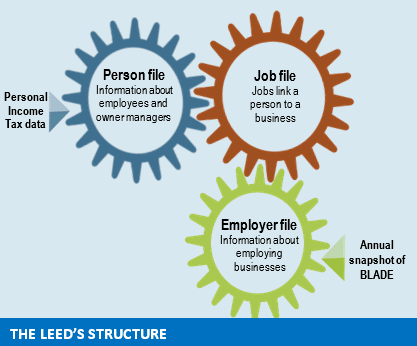
The LEED consists of three cross-sectional files:
- a person file;
- a jobs file; and
- an employer file.
The LEED associates information about a person with information about their employing business. This is done by establishing the existence of a job. An employed person can have one or more jobs throughout the year with one or more employers, some of which may be held concurrently with others. A job can be created either by an employing business or the personal enterprise of the individual (an owner manager).
LEED overview
Scope
The LEED contains information for all persons who interacted with the Australian taxation system since the 2011-12 financial year. The LEED covers all persons who either:
- submitted an individual tax return (ITR); or
- had an Income Statement (previously Pay As you Go (PAYG) payment summary) issued by an employer and then remitted to the ATO.
Employees who did not submit a tax return and have not provided their Tax File Number to their employer will not appear in the LEED. Owner managers of unincorporated enterprises (OMUEs) who did not submit an ITR are also excluded.
The LEED includes all sources of income, regardless of whether the income provider is based within Australia's economic territory.
Migrant data
From 2022, migrant data were added to the LEED. The migrant data used in LEED are sourced from the Person Level Integrated Dataset (PLIDA), formerly known as the Multi-Agency Data Integration Project (MADIP).
The migrant data are a suite of administrative datasets (visa grants and settlements database) from the Department of Home Affairs. These data pertain to permanent migrants and temporary entrants to Australia.
Integration methodology
LEED links jobs to employers and employed persons are linked to employers via the jobs they hold.
Initial data cleaning is undertaken to remove duplicate and erroneous records. In particular, job records are repaired to minimise the impact of administrative noise on output statistics, such as annual income statements issued in two separate parts.
Before the linkage takes place, an input job level file is created largely based on the income statement file. This file is also enhanced with job records derived using ITR information, to cover jobs without income statement information, such as OMUE jobs. Data quality of this file is also enhanced using occupation information from ITR, and the best available age, sex, and geographic information between the Income Statement, ITR and Client Register (CR) data.
Jobs are integrated with the employer by one of two methods. The method is dependent on which part of the business population on the ABS Business Register the employer is grouped into.
- Non-profiled population (businesses with a simple structure): a deterministic approach using the Australian Business Number (ABN).
- Profiled population (businesses with a complex structure): a more detailed approach to linking is used, detailed below.
Profiled population linking
Where an employer is part of the profiled population, the relevant jobs are assigned to type of activity units (TAUs) based on a logistic regression model developed using Census data. The model references independent variables common to both Census and personal income tax data, including sex, age, occupation, and region of usual residence. These are used to predict the industry of employment, which conceptually aligns to a type of activity unit.
Where an employee has multiple job relationships with the same reporting ABN in an enterprise group, each job relationship is assigned to the same type of activity unit.
Based on the model, each job record is assigned a probability of being in each of the type of activity units present in the employing enterprise group. Iterative random assignment is undertaken using these probabilities until employment benchmarks are met. Benchmarks are based on Quarterly Business Indicators Survey (QBIS) data where a unit is in scope. BLADE employment levels are substituted where QBIS data is not available, otherwise no benchmarking is done.
The above process is applied to link the different input datasets for each financial year. Records have not been integrated across years and therefore, the LEED is a cross-sectional database and is not longitudinal.
Integrating migrants data
Personal identifiers were used to first integrate the migrant data with the ATO's Client Register data and then integrated into LEED. This enables more detailed analysis of labour market and fiscal contributions of migrants to the economy, allowing policy makers and researchers to better understand the migrant experience and their economic contribution to Australia.
ABS data integration practices comply with the High-Level Principles for Data Integration Involving Commonwealth Data for Statistical and Research Purposes. For further information see - Keeping integrated data safe.
Legislative environment
The LEED incorporates:
- person level ITR data, job level income statement data and Client Register data supplied by the ATO to the ABS under the Taxation Administration Act 1953 - which requires that such data is only used for the purpose of administering the Census and Statistics Act 1905; and
- employer level data that include the ABS's BLADE data and the ABS Business Register data supplied by the Registrar of Australian Business Register (ABR) to the ABS under A New Tax System (Australian Business Number) Act 1999 - which requires that such data is only used for the purpose of carrying out the functions of the ABS.
The data limitations or weakness outlined here are in the context of using the data for statistical purposes, and not related to the ability of the data to support the ATO's or ABR's core operational requirements.
Legislative requirements to ensure privacy and secrecy of these data have been followed. In accordance with the Census and Statistics Act 1905, results have been confidentialised to ensure they are not likely to enable identification of a particular person or organisation. All personal information is handled in accordance with the Australian Privacy Principles contained in the Privacy Act 1988.
All personal income tax statistics were analysed in de-identified form with no home address or date of birth included in LEED input files. Addresses were coded to the Australian Statistical Geography Standard (ASGS) and date of birth was converted to an age at 30 June of the reference year prior to data provision.
The LEED is comprised of a person file, a job file and an employer file
Person file
Each person file contains data for all persons who either submitted an Individual Tax Return (ITR) or who were identifiable on an income statement in the reference year. Each record includes de-identified demographic and geographic data, and aggregate income information.
Employed persons may be either employees (including Owner Manager of Incorporated Enterprises or OMIEs), Owner Managers of Unincorporated Enterprises (OMUEs), or both. Employees are identified by the presence of aggregate employee income and at least one linked employee job.
Employees who have not submitted an ITR but who have provided their Tax File Number to their employer are imputed from income statement data.
OMUEs are identified by the presence of any of the own unincorporated business income types and a linked OMUE job.
Tax lodgers who are not employees or owner managers (such as persons with only investment incomes) are included on the person file to support statistical analysis that requires a more complete view of the tax lodger population.
Jobs file
The jobs file is a complete list of the job relationships held at any time during the reference year. It is constructed primarily from income statement data. Income statements describe the payments made to an individual by an employer within a financial year. Conceptually, income statement data should include most employee/employer job relationships. OMUE jobs are derived from ITR data and are added to the jobs file, some of these link to businesses in the Business Longitudinal Analysis Data Environment (BLADE).
In some cases a synthetic employee job record has been created based on information in the person file. This has occurred when a person has recorded wage or salary information that cannot be identified in income statement data. Sometimes, an employee job may not be able to be linked to an employing organisation due to reporting errors or missing information.
A person can hold several jobs during the year, either concurrently (as a multiple job-holder) or consecutively. For a person who is an employee of several employers, each relationship is listed as a separate job. Due to data limitations, only one self-employment job can be recorded for any OMUE even if a person owns and manage more than one enterprise. In the LEED, an OMUE can hold other jobs as an employee.
The LEED jobs file excludes voluntary jobs and unpaid contributing family worker jobs.
Employer file
In the LEED, an employer is any legal entity in the non-profiled population that is linked to a job; and any type of activity unit in the profiled population that is linked to a job.
The employer file contains business units present in BLADE that could be linked to a job, as well as unincorporated entities. Some unincorporated entities are identified in personal income tax data and are not otherwise included in BLADE or cannot be identified in BLADE. Industry and several other employer variables are not available for these unincorporated entities, except from 2017-18, where industry information in their ITR has been used if available.
LEED outputs
Key outputs
The LEED provides cross-sectional information relating to employees and owner managers of unincorporated enterprises
Key data/series include:
- Employed persons and their jobs (employees and owner managers of unincorporated enterprises)
- Multiple job holders
- Income at job and person levels
- Regional spotlights of jobs and employed persons
Other data includes (but is not limited to):
For people with income:
- Income types: Total, Employee, Investment, Own unincorporated business, Superannuation
- Counts of earners
- Distributional information: mean, median, quartiles, percentile ratios, gini coefficient, income share
- Geography - region of residence (at State and Territory, Local Government Area, Statistical Area 4, 3, and 2 levels)
- Demographic information: age, sex
- Migrant characteristics: visa, year of arrival, applicant status
In addition, for persons with jobs:
- Counts: Employed persons, Jobs, Employees, Owner-Managers of Unincorporated Enterprises, Multiple job holders
- Status in employment: Employee, Owner-manager of Unincorporated Enterprise
- Income: Employment, Employee, Own Unincorporated Business, Duration adjusted income per job (annualised)
- Detailed occupation and skill levels of persons
- Detailed industry of job
- Sector (public/private)
- Number of jobs held (employee jobs and owner manager of unincorporated enterprise jobs)
- Duration of jobs
- Concurrent and non-concurrent jobs
Information relating to employers:
- Employment size
- Detailed industry of business activity
- Type of legal organisation (TOLO)
- Institutional sector (SISCA)
Statistical releases
LEED data is disseminated through the publications listed below. Additional data is available through Customised Data Requests.
Jobs in Australia
Frequency: Annual, from 2011-12
Jobs in Australia (JIA) provides aggregate statistics from the Linked Employer-Employee Dataset. It provides information about filled jobs in Australia, the people who hold them, and their employers. JIA provides data across 2,288 Statistical Areas as well as Local Government Areas.
Personal Income in Australia
Frequency: Annual, from 2011-12
Personal Income in Australia (PIIA) provides a comprehensive range of income indicators across small geographic areas.
Tablebuilder: Jobs and Income of Employed Persons
Frequency: Annual, from 2011-12
Release of LEED data for employed persons through TableBuilder. This enables users to build their own customised tables from the Linked Employer-Employee Dataset microdata, including for State and Commonwealth Electoral Divisions.
Single Touch Payroll (STP)
The Australian Taxation Office (ATO) receives payroll information from employers through Single Touch Payroll (STP) enabled payroll and accounting software each time the employer runs its payroll. The ATO provides selected employer and job level data items from the STP system to the ABS for the production of official statistics. STP replaces the need for businesses to provide a payment summary annual report or 'group certificates.'
Estimates based on STP data begin from January 2020 at the earliest. Employers with 20 or more employees (large employers) commenced transition to STP reporting on 1 July 2018. Employers with less than 20 employees (small employers) began transitioning to STP on 1 July 2019. Any reporting concessions that were made available for small employers ended on 30 June 2021. From July 2021, almost all large employers and eligible small employers report through STP.
Other data sources
The STP data are enhanced through combining other administrative data held by the ABS (also sourced from the Australian taxation system).
Industry of activity, state/territory of operations, sector and employment size variables of the employing business are sourced from the ABS Business Register (ABSBR).
Sex, age and residential geography variables are primarily sourced from Client Register data (supplied by ATO to the ABS as part of the transfer of Personal Income Tax data). Sex can only be sourced from Client Register data. When age and residential geography are not available from Client Register data, they are sourced from STP data. The ABS receives annual snapshots of de-identified Client Register data from the ATO, for use in the production of statistics.
Scope and coverage
Detailed information on the scope and coverage of Labour statistics derived from Single Touch Payroll data can be found in the methodology pages accompanying respective statistical releases: Weekly Payroll Jobs; Monthly Employee Earnings Indicator and Public Sector Employment and Earnings.
STP outputs
The ABS has been using Single Touch Payroll (STP) data from the Australian Tax Office (ATO) to produce unique insights into the labour market since April 2020.
Monthly Employee Earnings Indicator
STP data are compiled into calendar month reference periods of total wages and salaries paid by employers. Estimates are compiled using STP data received around 6 weeks after the end of the latest reference month and are scoped and weighted to all active employing businesses/organisations in the Australian economy.
The release includes level estimates and percentage change for national, state and territory, Australian and New Zealand Standard Industry Classification (ANZSIC) division and subdivision, employment size and public/private sector, as outlined in Standard Economic Sector Classifications of Australia.
The estimates are presented as an original series only. Seasonally adjusted and trend estimates are not yet available as a number of years of stable data are required before seasonal patterns can be observed and adjusted for.
To improve the comparability of estimates between calendar months, an adjustment has been applied to account for the differing number of days in each month. The adjustment standardises all months to an average length of days and is known as calendar adjustment. This type of adjustment is usually done as part of seasonal adjustment.
The data underlying these estimates are revised in each release.
From February 2026, a new monthly employee jobs measure will be added to provide insights into jobs growth and its influence on the composition of total wages and salaries.
Public Sector Employment and Earnings
STP data are compiled annually to measure public sector wages and employee jobs. These are published annually in Public Sector Employment and Earnings (PSEE).
Each release contains cash wages and salaries for the financial year, and employee jobs in the month of June and is scoped and weighted to all active employing public sector organisations in the Australian economy.
Estimates are available by:
- Level of Government (Local, State and Commonwealth)
- National, state and territory
- Australian and New Zealand Standard Industry Classification (ANZSIC) division
The PSEE series commences from the 2021-22 financial year and replaces the annual Survey of Employment and Earnings which covered 2007-08 to 2021-22.
Weekly Payroll Jobs
Up until its retirement in July 2025, Payroll Jobs provided indexes of week-to-week changes in jobs, and previously wages paid, from STP data, across all industries.
Payroll jobs, and previously wages, are as reported to the ATO through STP-enabled payroll or accounting software. Payroll Jobs and wages indexes can be used to understand the short term changes in wages paid between January 2020 and June 2023 and in industry employment between January 2020 and March 2025.
Each release contains both indexes and percentage changes which are available for national, state and territory and Australian and New Zealand Standard Industry Classification (ANZSIC) division and subdivision by selected jobholder and employer attributes across the series.
Levels for jobs and wages are not available in this release. The payroll jobs index provides a measure of changes in jobs over time.
The estimates are presented as an original series only and the underlying data were revised in each release.
The issue was originally named Weekly Payroll Jobs and Wages and was renamed Weekly Payroll Jobs and then Payroll Jobs across its release history to reflect changes in content and methods.