- The Time Use Survey is released as How Australians Use Their Time.
- The Rise of Big Data and Integrated Data Assets – EY Conference ‘What not to ignore in ‘24’
https://www.abs.gov.au/about/our-organisation/australian-statistician/speeches/rise-big-data-and-integrated-data-assets
This is not the latest release View the latest release
ABS Corporate Plan
The ABS Corporate Plan outlines the role of the ABS as a national statistical agency and the future directions of the organisation.
Reference period
2024-25
30/08/2024
Foreword

Australian Statistician, Dr David Gruen AO
As Australia’s national statistical agency, the Australian Bureau of Statistics (ABS) tells Australia’s story through numbers. Our work provides valuable insights into Australia’s population, environment and economy, informing important decisions that have impacts on the daily lives of Australians.
With the 2026 Census just 2 years away, the ABS is developing the critical infrastructure required to ensure a secure and trusted Census. We are engaging with the community to co-design strategies to ensure that the Census is an easy and secure experience for all Australians.
This year we will continue Phase 2 of our major transformation program, Big Data, Timely Insights (BDTI), which is rebuilding core statistical tools and processes in a cloud-based data analytics environment and delivering a complete monthly measure of the Consumer Price Index (CPI). From 2024–25, we will commence building a Business Characteristics Asset to provide tailored, granular and timely insights on Australian businesses.
We continue to use administrative and alternate data sources to generate new insights through data integration initiatives. The ABS is developing new data assets to support the Australian Government’s Competition Review, provide insights into gender-based violence through the Criminal Justice Data Asset and a new Early Childhood Education and Care cost index to track changes in the costs of delivering childcare services over time. The Government has also invested in the ABS to design and conduct an annual social survey to provide timely data on Australia’s wellbeing for the Measuring What Matters Framework.
The ABS is modernising its data acquisition process to respond to long-term declines in survey response rates – a global phenomenon – and to enable a digital-first approach to data collection. We are strengthening our partnerships with states, territories and businesses to explore new data sources, while embracing new technologies, maintaining a strong focus on data security and on enhancing the value of data.
The ABS Corporate Plan 2024–25 is our key planning document. It provides an overview of the ABS’ operating environment, key priorities, challenges, activities, statistical outputs, and how we will measure our success.
As the Accountable Authority of the ABS, I am pleased to present the ABS Corporate Plan 2024–25, which covers the period 2024–25 to 2027–28, in accordance with the requirements of section 35(1)(b) of the Public Governance, Performance and Accountability Act 2013.
I look forward to reporting to the Australian Parliament and the public on our performance in delivering on this Plan in the ABS Annual Report 2024–25.
Dr David Gruen AO
Australian Statistician
About the ABS
Our purpose
To inform Australia’s important decisions by delivering relevant, trusted and objective data, statistics and insights.
Our role
The ABS is Australia’s national statistical agency. It provides trusted official statistics on a wide range of economic, social, population and environmental matters of importance to Australia.
The ABS leads the use of public data for statistical purposes and works to improve the Australian Government’s data and statistical capabilities. It works in partnership with other organisations to expand the range and quality of statistical data and information available to governments and the community.
The ABS advises official bodies on producing and using data and statistics, formulates standards, works with states and territories, and liaises internationally with other national statistical organisations.
The ABS also leads the Australian Public Service (APS) Data Profession, building the data capabilities of the APS workforce.
Our legislation
The primary functions, duties and powers of the ABS are set out in the:
- Australian Bureau of Statistics Act 1975, which establishes the ABS as an independent statutory authority and legislates its main function as the central statistical authority for the Government and a provider of services for state and territory governments.
- Census and Statistics Act 1905, which empowers the Australian Statistician to collect and publish statistical information on a broad range of demographic, economic, environmental and social topics and has strong provisions to maintain the confidentiality of information collected under the Act.
In addition, the Census and Statistics (Information Release and Access) Determination 2018 enables the Statistician to release information collected under the Census and Statistics Act 1905 when specific conditions are met.
The ABS must comply with the governance and accountability system defined by the Public Governance, Performance and Accountability Act 2013. The ABS must also comply with a range of legislation including the Public Service Act 1999, the Freedom of Information Act 1982, the Privacy Act 1988, the Public Interest Disclosure Act 2013, the National Anti-Corruption Commission Act 2022 and the Data Availability and Transparency Act 2022.
Operating context
Environment
Each year, in setting its priorities, the ABS considers the needs of key information users, current and emerging risks, the burden placed on data providers, available resources and opportunities to improve access to statistical information.
The demand for high-quality data continues to grow as governments and institutions respond to issues such as social disadvantage and the cost of living. To better inform policy decisions that have tangible implications for Australian households, the ABS is increasing the quality and frequency of statistics that provide insights into Australians’ financial and overall wellbeing. This includes delivering a comprehensive monthly Consumer Price Index (CPI) to offer more timely insights into inflation. The ABS will also conduct an annual General Social Survey to inform Australia’s national wellbeing framework, Measuring What Matters.
The ABS is responding to increased demand for data, embracing new technologies and exploring alternate sources of data. The secure linkage of administrative and alternate sources of data provides a new evidence base for policy, community insights and program evaluation. The ABS hosts these data assets securely and with well-developed protocols to protect individual and business information.
The ABS is modernising its data acquisition process to respond to long-term declines in survey response rates and to enable a digital-first approach to data collection. This will improve the user experience and reduce the time it takes individuals, businesses and households to provide information. Innovations such as the ABS Business Reporting web application allow businesses to use their accounting software to pre-fill survey responses, saving time and improving the quality of the data collected. The ABS is also conducting extensive community consultation and research ahead of the 2026 Census to inform strategies to support household participation.
In embracing the use of data linkage and new technologies to reduce provider burden, the ABS is also aware of Australians’ privacy expectations on the use of their data. There is a high level of public trust in how the ABS collects, handles and secures information. The ABS is undertaking Privacy Impact Assessments for the Census and other sensitive collections to ensure data handling practices are consistent with community expectations.
Capability
The ABS has a capable, diverse and highly engaged workforce. Our people are in high demand, with their skills making them attractive in both the public and private sector. The ABS value proposition for staff continues to be based on making a significant contribution to the Australian community, flexible approaches to working, the provision of development opportunities, and a strong and highly regarded graduate recruitment and development program.
The ABS ensures its time, resources and funds are directed to priority activities. Our governance minimises duplication and redundant effort, ensuring investments can deliver key statistical releases and support long-term projects.
The ABS is committed to the Australian Public Service (APS) Strategic Commissioning Framework to ensure the core work of the ABS is undertaken by APS employees.
The ABS has set a target to keep the amount of core work outsourced to less than 1% of its Full-Time Equivalent workforce. This target reflects our commitment to maintaining the ABS’ core work in-house and harnessing APS expertise and knowledge.
The ABS is making shifts to deliver on its strategic priorities and respond to changing priorities and opportunities. The 5 shifts are:
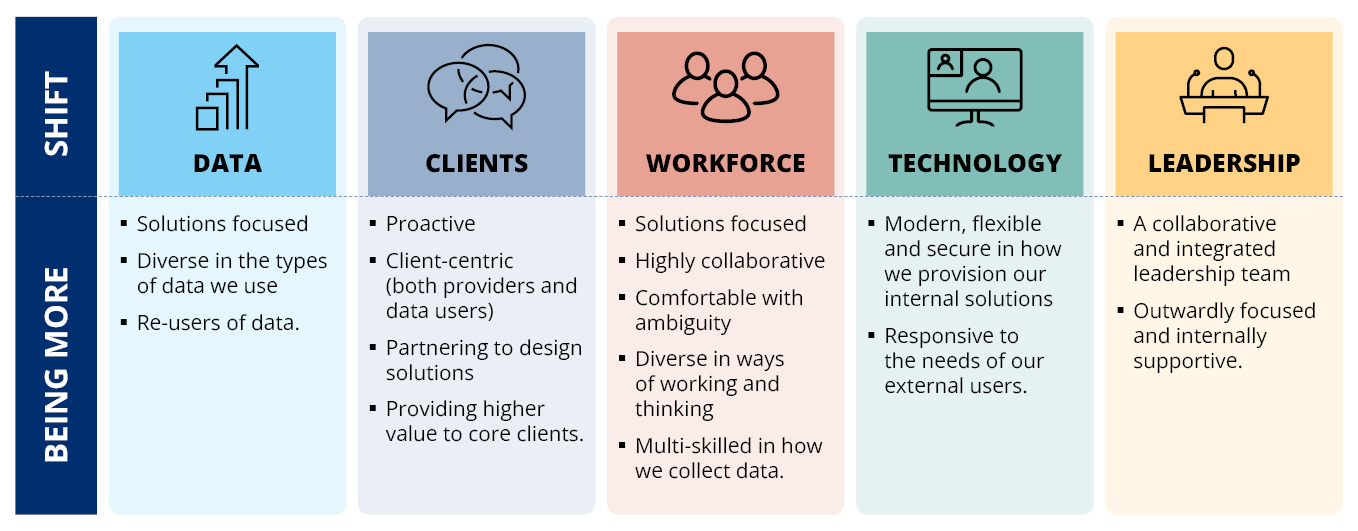
This image describes the five ways in which the ABS is making shifts to deliver on its strategic priorities and respond to changing priorities and opportunities.
The image describes how the ABS will source and protect data, engage with its clients, shape its workforce, modernise its technologies and strengthen its leadership. The image is divided into five columns.
- Data: The ABS will shift towards being more solutions focused, diverse in the types of data it uses and will maximise the reuse of data.
- Clients: The ABS will shift towards being more proactive, client-centric, active in partnering to design enhanced solutions and will provide higher value to core clients.
- Workforce: The ABS will shift towards being more solutions focussed, highly collaborative, comfortable with ambiguity, diverse in ways of working and thinking and multi-skilled in how it collects data.
- Technology: The ABS will shift towards being more modern, flexible and secure in how we provision our internal solutions and responsive to the needs of our external users.
- Leadership: The ABS will shift towards being more collaborative and have integrated leadership teams, outwardly focused and internally supportive.
The Big Data, Timely Insights (BDTI) program is supporting these shifts by the use of modern and secure technology, responding to the needs of our clients and providing timely and accurate economic insights.
Phase 2 of the BDTI program will support the transition of key data assets to a secure cloud environment, allowing the ABS to reduce the risks it currently faces to the production and accuracy of Australia's key economic statistics.
From 2024–25, the BDTI program will also commence work to replace the legacy Statistical Business Register system with a cloud-based product, the Business Characteristics Asset that will provide additional data on small businesses and more timely insights on business formation and resilience.
Risk oversight and management
The ABS recognises risk as a necessary part of the innovation required to deliver relevant, timely and high-quality statistics. Where strategies and priorities result in higher risk, internal management and engagement with clients ensures there is appropriate awareness and control of the risk.
The ABS Risk Management Framework sets out the Australian Statistician’s expectations for how the ABS manages risks to deliver better outcomes for the Australian community. Based on the Commonwealth Risk Management Policy, the framework supports the ABS in establishing and maintaining appropriate systems and controls for the oversight and management of risk, in line with Australian Government requirements.
The Australian Statistician has overarching responsibility for the ABS Risk Management Framework. The Australian Statistician chairs the ABS Executive Board that monitors the enterprise risks facing the ABS and determines our risk appetite and tolerance. The Chief Risk Officer supports the Executive Board in reviewing enterprise risk and assuring the effectiveness of our management of risk. The Audit and Risk Committee provides independent advice to the Australian Statistician on the appropriateness of the enterprise risk management framework and internal controls.
The ABS builds a line of sight for all staff to the enterprise-level strategy and priorities. Managers at all levels are accountable for managing risks to their objectives by establishing monitoring and control activities proportionate to the level of risk. ABS governance bodies enable collective and coordinated responses to risk by enabling investment in controls for common or systemic risks, supporting effective escalation of higher-level risks, and overseeing the efforts of line managers in addressing lower-level risks.
The ABS risk culture supports innovative projects by encouraging calculated risk-taking, finding opportunities and applying informed risk management practices.
The ABS has put plans in place to mitigate against key risks, which include the following:
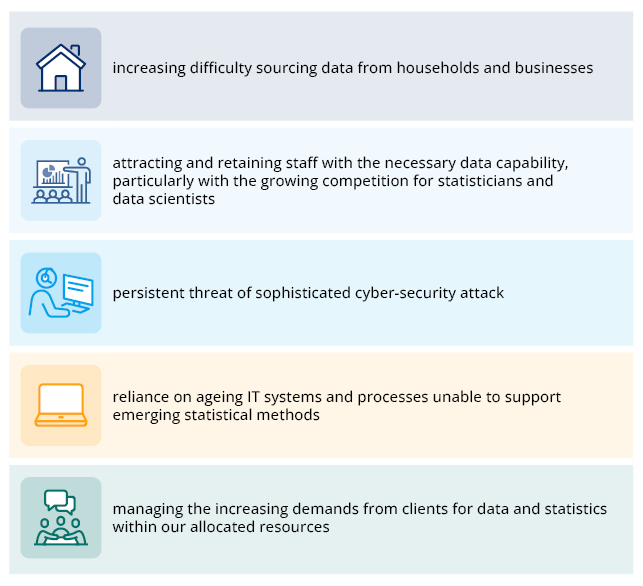
The image is divided into five rectangles down the page.
Each rectangle describes the plans the ABS has put in place to mitigate risk. They are:
- increasing difficulty sourcing data from households and businesses
- attracting and retaining staff with the necessary data capability particularly with the growing competition for statisticians and data scientists
- persistent threat of sophisticated cyber-security attack
- reliance on ageing IT systems and processes unable to support emerging statistical methods
- managing the increasing demands from clients for data and statistics within our allocated resources.
Collaboration and cooperation
As Australia’s national statistical agency, the ABS understands the importance of our relationships with key data providers, including state and territory governments and private sector entities. These partnerships are crucial in the dynamic data and statistical environment, enabling the ABS to bring together data from across the APS and private sector. Working together to harness opportunities will support the production of high-quality official statistics and new insights.
Our cooperation across government and research institutions includes working with:
- the Department of Education on the new Early Childhood Education and Care cost index
- the Reserve Bank of Australia to host conferences that showcase the role of data in tackling public policy problems
- the Australian Prudential Regulation Authority to enhance the data collection of insurance, superannuation and banking data
- the Department of Social Services, the Australian Institute of Health and Welfare and states and territories to deliver the National Disability Data Asset (NDDA) and Australian National Data Integration Infrastructure (ANDII)
- the Bureau of Meteorology, CSIRO and Geoscience Australia on the Australian Climate Service to help government and community better understand the threats posed by natural disasters and climate change and reduce their impacts
- Geoscience Australia to deliver the Digital Atlas of Australia to provide users with access to a selection of data, interactive applications and maps
- APS agencies to produce integrated data assets including the Person-Level Integrated Data Asset (PLIDA) and Business Longitudinal Analysis Data Environment (BLADE) about people and businesses
- ACT and SA Governments on the pilot Life Course Data Initiative (LCDI) which integrates data from a range of ACT and SA Government services to PLIDA and demonstrates its value in addressing entrenched disadvantage
- the Department of Agriculture, Forestry and Fisheries and the agricultural industry to modernise ABS agriculture statistics using alternative data sources
- the Australian university sector to develop and quality assure the methodological solutions which underpin our statistics and processes.
The ABS also develops and draws on international expertise by collaborating with statistical agencies worldwide and mentoring agencies in developing countries.
The ABS is an active member of the United Nations Statistical Commission and has many enduring international relationships. Through these connections, the ABS shares its expertise, collaborates on research and development, and enhances the quality and relevance of its own statistical products and services. The ABS’ international engagements include working with:
- the International Monetary Fund to develop the 7th edition of the Balance of Payments and International Investment Position Manual (BPM7)
- the United Nations Statistical Commission to update the System of National Accounts 2008 (2008 SNA), which will culminate in the 2025 SNA
- other nations in the High-Level Group for the Modernisation of Official Statistics (HLG-MOS) to develop strategies and solutions in a flexible and agile way
- the Department of Foreign Affairs and Trade to support regional statistical capability and institutional strengthening through programs in Indonesia, Timor-Leste, Papua New Guinea, Fiji and elsewhere in the Pacific.
The ABS works with the ABS Round Table for Aboriginal and Torres Strait Islander Statistics to ensure statistical programs are undertaken in a culturally safe manner and reflect the priorities, values and diversity of Aboriginal and Torres Strait Islander peoples.
Activities
The Australian Statistician, assisted by the Executive Board, ensures planned and executed activities are coherent, complementary and coordinated by articulating the ABS’ strategic priorities. These strategic priorities are set through collaboration with our partners and stakeholders, and in response to the external operating environment.
The ABS’ strategic priorities are:
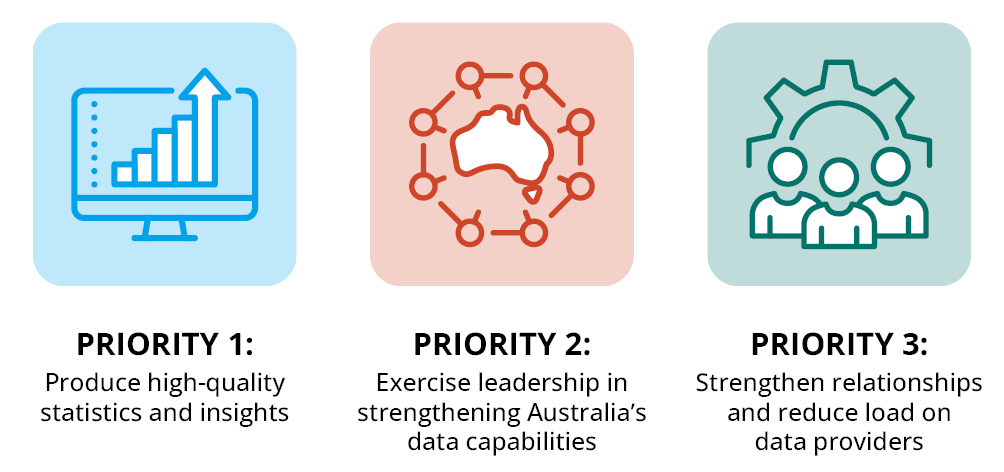
The image is divided into three squares. Each square describes one of the three ABS strategic priorities:
- Priority 1: Produce high-quality statistics and insights
- Priority 2: Exercise leadership in strengthening Australia's data capabilities
- Priority 3: Strengthen relationships and reduce load on data providers.
These priorities provide clear alignment with the ABS’ Portfolio Budget Statements and internal planning document, the Enterprise Strategy 2024–25 to 2028–29.
The ABS has revised its strategic priorities in 2024–25 to improve clarity and highlight enhanced commitments to strengthening Australia’s data capabilities and the growing importance of the ABS’ relationships with both public and private sector data providers.
Priority 1: Produce high-quality statistics and insights
The ABS collects and analyses a broad range of social, economic, business, population and environmental data and produces valuable statistics and insights to inform Australia’s important decisions.
ABS data and statistics underpin fiscal and monetary policy and inform the delivery of programs and services vital to the health and wellbeing of Australians. They support a strong, well-functioning democracy and provide reliable information on a range of matters critical to public debate.
The ABS uses survey and administrative data to provide insights into Australia as a nation. The ABS continues to build relationships with all levels of government, academia, business and the not-for-profit sector to generate statistical information to inform and assess the effectiveness of economic, social and environmental policies. ABS consults key clients and users of ABS data and statistics to ensure innovative statistical products are relevant and valuable.
During 2024–25, the ABS will continue to deliver a range of economic, industry, environmental and agricultural statistics and products to meet the needs of government, businesses and the community.
Key activities include:
- producing high-quality, respected, well explained macroeconomic statistics, including the Australian System of National Accounts
- producing quality price indexes, including the Consumer Price Index (CPI) (quarterly and new monthly indicator), Producer Price Index and Wage Price Index
- developing new statistics from the BDTI project, including a complete monthly measure of the CPI due for release in 2025–26.
During 2024–25, the ABS will continue to deliver a range of population, labour and social statistics such as quarterly population estimates and the monthly labour force series to meet the needs of government, businesses and the community.
Key activities include:
- continuing to address labour market data gaps to enhance data on employment outcomes and barriers, modernise survey forms for labour market content, expand the Labour Account and consult with Aboriginal and Torres Strait Islander peoples on more frequent employment data
- enhancing industrial relations and regional labour market statistics and providing more detailed geographic breakdowns
- reinstating the General Social Survey to provide statistics annually from 2026 onwards for the Treasury’s Measuring What Matters framework
- reinstating the Time Use Survey¹ every 2 years to assist the understanding of how Australians balance their time between work, family, leisure and caring activities
- implementing an intercensal review of Net Interstate Migration to reduce the accumulation of errors in state and territory population estimates between Censuses.
As required by the Census and Statistics Act 1905, the ABS will conduct the next Census in 2026. The Census provides a snapshot of the economic, social and cultural make-up of the nation and tells the story of how Australia is changing over time. The design and development of the 2026 Census continues in 2024–25.
Key activities include:
- finalising 2026 Census content
- community engagement to co-design strategies and plans to support all people to participate in the Census
- delivering critical infrastructure to support a secure and trusted 2026 Census
ensuring the 2026 Census will be an easy and secure experience for all Australians.
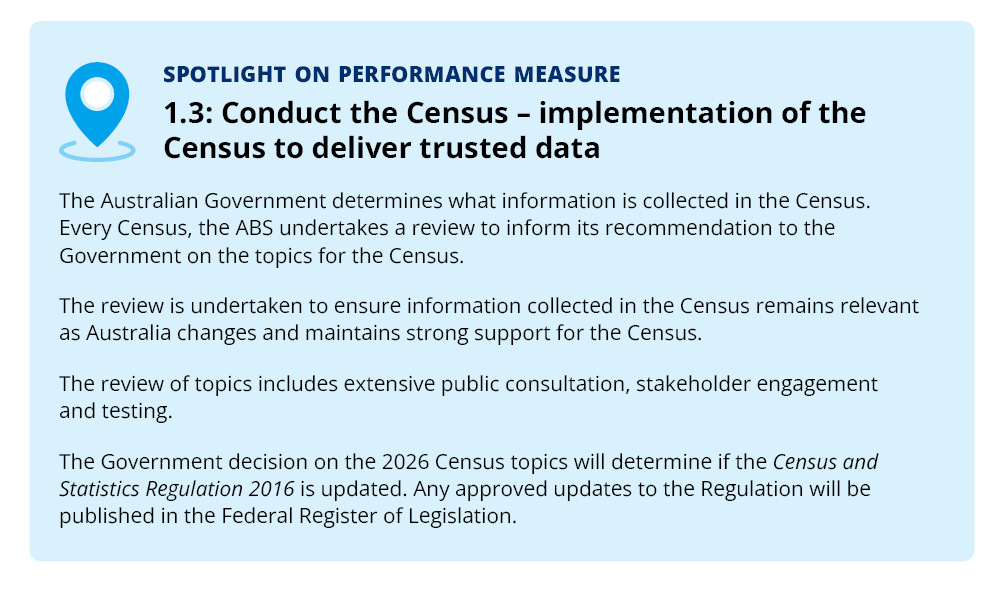
Spotlight on performance measure: 1.3: Conduct the Census – implementation of the Census to deliver trusted data.
The Australian Government determines what information is collected in the Census. Every Census, the ABS undertakes a review to inform its recommendation to the Government on the topics for the Census.
The review is undertaken to ensure information collected in the Census remains relevant as Australia changes and maintains strong support for the Census.
The review of topics includes extensive public consultation, stakeholder engagement and testing.
The Government decision on the 2026 Census topics will determine if the Census and Statistics Regulation 2016 is updated. Any approved updates to the Regulation will be published in the Federal Register of Legislation.
As the custodian of nationally significant data and statistical assets, the ABS serves a diverse range of stakeholders that use ABS data, including government agencies, local councils, the public, researchers, businesses and community groups. The ABS is dedicated to improving access to its products and services while maintaining privacy and confidentiality.
Key activities include:
- improving the digital experience for users by designing for accessibility and inclusiveness of ABS products and services using the Digital Service Standard 2.0 and Web Content Accessibility Guidelines 2.2.
The ABS builds and maintains integrated data assets for research in the public interest. By maintaining and regularly updating integrated data assets, the ABS can respond effectively to evolving research demands and users can undertake important research about people and businesses across time.
Key data asset activities in 2024–25 include:
- the Business Characteristics Asset is being rebuilt to provide tailored, granular and timely insights on Australian businesses
- developing new data assets to:
- support the Government’s Competition Review to provide greater ongoing visibility of merger and acquisition activity in the economy
- provide insights into gender-based violence through the Criminal Justice Data Asset
- create a new Early Childhood Education and Care cost index to track changes in the costs of delivering childcare services over time
- delivering the National Disability Data Asset (NDDA), a new source of information about people with disability. It will bring together de-identified data from Australian, state and territory government agencies for research and analysis. It will provide deeper, data driven insights about the needs and outcomes of people with disability to help improve programs and services
- continuing to develop the Life Course Data Initiative (LCDI), a 4-year program that will create a linked Life Course Dataset using Person-Level Integrated Data Asset (PLIDA) and deliver data insights to inform long term policy responses to address entrenched disadvantage.
The production of high-quality statistics relies on contemporary, high-quality statistical standards and infrastructure.
In 2024–25, the key activities include:
- completing the comprehensive review of the Australian and New Zealand Standard Classification of Occupations (ANZSCO). ANZSCO is used in the collection, publication and analysis of occupation statistics. It is used across the Australian Public Service (APS) in a variety of ways, including to reflect changes in the labour market. The review will be completed by December 2024 for use in the 2026 Census
- developing a coding capability using machine learning technology to code text to statistical classifications. This capability will be deployed as a whole of government facility for occupation coding, support ABS internal use across a number of classifications and increase data linkage and integration possibilities. This coding capability will also increase the efficiency of coding statistical information.
Priority 2: Exercise leadership in strengthening Australia’s data capabilities
“Investment in the safe and secure linkage of administrative data is becoming increasingly important to provide the evidence base for policy, community-level insights, and program evaluation.
Over time, these data assets should greatly expand the opportunity for analysts, both within government and beyond, to do high-quality empirical research and evaluations of programs and thereby to improve the information base on which future public policy is formulated.”²
Dr David Gruen AO
The Australian Statistician serves as a member of the National Data Advisory Council (the Council), set up under the Data Availability and Transparency Act 2022. The Council provides advice to the National Data Commissioner on matters including ethical use of public sector data, balancing data availability with privacy protection, technical best practice, and industry and international developments.
Other ABS engagement across the APS includes:
- outposting a team to support the Office of the National Data Commissioner (ONDC) in its stewardship of data sharing legislation
- outposting staff to other Commonwealth entities to support the delivery of the Data and Digital Government Strategy
- contributing as a member of the Deputy Secretaries Data Group and Secretaries’ Data and Digital Committee to provide oversight of data initiatives
- driving the Data Champions Forum and supporting the ONDC to implement new data sharing legislation.
The APS Data Profession focuses on strengthening data capabilities within the APS workforce. Key initiatives include streamlined data graduate recruitment, developing data specialist capability, promoting diversity in data roles and providing data literacy education. In doing so, the APS aims to harness the increasing availability and value of data across teams and agencies.
As Head of the APS Data Profession, the Australian Statistician leads initiatives that attract, develop, and retain skilled data professionals, fostering innovation and collaboration across APS agencies. The Australian Statistician collaborates with agencies to champion the APS Data Profession strategy, ensuring its successful implementation and impact.
The Data Profession Members’ Community Platform (MCP) continues to grow. It connects data professionals across the Australian and state and territory public service and hosts communities of practice. As of 30 June 2024, the MCP has over 9,500 members across Australia, working to enhance the data capability of the public sector workforce for better national outcomes.
Key activities include:
- continuing to lead the APS-wide graduate recruitment for the Data Profession, recruiting on behalf of over 35 agencies in 2024–25
- promoting the data specialist employee value proposition to attract, recruit and retain data professionals at all levels
- leading the APS Data Awards, a celebration of outstanding data-driven initiatives across the APS
- maturing and delivering training modules targeting the Senior Executive Service and executive level cohorts, covering data governance, management and leadership
- refining and developing career pathway tools, capability frameworks and foundational training for graduates, data professionals and those seeking to uplift data literacy.
Government agencies use ABS investment and expertise to access secure cloud-based data services required to safely manage data sharing.
Key activities include:
- the ABS Secure Environment for Analysing Data (SEAD) service, which will continue to provide a series of secure, self-contained environments within the ABS DataLab’s cloud-based infrastructure. Government agencies using this service maintain full control and management of their data, users, projects and outputs in accordance with their legislative, policy and risk requirements. The ABS maintains the system's protections, in line with the Five Safes framework.
Spotlight on performance measure - 2.1: Adoption of secure data infrastructure - providing secure data management and data sharing capabilities to support the Australian Government, and state and territory governments.
The ABS developed SEAD to meet the demand for secure cloud-based data access services across the Australian Government. SEAD supports government agencies in incorporating the ONDC Data Sharing Principles into their regular operations, ensuring safe data sharing and access to modern data science tools.
In 2024–25, the ABS has introduced a new performance measure to track the number of agreements in place for SEAD services, aiming to assess uptake in the future.
Priority 3: Strengthen relationships and reduce load on data providers
The ABS continues to strengthen relationships with all levels of government, academia, business and the not-for-profit sector to generate statistical information to inform and assess the effectiveness of economic, social and environmental policies. The ABS consults key clients and users of ABS data and statistics to ensure innovative statistical products are relevant and valued.
The ABS’ Outposted Officer network facilitates access to statistics, develops statistical capability and aims to strengthen statistical coordination with federal, state and territory government host agencies. The ABS needs to remain agile and responsive to changing client needs and circumstances, while continuing to safeguard community trust in the ABS as an effective, secure and ethical organisation.
The ABS continues to modernise its data acquisition process to respond to long-term declines in survey response rates and improve methodology and systems to enable a digital-first approach to data collection from Australians.
The ABS is committed to reducing the burden on data providers and is continuously reviewing data collection methods to ensure information is being collected efficiently. In line with the Government’s Data and Digital Strategy, the ABS strives to collect information in the most efficient and timely way with as little cost as possible imposed on businesses and households.
The ABS is increasing its use of administrative data, including data collected by governments and businesses, to reduce the need to conduct surveys.
Key activities include:
- modernising the ABS’ agricultural statistics after ceasing large agricultural surveys. The ABS will instead use existing data from government, industry and commercial sources to produce official agricultural statistics, now known as the Australian Agriculture series
- modernising the ABS’ data sourcing capabilities and accelerating use of digital technologies through the Data Acquisition Modernisation Strategy. This work focuses on a digital first approach to encourage and support online participation and improve usability, accessibility, flexibility and security.
Spotlight on performance measure - 3.1: Efficiency of statistical operations – improving data collection methods.
The ABS relies on public trust and must keep the information given to it safe. The ABS uses identity and authentication management systems to safeguard the data we collect.
The ABS has replaced the legacy system XIAM with OKTA to improve security and provide a simplified and contemporary experience for survey respondents accessing ABS’ digital surveys across household, business, and administrative collections.
The efficiency of this advancement will be measured by the reduction in respondent calls for account registration.
Footnotes:
Forward Work Program
ABS Forward Work Program
The Forward Work Program (FWP) provides the schedule of statistical releases over the next 4 years. This schedule does not include experimental estimates and research papers. It is developed through extensive consultation with Government, key stakeholders including users of statistics, other government organisations and a range of non-government organisations such as community groups and industry bodies.
The ABS reviews and makes changes to the FWP to ensure it continues to appropriately measure the Australian economy, environment and society.
Statistical releases are classified into 3 tiers to assist with prioritising resources. This tiering was developed in consultation with a wide range of interested parties.
| Tier 1 | Statistics representing the foundation work of a national statistical organisation. |
|---|---|
| Tier 2 | Important areas of statistics where there is a significant government outlay or where there is a significant public policy interest. |
| Tier 3 | Other important statistical work currently undertaken to meet identified user requirements. |
| Release | Tier | 2024–25 | 2025–26 | 2026–27 | 2027–28 | Release Frequency |
|---|---|---|---|---|---|---|
| Average Weekly Earnings, Australia | T1 | ✔ | ✔ | ✔ | ✔ | Six-monthly |
| Barriers and Incentives to Labour Force Participation, Australia | T2 | ✔ | ✔ | ✔ | ✔ | Quarterly and yearly |
Characteristics of Employment, Australia
| T2 | ✔ | ✔ | ✔ | ✔ | Yearly |
| Employee Earnings and Hours, Australia | T1 | ✔ | ✔ | Two-yearly | ||
| Industrial Disputes, Australia | T3 | ✔ | ✔ | ✔ | ✔ | Quarterly |
| Job Vacancies, Australia | T2 | ✔ | ✔ | ✔ | ✔ | Quarterly |
| Jobs in Australia | T2 | ✔ | ✔ | ✔ | ✔ | Yearly |
Labour Account, Australia
| T1 | ✔ | ✔ | ✔ | ✔ | Quarterly |
| Labour Force Status of Families | T2 | ✔ | ✔ | ✔ | ✔ | Yearly |
| Labour Force, Australia | T1 | ✔ | ✔ | ✔ | ✔ | Monthly and quarterly |
| Longitudinal Labour Force, Australia³ | T1 | ✔ | ✔ | ✔ | ✔ | Monthly |
| Monthly Employee Earnings Indicator | T2 | ✔ | ✔ | ✔ | ✔ | Six-monthly |
Participation, Job Search and Mobility, Australia
| T2 | ✔ | ✔ | ✔ | ✔ | Yearly |
| Personal Income in Australia | T3 | ✔ | ✔ | ✔ | ✔ | Yearly |
| Public Sector Employment and Earnings, Australia | T1 | ✔ | ✔ | ✔ | ✔ | Yearly |
| Retirement and Retirement Intentions, Australia | T2 | ✔ | ✔ | Two-yearly | ||
| Weekly Payroll Jobs | T2 | ✔ | ✔ | ✔ | ✔ | Quarterly |
| Work-Related Injuries | T3 | ✔ | Four-yearly |
| Release | Tier | 2024–25 | 2025–26 | 2026–27 | 2027–28 | Release Frequency |
|---|---|---|---|---|---|---|
| Australian Industry | T1 | ✔ | ✔ | ✔ | ✔ | Yearly |
| Assets and Liabilities of Australian Securitisers | T1 | ✔ | ✔ | ✔ | ✔ | Quarterly |
| Australian System of National Accounts | T1 | ✔ | ✔ | ✔ | ✔ | Yearly |
| Balance of Payments and International Investment Position | T1 | ✔ | ✔ | ✔ | ✔ | Quarterly |
| Building Activity and Engineering Construction | T1 | ✔ | ✔ | ✔ | ✔ | Quarterly |
| Building Approvals | T1 | ✔ | ✔ | ✔ | ✔ | Monthly |
| Business Characteristics | T2 | ✔ | ✔ | Two-yearly | ||
| Business Indicators | T1 | ✔ | ✔ | ✔ | ✔ | Quarterly |
| Construction Work Done, Preliminary | T1 | ✔ | ✔ | ✔ | ✔ | Quarterly |
| Counts of Australian Businesses, including Entries and Exits | T1 | ✔ | ✔ | ✔ | ✔ | Quarterly and yearly |
| Estimates of Industry Level KLEMS Multifactor Productivity | T2 | ✔ | ✔ | ✔ | ✔ | Yearly |
| Estimates of Industry Multifactor Productivity | T2 | ✔ | ✔ | ✔ | ✔ | Yearly |
| Finance and Wealth | T1 | ✔ | ✔ | ✔ | ✔ | Quarterly |
| Government Finance Statistics | T1 | ✔ | ✔ | ✔ | ✔ | Quarterly |
| Government Finance Statistics, Annual⁴ | T2 | ✔ | ✔ | ✔ | ✔ | Yearly |
| Input-Output Tables | T1 | ✔ | ✔ | ✔ | ✔ | Yearly |
| International Investment Position, Australia: Supplementary Statistics | T2 | ✔ | ✔ | ✔ | ✔ | Yearly |
| International Trade in Goods | T1 | ✔ | ✔ | ✔ | ✔ | Monthly |
| International Trade: Supplementary Information, Calendar Year | T2 | ✔ | ✔ | ✔ | ✔ | Yearly |
| International Trade: Supplementary Information, Financial Year | T2 | ✔ | ✔ | ✔ | ✔ | Yearly |
| Lending Indicators⁵ | T1 | ✔ | ✔ | ✔ | ✔ | Quarterly |
| Managed Funds, Australia⁶ | T1 | ✔ | ✔ | ✔ | Quarterly | |
| Mineral and Petroleum Exploration | T2 | ✔ | ✔ | ✔ | ✔ | Quarterly |
| Modellers’ Database | T3 | ✔ | ✔ | ✔ | ✔ | Quarterly |
| Monthly Business Turnover Indicator | T2 | ✔ | ✔ | ✔ | ✔ | Monthly |
| Monthly Household Spending Indicator | T2 | ✔ | ✔ | ✔ | ✔ | Monthly |
| National Income, Expenditure and Product | T1 | ✔ | ✔ | ✔ | ✔ | Quarterly |
| Private New Capital Expenditure and Expected Expenditure | T1 | ✔ | ✔ | ✔ | ✔ | Quarterly |
| Research and Development Expenditure, Business | T2 | ✔ | ✔ | Two-yearly | ||
| Research and Development Expenditure, Higher Education | T2 | ✔ | ✔ | Two-yearly | ||
| Research and Development, Expenditure, Government and Private Non-Profit Organisations | T2 | ✔ | ✔ | Two-yearly | ||
| Retail Trade Survey⁷ | T1 | ✔ | ✔ | Monthly | ||
| State Accounts | T2 | ✔ | ✔ | ✔ | ✔ | Yearly |
| Supply Use Tables | T1 | ✔ | ✔ | ✔ | ✔ | Yearly |
| Taxation Revenue, Australia | T2 | ✔ | ✔ | ✔ | ✔ | Yearly |
| Release | Tier | 2024–25 | 2025–26 | 2026–27 | 2027–28 | Release Frequency |
|---|---|---|---|---|---|---|
| Consumer Price Index | T1 | ✔ | ✔ | Quarterly | ||
| Consumer Price Index Indicator | T1 | ✔ | ✔ | Monthly | ||
| Consumer Price Index⁸ | T1 | ✔ | ✔ | ✔ | Monthly | |
| International Trade Price Indexes | T1 | ✔ | ✔ | ✔ | ✔ | Quarterly |
| Producer Price Indexes | T1 | ✔ | ✔ | ✔ | ✔ | Quarterly |
| Selected Living Cost Indexes | T1 | ✔ | ✔ | ✔ | ✔ | Quarterly |
| Total Value of Dwellings | T2 | ✔ | ✔ | ✔ | ✔ | Quarterly |
| Wage Price Index | T1 | ✔ | ✔ | ✔ | ✔ | Quarterly |
| Release | Tier | 2024–25 | 2025–26 | 2026–27 | 2027–28 | Release Frequency |
|---|---|---|---|---|---|---|
| Aboriginal and Torres Strait Islander Life Expectancy⁹ | T2 | Five-yearly | ||||
| Aboriginal and Torres Strait Islander Population Estimates and Projections¹⁰ | T2 | ✔ | ✔ | Five-yearly | ||
| Australian Historical Population Statistics | T3 | ✔ | Five-yearly | |||
| Births and Deaths | T1 | ✔ | ✔ | ✔ | ✔ | Quarterly and yearly |
| Causes of Death | T2 | ✔ | ✔ | ✔ | ✔ | Yearly |
| Household and Family Projections¹¹ | T3 | Five-yearly | ||||
| Life Expectancy | T1 | ✔ | ✔ | ✔ | ✔ | Yearly |
| Marriages and Divorces | T3 | ✔ | ✔ | ✔ | ✔ | Yearly |
| Overseas Arrivals and Departures | T1 | ✔ | ✔ | ✔ | ✔ | Monthly |
| Overseas Migration | T1 | ✔ | ✔ | ✔ | ✔ | Quarterly and yearly |
| Population by Country of Birth | T2 | ✔ | ✔ | ✔ | ✔ | Yearly |
| Population Projections, Australia¹² | T2 | Five-yearly | ||||
| Provisional Mortality Statistics | T2 | ✔ | ✔ | ✔ | ✔ | Two-monthly |
| Quarterly Estimated Resident Population by State/Territory (including components of growth) | T1 | ✔ | ✔ | ✔ | ✔ | Quarterly |
| Regional Population Statistics | T1 | ✔ | ✔ | ✔ | ✔ | Yearly |
| Release | Tier | 2024–25 | 2025–26 | 2026–27 | 2027–28 | Release Frequency |
|---|---|---|---|---|---|---|
| Australian Agriculture: Broadacre Crops | T2 | ✔ | ✔ | ✔ | ✔ | Yearly |
| Australian Agriculture: Horticulture | T2 | ✔ | ✔ | ✔ | ✔ | Yearly |
| Australian Agriculture: Livestock | T2 | ✔ | ✔ | ✔ | ✔ | Yearly |
| Australian Defence Industry Account | T3 | ✔ | Irregular | |||
| Australian Transport Economic Account | T3 | ✔ | Irregular | |||
| Energy Account, Australia | T2 | ✔ | ✔ | ✔ | ✔ | Yearly |
| Livestock Products | T2 | ✔ | ✔ | ✔ | ✔ | Quarterly |
| National Land Account | T2 | ✔ | ✔ | ✔ | ✔ | Yearly |
| National Ecosystem Account¹⁴ | T3 | ✔ | ✔ | ✔ | ✔ | Yearly |
| Tourism Satellite Account | T2 | ✔ | ✔ | ✔ | ✔ | Yearly |
| Water Account, Australia | T2 | ✔ | ✔ | ✔ | ✔ | Yearly |
| Release | Tier | 2024–25 | 2025–26 | 2026–27 | 2027–28 | Release Frequency |
|---|---|---|---|---|---|---|
| Corrective Services, Australia | T3 | ✔ | ✔ | ✔ | ✔ | Quarterly |
| Criminal Courts, Australia | T3 | ✔ | ✔ | ✔ | ✔ | Yearly |
| Crime Victimisation, Australia | T3 | ✔ | ✔ | ✔ | ✔ | Yearly |
| Cultural and creative activities | T3 | ✔ | Four-yearly | |||
| Disability, Ageing and Carers¹⁵ | T2 | ✔ | Irregular | |||
| Education and Work, Australia | T2 | ✔ | ✔ | ✔ | ✔ | Yearly |
| Gender Indicators | T3 | ✔ | ✔ | ✔ | ✔ | Yearly |
| General Social Survey¹⁶ | T1 | ✔ | ✔ | ✔ | Yearly | |
| Household Expenditure¹⁷ | T1 | Irregular | ||||
| How Australians Use Their Time¹⁸ | T1 | ✔ | ✔ | Two-Yearly | ||
| Intergenerational Health and Mental Health Study | ||||||
| T1 | ✔ | Irregular | |||
| T1 | ✔ | Irregular | |||
| T1 | ✔ | Irregular | |||
| T1 | ✔ | Irregular | |||
| Legal Assistance Services¹⁹ | T3 | ✔ | ✔ | Yearly | ||
| Migrant Settlement Outcomes | T3 | ✔ | ✔ | ✔ | ✔ | Yearly |
| National Health Survey²⁰ | T2 | ✔ | Three-yearly | |||
| Patient Experience | T3 | ✔ | ✔ | ✔ | ✔ | Yearly |
| Personal Safety | T3 | ✔ | Four-yearly | |||
| Qualifications and Work, Australia | T3 | ✔ | Four-yearly | |||
| Prisoners in Australia | T3 | ✔ | ✔ | ✔ | ✔ | Yearly |
| Recorded Crime – Offenders | T3 | ✔ | ✔ | ✔ | ✔ | Yearly |
| Recorded Crime - Victims | T3 | ✔ | ✔ | ✔ | ✔ | Yearly |
| Sun Protection Measures | T3 | ✔ | Irregular | |||
| Survey of Income and Housing²¹ | T1 | ✔ | ✔ | Two-yearly | ||
| Work-Related Training and Adult Learning Survey, Australia | T3 | ✔ | Four-yearly |
| Release | Tier | 2024–25 | 2025–26 | 2026–27 | 2027–28 | Release Frequency |
|---|---|---|---|---|---|---|
| Population and Housing²² | T1 | ✔ | ✔ | Five-yearly | ||
| Post Enumeration Survey²³ | T1 | ✔ | Five-yearly |
| Release | Tier | 2024–25 | 2025–26 | 2026–27 | 2027–28 | Release Frequency |
|---|---|---|---|---|---|---|
| Australian Census Longitudinal Dataset (ACLD) | T2 | ✔ | Five-yearly | |||
| Australian Census and Migrants Integrated Dataset²⁵ (ACMID) | T2 | ✔ | Five-yearly | |||
| Australian Census Temporary Entrants Integrated Dataset²⁶ (ACTEID) | T3 | ✔ | Five-yearly | |||
| Business Longitudinal Analytical Data Environment (BLADE) | T1 | ✔ | ✔ | ✔ | ✔ | Yearly |
| Life Course Data Initiative (LCDI) | T1 | ✔ | ✔ | Irregular | ||
| Linked Employer-Employee Database (LEED) | T1 | ✔ | ✔ | ✔ | ✔ | Yearly |
| National Disability Data Asset (NDDA) | T1 | ✔ | ✔ | Yearly | ||
| Person-Level Integrated Data Asset (PLIDA) | T1 | ✔ | ✔ | ✔ | ✔ | Yearly |
| Vocational Education and Training National Data Asset (VNDA) | T2 | ✔ | ✔ | ✔ | ✔ | Yearly |
| Release | Tier | 2024–25 | 2025–26 | 2026–27 | 2027–28 | Release Frequency |
|---|---|---|---|---|---|---|
| Data by Region | T2 | ✔ | ✔ | ✔ | ✔ | Six-monthly |
Footnotes
Performance measures and targets
The Corporate Plan is the ABS’ principal planning document and sets out how the ABS manages its responsibilities and use of public resources. The ABS, as with all other non-Corporate Commonwealth entities, is required to use qualitative and quantitative performance measures to assess the extent to which it has delivered against its purpose.
For 2024–25 and the forward estimates period referenced in this Corporate Plan:
- the performance measures meet the requirements of section 16EA of the Public Governance, Performance and Accountability Rule 2014
- targets for performance measures are reviewed annually and have been provided for each performance measure where it is reasonable to do so.
The assessment of the ABS’ performance and achievements will be reported in the Annual Performance Statement, which is incorporated in the ABS Annual Report 2024–25.
Priority 1: Produce high-quality statistics and insights
1.1 Trust in ABS statistics - level of trust in the ABS and its statistics
| Method | Targets | Years measured |
|---|---|---|
| Community Trust in ABS Statistics Survey (CTASS)²⁷ | At least 85% level of trust in the ABS and ABS statistics | 2024-25 |
| Number of statistics released free of significant errors²⁸ | 100% of statistics are released free of significant errors | 2024-25 to 2027-28 |
1.2 International compliance - ABS statistics meet the standards for National and International Accounts, Labour Force, Unemployment, Consumer Price Index, and Estimated Resident Population
| Method | Targets | Years measured |
|---|---|---|
| Compliance with International Monetary Fund (IMF) Special Data Dissemination Standard (SDDS)²⁹ | IMF assesses ABS to be 100% compliant with SDDS for in-scope collections | 2024-25 to 2027-28 |
1.3 Conduct the Census³⁰ - implementation of the Census to deliver trusted data
| Method | Targets | Years measured |
|---|---|---|
| Finalise 2026 Census topics | Regulations are updated to define Census topics | 2024-25 |
| Successful completion of the 2025 Census Operational Readiness Exercise (ORE) | Census ORE is completed, and the evaluation report is agreed and accepted by the 2026 Census governance forum | 2025-26 |
| Response rate to the 2026 Census | 95% response rate | 2026-27 |
| Independent survey of user sentiment toward the 2026 Census | 80% of the community support the Census | 2026-27 |
| Validation of the quality of 2026 Census data by the Independent Assurance Panel | 2026 data is of a comparable quality to previous Censuses | 2026-27 |
| Completion of the release of data on all 2026 Census topics | Data is publicly released on all prescribed 2026 Census topics | 2027-28 |
1.4 Access to ABS data and statistics - access to data products and services
| Method | Targets³¹ | Years measured |
|---|---|---|
Composite index of channel access:³²
| 111 | 2024-25 |
| 114 | 2025-26 | |
| 117 | 2026-27 | |
| 120 | 2027-28 |
Priority 2: Exercise leadership in strengthening Australia’s data capabilities
2.1 Adoption of secure data infrastructure - providing secure data management and data sharing capabilities to support the Australian Government, and state and territory governments
| Method | Targets | Years measured |
|---|---|---|
| Number of agreements in place for Secure Environment for Analysing Data (SEAD) services | 10 agreements in place³³ | 2024-25 |
| 14 agreements in place | 2025-26 | |
| 18 agreements in place | 2026-27 | |
| 22 agreements in place | 2027-28 |
2.2 Engagement with the APS Data Profession - enhancing engagement with Australian Public Servants who use data for informed decision-making³⁴
| Method | Targets³⁵ | Years measured |
|---|---|---|
| Number of Member Community Platform (MCP) members and interactions with the MCP³⁶ | 5% increase on benchmark | 2024-25 |
| 5% increase on benchmark | 2025-26 | |
| 5% increase on benchmark | 2026-27 | |
| 5% increase on benchmark | 2027-28 |
Priority 3: Strengthen relationships and reduce load on data providers
3.1 Efficiency of statistical operations - improving data collection methods
| Method | Target: Case studies³⁷ | Years measured |
|---|---|---|
| Case study showing efficiencies made in collecting data for statistical purposes | Whole of Australian Government coding capability project to deliver a modern machine learning statistical coding capability to a minimum of 3 Australian Government or state government agencies by June 2025. This coder is expected to deliver longer term efficiencies, standardise coding and ensure alignment with current standards when classifying occupations in the Australian and New Zealand Standard Classification of Occupation (ANZSCO) | 2024-25 |
| Replacing the legacy system XIAM with OKTA to improve security and provide a simplified and contemporary experience for survey respondents accessing ABS’ digital surveys, measured by 10% reduction in respondent calls for account registration | 2024-25 |
3.2 Data collection effort and respondent experience - improve data collection methods and the experience for businesses and households³⁸
| Method | Targets | Years measured |
|---|---|---|
| Total time taken for survey respondents to complete business surveys | 17 percentage point decrease on benchmark³⁹ | 2024-25 |
| 21 percentage point decrease on benchmark | 2025-26 | |
| 25 percentage point decrease on benchmark | 2026-27 | |
| 27 percentage point decrease on benchmark⁴⁰ | 2027-28 | |
| Percentage of households responding online | 41% of households complete the Monthly Population Survey online⁴¹ | 2024-25 |
| 42% of households complete the Monthly Population Survey online | 2025-26 | |
| 43% of households complete the Monthly Population Survey online | 2026-27 | |
| 50% of households complete the Monthly Population Survey online⁴² | 2027-28 |