|
|
In the Labour Force Survey, people are considered to be unemployed if they satisfy three criteria: they are not employed; they are available for work; and they are taking active steps to find work.
Two important measures of unemployment are the number of persons unemployed and the unemployment rate. The unemployment rate is defined as the number of unemployed persons expressed as a percentage of the labour force.
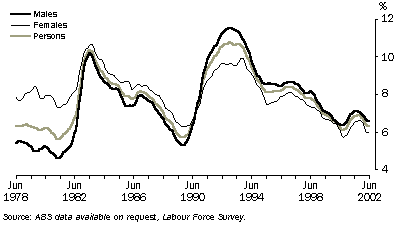
The unemployment rate has fluctuated over the past 20 years, with two significant periods of high unemployment reflecting the recessions of the early 1980s and early 1990s (graph 6.18). The unemployment rate peaked at 10.7% in December 1992, and has generally fallen over the rest of the 1990s, standing at 6.3% in June 2002.
Historically, the unemployment rate for males has been lower than for females. However, just prior to the recession of the early 1990s, when unemployment increased dramatically, the male unemployment rate increased to a level above the female unemployment rate, and has remained higher ever since.
6.18 UNEMPLOYMENT RATE: Trend estimates
Unemployment rates vary across states (table 6.19). For 2001-02, the average unemployment rate was 6.6%, with the Australian Capital Territory (4.6%), New South Wales (6.1%), Victoria (6.3%) and Western Australia (6.5%) all below the national average. Tasmania (8.8%) and Queensland (7.9%) both recorded unemployment rates well above the national average.
There are also differences in the rates of unemployment between the capital cities and regional areas. In 2001-02, the unemployment rate for all capital cities was 6.3%, compared to 7.3% for all regional areas. New South Wales had the largest difference, with Sydney recording an unemployment rate of 5.2%, while for the rest of New South Wales the rate was 8.0%. In contrast, South Australia, Western Australia and Tasmania all recorded lower unemployment rates in regional areas than in their capitals.
6.19 UNEMPLOYMENT RATE: Annual average - 2001-02
|
 | NSW | Vic. | Qld | SA | WA | Tas. | NT(a) | ACT(a) | Aust. |
| % | % | % | % | % | % | % | % | % |
|
| Capital city | 5.2 | 6.2 | 7.9 | 7.1 | 6.5 | 8.8 | . . | . . | 6.3 |
| Balance of state | 8.0 | 6.4 | 7.9 | 6.7 | 6.3 | 8.7 | 6.8 | 4.6 | 7.3 |
| All regions | 6.1 | 6.3 | 7.9 | 7.0 | 6.5 | 8.8 | 6.8 | 4.6 | 6.6 |
|
| (a) All included in balance of state. |
Source: ABS data available on request, Labour Force Survey. |
The number of unemployed persons increased from 647,700 in 2000-01 to 656,800 in 2001-02 (table 6.20). This represents the first annual increase since the peak of 914,100 in 1992-93.
In 2001-02, 63.3% of unemployed persons had been unemployed for less than 26 weeks, while 22.4% had been unemployed for 52 weeks or more (long-term unemployed). In contrast, in 1997-98, 51.8% of unemployed persons had been unemployed for less than 26 weeks, while 31.7% were long-term unemployed.
6.20 UNEMPLOYED PERSONS(a), Duration of unemployment: Annual average
|
| Weeks | Units | 1996-97 | 1997-98 | 1998-99 | 1999-2000 | 2000-01 | 2001-02 |
|
| Under 8 | % | 29.3 | 27.9 | 29.8 | 34.0 | 35.8 | 35.0 |
| 8 to under 26 | % | 24.8 | 23.9 | 23.3 | 23.6 | 25.7 | 28.3 |
| 26 to under 52 | % | 16.7 | 16.6 | 14.9 | 13.8 | 13.9 | 14.3 |
| 52 to under 104 | % | 13.2 | 14.5 | 13.4 | 10.8 | 9.7 | 9.0 |
| 104 and over | % | 16.0 | 17.2 | 18.5 | 17.9 | 14.9 | 13.4 |
| Total | % | 100.0 | 100.0 | 100.0 | 100.0 | 100.0 | 100.0 |
| Number | '000 | 792.4 | 764.2 | 718.2 | 661.4 | 647.7 | 656.8 |
|
| (a) Data have not been revised to reflect definitional changes in the Labour Force Survey questionnaire introduced in April 2001. Data collected from April 2001 onwards are not strictly comparable with data collected in earlier periods. For further information, see 'Information Paper: Implementing the Redesigned Labour Force Survey Questionnaire' (6295.0). |
Source: ABS data available on request, Labour Force Survey. |
Educational qualifications have a significant bearing on labour market prospects. Table 6.21 shows that, as the level of educational attainment decreases, the unemployment rate increases, from 2.8% for those with a bachelor degree or higher to 11.0% for those who had completed Year 10 or below. It also shows the relationship between the level of highest educational attainment and duration of unemployment. Of unemployed persons with a bachelor degree or above, 13% were long-term unemployed, compared to 30% of those who had completed Year 10 or below.
6.21 UNEMPLOYED PERSONS, Educational attainment(a) and duration of unemployment - July 2001
|
| | Level of highest educational attainment
| |
Duration of current
period of unemployment
(weeks) | Units | Bachelor
degree
or above | Advanced
diploma
or diploma | Certificate | Year 12(b) | Year 11(b) | Year 10
or below(b) | All
unemployed persons |
|
| 1 to under 8 | % | 41.3 | 38.3 | 31.3 | 33.2 | 30.8 | 30.3 | 32.2 |
| 8 to under 26 | % | 27.7 | 22.1 | 37.3 | 31.0 | 30.8 | 25.5 | 28.7 |
| 26 to under 52 | % | 18.3 | 20.4 | 9.6 | 20.3 | 15.8 | 14.1 | 15.6 |
| 52 to under 104 | % | 3.8 | 5.1 | 10.0 | 7.4 | 10.7 | 10.1 | 8.9 |
| 104 and over | % | 8.8 | 13.6 | 11.8 | 8.1 | 11.9 | 20.0 | 14.6 |
| Total(c) | % | 100.0 | 100.0 | 100.0 | 100.0 | 100.0 | 100.0 | 100.0 |
| Number(c) | '000 | 52.0 | 23.5 | 71.9 | 123.7 | 83.4 | 254.1 | 613.0 |
| Unemployment rate(d) | % | 2.8 | 4.3 | 5.1 | 7.4 | 9.4 | 11.0 | 6.9 |
|
(a) The levels of education are not necessarily listed in order from highest to lowest. See paragraphs 15-17 of the Explanatory Notes in 'Education and Work, Australia' (6227.0) for further details on how highest educational attainment is determined.
(b) Includes persons who are currently undertaking school study.
(c) Includes no educational attainment and level not determined.
(d) From 'Education and Work, Australia' (6227.0). |
Source: Education and Work, Australia, May 2001 (6227.0); Job Search Experience of Unemployed Persons, Australia, July 2001 (6222.0). |
Unemployed persons can encounter a variety of difficulties in finding work, as shown in table 6.22. The most commonly reported difficulties were 'Considered too young or too old by employers' (11.7%), 'Insufficient work experience' (11.6%) and 'Too many applicants for available jobs' (11.5%). The proportions of males and females who reported most of the more common difficulties are largely similar. However, females were more likely to report insufficient work experience as their main difficulty (14.5% compared to 9.6% for males), as well as difficulties that relate to concerns outside of the workplace, such as 'Unsuitable hours' (8.5% to 2.5%) and 'Difficulties with childcare, other family responsibilities' (4.4% to 0.3%). Males were more likely to report their main difficulty as being related to the availability of work, for example, 'No vacancies at all' (12.4% compared to 8.1% for females) and 'No vacancies in line of work' (12.1% compared to 7.9% for females).
6.22 UNEMPLOYED PERSONS, Main difficulty in finding work - July 2001
|
| Units | Males | Females | Persons |
|
| Too many applicants for available jobs | % | 11.9 | 10.9 | 11.5 |
| Lacked necessary skills or education | % | 11.1 | 9.4 | 10.4 |
| Considered too young or too old by employers | % | 12.2 | 11.0 | 11.7 |
| Insufficient work experience | % | 9.6 | 14.5 | 11.6 |
| No vacancies at all | % | 12.4 | 8.1 | 10.7 |
| No vacancies in line of work | % | 12.1 | 7.9 | 10.3 |
| Too far to travel, transport problems | % | 7.4 | 5.8 | 6.8 |
| Own ill health or disability | % | 6.7 | 4.3 | 5.7 |
| Language difficulties | % | 2.6 | *2.1 | 2.4 |
| Unsuitable hours | % | 2.5 | 8.5 | 5.0 |
| Difficulties with childcare, other family responsibilities | % | *0.3 | 4.4 | 2.0 |
| Other difficulties(a) | % | 3.7 | 3.1 | 3.4 |
| No difficulties reported | % | 7.7 | 9.8 | 8.5 |
| Total | % | 100.0 | 100.0 | 100.0 |
| Number | '000 | 363.2 | 249.8 | 613.0 |
|
| (a) Includes persons who reported difficulties because of ethnic background. |
Source: Job Search Experience, Australia, July 2001 (6222.0). |
|
 Print Page