Job vacancy statistics can be used to assess changes in the demand for labour. The ABS conducts a quarterly Job Vacancies Survey. In this survey, a job vacancy is defined as a job available for immediate filling on the survey reference day and for which recruitment action has been taken by the employer. Recruitment action includes efforts to fill the vacancy by advertising, posting factory notices, notifying public or private employment agencies or trade unions, and contacting, interviewing or selecting applicants already registered with the business.
Graph 6.23 provides trend estimates of job vacancies, including the private and public sectors, for the period May 1982 to May 2002. It shows that, after peaking at 86,400 in February 1989, the estimated number of job vacancies in Australia fell rapidly to a low of 29,700 in August 1991. Vacancies subsequently rose to a new peak of 109,300 in May and August 2000. Public sector job vacancies have increased recently, standing at 16,300 in May 2002, after declining to below 10,000 through much of the 1990s. In contrast, the number of job vacancies in the private sector has been far more volatile. After reaching a low of 19,100 in May 1991, private sector job vacancies climbed to 93,800 in August 2000, the highest level recorded to that point.
6.23 JOB VACANCIES: Trend estimates
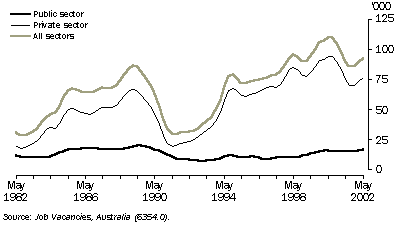
Table 6.24 shows that the number of job vacancies (original estimates) increased from 83,400 in May 2001 to 88,800 in May 2002. The overall increase in job vacancies of 5,400 was spread unevenly across the industries, with eight industries recording a decrease, six recording an increase, and two remaining unchanged. The largest increases occurred in Construction (by 4,400), Retail trade (by 3,500) and Manufacturing (by 1,600). The largest decreases were recorded in Wholesale trade (by 2,200), Finance and insurance (by 1,200) and Cultural and recreational services (by 1,100).
6.24 JOB VACANCIES, By industry(a) - May
|
 | 1997 | 1998 | 1999 | 2000 | 2001 | 2002 |
| '000 | '000 | '000 | '000 | '000 | '000 |
|
| Mining | 1.5 | 1.1 | 1.1 | 0.8 | 1.2 | 1.1 |
| Manufacturing | 7.5 | 8.3 | 12.2 | 12.2 | 8.4 | 10.0 |
| Electricity, gas and water supply | 0.3 | 0.2 | 0.3 | 0.4 | 0.3 | 0.3 |
| Construction | 5.9 | 7.8 | 4.6 | 4.4 | 3.4 | 7.8 |
| Wholesale trade | 6.4 | 7.6 | 6.6 | 5.2 | 5.9 | 3.7 |
| Retail trade | 9.0 | 15.5 | 9.0 | 8.3 | 7.9 | 11.4 |
| Accommodation, cafes & restaurants | 6.0 | 4.5 | 8.9 | 8.5 | 6.1 | 6.5 |
| Transport and storage | 0.7 | 1.7 | 2.7 | 2.9 | 1.5 | 2.4 |
| Communication services | 0.3 | 0.3 | 1.2 | 1.5 | 0.6 | 0.4 |
| Finance and insurance | 5.0 | 3.1 | 3.1 | 5.2 | 4.9 | 3.7 |
| Property and business services | 13.1 | 22.5 | 17.2 | 20.0 | 15.3 | 15.8 |
| Government administration & defence | 3.3 | 3.8 | 4.7 | 4.9 | 5.9 | 5.7 |
| Education | 2.8 | 3.7 | 3.1 | 6.7 | 3.6 | 2.8 |
| Health and community services | 7.9 | 7.7 | 7.7 | 9.7 | 11.0 | 11.0 |
| Cultural and recreational services | 1.9 | 1.2 | 3.1 | 2.9 | 2.9 | 1.8 |
| Personal and other services | 1.2 | 3.5 | 3.4 | 8.4 | 4.5 | 4.2 |
| All industries | 72.7 | 92.5 | 88.9 | 102.1 | 83.4 | 88.8 |
|
| (a) Classified according to the Australian and New Zealand Standard Industrial Classification (ANZSIC). |
Source: Job Vacancies, Australia (6354.0). |
The job vacancy rate is the number of job vacancies expressed as a percentage of the number of employees plus the number of vacancies. The job vacancy rate for Australia was 1.16% in May 2002, compared to 1.10% in May 2001 and 1.36% in May 2000 (table 6.25). The job vacancy rate varied considerably across the states and territories in May 2002, with the Australian Capital Territory recording the highest job vacancy rate (1.97%) and Queensland the lowest (0.74%). Western Australia recorded the largest increase between May 2001 and May 2002 (0.89% to 1.24%), while Queensland recorded the largest decrease (1.03% to 0.74%).
6.25 JOB VACANCY RATE, By state/territory - May
|
| 1997 | 1998 | 1999 | 2000 | 2001 | 2002 |
| % | % | % | % | % | % |
|
| New South Wales | 1.04 | 1.06 | 1.38 | 1.67 | 1.16 | 1.22 |
| Victoria | 0.77 | 1.20 | 1.05 | 1.28 | 1.11 | 1.28 |
| Queensland | 1.20 | 1.46 | 0.87 | 1.22 | 1.03 | 0.74 |
| South Australia | 0.68 | 0.58 | 0.82 | 0.95 | 0.99 | 1.28 |
| Western Australia | 1.44 | 1.89 | 1.15 | 1.08 | 0.89 | 1.24 |
| Tasmania | 1.14 | 0.45 | 1.37 | 0.77 | 0.89 | 0.84 |
| Northern Territory | 1.52 | 2.35 | 1.52 | 1.51 | 1.79 | 1.60 |
| Australian Capital Territory | 0.79 | 1.13 | 1.64 | 2.02 | 1.64 | 1.97 |
| Australia | 1.01 | 1.22 | 1.15 | 1.36 | 1.10 | 1.16 |
|
| | | | | | |
| Source: Job Vacancies, Australia (6354.0). |
 Print Page