LABOUR FORCE
Age groups
Occupation
Industry
Usual hours
Average weekly earnings
Underutilisation rate
Age groups
EMPLOYED PERSONS(a), By Age |
|
 | February 2005 | February 2009 | February 2010 |
| Full time | Part time | Full time | Part time | Full time | Part time |
| Age group (years) | '000 | % | '000 | % | '000 | % | '000 | % | '000 | % | '000 | % |
Australian Capital Territory |
|
| 15 - 24 | 18.9 | 14.2 | 16.9 | 35.7 | 21.3 | 14.5 | 15.5 | 31.3 | 18.6 | 12.7 | 16.6 | 34.4 |
| 25 - 34 | 34.8 | 26.1 | 7.7 | 16.3 | 39.9 | 27.2 | 7.8 | 15.8 | 40.0 | 27.3 | 7.0 | 14.5 |
| 35 - 44 | 32.5 | 24.4 | 8.5 | 17.8 | 34.2 | 23.2 | 9.3 | 18.8 | 33.7 | 23.0 | 8.7 | 18.0 |
| 45 - 54 | 32.7 | 24.6 | 7.4 | 15.5 | 33.3 | 22.7 | 8.2 | 16.6 | 33.3 | 22.7 | 7.3 | 15.1 |
| 55 - 64 | 13.2 | 9.9 | 5.8 | 12.1 | 16.7 | 11.3 | 6.9 | 13.9 | 18.9 | 12.9 | 6.3 | 12.9 |
| 65 and over | 1.1 | 0.8 | 1.2 | 2.6 | 1.6 | 1.1 | 1.8 | 3.7 | 2.0 | 1.4 | 2.4 | 5.1 |
| Total | 133.1 | 100.0 | 47.5 | 100.0 | 147.0 | 100.0 | 49.4 | 100.0 | 146.7 | 100.0 | 48.3 | 100.0 |
Australia |
|
| 15 - 24 | 946.7 | 13.6 | 787.4 | 28.7 | 1 044.5 | 13.5 | 850.9 | 27.7 | 958.9 | 12.6 | 879.2 | 27.3 |
| 25 - 34 | 1 766.5 | 25.4 | 444.9 | 16.2 | 1 904.2 | 24.7 | 452.5 | 14.7 | 1 879.3 | 24.7 | 475.4 | 14.8 |
| 35 - 44 | 1 744.5 | 25.0 | 587.6 | 21.4 | 1 851.1 | 24.0 | 637.6 | 20.7 | 1 815.8 | 23.8 | 661.8 | 20.6 |
| 45 - 54 | 1 648.7 | 23.7 | 512.2 | 18.6 | 1 818.0 | 23.6 | 566.4 | 18.4 | 1 810.5 | 23.8 | 592.8 | 18.4 |
| 55 - 64 | 777.8 | 11.2 | 324.2 | 11.8 | 971.1 | 12.6 | 426.9 | 13.9 | 1 017.4 | 13.4 | 451.8 | 14.0 |
| 65 and over | 80.4 | 1.2 | 91.4 | 3.3 | 125.1 | 1.6 | 141.1 | 4.6 | 136.0 | 1.8 | 158.5 | 4.9 |
| Total | 6 964.5 | 100.0 | 2 747.7 | 100.0 | 7 714.0 | 100.0 | 3 075.3 | 100.0 | 7 617.9 | 100.0 | 3 219.4 | 100.0 |
|
| (a) Annual averages. |
| Source: Labour Force, Australia, Detailed - Electronic Delivery (cat. no. 6291.0.55.001). |
Employed full time
The average number of Australian Capital Territory (ACT) usual residents employed full time in the 12 months ending February 2010 was 146,700, similar to the previous year (147,000), and up 10.2% (+13,600) from February 2005 (133,100). The average number of people employed full time in Australia in the 12 months ending February 2010 was 7.6 million, down 1.2% (-96,100) from the year to February 2009 (7.7 million) and up 9.4% (653,400) from the 12 months ending February 2005 (6.9 million).
From the 12 months ending February 2005 to the 12 months ending February 2010 the number of full time employed persons in the 65 years and over age group in the ACT experienced the strongest growth of all age groups up 900 (+81.8%). Nationally, the 65 years and over age group experienced the strongest growth in the number of employed persons with an increase of 55,600 (+69.2%).
Employed part time
The average number of ACT usual residents employed part time in the 12 months ending February 2010 was 48,300, down 2.2% from the previous year (49,400). Nationally, the average number of people employed part time in the 12 months ending February 2010 was 3.2 million, up 5% (+144,100) from 2009 (3.1 million).
The proportion of people employed part time, aged 15-24 years, has consistently been higher than any other age group in the ACT and nationally. However, the proportion in the ACT has declined from 35.7% in 2005 to 34.4% in 2010, while nationally the decline was from 28.7% in 2005 to 27.3% in 2010.
Occupation
EMPLOYED PERSONS(a), By Occupation - Australian Capital Territory |
|
| February 2005 | February 2010 |
| Occupation major group(b) | '000 | % | '000 | % |
|
| Managers | 25.8 | 14.3 | 28.7 | 14.7 |
| Professionals | 51.3 | 28.3 | 63.6 | 32.6 |
| Technicians and Trades Workers | 20.6 | 11.4 | 20.2 | 10.3 |
| Community and Personal Service Workers | 17.6 | 9.8 | 18.0 | 9.2 |
| Clerical and Administrative Workers | 35.0 | 19.3 | 36.7 | 18.8 |
| Sales Workers | 15.6 | 8.6 | 13.9 | 7.1 |
| Machinery Operators And Drivers | 4.8 | 2.7 | 4.4 | 2.3 |
| Labourers | 10.2 | 5.6 | 9.6 | 4.9 |
| Total | 180.9 | 100.0 | 195.2 | 100.0 |
|
| (a) Annual average of quarterly data. |
| (b) Classified according to the Australian and New Zealand Standard Classification of Occupation (ANZSCO), First Edition, 2006. |
| Source: Labour Force, Australia, Detailed, Quarterly (cat. no. 6291.0.55.003) |
Based on occupation by major group,
Professionals made up the largest proportion of employed persons in the ACT for the February 2010 quarter (32.6%). The group with the largest increase over the five years (2004 to 2009) was
Professionals, with 12,300 more people employed in the February 2010 quarter than in 2005. The group experiencing the largest decrease was Sales Workers, falling 1,700 persons from the quarter ending February 2005 to 2010.
Industry
EMPLOYED PERSONS(a), By Industry - Australian Capital Territory |
|
| February 2005 | February 2010 |
| Industry division(b) | '000 | % | '000 | % |
|
| Agriculture, Forestry and Fishing | 0.7 | 0.4 | 0.9 | 0.5 |
| Mining | - | - | - | - |
| Manufacturing | 4.5 | 2.5 | 3.5 | 1.8 |
| Electricity, Gas, Water and Waste Services | 1.5 | 0.8 | 1.1 | 0.6 |
| Construction | 10.5 | 5.8 | 12.8 | 6.6 |
| Wholesale Trade | 2.9 | 1.6 | 3.2 | 1.6 |
| Retail Trade | 17.7 | 9.8 | 14.6 | 7.5 |
| Accommodation and Food Services | 11.4 | 6.3 | 10.9 | 5.6 |
| Transport, Postal and Warehousing | 5.0 | 2.8 | 5.3 | 2.7 |
| Information Media and Telecommunications | 5.1 | 2.8 | 4.4 | 2.3 |
| Financial and Insurance Services | 3.4 | 1.9 | 3.9 | 2.0 |
| Rental, Hiring and Real Estate Services | 3.1 | 1.7 | 2.1 | 1.1 |
| Professional, Scientific and Technical Services | 17.2 | 9.5 | 21.2 | 10.9 |
| Administrative and Support Services | 5.9 | 3.2 | 4.6 | 2.3 |
| Public Administration and Safety | 48.7 | 26.9 | 57.2 | 29.3 |
| Education and Training | 16.2 | 8.9 | 19.6 | 10.0 |
| Health Care and Social Assistance | 16.4 | 9.1 | 17.8 | 9.1 |
| Total | 180.9 | 100.0 | 195.2 | 100.0 |
|
| - nil or rounded to zero (including null cells) |
| (a) Annual average of quarterly data. |
| (b) Classified according to the Australian and New Zealand Standard Industrial Classification (ANZSIC) 2006 edition. |
| Source: Labour Force, Australia, Detailed, Quarterly (cat. no. 6291.0.55.003). |
Based on employment by industry division, the largest employer in the ACT for the 12 months ending February quarter 2010 was
Public Administration and Safety (57,200). This was also the industry with the largest increase in employed persons between the quarter ending February 2005 and quarter ending February 2010 (8,500 persons).
Usual hours
EMPLOYED PERSONS(a), By Usual hours worked |
|
| February 2010 |
| Full time | Part time |
| '000 | % | '000 | % |
Australian Capital Territory |
|
| 0 hours | - | - | - | - |
| 1-15 hours | 0.3 | 0.2 | 19.2 | 39.8 |
| 16-29 hours | 0.9 | 0.6 | 19.7 | 40.9 |
| 30-34 hours | 1.2 | 0.8 | 9.1 | 18.8 |
| 35-39 hours | 56.8 | 38.7 | - | - |
| 40 hours | 39.1 | 26.7 | - | - |
| 41-44 hours | 7.2 | 4.9 | - | - |
| 45-49 hours | 14.9 | 10.2 | - | - |
| 50-59 hours | 17.3 | 11.8 | - | - |
| 60 or more hours | 9.1 | 6.2 | - | - |
| Total | 146.7 | 100.0 | 48.3 | 100.0 |
Australia |
|
| 0 hours | 3.1 | - | 22.1 | 0.7 |
| 1-15 hours | 11.9 | 0.2 | 1 241.9 | 38.6 |
| 16-29 hours | 49.6 | 0.7 | 1 376.3 | 42.8 |
| 30-34 hours | 78.7 | 1.0 | 579.1 | 18.0 |
| 35-39 hours | 2 354.0 | 30.9 | - | - |
| 40 hours | 2 288.0 | 30.0 | - | - |
| 41-44 hours | 321.2 | 4.2 | - | - |
| 45-49 hours | 791.8 | 10.4 | - | - |
| 50-59 hours | 984.5 | 12.9 | - | - |
| 60 or more hours | 735.0 | 9.6 | - | - |
| Total | 7 617.9 | 100.0 | 3 219.4 | 100.0 |
|
| - nil or rounded to zero (including null cells) |
| (a) Annual average monthly data. |
| Source: Labour Force, Australia, Detailed - Electronic Delivery (cat. no. 6291.0.55.001). |
Usual hours worked by employed persons, on average, during the 12 months ending February 2010 differed between the ACT and Australia. A smaller proportion of full-time workers in the ACT worked 41 hours or more per week (33.1%) compared with Australia (37.1%). However, a larger proportion of ACT full-time employed (65.4%) worked between 35-40 hours than the national average (60.9%). In the 12 months ending February 2010 the most common hours usually worked by people employed part time in the ACT and Australia were 16-29 hours per week (ACT 40.9%, Australia 42.8%).
Average weekly earnings
AVERAGE WEEKLY EARNINGS: Trend |
|
| | November 2008 | November 2009 |
Australian Capital Territory |
|
| Earnings | $ | 1 075.2 | 1 126.8 |
| Change from previous quarter | % | 2.1 | 1.1 |
| Change from corresponding quarter of previous year | % | 6.5 | 4.8 |
Australia |
|
| Earnings | $ | 909.0 | 953.7 |
| Change from previous quarter | % | 1.0 | 1.6 |
| Change from corresponding quarter of previous year | % | 3.8 | 4.9 |
|
| Source: Average Weekly Earning, Australia (cat. no. 6302.0) |
In trend terms, Average Weekly Earnings (AWE) of $1,127 for the ACT in November 2009 were $173 higher than the national average of $954. AWE increased 4.8% between November 2008 and November 2009 for the ACT (from $1,075 to $1,127) and 4.9% for Australia (from $909 to $954).
Underutilisation rate
LABOUR FORCE UNDERUTILISATION RATE(a), Trend
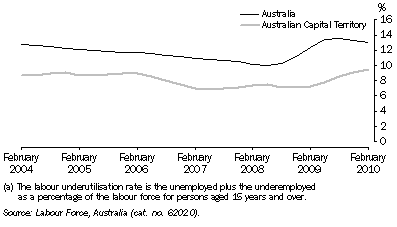
In trend terms, the labour force underutilisation rate for Australia generally fell between February 2004 and May 2008 to a low of 10.0% and has since risen to 13.0% in Feb 2010. Over the same period, the labour force underutilisation rate for ACT has increased by only 0.8 percentage points (8.7% in the February quarter 2004 to 9.5% in the February quarter 2010).

 Print Page