|
|
WATER USE
IRRIGATION WATER USE
The agriculture industry is by far the largest consumer of water in Australia, accounting for about two-thirds of total water consumed in 2000–01. In contrast, manufacturing accounted for about 4% and mining for less than 2% of total water consumption, while households used about 10%. Most of the water (91%) used for agricultural production was for irrigation of crops and pastures, with the rest used for other agricultural purposes such as stock drinking water and piggery cleaning.
For Australia as a whole, the area of crops and pastures irrigated is less than 1% of total agricultural land holdings. However, irrigated agriculture represents about a quarter of the gross value of agricultural production in Australia ($9 billion in 2003–04) (1).
The number of agricultural establishments irrigating continued to decline in 2004–05, with irrigation undertaken by 35,244 (or 27%) of Australia's agricultural establishments. This was a 12.8% decrease from 40,400 irrigating establishments in 2003–04. The number of agricultural establishments irrigating fell but the total area of irrigated land remained steady at 2.4 million hectares.
The total volume of water used for irrigation fell by 357 gigalitres (GL) from 10,442 GL in 2003–04 to 10,085 GL in 2004–05. At the state level, Victoria reported the largest number of agricultural establishments irrigating (9,828), followed by New South Wales (8,606). With more than 900,000 hectares irrigated and 3,717 GL of irrigation water used, New South Wales was the largest irrigating state, representing nearly 40% of Australia's total area irrigated and just over a third of Australia's total irrigation water used.
‘Pasture for grazing’ used the most water in Australia in 2004–05. It accounted for nearly one-third of the total volume of irrigation water and for one-third of the total area irrigated nationally in 2004–05.
Some crops are almost totally dependent on irrigation, while for others irrigation water supplements natural rainfall or provides moisture at critical periods of plant growth. The most heavily irrigated crop in terms of the volume of water applied was rice, which had an average application rate of 12.1 megalitres per hectare (ML/ha) in 2004–05. This was almost three times the national average rate across all crops and pastures (4.2 ML/ha). Cotton was the next highest (6.7 ML/ha).
IRRIGATION WATER USE, 2004–05 |
|
 | Agricultural establishments irrigating
no. | Area irrigated
‘000 ha | Volume applied
‘000 ML | Application rate
ML/ha (a) |
|
| Australia: | | | | |
| 2002–03 | 43 774 | 2 378 | 10 403.8 | 4.4 |
| 2003–04 | 40 400 | 2 402 | 10 441.5 | 4.3 |
| 2004–05 | 35 244 | 2 405 | 10 084.6 | 4.2 |
| | | | |
| 2004–05: | | | | |
| NSW & ACT | 8 606 | 910 | 3 716.6 | 4.1 |
| Vic. | 9 828 | 636 | 2 363.8 | 3.7 |
| Qld | 8 258 | 542 | 2 613.4 | 4.8 |
| SA | 4 739 | 184 | 877.8 | 4.8 |
| WA | 2 049 | 45 | 267.1 | 6.0 |
| Tas. | 1 654 | 86 | 231.8 | 2.7 |
| NT | 110 | 4 | 14.2 | 4.0 |
|
(a) Averaged across all irrigated pastures and crops.
Note: 1 gigalitre (GL) = 1,000 megalitres (ML).
Source: ABS, Water Use on Australian Farms, 2004–05 (cat. no. 4618.0). |
HOUSEHOLD WATER USE PER CAPITA, 2000-01
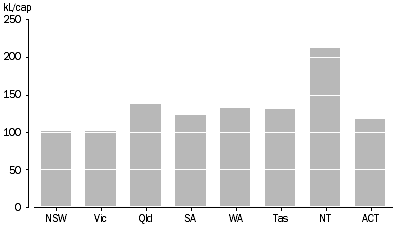
Households account for about 10% of total water consumption in Australia. Household water use includes water for drinking, cooking, cleaning and outdoors (in gardens and swimming pools). The Northern Territory had the highest average household use per person (212 kL/capita) in 2000–01, followed by Queensland (137 kL/capita). New South Wales had the lowest (101 kL/capita).
HOUSEHOLD WATER USE PER CAPITA, 2000–01
 Source: Water Account Australia 2000-01 (cat. no. 4610.0)
HOUSEHOLD WATER USE BY LOCATION, 2000-01
The majority of household water is used for outdoor purposes (44%) such as water for gardens and swimming pools, followed by indoor uses, including bathrooms (20%) and toilets (15%). Households in Queensland, South Australia, Western Australia and the Australian Capital Territory all reported using more than 50% of household water outdoors in 2000–01. In New South Wales, 25% of household water was used for outdoor purposes and 35% was used outdoors in Victoria. These differences can be partly explained by the smaller individual block sizes and percentages of households with no outdoor facilities in more densely populated areas of these states, as well as by the climatic differences between regions.
Despite rising household water consumption to 2001, the 2002–03 drought and ensuing water restrictions saw household mains water consumption decrease between 2001 and 2004. Unpublished figures from water authorities show in Perth, Western Australia, daily water use per household fell from 317 litres in 2000–01 to 279 litres in 2003–04. Similar falls were observed in most other capital cities during this period (2).
Schemes to encourage greater use of water saving devices and/or practices include the NSW State Government BASIX (Building Sustainability Index) requirements. Taking effect from July 2004, BASIX requires all new homes and all alternations and additions to homes in coastal NSW to produce 25% less greenhouse gases and use up to 40% less water than the NSW average (or a lesser percentage if they are further inland).
HOUSEHOLD WATER USE BY LOCATION, 2000-01(a)
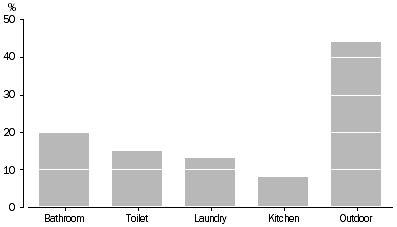 (a) Excludes Tasmania and Northern Territory.
Source: Water Account Australia, 2000–01 (cat. no. 4610.0).
(a) Excludes Tasmania and Northern Territory.
Source: Water Account Australia, 2000–01 (cat. no. 4610.0).
ENDNOTES
1. ABS/Productivity Commission 2006, Characteristics of Australia’s Irrigated Farms, 2000-01 to 2003-04, (cat. no. 4623.0).
2. ABS, 2005, Australian Economic Indicators, Feature Article, July 2005, (cat. no. 1350.0).
|
|
 Print Page
 Print All