Page tools:
 Print Page Print Page
 Print All Print All
| |||||||||||||||||||||||||||||||||||||||||||||||||||||||||||||||||||||||
MEASURING AUSTRALIANS Height, weight and waist measurements can be useful indicators of health-related risks [1]. With three out of five Australian adults (61%) either overweight or obese [2], it is important to monitor how Australians measure up to identify high risk groups and recognise the characteristics associated with these physical attributes.
THE AVERAGE AUSTRALIAN
1.1 Mean measured height, weight, waist and hip by sex, 1995(a) and 2007–08(b)
(a) Persons aged 18 years and over who had their height and weight measured. (b) Persons aged 18 years and over who had their height, weight, waist and hips measured. 1.2 Mean measured height by age and sex(a), 1995 and 2007–08  Footnote(s): (a) Persons aged 18 years and over who had their height measured. Source(s): ABS National Nutrition Survey, 1995, National Health Survey, 2007–08 1.3 Mean measured weight by age and sex(a), 1995 and 2007–08  Footnote(s): (a) Persons aged 18 years and over who had their weight measured. Source(s): ABS National Nutrition Survey, 1995, ABS National Health Survey, 2007–08 Mean measured height and weight
Waist measurement is widely accepted as an indicator of potential risk in developing diabetes, cardiovascular disease and some type of cancers. The NHMRC guidelines for waist circumference and risk levels are presented in Table 1.4 [1]. For the purpose of this analysis, men with waistlines less than 94 cm are considered to have healthy waistlines, while those with waistlines greater than or equal to 94 cm are considered to have risky waistlines. Women with waistlines less than 80 cm are considered to have healthy waistlines, while those with waistlines greater than or equal to 80 cm are considered to have risky waistlines. 1.4 Waist circumference and risk level
Waist risk distribution of the Australian population
1.5 Male waist risk distribution by age(a), 2007–08 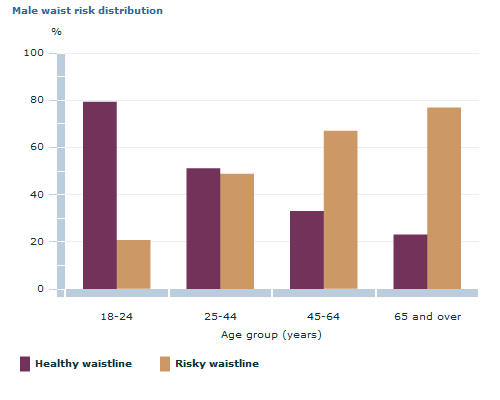 Footnote(s): (a) Persons aged 18 years and over who had their waist measured. Source(s): ABS National Health Survey, 2007–08 1.6 Female waist risk distribution by age(a), 2007–08 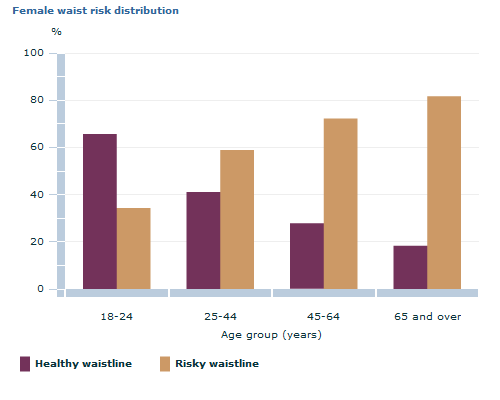 Footnote(s): (a) Persons aged 18 years and over who had their waist measured. Source(s): ABS National Health Survey, 2007–08 Demographics
1.7 Male waist risk distribution by SEIFA Index of Disadvantage(a), 2007–08 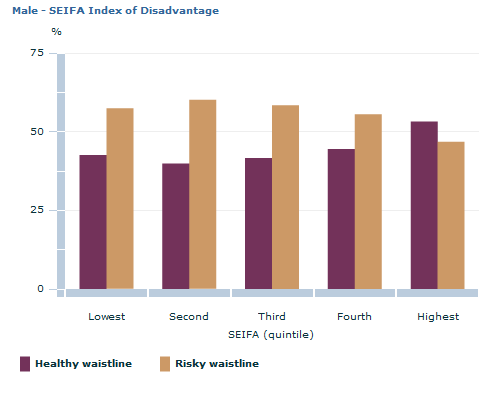 Footnote(s): (a) Persons aged 18 years and over who had their waist measured. (b) Waist risk distributions are age-standardised to 2001 estimated resident population. Source(s): ABS National Health Survey, 2007–08 1.8 Female waist risk distribution by SEIFA Index of Disadvantage(a), 2007–08  Footnote(s): (a) Persons aged 18 years and over who had their waist measured. (b) Waist risk distributions are age-standardised to 2001 estimated resident population. Source(s): ABS National Health Survey, 2007–08
1.9 Male waist risk distribution by long-term health conditions(a)(b)(c), 2007–08 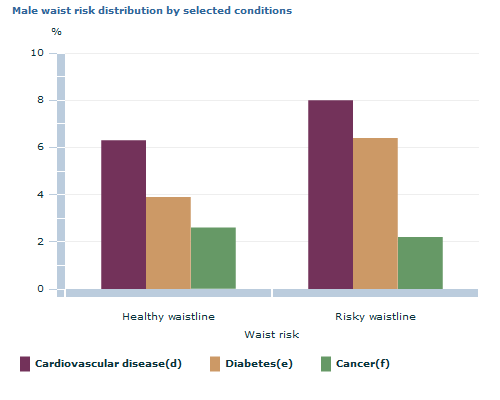 Footnote(s): (a) Persons aged 18 years and over who had their waist measured. (b) Current condition which has lasted, or is expected to last, for 6 months or more. (c) Waist risk distributions are age-standardised to 2001 estimated resident population. (d) Includes angina, other ischaemic heart diseases, cerebrovascular diseases, oedema, heart failure and diseases of arteries, arterioles and capillaries. (e) Includes Type 1, Type 2 and unknown. (f) Includes malignant neoplasms. Source(s): ABS National Health Survey, 2007–08 1.10 Female waist risk distribution by long-term health conditions(a)(b)(c), 2007–08 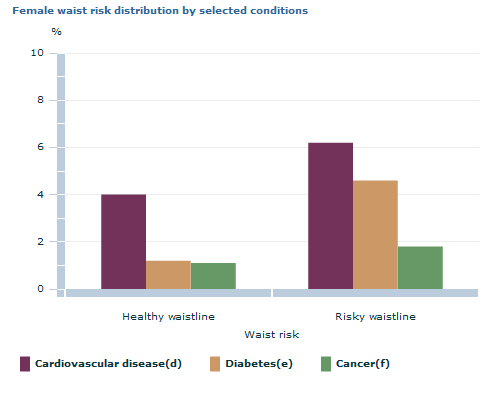 Footnote(s): (a) Persons 18 years and over who had their waist measured. (b) Current condition which has lasted, or is expected to last, for 6 months or more. (c) Waist risk distributions are age-standardised to 2001 estimated resident population. (d) Includes angina, other ischaemic heart diseases, oedema, heart failure and diseases of arteries, arterioles and capillaries. (e) Includes Type 1, Type 2 and unknown. (f) Includes malignant neoplasms. Source(s): ABS National Health Survey, 2007–08 Selected risk factors
MEASURED BODY MASS INDEX In the 2007–08 NHS, height and weight measurements were used to calculate Body Mass Index (BMI), a common measure used to estimate whether a person is underweight, a healthy weight, overweight or obese.
For more information on how physical measurements were obtained in the 1995 NNS and 2007–08 NHS, see How Australians Measure Up, 1995 and The National Health Survey Users Guide 2007–08. REFERENCE 1. Department of Health and Ageing, 2003, Clinical Practice Guidelines for the Management of Overweight and Obesity in Adults, viewed 31/05/2012, http://www.health.gov.au/internet/main/publishing.nsf/Content/7AF116AFD4E2EE3DCA256F190003B91D/$File/adults.pdf <www.health.gov.au> 2. ABS Overweight and Obesity in Adults in Australia: A Snapshot (cat. no. 4842.0.55.001), viewed 24/07/2012, https://abs.gov.au/ausstats/abs@.nsf/mf/4842.0.55.001 <www.abs.gov.au>
|
|||||||||||||||||||||||||||||||||||||||||||||||||||||||||||||||||||||||