|
|
There are no accurate estimates of the population of Australia before European settlement. Many estimates were based on post-1788 observations of a population already reduced by introduced diseases and other factors. In 1930 the anthropologist Radcliffe-Brown postulated a minimum figure of 300,000. In 1980 L.R. Smith estimated the absolute minimum pre-1788 population at 315,000. Other estimates have put the figure at over 1 million, while recent archaeological finds suggest that a population of 750,000 could have been sustained.
Whatever the size of the Indigenous population before European settlement, it declined dramatically under the impact of new diseases, repressive and often brutal treatment, dispossession, and social and cultural disruption and disintegration (Year Book Australia 1994). The decline of the Indigenous population continued well into the twentieth century.
Changing social attitudes, political developments, improved statistical coverage, and a broader definition of Indigenous origin have all contributed to the increased likelihood of people identifying as being of Aboriginal or Torres Strait Islander origin. This is reflected in the large increases in the number of people who are identified as Indigenous in each Census, increases in excess of those which can be attributed to natural increase in the Indigenous population. If there is no future change in Indigenous identification, the Indigenous population is projected to be 469,000 in 2006. On the other hand, if the change in propensity to identify as Indigenous between the 1991 and 1996 Censuses continues then the Indigenous population is projected to reach 649,000 in 2006 - an increase of over 50% over the 1996 estimate. Table 5.7 shows the distribution of the Indigenous population between 1901 and 1996, and projections for 2001 and 2006.
5.7 ESTIMATES OF THE INDIGENOUS POPULATION - At 30 June
 | 1901(a)
| 1991(b)
| 1996(c)
| 2001(d)
| 2006(d)
|
|
| State/Territory | no. | % | no. | % | no. | % | no. | % | no. | % |
| New South Wales | 7,434 | 8.0 | 75,020 | 26.5 | 109,925 | 28.5 | 121,142 | 28.4 | 132,716 | 28.3 |
| Victoria | 652 | 0.7 | 17,890 | 6.3 | 22,598 | 5.9 | 24,586 | 5.8 | 26,541 | 5.7 |
| Queensland | 26,670 | 28.6 | 74,214 | 26.2 | 104,817 | 27.2 | 118,749 | 27.8 | 133,288 | 28.4 |
| South Australia | 5,185 | 5.6 | 17,239 | 6.1 | 22,051 | 5.7 | 24,313 | 5.7 | 26,633 | 5.7 |
| Western Australia | 30,000 | 32.1 | 44,082 | 15.6 | 56,205 | 14.6 | 61,505 | 14.4 | 66,976 | 14.3 |
| Tasmania | 157 | 0.2 | 9,461 | 3.3 | 15,322 | 4.0 | 16,644 | 3.9 | 18,023 | 3.8 |
| Northern Territory | 23,235 | 24.9 | 43,273 | 15.3 | 51,876 | 13.4 | 56,364 | 13.2 | 60,610 | 12.9 |
| Australian Capital Territory | . . | . . | 1,616 | 0.6 | 3,058 | 0.8 | 3,589 | 0.8 | 4,149 | 0.9 |
| Australia(e) | 93,333 | 100.0 | 282,979 | 100.0 | 386,049 | 100.0 | 427,094 | 100.0 | 469,135 | 100.0 |
|
(a) Estimates in 1901 based on separate State Censuses. WA number was estimated without an enumeration of the Indigenous population.
(b) Estimate based on the 1991 Census of Population and Housing.
(c) Estimate based on the 1996 Census of Population and Housing.
(d) Projection based on low series, which assumes no further increase in propensity to identify as Indigenous from 1996.
(e) Includes Jervis Bay.
Source: Experimental Estimates of the Aboriginal and Torres Strait Islander Population (3230.0); Experimental Projections of the Aboriginal and Torres Strait Islander Population (3231.0); Population Issues, Indigenous Australians (4708.0). |
Graph 5.8 shows the very young age structure of the Indigenous population. In 1996, the median age of the Indigenous population was 20 years, compared with 34 years for the total population. With 40% of the population aged under 15, and 3% aged over 65, the Indigenous population of 1996 had a younger age structure than that of the total Australian population at the beginning of this century.
This age structure is largely a product of high fertility and high mortality among the Indigenous population. During the 1960s Indigenous women had, on average, about six children each but by the 1980s this had fallen to about three children each, compared to 1.9 for all Australian women. The high mortality experienced by the Indigenous population is reflected in their life expectancy at birth, which in 1997-99 was about 56 years for males and 63 years for females - around 20 years less than the respective life expectancies of all males and females in Australia in 1997 to 1999.
5.8 Age Structure of the Indigenous Population
While most of the total Australian population is concentrated along the east and (to a lesser extent) the south west coasts, the Indigenous population is much more widely spread. About 90% of Australia's Indigenous population live in areas covering 25% of the continent whereas 90% of Australia's total population are contained within just 2.6% of the continent. This reflects the fact that Indigenous people are much more likely to live in remote areas than the rest of the population, and that there is a higher level of urbanisation among the non-Indigenous population than the Indigenous population. Approximately half of the continent of Australia contains just 0.3% of the total population, compared to 3.1% of the Indigenous population (see maps 5.9 and 5.14).
5.9 DISTRIBUTION OF INDIGENOUS POPULATION(a) - 1996
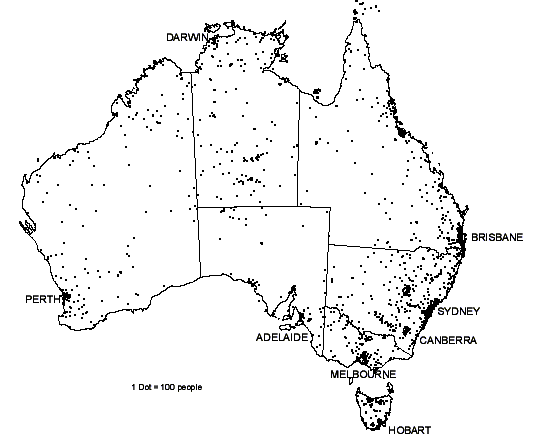
| (a) Represents a random distribution within Statistical Local Area boundaries.
Source: 1996 Census of Population and Housing. |
| | |
|
 Print Page