|
|
THE INFLUENCE OF LIFESTYLES ON ENVIRONMENTAL PRESSURE
This article was contributed by Manfred Lenzen, School of Physics, The University of Sydney.
Living means consuming, and consuming causes resource depletion and environmental degradation. Some of these contributions to environmental pressure arise from activities occurring directly in the household. These are, for example, the consumption of water in the house, or the emission of pollutants when driving a private car. The resources needed and pollutants emitted by households are called direct requirements.
Households also cause environmental pressure indirectly through the consumption of goods and services. The corresponding resources and pollutants needed to satisfy consumer demand are called indirect requirements. Examples of indirect water requirements for the activity ‘driving a private car’ include the water used during the assembly of the car and for producing the steel sheets for the car manufacturer, the cooling water used during the generation of the electricity for the steel plant, the water used for dust suppression and washing while mining the coal for the power plant, and so on. This process of industrial interdependence proceeds infinitely in an upstream direction, through the whole life cycle of all products, like the branches of an infinite tree.
By calculating direct and indirect resource and pollutant requirements of goods and services purchased by households, the influence of lifestyles on environmental pressure can be investigated in a comprehensive way (Lenzen 1998). Lifestyle choices and changes include family size, home type, floor space and location, comfort through appliance ownership, mobility through car ownership, out-of-home leisure and holiday travel, and are in turn affected by other socioeconomic and demographic trends such as income growth, increasing women’s participation in the workforce, and the ageing of the society. These trends often influence overall environmental pressure in a much stronger way than technological improvements. In this article, the effect of lifestyles on environmental pressure are illustrated for the example of water requirements of the population of Sydney.
Apart from being one of the driest continents, Australia experiences a spatially and temporally highly variable climate that includes periodic drought, leading to a relatively unpredictable water supply. On the other hand, Australian net water demand has increased by 19% between 1994 and 1997, resulting in water being a critical resource in some Australian agricultural and urban areas. For example, in the Murray-Darling Basin, which accounts for more than 50% of Australian water use, water resources are already fully committed, and governments recently agreed on capping water diversions at 1994 levels (Murray-Darling Basin Ministerial Council 1995). Nevertheless, significant environmental damage has occurred in the form of widespread soil and water salinisation (Australian Academy of Technological Sciences and Engineering, and Institution of Engineers Australia 1999).
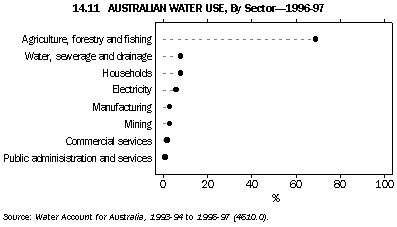
Graph 14.11 shows a breakdown of 1996-97 Australian water use, excluding the regulated discharge of hydro-electric power plants, aquaculture, drainage and sewerage providers, and fossil-fuelled power plants. More than two-thirds of Australian water is used for irrigating crops for animal and human consumption (38% livestock and pastures, 3% grains excluding rice, 7% sugar, 7% rice, 6% cotton, 6% fruit and vegetables). All other industry sectors use comparatively small amounts.
 14.12 EMBODIED WATER INTENSITIES, Selected Goods and Services Produced in Australia
|
| Product | Water intensity (Litres/$) |
|
| Rice (in the husk) | 7,459 |
| Seed cotton | 1,600 |
| Sugar cane | 1,239 |
| Dairy products | 680 |
| Wine | 503 |
| Beef products | 381 |
| Vegetables and fruit | 103 |
| Clothing | 90 |
| Paper products | 30 |
| Coal, ores and other mining products | 24 |
| Motor vehicles | 15 |
| Electronic equipment, TV, household appliances | 16 |
| Phone, FAX and mail | 11 |
| Banking and insurance | 7 |
| Education and health | 7 |
|
| Source: Lenzen and Foran 2001. |
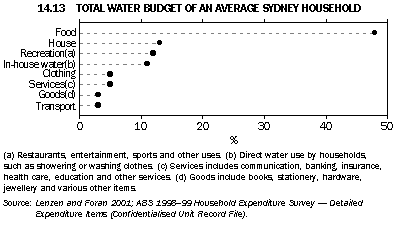
Multiplying water intensities with figures on household expenditure (from the 1998-99 Household Expenditure Survey (ABS 2000a) yields a household budget in terms of embodied water. A breakdown of such a budget is depicted in graph 14.13 for an average Sydney household. All categories except for ‘in-house water’ describe embodied water. The total water budget of an average Sydney household presented in the graph is about 3 million litres of water. The breakdown demonstrates the importance of indirect water requirements: in-house or direct water use is only 11% of the total water requirements.
 14.14 IN-HOUSE WATER USE, EMBODIED WATER, GROSS INCOME AND HOUSEHOLD SIZE,
14 Sydney Statistical Subdivisions
|
Region
| In-house
mains
water
use
(kL/cap.) | Embodied
mains
water
use(a)
(kL/cap.) | Embodied
self-extracted
surface
water(b)
(kL/cap.) |
Total water
budget
(kL/cap.)
|
Gross
income
($/cap.)
|
Household
size
persons
|
|
| Lower Northern Sydney | 151.3 | 623.6 | 631.8 | 1,406.8 | 30,072 | 2.2 |
| Northern Beaches | 172.3 | 696.2 | 734.8 | 1,603.3 | 28,135 | 2.6 |
| Eastern Suburbs | 113.4 | 577.4 | 570.6 | 1,261.4 | 23,976 | 2.2 |
| Hornsby- Ku-ring-gai | 171.1 | 573.1 | 602.0 | 1,346.2 | 23,230 | 3.2 |
| Inner Sydney | 110.2 | 536.1 | 535.5 | 1,181.8 | 22,509 | 2.1 |
| St George - Sutherland | 149.7 | 497.0 | 516.0 | 1,162.8 | 21,673 | 2.7 |
| Inner Western Sydney | 138.8 | 574.3 | 606.2 | 1,319.3 | 20,735 | 2.6 |
| Blacktown - Baulkham Hills | 146.3 | 428.1 | 451.5 | 1,026.0 | 19,585 | 2.8 |
| Outer Western Sydney | 132.9 | 446.2 | 448.2 | 1,027.3 | 19,198 | 2.8 |
| Central Western Sydney | 124.9 | 435.2 | 433.5 | 993.5 | 17,292 | 2.6 |
| Outer South Western Sydney | 115.1 | 433.4 | 435.6 | 984.0 | 16,504 | 3.3 |
| Gosford - Wyong | 127.0 | 410.7 | 421.2 | 959.0 | 16,076 | 2.7 |
| Canterbury - Bankstown | 148.1 | 430.4 | 439.0 | 1,017.5 | 15,284 | 2.8 |
| Fairfield - Liverpool | 123.4 | 383.4 | 385.1 | 891.9 | 13,881 | 3.6 |
|
(a) Derived from limited sample data with an unknown fraction of houses and flats; high standard errors apply.
(b) Non-treated water extracted from rivers.
Source: Lenzen and Foran 2001; ABS 1998-99 Household Expenditure Survey - Detailed Expenditure Items (Confidentialised Unit Record File). |
 |
Trends in water requirements and water intensities are illustrated in graph 14.15, which shows that in-house water use is relatively small compared to total water budgets, which range mostly between half a million and one million litres per capita. The water budget increases almost linearly with income, but this increase becomes smaller with increasing income. This effect can be explained by a trend in water intensities, which are obtained by dividing each water budget by the corresponding total household expenditure: on average, high-income households choose items that are less water intensive than those consumed by low-income households. Graph 14.16 shows that the water budget decreases with increasing household size. However, as the lack of a trend in the water intensity data demonstrates, this is not due to differences in choices, but simply because members of larger households share more than those of smaller households.
In summary, linking the concept of water embodied in goods and services with household expenditure and income provides some insightful correlations. Statistics on direct water use show that urban water consumers require approximately 0.2 ML per capita per year depending on location. However once the full water embodiment of their consumption mix is included, this value increases to between 0.6 and 1.1 ML per capita. Equally important is the decline in water intensity across the expenditure range: a 100% increase of household expenditure will result on average in a 70% increase in water use. This is not due to longer showers, swimming pools or green lawns, but to the water embodied in the extra goods and services a household with a higher income consumes. In Sydney, high embodied water budgets are associated with the affluent suburbs on the coast and around the harbour, where the water use is 1.5 times that of the less affluent suburbs on the western fringes of the city. The figures highlight that growth in population and income over the next twenty to thirty years may significantly increase the water requirement of Australians, posing substantial challenges to technology and governance to improve water efficiency in industrial and agricultural production, as well as final demand management.
14.15 TOTAL WATER BUDGETS AND IN-HOUSE WATER USE,
By Gross Household Income per Capita, 14 Sydney Statistical Subdivisions
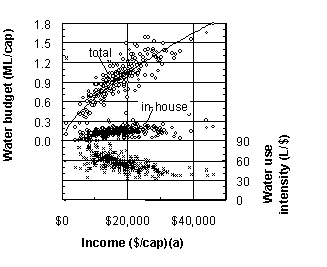 (a) In-house water use (o), total water budget (o), and water intensity (x) of Sydney households as a function of per-capita income.
Source: Lenzen and Foran 2001; ABS 1998-99 Household Expenditure Survey - Detailed Expenditure Items (Confidentialised Unit Record File).
14.16 TOTAL WATER BUDGETS AND IN-HOUSE WATER USE,
By Household Size, 14 Sydney Statistical Subdivisions
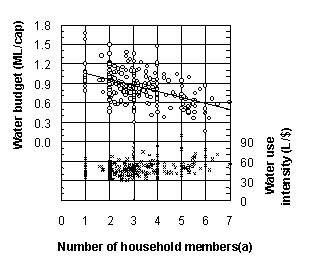 (a) As a function of household size.
Source: Lenzen and Foran 2001; ABS 1998-99 Household Expenditure Survey - Detailed Expenditure Items (Confidentialised Unit Record File).
References
Australian Academy of Technological Sciences and Engineering, Institution of Engineers Australia 1999, Water and the Australian Economy. Australian Academy of Technological Sciences and Engineering , Parkville, Victoria, Australia.
ABS 1999, Australian National Accounts, Input-Output Tables, 1994-95, Commodity Details. Electronic file (unpublished).
ABS 2000a, 1998-99 Household Expenditure Survey - Detailed Expenditure Items (Confidentialised Unit Record File). Electronic file (unpublished).
ABS 2000b, Water Account Data 1993-94 to 1996-97. Electronic file (unpublished).
Lenzen, M. 1998, "The energy and greenhouse gas cost of living for Australia during 1993-94", Energy 23 (6), 497-516.
Lenzen, M. and Foran, B. 2001, "An input-output analysis of Australian water usage", in Water Policy, in press.
Murray-Darling Basin Ministerial Council 1995, An audit of water use in the Murray-Darling Basin. Murray-Darling Basin Ministerial Council, Canberra, Australia.
|
 Print Page