- About this Release
- Duration of unemployment: recent definitional changes (Jun, 2001) (Feature Article)
|
Special Article - Duration of unemployment: recent definitional changes (Jun, 2001)
This article has been sourced from Labour Force, Australia (Cat. no. 6203.0), June 2001.
INTRODUCTION
Participation in paid work, for many people of working age, provides the basis for their personal and economic well-being. Those who are out of work, even for a relatively short period of time, may experience some reduction in their standard of living. It is also well established that the economic and social consequences of being unemployed increase with the duration of unemployment.
Results from the monthly Labour Force Survey (LFS) show that, in original terms, in April 2001 there were 359,500 people who had been unemployed for more than 13 weeks and of these, almost 42% had been unemployed for a year or more.
The ABS definition of duration of unemployment changed in April 2001, as part of the implementation of the redesigned LFS questionnaire. This article explains the new definition and its impact on duration of unemployment statistics.
DEFINING DURATION OF UNEMPLOYMENT
The monthly Labour Force Survey (LFS) measures the labour force status of the Australian civilian population aged 15 years and over. Persons are considered to be employed if they worked in the reference week for one hour or more for pay, profit, commission or payment in kind, in a job or business or on a farm; or were away from a job but satisfied certain job attachment criteria (see Glossary under ‘Employed’ for further details).
To be classified as unemployed, a respondent in the survey must satisfy each of the following criteria during the survey reference week: was not employed, had actively looked for work in the previous four weeks, and was available to start work in the reference week. Respondents who fulfil these criteria are asked further questions to determine their duration of unemployment.
In the LFS, duration of unemployment refers to the current incomplete spell of unemployment for an unemployed person. Prior to April 2001, duration of unemployment was defined as the period of time from when an unemployed person began looking for work, until the end of the survey reference week; or, the period of time since an unemployed person last worked full-time for two weeks or more, until the end of the survey reference week; whichever was the shorter period.
The revised definition retains the two alternative criteria, but widens the second criterion to refer to the period of time since a person last worked in any job for two weeks or more, regardless of whether it was full-time or part-time. This change aligns the ABS definition with International Labour Organisation guidelines for measuring duration of unemployment.
The changed definition reduces the duration of unemployment as measured in the LFS. As a consequence, there is also a reduction in the number of persons classified as long-term unemployed (that is, those unemployed persons whose duration of unemployment is 52 weeks or more). An analysis of monthly duration of unemployment data for the period April 1986 to March 2001 shows that, on average, there were 17,900 persons reclassified from long-term unemployed to unemployed for less than 12 months.
DEFINING UNEMPLOYMENT
In April 2001, changes were also made to the definition of unemployment. These changes also had an impact on the statistics for duration of unemployment.
In particular, under the new definition, persons who had been away from their job without pay for less than four weeks up to the end of the reference week because of insufficient work (that is, persons temporarily stood down), have been reclassified from unemployed to employed. Analysis of monthly data for the period April 1986 to March 2001 shows that, on average, 19,900 persons were reclassified from unemployed to employed under this new definition.
The decrease in the number of persons unemployed for less than four weeks is, coincidentally, of similar size to the reduction in long-term unemployed resulting from the change in definition of duration of unemployment.
Also under the definitional change, people who were not working, were actively seeking work, but were not available to start work during the reference week due to temporary illness, have been reclassified from unemployed to not in the labour force. Analysis of monthly data for the period April 1986 to March 2001 shows that, on average, there were 4,300 persons reclassified in this way.
IMPACT OF CHANGES TO DEFINITIONS
The impact of the combination of the changes to the definition of duration of unemployment and to the definition of unemployment was to reduce the proportion of unemployed who are long-term unemployed by about 1.7 percentage points on average per month over the period April 1986 to March 2001.
The changes also have an impact on the proportion of unemployed who fall within each of the categories of duration of unemployment. For example, the following table shows the proportion of persons unemployed for increasing durations of unemployment, under the previous and current definitions at March 2001. (March 2001 is the final month for which duration of unemployment data (in weeks) for both new and previous definitions are available.)
PERCENTAGE UNEMPLOYED BY WEEKS UNEMPLOYED, MARCH 2001
|
| Weeks Unemployed | Previous Definition of Unemployment
and Duration
(1%) | New Definition of Unemployment; Previous Definition of Duration
(1%) | New definition of Unemployment
and Duration
(1%) |
 |
|
| Under 4 weeks | 21.8 | 18.8 | 20.3 |
| 4 and under 13 | 30.1 | 31.3 | 32.2 |
| 13 and under 26 | 13.9 | 14.5 | 14.8 |
| 26 and under 52 | 10.6 | 11 | 11.1 |
| 52 and under 104 | 9.7 | 10 | 9.5 |
| 104 weeks and over | 13.9 | 14.4 | 12.1 |
| Total | 100 | 100 | 100 |
|
In original terms in March 2001, 21.6% of unemployed persons were long-term unemployed under the new definitions, compared with 23.6 % under the previous definitions. Under the new definitions, 20.3% of unemployed persons had been unemployed for less than 4 weeks, compared with 21.8% under the previous definitions.
LIKELIHOOD OF FINDING EMPLOYMENT
The likelihood of finding employment is related to the duration of unemployment. The following table shows the proportion of people unemployed in March 2001, by duration of unemployment, who had found employment by the following month. It shows that, in general, the longer a person had been unemployed, the less likely they were to find employment. For example, of all persons who were unemployed for less than 4 weeks in March 2001, 35.3% were employed in April 2001. In contrast, of all persons unemployed for 104 weeks or more in March 2001, only 5.4% were employed in April 2001.
LABOUR FORCE STATUS IN APRIL 2001 OF PERSONS UNEMPLOYED IN MARCH 2001, BY DURATION OF UNEMPLOYMENT IN WEEKS IN MARCH 2001 (new definition)
|
| March 2001 Duration of | Labour Force Status, April 2001 (%) |
| Unemployment (weeks) |
|
| Employed | Unemployed | Not in Labour Force | Total |
|
|
| Under 4 weeks | 35.3 | 37.4 | 27.3 | 100.0 |
| 4 and under 13 weeks | 22.1 | 54.9 | 22.9 | 100.0 |
| 13 and under 26 weeks | 14.3 | 69.5 | 16.2 | 100.0 |
| 26 and under 52 weeks | 12.4 | 71.4 | 16.2 | 100.0 |
| 52 and under 104 weeks | 8.6 | 72.5 | 18.9 | 100.0 |
| 104 weeks and over | 5.4 | 72.0 | 22.5 | 100.0 |
| Total Unemployed | 20.0 | 58.2 | 21.9 | 100.0 |
|
TRENDS IN LONG-TERM UNEMPLOYMENT
Long-term unemployment is of particular interest to economic, labour market and social analysts. The social consequences of being unemployed for a year or longer may include financial difficulties, loss of self esteem, outdated skills and relatively poor prospects of finding work. The persistence of high levels of long-term unemployment may also affect macroeconomic management. Economic policies may have limited success in reducing unemployment if employers are reluctant to employ the long-term unemployed.
As with unemployment in general, increases in long-term unemployment are generally associated with downturns in the economic cycle. However, decreases in the number of long-term unemployed often lag behind improvements in the economy, with the long-term unemployed having lower chances of gaining employment than the short-term unemployed. In addition, long-term unemployment as a proportion of total unemployment may continue to rise during an economic recovery when total unemployment falls at a faster rate than long-term unemployment.
The following graph shows the trend series for the number of persons in long-term unemployment for the period April 1986 to March 2001, and also shows the difference in the series resulting from the definitional changes.
LONG-TERM UNEMPLOYMENT, APRIL 1986-MARCH 2001,
Previous and new definition - Trend
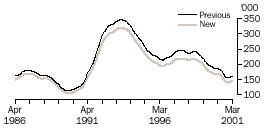
The trend estimate of long-term unemployment was at a relatively low level during the period of high employment growth in the late 1980s, bottoming at 104,900 in November 1989. At that time, the long-term unemployed represented 22% of total unemployment. Following the economic downturn of the early 1990s, the number of long-term unemployed trebled by June 1993, to 320,500, and accounted for 35.1% of total unemployment.
With the strong growth in employment from early 1993, the trend estimate of long-term unemployment fell rapidly to 192,900 in May 1996. The trend estimate then rose until late 1997 and has been generally falling since that time.
The trend estimate of long-term unemployment, as a proportion of total unemployment, rose between mid 1997 and early 1999, and has fallen rapidly since then. In March 2001 there were 146,400 long-term unemployed, representing 22.6% of total unemployment.
The following graph shows the trend series for long-term unemployment as a proportion of total unemployment for the period April 1986 to March 2001, as well as showing the difference between the series resulting from the definitional changes.
LONG-TERM UNEMPLOYMENT AS % OF UNEMPLOYMENT,
TREND 1986-2001 Previous and new definition
REVISIONS TO HISTORICAL DURATION OF UNEMPLOYMENT SERIES
Original, seasonally adjusted and trend series for duration of unemployment and long-term unemployment have been recompiled for the period April 1986 to March 2001 to reflect the new definitions of unemployment and duration of unemployment. These new series are now recognised as the official ABS series, and appear in ABS standard outputs. The specific duration of unemployment series which have been constructed are the series for:
Duration of unemployment (based on last job) - by sex less
than 52 weeks
52 weeks and under 104
104 weeks and over.
The previous measure of duration of unemployment (based on last full-time job) will continue to be available for periods after April 2001, on request, for users interested in maintaining a time series on the previous basis.
Additional data on the long-term unemployed are available from the revised questionnaire. Duration of unemployment (in months) is now available for those who last worked between two and five years ago. This will supplement the existing breakdown of unemployment (in weeks) for persons who last worked less than two years ago, which will continue to be available.
More comprehensive information on the definitional and other changes implemented in the Labour Force Survey in April 2001 is contained in Information Paper: Implementing the Redesigned Labour Force Survey Questionnaire (6295.0) which was released on 3 May 2001.
CONCLUSION
For further information relating to duration of unemployment statistics and the implementation of the redesigned LFS questionnaire, please contact Peter Bradbury on (02) 6252 6565, or email peter.bradbury@abs.gov.au.
|

 Print Page
 Print All