|
|
Retail trade
The retail trade industry comprises businesses primarily engaged in the resale of new or used goods to final consumers for personal or household consumption, or in selected repair activities such as repair of household equipment or motor vehicles.
Retail turnover estimates shown below relate to the value of turnover for retailing (such as supermarkets, clothing and department stores, etc.) and hospitality and selected service industries (such as cafes and restaurants, hotels and licensed clubs, etc.). In order to measure the actual value paid by consumers from 1 July 2000, retail turnover is recorded inclusive of the Goods and Services Tax (GST).
These estimates are used by retailers, industry associations, economists, government and media to analyse consumer spending behaviour and, in conjunction with other economic indicators, to help assess current Australian economic performance. Quarterly retail turnover estimates, along with other data, are used in the calculation of household final consumption expenditure in the Australian national accounts.
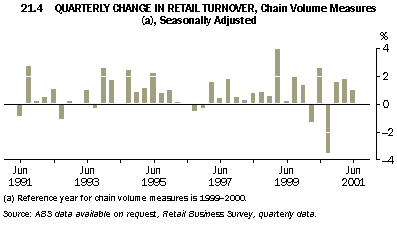
Graph 21.4 presents quarterly changes in the seasonally adjusted chain volume measure of Australian total retail turnover (including selected services). The series rose from $27,510m in the June quarter 1991 to $37,726m in the June quarter 2001, an increase of 37.1% representing an average growth of 0.9% per quarter.
The largest quarterly increases in the seasonally adjusted chain volume measure occurred in the March quarter 1999 (3.9%) and in the September quarter 1991 (2.7%). The series also rose by 2.6% in the June quarter 2000, reflecting the unusual increase in the volume of goods sold in some industries prior to the introduction of The New Tax System (TNTS) on 1 July 2000.
While the price of most goods rose from 1 July 2000, the volume of goods sold across most industries and States dropped as the apparent pull forward in spending in June unwound and the impact of the GST flowed through the economy. This led to a decrease of 3.6% in September quarter 2000, the most significant fall in the period June quarter 1991 to June quarter 2001. The next largest decreases in the series occurred in the March quarter 2000 (by 1.4%) and in the September quarter 1992 (by 1.2%).
Spending patterns stabilised slowly after the introduction of TNTS, although at different rates across industries and States. The seasonally adjusted chain volume measure of Australian retail turnover increased in the most recent three quarters, with a rise of 1% in the June quarter 2001 (graph 21.4).
21.5 RETAIL TURNOVER, Chain Volume Measures (a), By Industry Group, Original |
|
 | Food
retailing | Department
stores | Clothing
and soft
good
retailing | Household
good
retailing | Recreational
good
retailing | Other
retailing | Hospitality
and
services | Total(b) |
| Year | $m | $m | $m | $m | $m | $m | $m | $m |
|
| 1990-91 | 47,176 | 10,485 | 7,939 | 9,227 | 6,438 | 9,365 | 21,523 | 111,054 |
| 1991-92 | 49,068 | 10,858 | 8,257 | 9,558 | 6,507 | 9,857 | 20,639 | 113,732 |
| 1992-93 | 49,304 | 11,019 | 7,972 | 10,175 | 6,272 | 10,006 | 20,040 | 114,030 |
| 1993-94 | 49,826 | 11,101 | 7,992 | 10,959 | 6,513 | 10,920 | 20,879 | 117,639 |
| 1994-95 | 52,474 | 11,450 | 8,208 | 11,782 | 6,896 | 11,558 | 22,586 | 124,382 |
| 1995-96 | 54,953 | 11,760 | 8,376 | 12,569 | 7,271 | 12,094 | 22,980 | 129,478 |
| 1996-97 | 55,342 | 11,690 | 8,259 | 13,771 | 6,917 | 12,521 | 21,695 | 129,979 |
| 1997-98 | 57,281 | 12,025 | 8,477 | 14,289 | 7,051 | 13,595 | 22,027 | 134,561 |
| 1998-99 | 58,257 | 12,408 | 9,495 | 14,691 | 7,147 | 14,386 | 23,904 | 140,146 |
| 1999-2000 | 58,953 | 13,148 | 10,167 | 17,314 | 7,261 | 15,589 | 25,150 | 147,581 |
| 2000-01 | 58,752 | 12,547 | 9,631 | 17,940 | 6,973 | 16,725 | 25,335 | 147,903 |
|
| (a) Reference year for chain volume measures is 1999-2000. (b) Chain volume measures are not additive for most periods; the component measures do not sum to a total in the same way as the corresponding current price components do. |
Source: ABS data available on request, Retail Business Survey, aggregated quarterly data. |
Wholesale trade
The wholesale trade industry covers those businesses involved in the resale of new or used goods to businesses or to institutional (including government) users.
Along with the retail trade industry, the wholesale trade industry is a significant component of the Australian economy and provides a key indicator of economic activity.
The quarterly trend chain volume measure of Australian total wholesale sales by private businesses rose from $31,933m in the June quarter 1991 to $53,715m in the June quarter 2001, an overall increase of 68.2% representing an average growth of 1.7% per quarter.
As shown in graph 21.6, the series reflected the downturn in the economy in 1991, with wholesale sales declining by 3.1% in the June quarter 1991 and 2.7% in the September quarter 1991. The largest increase (5.4%) was recorded in the June quarter 1994. A break in the series occurred between the June and September quarters 1999 as a result of the inclusion of three significant privatised marketing authorities. After declining in the September and December 2000 quarters and the March 2001 quarter (by 1.2%, 1.3% and 0.3% respectively), wholesale sales increased by 0.4% in the June quarter 2001.
|

 Print Page