|
|
INTRODUCTION
Recent rises in the value of the Australian dollar in relation to some of the currencies of our major trading partners has renewed interest in the currencies used in invoices for Australia's exports and imports.
This article analyses the major invoice currencies used for Australia's international merchandise trade for the five quarters from March quarter 2002 to March quarter 2003. Changes in the composition of the currencies in which goods are invoiced are identified. The article also examines selected invoice currencies of major commodities exported and imported into Australia, classified according to the Standard International Trade Classification Revision 3 (SITC Rev3).
An historical comparison is also provided to examine changes over a longer period. Previous articles in the March quarter 1998 and March quarter 2001 issues of this publication provided similar analyses. Copies of these articles are available on the ABS web site <www.abs.gov.au> by selecting Themes / International Trade / Topics of Interest.
All values in this article are reported in Australian dollars. Details about the treatment of invoice currencies are included as an Appendix to this article.
EXCHANGE RATES
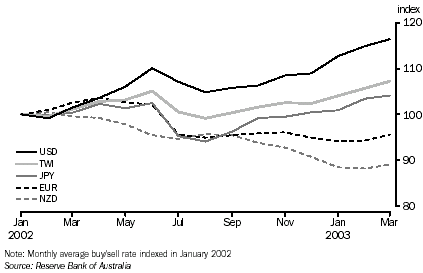
Graph F1 shows movements in the value of the Australian dollar against selected other currencies since the beginning of 2002, which is the period covered by this analysis. The Trade Weighted Index (TWI) is also included. The Australian dollar has appreciated against the US dollar (up 16%) and the Japanese yen (up 4%), but has depreciated against the euro (down 4%) and the NZ dollar (down 11%) in that period, leading to an overall rise in the TWI of 7%.
With an appreciating currency, Australian exports invoiced in Australian dollars become less attractive to foreign buyers, as it takes more of their currency to purchase Australian goods. Australian exports invoiced in other currencies provide smaller Australian dollar returns to exporters, and decrease the nominal value of Australian exports. Australian imports of foreign goods invoiced in other currencies require fewer Australian dollars, making imports more attractive to domestic consumers.
F1 MOVEMENTS IN SELECTED EXCHANGE RATES
EXPORTS
Table F2 lists the major invoice currencies used for Australia's merchandise exports for the period from March quarter 2002 to March quarter 2003. Just over 95% of Australia's exports were written in either US or Australian dollars in that period. The US dollar was
the predominant currency, accounting for 68% of exports while the Australian dollar accounted for 27% of exports. The euro, the NZ dollar and the Japanese yen were the only other currencies in which more than 1% of exports were invoiced since the beginning of 2002.
Over the five quarters, the proportion of exports invoiced in US dollars fell, then rose giving a net increase over the period of 1.3 percentage points to 70.2%. The higher proportion of exports invoiced in US dollars in March quarter 2003 was largely caused by increases in exports of a small number of commodities invoiced mainly in US dollars combined with a fall in exports invoiced in Australian dollars across a range of commodities.
The proportion invoiced in Australian dollars fell a net 1.1 percentage points over the period to 25.8%. The proportion invoiced in Australian dollars in March quarter 2003 was the lowest observed since analysis of invoice currencies commenced in 1997.
F2. INVOICE CURRENCIES FOR EXPORTS
| Currency | Mar qtr 2002 | Jun qtr 2002 | Sep qtr 2002 | Dec qtr 2002 | Mar qtr 2003 | Total |
|
CURRENCY ($million) |
|
| US dollars | 19,772 | 20,251 | 20,276 | 20,812 | 19,499 | 100,609 |
| Australian dollars | 7,727 | 8,031 | 8,536 | 8,629 | 7,158 | 40,082 |
| Euros | 472 | 471 | 356 | 375 | 335 | 2,009 |
| NZ dollars | 260 | 309 | 361 | 397 | 345 | 1,672 |
| Japanese yen | 225 | 252 | 459 | 255 | 209 | 1,400 |
| Pound sterling | 214 | 247 | 271 | 263 | 195 | 1,190 |
| Other | 43 | 48 | 56 | 44 | 40 | 231 |
 | | | | | | |
| Total | 28,713 | 29,609 | 30,316 | 30,774 | 27,782 | 147,194 |
|
PROPORTION (%) |
|
| US dollars | 68.9 | 68.4 | 66.9 | 67.6 | 70.2 | 68.4 |
| Australian dollars | 26.9 | 27.1 | 28.2 | 28.0 | 25.8 | 27.2 |
| Euros | 1.6 | 1.6 | 1.2 | 1.2 | 1.2 | 1.4 |
| NZ dollars | 0.9 | 1.0 | 1.2 | 1.3 | 1.2 | 1.1 |
| Japanese yen | 0.8 | 0.9 | 1.5 | 0.8 | 0.8 | 1.0 |
| Pound sterling | 0.7 | 0.8 | 0.9 | 0.9 | 0.7 | 0.8 |
| Other | 0.2 | 0.2 | 0.2 | 0.1 | 0.1 | 0.2 |
| | | | | | |
| Total | 100.0 | 100.0 | 100.0 | 100.0 | 100.0 | 100.0 |
|
EXPORT COMMODITIES
Table F3 summarises the invoice currencies used for Australia's major export commodities between March quarter 2002 and March quarter 2003. By commodity, there were substantial differences in the invoice currencies used. The US dollar was used most often as the invoice currency in the resources sector, particularly for gold (SITC 97), natural gas (SITC 34) and coal (SITC 32). Over 95% of each of these
commodities were invoiced in US dollars.
There were several commodities where the Australian dollar was the predominant invoice currency. Over 60% of exports of beverages (SITC 11), miscellaneous manufactured articles (SITC 8) and medicinal and pharmaceutical products (SITC 54) were invoiced in Australian dollars.
For a small number of commodities, other currencies were used for a significant proportion of exports. Around 20% of exports of fish and crustaceans (SITC 03) were invoiced in Japanese yen, while a similar proportion of beverages (SITC 11) were invoiced in pounds sterling, reflecting significant export destinations for these commodities.
F3. INVOICE CURRENCIES OF SELECTED EXPORT COMMODITIES, March qtr 2002 to March qtr 2003
| Value | US
Dollars | Australian Dollars | Euros | NZ
Dollars | Japanese Yen | Pounds Sterling | All other currencies |
| SITC (Rev 3) code and commodity | $m | % | % | % | % | % | % | % |
|
| 01 Meat and meat preparations | 7,200 | 61.8 | 31.1 | 0.7 | 0.7 | 2.8 | 1.5 | 1.4 |
| 02 Dairy products and birds' eggs | 3,448 | 69.5 | 29.2 | 0.4 | 0.2 | 0.5 | 0.3 | 0.0 |
| 03 Fish (not marine mammals), crustaceans, molluscs and aquatic invertebrates, and preparations thereof | 1,943 | 35.5 | 44.2 | 0.1 | 0.0 | 20.1 | 0.0 | 0.1 |
| 04 Cereals and cereal preparations | 6,912 | 79.4 | 9.1 | 10.6 | 0.1 | 0.7 | 0.0 | 0.1 |
| 11 Beverages | 3,081 | 13.8 | 61.7 | 2.1 | 2.0 | 0.4 | 18.7 | 1.2 |
| 26 Textile fibres and their wastes (not manufactured into yarn or fabric) | 5,954 | 60.1 | 34.5 | 4.9 | 0.0 | 0.2 | 0.3 | 0.0 |
| 28 Metalliferous ores and metal scrap | 17,272 | 90.0 | 10.0 | 0.0 | 0.0 | 0.0 | 0.0 | 0.0 |
| 32 Coal, coke and briquettes | 15,911 | 95.5 | 4.5 | 0.0 | 0.0 | 0.0 | 0.0 | 0.0 |
| 33 Petroleum, petroleum products and related materials | 10,621 | 82.7 | 17.3 | 0.0 | 0.0 | 0.0 | 0.0 | 0.0 |
| 34 Gas, natural and manufactured | 4,094 | 99.9 | 0.1 | 0.0 | 0.0 | 0.0 | 0.0 | 0.0 |
| 54 Medicinal and pharmaceutical products | 2,385 | 21.9 | 68.5 | 1.7 | 5.2 | 0.9 | 1.4 | 0.4 |
| 68 Non-ferrous metals | 10,481 | 87.7 | 12.0 | 0.0 | 0.1 | 0.0 | 0.1 | 0.0 |
| 77 Electrical machinery, apparatus, appliances, parts (incl. non-electrical counterparts of electrical domestic equipment) | 2,088 | 33.2 | 49.8 | 11.6 | 2.1 | 0.2 | 3.0 | 0.2 |
| 78 Road vehicles (incl. air-cushion vehicles) | 5,210 | 57.4 | 29.8 | 0.4 | 9.3 | 2.6 | 0.6 | 0.0 |
| 8 Miscellaneous manufactured articles | 5,418 | 29.2 | 60.3 | 3.4 | 3.9 | 0.4 | 2.6 | 0.1 |
| 93 Special transactions and commodities not classified according to kind | 3,484 | 69.5 | 28.4 | 0.1 | 1.9 | 0.0 | 0.1 | 0.0 |
| 97 Gold, non-monetary (excl. gold ores and concentrates) | 6,864 | 97.8 | 2.2 | 0.0 | 0.0 | 0.0 | 0.0 | 0.0 |
| Other | 34,828 | 45.5 | 49.4 | 1.0 | 1.7 | 1.5 | 0.6 | 0.2 |
| Total | 147,194 | 68.4 | 27.2 | 1.4 | 1.1 | 1.0 | 0.8 | 0.2 |
|
IMPORTS
Table F4 lists the major invoice currencies used for Australia's merchandise imports for the period from March quarter 2002 to March quarter 2003. The US dollar was the predominant currency, although less so than for exports, accounting for almost 50% of
imports.
The Australian dollar was the second most significant invoice currency over the period, accounting for almost 31% of imports. Other currencies were more significant for imports than exports. The euro (9%) and Japanese yen (4%) were the next most significant invoice currencies, while all other currencies combined accounted for about 7% of imports over the period.
F4. INVOICE CURRENCIES FOR IMPORTS
| Currency | Mar qtr 2002 | Jun qtr 2002 | Sep qtr 2002 | Dec qtr 2002 | Mar qtr 2003 | Total |
|
CURRENCY ($million) |
|
| US dollars | 14,490 | 14,650 | 16,530 | 18,254 | 15,583 | 79,507 |
| Australian dollars | 8,599 | 9,671 | 10,323 | 10,446 | 9,793 | 48,831 |
| Euros | 2,302 | 2,517 | 3,130 | 3,188 | 2,999 | 14,136 |
| Japanese yen | 1,132 | 1,202 | 1,415 | 1,405 | 1,266 | 6,421 |
| Pounds sterling | 633 | 598 | 754 | 751 | 593 | 3,328 |
| NZ dollars | 343 | 375 | 431 | 454 | 395 | 1,997 |
| Selected Asian currencies(a) | 195 | 207 | 208 | 283 | 519 | 1,412 |
| Other | 879 | 693 | 722 | 873 | 725 | 3,891 |
| | | | | | |
| Total | 28,573 | 29,913 | 33,512 | 35,654 | 31,873 | 159,524 |
|
PROPORTION (%) |
|
| US dollars | 50.7 | 49.0 | 49.3 | 51.2 | 48.9 | 49.8 |
| Australian dollars | 30.1 | 32.3 | 30.8 | 29.3 | 30.7 | 30.6 |
| Euros | 8.1 | 8.4 | 9.3 | 8.9 | 9.4 | 8.9 |
| Japanese yen | 4.0 | 4.0 | 4.2 | 3.9 | 4.0 | 4.0 |
| Pounds sterling | 2.2 | 2.0 | 2.2 | 2.1 | 1.9 | 2.1 |
| NZ dollars | 1.2 | 1.3 | 1.3 | 1.3 | 1.2 | 1.3 |
| Selected Asian currencies(a) | 0.7 | 0.7 | 0.6 | 0.8 | 1.6 | 0.9 |
| Other | 3.1 | 2.3 | 2.2 | 2.4 | 2.3 | 2.4 |
| | | | | | |
| Total | 100.0 | 100.0 | 100.0 | 100.0 | 100.0 | 100.0 |
|
(a) Selected Asian currencies include currencies for the following countries: China, Hong Kong (SAR of China), Indonesia, Republic of Korea, Malaysia, Philippines, Singapore, Taiwan and Thailand.
IMPORT COMMODITIES
Invoice currencies used for Australia's major import commodities are summarised in Table F5 for the period from March quarter 2002 to March quarter 2003.
A small number of commodities were dominated by invoices in US dollars, particularly petroleum products (SITC 33) at 99%, and transport vehicles (excluding road vehicles) (SITC 79) at 82%. By comparison, 75% of medicinal and pharmaceutical products (SITC 54) and almost two-thirds of road vehicles (SITC 78) were invoiced in Australian dollars.
The euro was the third most significant invoice currency, with industrial machinery (SITC 72 & SITC 74) accounting for approximately one-quarter of these imports. The Japanese yen was the invoice currency for 10% of machinery specialised for particular industries (SITC 72), and 13% of road vehicles (SITC 78).
F5. INVOICE CURRENCIES OF SELECTED IMPORT COMMODITIES, March qtr 2002 to March qtr 2003
| Value | US Dollars | Australian Dollars | Euros | Japanese Yen | Pounds Sterling | NZ Dollars | All other currencies |
| SITC (Rev 3) code and commodity | $m | % | % | % | % | % | % | % |
|
| 33 Petroleum, petroleum products and related materials | 12,081 | 99.3 | 0.5 | 0.1 | 0.0 | 0.0 | 0.0 | 0.0 |
| 51 Organic chemicals | 3,062 | 52.2 | 39.5 | 4.9 | 0.9 | 1.3 | 0.1 | 2.0 |
| 54 Medicinal and pharmaceutical products | 6,547 | 14.6 | 75.3 | 6.4 | 0.2 | 1.6 | 0.4 | 1.4 |
| 69 Manufactures of metals, nes | 3,758 | 51.8 | 22.1 | 13.3 | 2.7 | 3.3 | 2.2 | 4.6 |
| 71 Power generating machinery and equipment | 3,839 | 46.2 | 27.1 | 10.8 | 6.0 | 4.1 | 0.4 | 5.4 |
| 72 Machinery specialised for particular industries | 5,489 | 36.0 | 17.9 | 26.8 | 10.0 | 3.2 | 1.1 | 4.9 |
| 74 General industrial machinery and equipment, nes and machine parts, nes | 8,353 | 40.2 | 22.8 | 22.0 | 6.9 | 3.0 | 1.4 | 3.8 |
| 75 Office machines and automatic data processing machines | 9,702 | 75.1 | 19.3 | 1.4 | 2.1 | 0.6 | 0.4 | 1.0 |
| 76 Telecommunications and sound recording and reproducing apparatus and equipment | 8,244 | 39.7 | 46.8 | 4.8 | 5.1 | 2.0 | 0.2 | 1.5 |
| 77 Electrical machinery, apparatus, appliances, parts (incl. non-electrical counterparts of electrical domestic equipment) | 8,469 | 52.3 | 23.7 | 14.3 | 3.0 | 3.0 | 1.1 | 2.5 |
| 78 Road vehicles (incl air-cushion vehicles) | 19,676 | 12.9 | 64.5 | 8.3 | 12.9 | 0.6 | 0.3 | 0.5 |
| 79 Transport equipment (excl. road vehicles) | 7,345 | 82.4 | 12.6 | 1.5 | 0.2 | 1.9 | 0.5 | 0.9 |
| 84 Articles of apparel and clothing accessories | 4,281 | 58.7 | 24.2 | 3.7 | 0.2 | 0.7 | 2.6 | 10.0 |
| 87 Professional, scientific and controlling instruments and apparatus, nes | 3,833 | 48.4 | 20.1 | 13.7 | 3.8 | 5.2 | 0.9 | 7.9 |
| 89 Miscellaneous manufactured articles, nes | 8,733 | 49.4 | 26.6 | 7.7 | 1.7 | 6.1 | 2.0 | 6.5 |
| Other | 46,112 | 51.2 | 26.9 | 9.8 | 2.6 | 2.1 | 2.4 | 4.9 |
| Total | 159,524 | 49.8 | 30.6 | 8.9 | 4.0 | 2.1 | 1.3 | 3.3 |
|
HISTORICAL COMPARISON
Table F6 shows the proportion of exports and imports invoiced in the major currencies for the last four years. Over this longer period, trends in the data are more readily apparent. The proportion of merchandise exports invoiced in US dollars increased from 64% in 1999 to around 68% in each of the subsequent three years.
The proportion of imports invoiced in US dollars has remained relatively stable over the four year period, while a greater proportion of imports have been invoiced in Australian dollars since 2001 compared with earlier years.
The euro was introduced as a scriptural currency on 1 January 1999. Euro banknotes and coin came into circulation on 1 January 2002, replacing the individual currencies of 12 European Union (EU) countries. Denmark, Sweden and the UK were the only EU countries which subsequently retained their own currencies. This is reflected in the proportion of trade invoiced in the euro which has risen substantially since 2002, particularly for imports.
F6. EXPORTS AND IMPORTS BY INVOICE CURRENCIES
| 1999 | 2000 | 2001 | 2002 | Mar qtr 2003 |
| Currency | % | % | % | % | % |
|
EXPORTS |
|
| US dollars | 64.2 | 68.4 | 68.8 | 67.9 | 70.2 |
| Australian dollars | 32.1 | 28.6 | 27.7 | 27.6 | 25.8 |
| Euros | 0.2 | 0.3 | 0.5 | 1.4 | 1.2 |
| NZ dollars | 0.8 | 0.7 | 0.8 | 1.1 | 1.2 |
| Japanese yen | 1.0 | 0.8 | 0.9 | 1.0 | 0.8 |
| Pounds sterling | 1.0 | 0.9 | 0.9 | 0.8 | 0.7 |
| Other | 0.7 | 0.4 | 0.4 | 0.2 | 0.1 |
| | | | | |
| Total | 100.0 | 100.0 | 100.0 | 100.0 | 100.0 |
| | | | | |
| Total exports ($m) | 86,893 | 110,354 | 122,530 | 119,412 | 27,782 |
|
IMPORTS |
|
| US dollars | 49.7 | 51.4 | 49.5 | 50.1 | 48.9 |
| Australian dollars | 28.6 | 28.3 | 30.7 | 30.6 | 30.7 |
| Euros | 1.2 | 2.3 | 4.8 | 8.7 | 9.4 |
| Japanese yen | 5.6 | 5.2 | 4.4 | 4.0 | 4.0 |
| Pounds sterling | 2.7 | 3.1 | 2.4 | 2.1 | 1.9 |
| NZ dollars | 1.5 | 1.3 | 1.3 | 1.3 | 1.2 |
| Other | 10.7 | 8.5 | 7.0 | 3.2 | 3.9 |
| | | | | |
| Total | 100.0 | 100.0 | 100.0 | 100.0 | 100.0 |
| | | | | |
| Total imports ($m) | 101,517 | 116,955 | 117,746 | 127,652 | 31,873 |
|
APPENDIX
TREATMENT OF INVOICE CURRENCIES
Historical Comparison
Information on the invoice currencies used in export and import transactions is collected by the Australian Customs Service (Customs) and passed to the ABS with other international trade information.
For exports, goods invoiced in US dollars, Japanese yen, Pounds sterling, Euros and NZ dollars are reported in those foreign currencies. Amounts invoiced in other currencies are converted to Australian dollars by the exporter and this value is reported on the Customs entry. The invoice currency is also reported. The ABS receives the exports data as reported to Customs and converts values reported in the foreign currencies to Australian dollars using the exchange rate prevailing on the date of departure of the goods from Australia.
For imports, the value of the goods is reported to Customs in the invoice currency of the transaction. The Customs system automatically converts the value to Australian dollars using exchange rates prevailing on the reported date of departure of the goods from the overseas country. The ABS receives details of the reported invoice currency, together with the value of the import transaction in Australian dollars.
While currencies are converted to Australian dollars at exchange rates applicable on the day of shipment, the Australian exporter or importer may undertake the conversion for the actual receipt or payment using a different exchange rate, or one applying on a different day. As well, many exporters and importers hedge transactions and the actual exchange rate applied may differ from that applicable on the shipment date.
|

 Print Page
 Print All