How the ABS operates
Introduction
The ABS produces and disseminates statistics under the following broad programs:
- Economic and Environment Statistics
- Population, Labour and Social Statistics
These areas of statistics involve extensive data collection through censuses and surveys and from administrative data sources.
The statistical programs are supported by service areas, which deliver assistance and advice on statistical methods, data and metadata arrangements, information technology, data acquisition and collection, client management, dissemination, human resources and other corporate services.
The ABS has a central office in Canberra and regional offices located in the eight state and territory capitals. Regional offices are responsible for the delivery of statistical services to their state or territory. Additionally all regional offices, apart from the ACT office, have some responsibilities for national operations for particular statistical activities.
The statistical collection process
The ABS conducts a large number of business and household collections. These collections are characterised by common statistical principles and many similar procedures. The statistical process involves a range of statistical operations, from developing specifications for statistics based on user information needs through to the delivery of data and support to clients.
The diagram below presents a typical survey cycle. It distinguishes between a core set of tasks and activities which form the three broad stages of the statistical collection process, and two overarching functions which ensure that ABS products, processes and services are of high quality and contribute to achieving corporate objectives and delivering on the ABS mission.
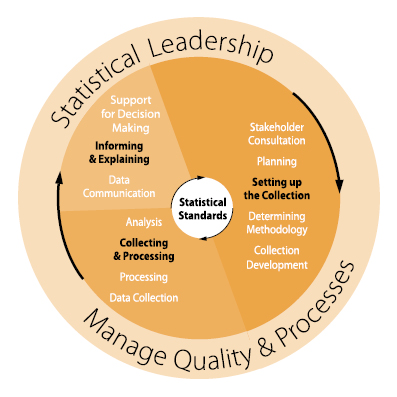
Functional areas undertaking statistical operations
Once statistical priorities have been set, through consultation and planning with statistics users, the ABS sets up arrangements for data collection, processing and analysis. Data collection activities include form creation for deployment to field Interviewers or mail dispatch to businesses, data receipt and follow-up of non-response. Data may be collected directly from providers through surveys or censuses, or indirectly by accessing data collected by other organisations, particularly Australian, state and territory administrative agencies. The processing stages of the cycle cover data editing and validation; checking individual records for completeness, consistency and accuracy; producing aggregate survey results; checking consistency and validity of aggregated data and preparing data for public release. Confidentiality rules are applied at all stages.
The final stage of the statistical cycle covers data communication and support for decision making. A key objective for the ABS is to maximise the informed use of ABS and non-ABS statistics by increasing the visibility of, and access to, statistics, optimising the mix of dissemination channels, and improving the efficiency and effectiveness of information service delivery. To achieve this, a range of products and delivery options have been developed, with a focus on meeting the needs of ABS clients. Several areas support these activities, including market research, website publishing and development, a telephone enquiry service, delivery of customised products and working with various sectors to improve statistical literacy.
The statistical operations of each stage of the cycle are undertaken by a range of specialist areas. Other specialist areas have responsibility for achieving the broader objectives of managing quality and processes, and delivering statistical leadership. The key organisational areas and functions that are involved in the statistical collection and dissemination processes are described below.
- National Statistics Centres (NSCs) provide statistical leadership, internally and externally, for each field of statistics. NSC responsibilities include: establishing and maintaining close links with key external clients and ensuring the ABS understands and satisfies their needs for data; providing leadership in the development of statistics within and outside the ABS; maintaining knowledge of current and emerging policy issues and debates, and assessing potential statistical impacts; understanding and awareness of important national and international statistics relating to these issues; and complex analytical work, which often draws on multiple information sources. NSCs also participate in the development of survey proposals and survey outputs, including dissemination strategies.
- Business Statistics Centres (BSCs) are responsible for ABS business collections. The BSCs are responsible for the specification of output requirements to meet user needs and for determining appropriate collection methodologies for their specific subject matter. BSCs undertake more complex editing functions, analysis and preparation of survey-specific commentary and articles. They are the main contact point for data users, to help users interpret survey results for regular releases of ABS statistics in their field. Other responsibilities of BSCs include: data quality assurance, including the specification of data quality requirements to the Data Acquisition and Collection Branch (see below); and the consistent application of existing or new statistical frameworks, classifications, standards and concepts.
- Household Survey Centres (HSCs) are responsible for ABS household surveys. HSCs manage consultation with relevant statistics users, develop survey objectives, prepare survey proposals and develop survey content. To support the data collection phase, HSCs develop and maintain survey-specific classifications and coding systems. In association with Methodology and Data Management Division, they ensure appropriate sample design and collection methodologies are developed. HSCs are responsible for quality assurance of survey development and processing. They develop dissemination strategies, manage the delivery of the initial publications and other outputs from each collection, and coordinate evaluation of the survey process.
- The Data Acquisition and Collection Branch (DACB) supports the ABS corporate objectives by providing high quality, timely and cost effective collection and data acquisition services while maintaining the trust and cooperation of providers. To achieve this, the Branch provides leadership in development and delivery of data collection strategies and services across business, household and administrative data collections. DACB plays a pivotal role in the end to end process of survey development and data capture, including questionnaire development and testing; collection design, questionnaire deployment and despatch; quality checks; face-to-face and telephone interviewing; non-response follow-up; provider management and query/complaints resolution; and data receipt and uploading to a range of internal processing systems. For household surveys, DACB is also responsible for sample generation and maintenance, and interviewer management including recruitment, training and development. In addition, DACB has an ongoing research and development program aimed at identifying and progressing initiatives for providing multi-modal, flexible data acquisition solutions.
- The Customer Services Branch (CSB) supports the corporate mission to assist and encourage informed decision making, by providing high quality communication and dissemination services to clients. The program seeks to utilise leading edge technology and aspires to showcase ‘best practice’ communication of official statistics. The branch provides a range of information solutions for customers, including self-serve statistics and other information on the ABS website, the free National Information and Referral telephone service, user-pays information consultancies and support for the complex needs of researchers through streamlined access to, and use of, microdata. Underpinning Customer Services support for the ABS Mission is our development of an ABS national approach to improving statistical literacy and capability across the Australian population.
Supporting statistical operations
Several programs within the ABS provide the infrastructure necessary for undertaking data collection and producing official statistics. This infrastructure comprises the concepts, classifications, standards, survey methodology and information technology systems, which support the statistical process.
Methodology and Data Management Division (MDMD) has specific responsibilities for supporting the statistical collection process. MDMD provides advice on metadata management, survey design, data collection methodology, analysis of outputs and data quality management through all stages of the survey cycle. The Division ensures ABS surveys are based on sound statistical principles and practices and that the statistics produced best meet survey design objectives, while maintaining data confidentiality. MDMD undertakes research on statistical methods to improve the efficiency and accuracy of ABS work, and provides leadership and support in the development, review and application of statistical classifications. The division is responsible for promoting the comparability, integration and quality of ABS statistics, through the use of standard concepts, definitions, classifications and procedures. It is also responsible for overseeing the Statistical Clearing House which reviews the business of surveys conducted by Australian Government agencies.
Corporate Services is responsible for recruitment, development and retention of the workforce needed to deliver the ABS work program; for the provision of leadership in driving cultural change; and for ensuring staff have a healthy, safe and functional working environment. The functions and responsibilities of the Chief Financial Officer are also included in the Corporate Services operations.
Technology Services Division (TSD) provides ABS staff with effective, reliable, and secure information technology infrastructure, knowledge and library services. TSD works in partnership with areas of the ABS to deliver Statistical and Business Solutions that support efficient ABS statistical processes and timely release of ABS statistical outputs.
The Office of the Statistician and External Engagement (OOTSEE) is responsible for key corporate functions that support the Australian Statistician’s administrative, statistical and strategic roles. OOTSEE manages: relationships with key external stakeholders including the Minister, the Australian Statistics Advisory Council (ASAC) and the media; corporate communications including graphic design; corporate governance activities including compliance with legislation under which the ABS operates; ABS’s international activities; organisational performance monitoring and risk management; and strategic and work program planning and budget allocation.
 Print Page
 Print All