In the Labour Force Survey, people are considered to be unemployed if they satisfy three criteria: they are not employed; they are available for work; and they are taking active steps to find work.
Two important measures of unemployment are the number of persons unemployed and the unemployment rate. The unemployment rate, defined as the number of unemployed persons expressed as a percentage of the labour force, offers an insight into the degree of slack in the labour market.
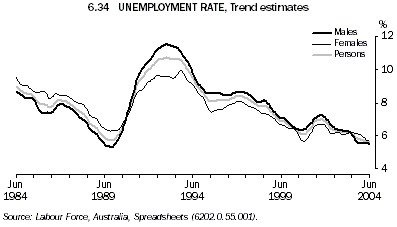
Movements in the unemployment rate over the past 20 years are dominated by the economic downturns of the early-1980s and early-1990s, and the subsequent periods of economic recovery (graph 6.34). In trend terms, the unemployment rate peaked at 10.7% in December 1992, then generally fell over the rest of the 1990s, to stand at 5.6% in June 2004.
Historically, the unemployment rate for males has been lower than for females. Just prior to the downturn of the early-1990s, when unemployment increased sharply, the male unemployment rate increased to a level above the female unemployment rate. However, since June 2003, this has reversed and the female unemployment rate has been slightly higher.
6.36 UNEMPLOYED PERSONS(a)(b), By duration of unemployment
|
| Weeks | Units | 1998-99 | 1999-2000 | 2000-01 | 2001-02 | 2002-03 | 2003-04 |
|
| Under 8 | % | 29.7 | 33.4 | 35.5 | 35.8 | 37.0 | 38.6 |
| 8 to under 26 | % | 24.9 | 25.5 | 26.8 | 28.0 | 27.7 | 26.9 |
| Under 26 | % | 54.7 | 58.9 | 62.3 | 63.8 | 64.7 | 65.5 |
| 26 to under 52 | % | 15.6 | 14.2 | 14.3 | 14.1 | 13.7 | 13.5 |
| 52 to under 104 | % | 13.1 | 10.7 | 9.6 | 8.8 | 8.9 | 9.0 |
| 104 and over | % | 16.6 | 16.2 | 13.8 | 13.3 | 12.8 | 12.0 |
| 52 and over | % | 29.8 | 26.9 | 23.4 | 22.1 | 21.6 | 21.0 |
| Total | % | 100.0 | 100.0 | 100.0 | 100.0 | 100.0 | 100.0 |
| Number | '000 | 689.6 | 626.3 | 619.5 | 663.3 | 624.4 | 586.0 |
|
(a) Annual averages.
(b) Data have not been revised to reflect definitional changes introduced in April 2001. Data collected from April 2001 onwards are not strictly comparable with data collected in earlier periods. For further information, see 'Information Paper: Implementing the Redesigned Labour Force Survey Questionnaire' (6295.0).
Source: ABS data available on request, Labour Force Survey. |
Educational qualifications have a significant bearing on labour market prospects. Table 6.37 shows the relationship between the level of highest educational attainment and duration of unemployment. Of unemployed persons with a bachelor degree or above in July 2003, 20% were long-term unemployed, compared with 26% of those whose highest educational attainment was Year 10 or below.
6.37 UNEMPLOYED PERSONS, Educational attainment(a) and duration of unemployment - July 2003
|
 | Duration of current period of unemployment (weeks) | | |
|
| | |
| 1 to under 8 | 8 to under 26 | 26 to under 52 | 52 to under 104 | 104 and over | Total | Number |
| Level of highest educational attainment | % | % | % | % | % | % | '000 |
|
| Bachelor degree or above | 37.5 | 31.9 | 10.8 | 12.2 | *7.5 | 100.0 | 51.8 |
| Advanced diploma or diploma | 31.0 | 28.5 | 18.1 | *3.3 | 19.0 | 100.0 | 32.3 |
| Certificate III / IV | 34.0 | 25.0 | 19.8 | 12.0 | 9.2 | 100.0 | 71.3 |
| Certificate I / II | *33.3 | *29.8 | *18.1 | **4.6 | *14.2 | 100.0 | 10.3 |
| Certificate not further defined | - | **14.9 | *28.1 | *39.1 | **17.9 | 100.0 | 3.8 |
| Year 12(b) | 45.4 | 24.8 | 14.2 | 7.7 | 7.9 | 100.0 | 118.5 |
| Year 11(b) | 34.6 | 33.0 | 13.8 | *6.4 | 12.2 | 100.0 | 60.5 |
| Year 10 or below(b) | 33.8 | 26.1 | 14.0 | 8.5 | 17.7 | 100.0 | 211.3 |
| All unemployed persons(c) | 36.3 | 27.0 | 14.9 | 8.7 | 13.2 | 100.0 | 564.5 |
|
(a) The levels of education are not necessarily listed in order from highest to lowest. See paragraphs 15-17 of the Explanatory Notes in 'Education and Work, Australia' (6227.0) for further details on how level of highest educational attainment is determined.
(b) Includes persons who are currently undertaking school study.
(c) Includes no educational attainment, and level not determined.
Source: Job Search Experience, Australia, July 2003 (6222.0). |
Unemployed persons may encounter a variety of difficulties in finding work. In the July 2003 survey, males and females reported most of the more common difficulties in largely similar proportions as shown in graph 6.38. However, females were more likely to report insufficient work experience as their main difficulty (16% compared with 10% for males), as well as difficulties that relate to concerns outside of the workplace, such as 'Unsuitable hours' (9% to 4%) and 'Difficulties with child care, other family responsibilities' (3% to 1%). Males were more likely to report their main difficulty as being 'Considered too young or too old by employers' (14% compared with 12% for females) and 'No vacancies at all' (10% compared with 7% for females).
 Print Page