|
|
LOCATIONS OF WORK
Working at home may give people greater flexibility than standard working arrangements. Productivity may be enhanced, as less time is spent on peripheral tasks (e.g. travel to and from work) and there is a greater ability for people to 'return' to work outside office hours (Whitehouse et al, 2002). People who work at home may also have a greater ability to balance their work and family commitments.
There were 9.4 million employed people in November 2005, of whom one-quarter (25%) worked at least some hours at home in their main or second job. Almost one-third (31%) of these people were employed only or mainly at home. (End note 1)
Data about the types of places where people work, and the job characteristics and working arrangements of people who work at home were collected in November 2005 as a supplement to the monthly Labour Force Survey, conducted by the Australian Bureau of Statistics. The focus of this article is on those people employed only or mainly at home, (End note 1) referred to as 'people who work at home'.
EMPLOYMENT TYPE
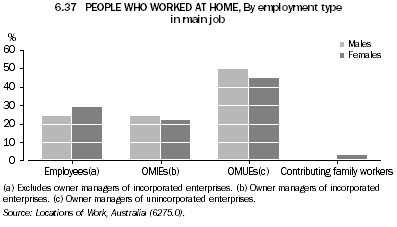
In November 2005 there were 724,500 people who worked at home. More than two-thirds (70%) were owner managers, just over one-quarter (27%) were employees (excluding owner managers of incorporated enterprises) and 2% were contributing family workers (graph 6.37). This contrasts with the distribution of all employed people (End note 2) where one-fifth (20%) were owner managers, four-fifths (80%) were employees (End note 3) and less than 0.5% were contributing family workers. Almost three-quarters (74%) of men who worked at home were owner managers, as were 68% of women who worked at home.
MAIN REASON PEOPLE WORKED AT HOME
Of the people who worked at home 40% stated their main reason was that they wanted their office at home or they wanted no overheads or rent and the majority of these (82%) were owner managers (table 6.38).
One-fifth (20%) of people who worked at home gave their main reason as operating a farm. More than one-quarter (27%) of men who worked at home stated they were operating a farm, compared with 15% of women. Of employees (End note 3) who worked at home, 16% stated this was a condition of their employment.
Flexible working times, which usually apply to home-based work, may assist in juggling family responsibilities, in particular child care (Whitehouse et al, 2002). One-fifth (20%) of people who worked at home gave child care or family considerations and flexible working arrangements as their main reasons for doing so (table 6.38). More than one-quarter (27%) of women who worked at home stated these reasons, compared to 12% of men.
Women are more likely to work at home as they tend to be family carers. In November 2005 women represented more than half (55%) of all people who worked at home. Women who worked at home were also more likely to have children aged under 15 years (44%), when compared with all employed women (33%).
6.38 MAIN REASON PEOPLE WORKED AT HOME, By employment type in main job
|
 | Employees(a) | Owner managers | Total(b) |
| % | % | % |
|
MALES |
|
| Wanted office at home/no overheads/no rent | 5.3 | 35.6 | 41.5 |
| Childcare/family considerations | *0.4 | *1.5 | 2.1 |
| Flexible working arrangements | 3.7 | 5.7 | 9.5 |
| To catch up on work | 2.5 | *1.5 | 4.0 |
| Condition of employment | 4.7 | . . | 4.8 |
| To operate a farm | 3.4 | 22.7 | 26.9 |
| Other reason | 4.0 | 7.0 | 11.1 |
| Total | 24.0 | 74.0 | 100.0 |
|
FEMALES |
|
| Wanted office at home/no overheads/no rent | 7.4 | 30.7 | 39.0 |
| Childcare/family considerations | 3.8 | 9.5 | 14.2 |
| Flexible working arrangements | 4.5 | 7.6 | 12.3 |
| To catch up on work | 2.8 | *1.0 | 3.8 |
| Condition of employment | 4.1 | . . | 4.2 |
| To operate a farm | 2.2 | 12.4 | 15.3 |
| Other reason | 4.5 | 6.3 | 11.2 |
| Total | 29.3 | 67.6 | 100.0 |
|
PERSONS |
|
| Wanted office at home/no overheads/no rent | 6.5 | 32.9 | 40.1 |
| Childcare/family considerations | 2.3 | 6.0 | 8.8 |
| Flexible working arrangements | 4.2 | 6.8 | 11.1 |
| To catch up on work | 2.7 | 1.2 | 3.9 |
| Condition of employment | 4.3 | . . | 4.5 |
| To operate a farm | 2.7 | 17.0 | 20.4 |
| Other reason | 4.3 | 6.6 | 11.2 |
| Total | 27.0 | 70.4 | 100.0 |
|
a) Employees (excluding owner managers of incorporated enterprises).
(b) Total includes 'Contributing family workers'. |
| | | |
| Source: Locations of Work, Australia (6275.0). |
ARRANGEMENT TO WORK AT HOME
In November 2005 more than four-fifths (82%) of employees (End note 3) who worked at home had an arrangement with their employer. Women represented 61% of those with an arrangement. Almost two-thirds (65%) of employees (End note 3) with an arrangement had leave entitlements.
AGE
More than half (53%) of all people who worked at home were aged between 35 and 54 years, which was higher than the proportion of all employed people in this age group (46%) (graph 6.39). Those aged 15-24 years accounted for only 4% of those who worked at home, but represented 18% of all employed people. Those aged 65 years and over accounted for 8% of those who worked at home, compared to 2% of all employed people. Men aged 65 years and over were more likely than women to work at home (5% and 3% respectively).
OCCUPATION
People who worked at home were highly represented in the higher-skilled occupation groups. Two-thirds (67%) of men who worked at home in November 2005 were Managers and administrators or Professionals. In contrast, these occupations accounted for just over one-quarter (28%) of all employed men (table 6.40). (End note 4) More than half (51%) the women who worked at home were Advanced clerical and service workers or Professionals. In comparison, less than one-third (29%) of all employed women (End note 4) were represented in these occupations.
6.40 OCCUPATION IN JOB WORKED AT HOME(a), Main or second job
|
| Males | Females | Persons |
| % | % | % |
|
| Managers and administrators | 36.2 | 15.6 | 24.8 |
| Professionals | 30.5 | 20.7 | 25.1 |
| Associate professionals | 13.7 | 9.8 | 11.6 |
| Tradespersons and related workers | 7.4 | 2.6 | 4.8 |
| Advanced clerical and service workers | *0.8 | 30.0 | 16.9 |
| Intermediate clerical, sales and service workers | 4.1 | 14.0 | 9.6 |
| Intermediate production and transport workers | 2.1 | 1.4 | 1.7 |
| Elementary clerical, sales and service workers | 2.0 | 3.1 | 2.6 |
| Labourers and related workers | 3.3 | 2.7 | 2.9 |
| All people who worked at home | 100.0 | 100.0 | 100.0 |
|
| (a) Occupation group of main job; classified according to the Australian Standard Classification of Occupations (ASCO), Second Edition. |
| | | |
| Source: Locations of Work, Australia (6275.0). |
HOURS WORKED AT HOME
Of the people who worked at home, almost two-thirds (63%) worked less than 35 hours per week (End note 5) and more than one-third (37%) of these worked 1-15 hours. In comparison, 40% of all employed people worked less than 35 hours per week. (End note 6)
USE OF INFORMATION TECHNOLOGY
Improvements in technology have made home-based work a viable alternative, linking people who work at home with central offices or clients via online networks. Four-fifths (80%) of those who worked at home in their main job used information technology. The majority of these people (91%) used both a computer and the Internet. Professionals represented the highest proportion (31%) of those who used both a computer and the Internet, while Intermediate production and transport workers represented the lowest proportion (1%).
END NOTES
- Employed people who, during the survey reference week, worked more hours at their own home than any other single location in their main or second job.
- Employed people in the survey reference week by employment type in main job.
- Employees (excluding owner managers of incorporated enterprises).
- Employed people in the survey reference week by occupation in main job.
- Hours actually worked at home in main job.
- Hours actually worked in main job.
REFERENCE
Whitehouse G, Diamond C & Lafferty G 2002, 'Assessing the benefits of telework: Australian case study evidence', New Zealand Journal of Industrial Relations, vol. 27, no. 3, pp. 257-268, Wellington, New Zealand
|
|

 Print Page