HOW AUSTRALIA ACCESSES AND USES THE INTERNET
Australians have access to a range of internet access technologies, including analog, digital subscriber line (DSL), hybrid fibre coaxial, fixed and mobile wireless, satellite and optical fibre services. The availability of these services depends upon a consumer's geographic location.
At the end of June 2009 there were 8.4 million active internet subscribers in Australia, with household subscriptions accounting for 84%, with the remaining 16% being corporate, business and government subscribers (table 25.7).
25.7 Internet Activity Summary, Australia |
|
 | | June 2008(a) | June 2009(b) |
| | '000 | '000 |
Subscribers |
|
| Dial-up | | |
| Business and government | 291 | 215 |
| Household | 1 275 | 887 |
| Total | 1 566 | 1 103 |
| Non dial-up | | |
| Business and government | 726 | 1 174 |
| Household | 4 935 | 6 144 |
| Total | 5 661 | 7 317 |
| Total | | |
| Business and government | 1 018 | 1 389 |
| Household | 6 210 | 7 031 |
| Total | 7 228 | 8 420 |
|
| (a) Data for ISPs with more than 10,000 active subscribers. |
| (b) Data for ISPs with more than 1,000 active subscribers. |
| Source: ABS Internet Activity, Australia (8153.0). |
At 30 June 2009, 87% of subscribers used a broadband internet connection, compared with 13% who used dial-up services (table 25.8). The most prevalent form of access technology for broadband connections was DSL which accounted for 50% of all subscriptions. Mobile wireless technology recorded the largest growth in subscriber numbers, rising from 16% of all connections on 31 December 2008 to 23% on 30 June 2009.
25.8 Internet subscribers, by access connection - June 2009 |
|
| | No. of subscribers | Proportion of subscribers |
| | '000 | % |
|
| Dial-up | | |
| Analog | 1 077 | 13 |
| ISDN/Other | 10 | - |
| Total | 1 087 | 13 |
| Non dial-up | | |
| DSL | 4 171 | 50 |
| Fixed wireless | 160 | 2 |
| Mobile wireless | 1 961 | 23 |
| Satellite | 90 | 1 |
| Cable and fibre | 931 | 11 |
| ISDN/Other | 20 | - |
| Total | 7 333 | 87 |
| Total all subscribers | 8 420 | 100 |
|
| - nil or rounded to zero (including null cells) |
| Source: ABS Internet Activity, Australia (8153.0). |
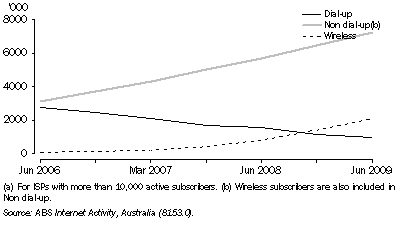
Graph 25.9 shows the overall trend of internet access connections; notably, the switch from dial-up to non-dial-up connections. In June 2006, there were 2.8 million dial-up connections in Australia compared with 3.2 million non dial-up connections. Dial-up connections continued to decrease over the three years to June 2009 to 1.0 million subscribers, while non dial-up connections increased over the same period to 7.2 million subscribers as Australians availed themselves of broadband technology. The graph also depicts the trend in the uptake of wireless technology with wireless connections increasing from 0.1 million in June 2006 to 2.1 million in June 2009.
25.9 Internet subscribers by access connections(a)
Internet subscribers continued to switch to higher download speeds with over half of all subscriptions (57% or 4.8 million) now with download speeds of 1.5Mbps or greater (table 25.10). A speed of 1.5Mbps or greater enables live streaming of video.
25.10 Internet subscribers, By subscriber type and download speed - June 2009 |
|
| | | Number of subscribers | Proportion of subscribers |
| | | '000 | % |
|
| Business and Government Subscribers | | |
| Less than 256 kbps | 215 | 3 |
| Broadband(a) | | |
| | 256kbps to less than 512kbps | 124 | 1 |
| | 512kbps to less than 1.5Mbps | 166 | 2 |
| | 1.5Mbps to less than 8Mbps | 698 | 8 |
| | 8Mbps to less than 24Mbps | 147 | 2 |
| | 24Mbps or greater | 39 | - |
| | Total broadband (256kbps or greater) | 1 174 | 14 |
| Total all download speeds | 1 389 | 16 |
| Household Subscribers | | |
| Less than 256 kbps | 887 | 11 |
| Broadband(a) | | |
| | 256kbps to less than 512kbps | 1 173 | 14 |
| | 512kbps to less than 1.5Mbps | 1 084 | 13 |
| | 1.5Mbps to less than 8Mbps | 1 831 | 22 |
| | 8Mbps to less than 24Mbps | 1 652 | 20 |
| | 24Mbps or greater | 404 | 5 |
| | Total broadband (256kbps or greater) | 6 144 | 73 |
| Total all download speeds | 7 031 | 84 |
| All Subscribers | | |
| Less than 256 kbps | 1 103 | 13 |
| Broadband(a) | | |
| | 256kbps to less than 512kbps | 1 297 | 15 |
| | 512kbps to less than 1.5Mbps | 1 249 | 15 |
| | 1.5Mbps to less than 8Mbps | 2 529 | 30 |
| | 8Mbps to less than 24Mbps | 1 800 | 21 |
| | 24Mbps or greater | 443 | 5 |
| | Total broadband (256kbps or greater) | 7 317 | 87 |
| Total all download speeds | 8 420 | 100 |
|
| - nil or rounded to zero (including null cells) |
| (a) Broadband refers to an 'always on' Internet connection with an access speed equal to or greater than 256 kbps. |
| Source: ABS Internet Activity, Australia (8153.0). |
Business use
The proportion of Australian businesses using the Internet to place orders during 2007-08 was 43% which continued the pattern of growth over recent years of this business practice. The proportion of businesses reporting receipt of orders via the internet has remained relatively steady over the past two years, moving from 21% in 2005-06 to 24% in 2007-08, although the overall volume of income that resulted from orders received via the internet for goods or services increased significantly from $56.7b to $81.0b over the same time frame. In terms of the percentage of income received from these orders, the majority of businesses received less than 10% of their income from orders received in this manner.
25.11 Internet commerce(a) |
|
| | | 2002-03 | 2003-04 | 2004-05 | 2005-06 | 2006-07 | 2007-08 |
|
| Businesses which | | | | | | | |
| Placed orders via the Internet or web | % | 28 | 31 | 33 | 37 | 40 | 43 |
| Received orders via the Internet or web | % | 13 | 12 | 12 | 21 | 23 | 24 |
| Internet income | $b | 24.3 | 33.3 | 39.6 | 56.7 | 67.6 | 81.0 |
|
| (a) Proportions are of all businesses. |
| Source: ABS Business Use of Information Technology (8129.0). |
As with web presence and internet access, the likelihood of a business placing orders via the Internet or web increased with the employment size of the business (table 25.12). In 2007-08, 71% of businesses with 200 or more employees placed orders in this manner, compared with 37% of businesses with 0-4 employees. At the industry level, Information media and telecommunications had the highest proportion of businesses which placed orders via the Internet or web (61%), while Transport, postal and warehousing and Construction both reported the lowest proportions (28% and 30% respectively).
There was less variability by employment size for businesses receiving orders via the Internet or web. Businesses with 20-199 employees received the highest proportion of orders in this way (32%), compared with those employing 0-4 people which received the lowest proportion (21%). At the industry level, Information media and telecommunications had the highest proportion of businesses which received orders via the Internet or web (41%), while the lowest proportion was recorded for Health care and social assistance (11%).
25.12 Business use of selected technologies, By employment size and industry - 2007-08 |
|
| | Businesses which:
|
| | Placed orders via the Internet or web | Received orders via the Internet or web |
| | % | % |
|
| Employment size | | |
| 0-4 persons | 37 | 21 |
| 5-19 persons | 51 | 29 |
| 20-199 persons | 59 | 32 |
| 200 or more persons | 71 | 29 |
| Industry | | |
| Mining | 46 | 14 |
| Manufacturing | 46 | 38 |
| Electricity, gas, water and waste services | 34 | 23 |
| Construction | 30 | 19 |
| Wholesale trade | 50 | 40 |
| Retail trade | 48 | 32 |
| Accommodation and food services | 33 | 17 |
| Transport, postal and warehousing | 28 | 17 |
| Information, media and telecommunications | 61 | 41 |
| Financial and insurance services | 50 | 19 |
| Rental, hiring and real estate services | 51 | 24 |
| Professional, scientific and technical services | 60 | 26 |
| Administrative and support services | 43 | 22 |
| Health care and social assistance | 39 | 11 |
| Arts and recreation services | 51 | 24 |
| Other services | 32 | 17 |
| Total | 43 | 24 |
|
| Source: ABS Business Use of Information Technology (8129.0). |
Personal use
During 2008-09, three quarters (74%) of people aged 15 years or over accessed the internet in the previous 12 months (table 25.13). Home was the most popular location to access the internet for two thirds (68%) of people aged 15 years or over, followed by work (35%) and a neighbour's, friend's or relative's house (25%).
Use of the internet at any location was significantly higher than average (74%) for those with the following characteristics: people aged 15 to 17 years (94%); people from households in the top two income quintiles (93% for the highest and 87% for the second highest); people with higher levels of educational attainment (93% for people with a Bachelor degree or above); and the employed (85%). In contrast, older people (31% for people 65 or over), people with lower household incomes (44% for people in the lowest quintile), people not employed (54%) and Indigenous people (62%) reported significantly lower than average levels of internet access.
In 2008-09, 71% of people accessing the internet from home reported personal or private purposes as the main purpose of internet access, followed by work related purposes (17%) (see table 25.13). Work related purposes were reported more frequently as the main purpose of internet use at home among income earners in the highest income quintile (27%) and people with higher levels of educational attainment (27% of people with a Bachelor degree or higher).
25.13 Use of Internet at home, By main purpose - 2008-09 |
|
| | No. of persons aged 15 years or over who used the Internet at home | Personal or private purposes | Work or business related purposes | Education or study related purposes | Voluntary or community purpose | Other purposes | Could not be determined |
| Characteristics | '000 | % | % | % | % | % | % |
|
| Age group (years) | | | | | | | |
| 15-17 | 755 | 71 | np | 27 | np | np | *2 |
| 18-24 | 1 659 | 75 | np | 20 | np | np | **1 |
| 25-34 | 2 382 | 75 | 15 | ^8 | - | *1 | *1 |
| 35-44 | 2 461 | 68 | 24 | ^6 | *1 | - | *1 |
| 45-54 | 2 163 | 66 | 25 | ^7 | *1 | *1 | *1 |
| 55-64 | 1 393 | 71 | 21 | *3 | ^4 | *1 | *1 |
| 65 or over | 779 | 80 | ^10 | *2 | ^4 | *2 | *1 |
| Sex | | | | | | | |
| Male | 5 814 | 70 | 20 | 8 | ^1 | - | ^1 |
| Female | 5 777 | 73 | 13 | 11 | ^1 | ^1 | ^1 |
| Personal income | | | | | | | |
| Less than $40,000(a) | 5 391 | 74 | 9 | 14 | ^1 | - | ^1 |
| $40,000-$79,999 | 3 271 | 74 | 18 | ^6 | *1 | *1 | ^1 |
| $80,000-$119,000 | 934 | 61 | 32 | ^5 | **1 | np | np |
| $120,000 or over | 529 | 49 | 46 | *3 | **2 | np | np |
| Could not be determined | 1 466 | 71 | 20 | ^5 | *1 | *1 | *2 |
| Equivalised household income quintiles | | | | | | | |
| Lowest quintile | 827 | 69 | ^13 | ^16 | *2 | **1 | - |
| Second quintile | 1 568 | 75 | ^10 | ^12 | ^2 | - | *1 |
| Third quintile | 1 910 | 75 | 14 | ^9 | ^1 | *1 | *1 |
| Fourth quintile | 2 241 | 74 | 17 | 7 | *1 | - | *1 |
| Highest quintile | 2 361 | 64 | 27 | ^7 | *1 | *1 | ^1 |
| Could not be determined | 2 684 | 72 | 15 | 10 | ^1 | - | *1 |
| Labour force status(b) | | | | | | | |
| Employed | 8 647 | 70 | 21 | 7 | ^1 | - | ^1 |
| Not employed | 2 944 | 77 | ^3 | 15 | ^3 | *1 | *1 |
| Indigenous | | | | | | | |
| Non Indigenous | 11 491 | 71 | 17 | 9 | np | np | np |
| Indigenous | ^100 | ^66 | *18 | **10 | np | np | np |
| Level of highest educational attanment | | | | | | | |
| Bachelor degree or above | 2 989 | 60 | 27 | 10 | ^2 | - | ^1 |
| Advanced diploma or diploma | 1 361 | 73 | 17 | ^8 | *1 | **1 | *1 |
| Certificate | 2 009 | 75 | 17 | ^5 | *1 | *1 | *1 |
| Year 12 or below | 5 053 | 76 | 10 | 12 | ^1 | *1 | ^1 |
| State or territory | | | | | | | |
| New South Wales | 3 776 | 71 | 17 | 10 | *1 | *1 | *1 |
| Victoria | 2 951 | 72 | 16 | 10 | ^2 | - | *1 |
| Queensland | 2 303 | 71 | 17 | ^9 | *2 | *1 | *1 |
| South Australia | 824 | 71 | 15 | 11 | *1 | *1 | *1 |
| Western Australia | 1 202 | 72 | 19 | ^7 | *1 | np | np |
| Tasmania | 235 | 75 | ^16 | ^7 | *1 | np | np |
| Northern Territory | 87 | 72 | ^18 | *8 | **1 | - | **1 |
| Australian Capital Territory | 212 | 76 | ^14 | ^7 | **2 | np | np |
| Remoteness area | | | | | | | |
| Major cities of Australia | 8 477 | 71 | 17 | 10 | ^1 | - | ^1 |
| Inner regional Australia | 2 134 | 73 | 16 | ^8 | ^2 | - | *1 |
| Outer regional Australia | 844 | 71 | ^19 | ^8 | np | np | *1 |
| Remote Australia | ^127 | 73 | ^20 | **1 | np | np | *3 |
| Region | | | | | | | |
| Metropolitan areas | 7 832 | 71 | 17 | 10 | ^1 | - | ^1 |
| Ex-metropolitan areas | 3 759 | 73 | 17 | ^8 | ^2 | *1 | ^1 |
| Total | 11 591 | 71 | 17 | 9 | ^1 | - | ^1 |
|
| ^ estimate has a relative standard error of 10% to less than 25% and should be used with caution |
| * estimate has a relative standard error of 25% to 50% and should be used with caution |
| ** estimate has a relative standard error greater than 50% and is considered too unreliable for general use |
| - nil or rounded to zero (including null cells) |
| np not available for publication but included in totals where applicable, unless otherwise indicated |
| (a) Includes those persons with income less than zero. |
| (b) Labour force status in the week before the survey. |
| Source: ABS Household Use of Information Technology, Australia 2008-09 (8146.0). |
The proportion of people accessing the internet at home who used the internet every day grew from 51% in 2007-08 to 58% in 2008-09. During 2008-09, two-thirds (67%) of people aged 15-34 years accessed the internet every day, compared with around half (52%) the people aged 35 years or more. Nearly all (94%) people with access to the internet used it at least weekly.
Children's use of the internet and mobile phones
The 2009 Children's Participation in Cultural and Leisure Activities survey reported that of the 2.7 million children aged 5 to 14 years, 79% used the internet. Home was reported as the most common site of internet use (73%) followed by school (69%). Of the 2.0 million children accessing the internet at home in 2009, educational activities (85%) and playing online games (69%) were the most common activities. Less than half (42%) of children who used the internet at home did so for 2 hours or less per week, while 4% were online for 20 hours or more.
In 2009 an estimated 841,000 children (31%) aged 5 to 14 years had access to their own mobile phones. Of these children, the majority (60%) used their mobile phone mostly to contact family. Only a small proportion of children (4%) used their mobile phone to access the internet.
 Print Page