 POPULATION
Population change, Queensland
Regional population growth, Queensland
POPULATION CHANGE, QUEENSLAND
The preliminary estimated resident population (ERP) for Queensland was 4,450,400 at 30 September 2009, an increase of 115,200 (2.7%) since 30 September 2008. Queensland accounted for 20% of the Australian population at 30 September 2009.
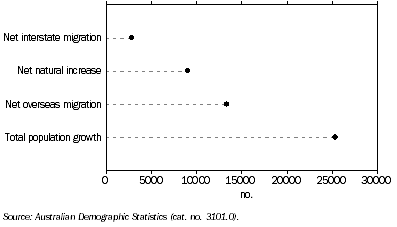
Between the June 2009 quarter and the September 2009 quarter, 53% (13,400 persons) of the total population increase of 25,300 persons was due to net overseas migration, 36% (9,100 persons) to natural increase (excess of births over deaths) and 11% (2,900 persons) was attributable to net interstate migration.
Population Change from Previous Quarter, Queensland
- September 2009 quarter
Further information about Queensland's population can be accessed from
Australian Demographic Statistics (cat. no. 3101.0) or by contacting the National Information and Referral Service on 1300 135 070. This publication is released quarterly.
REGIONAL POPULATION GROWTH,QUEENSLAND
At 30 June 2009, the Queensland population was estimated to be 4,425,100 persons. The south east corner comprising Brisbane, Gold Coast, Sunshine Coast and West Moreton statistical divisions accounted for two-thirds (66%) of the state's population. During the year to June 2009, Brisbane statistical division reached the population milestone of two million, which was 45% of Queensland's population.
Regional Population(a), By Statistical Division - At 30 June - 2001, 2006, 2007, 2008 and 2009 |
|
 | | 2001 | 2006 | 2007r | 2008r | 2009p |
| | '000 | '000 | '000 | '000 | '000 |
|
| Statistical division | | | | | |
| Brisbane | 1 663.1 | 1 857.8 | 1 902.2 | 1 952.2 | 2 004.3 |
| Gold Coast | 387.1 | 466.4 | 484.6 | 499.5 | 515.2 |
| Sunshine Coast | 247.2 | 295.1 | 304.1 | 313.9 | 323.4 |
| West Moreton | 77.2 | 86.4 | 88.6 | 91.0 | 94.7 |
| Wide Bay-Burnett | 232.0 | 264.1 | 271.3 | 278.9 | 287.4 |
| Darling Downs | 209.0 | 225.8 | 228.8 | 232.4 | 237.2 |
| South West | 27.0 | 26.4 | 26.2 | 26.2 | 26.3 |
| Fitzroy | 186.5 | 206.2 | 210.9 | 215.5 | 220.7 |
| Central West | 13.6 | 12.5 | 12.4 | 12.3 | 12.3 |
| Mackay | 137.5 | 159.8 | 163.6 | 168.2 | 172.7 |
| Northern | 190.3 | 209.9 | 215.4 | 221.4 | 227.3 |
| Far North | 224.2 | 247.3 | 254.3 | 262.9 | 269.7 |
| North West | 34.3 | 33.2 | 33.5 | 34.2 | 34.0 |
| Queensland | 3 628.9 | 4 090.9 | 4 196.0 | 4 308.6 | 4 425.1 |
|
| (a) Estimates as at 30 June are final for 2001 to 2006, revised for 2007 and 2008 and preliminary for 2009. For all years, Statistical divisions are based on the Australian Standard Geographical Classification 2009 Edition. |
| Source: Regional Population Growth, Australia (cat. no. 3218.0). |
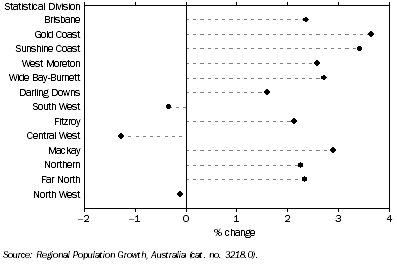
The fastest growing statistical divisions over the eight years between 30 June 2001 and 30 June 2009 were Gold Coast with an average annual growth rate of 3.6%, Sunshine Coast (3.4%) and Mackay (2.9%). Three statistical divisions recorded negative average annual growth during the same period: North West (-0.1%), South West (-0.3%) and Central West (-1.3%).
Regional Population, Average Annual Growth Rate, at 30 June
- 2001 to 2009
For more information on Queensland's regional population distribution, please refer to
Regional Population Growth, Australia (cat. no. 3218.0) or contact the National Information and Referral Service on 1300 135 070. This publication is released annually.
 Quality Declaration
  Print Page
 Print All